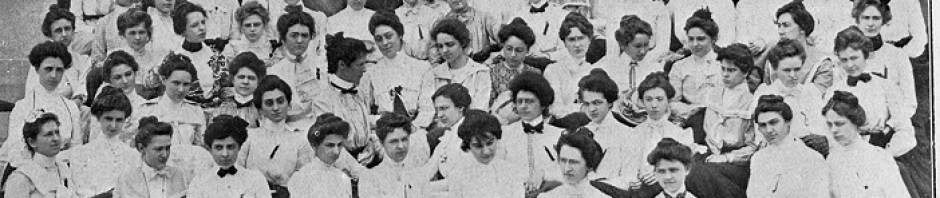
Julia Morgan Nearing Kappa Alpha Theta’s 149th

I missed Julia Morgan’s birthday, but was reminded of it via a reader of this blog. She belongs to the East Bay Yesterday Facebook group and there was a post about her and many comments about her and the buildings she designed. One of my earliest blog posts in 2012 was about Morgan and I’ve included it below.

It’s also a great time to note that Kappa Alpha Theta will turn 149 on January 27. I also have a favor to ask of readers. With Women’s History Month coming up in March, please let the sorority women you come in contact know that there are a plethora of #NotableSororityWomen who have been profiled on this site. The search feature is easy to use. I plan to celebrate the month again this year with posts about the outstanding women who have worn our badges.

The renowned architect Julia Morgan was a native Californian. She was born in San Francisco on January 20, 1872. Morgan entered the University of California at Berkeley where she became a member of the Omega Chapter of Kappa Alpha Theta, which was founded in 1890.

She was one of the first women to graduate from Berkeley with a civil engineering degree. Although she developed a keen interest in architecture, there were no architecture programs on the west coast. After graduation, she headed to Paris to study at the Ecole des Beaux Arts. At that time there were entrance exams and the school was not very welcoming of foreigners. She did not take “no” for an answer. Instead of returning home, she spent two years studying and working in a Paris studio to prove herself and her interest in the field. Morgan was the first woman to enter the Ecole’s Department of Architecture. Four years later, she graduated and returned to California.

Morgan was the first woman in California to be granted an architect’s license. She first worked with John Galen Howard in San Francisco. At the time he was supervising the University of California Master Plan and she worked on several campus buildings.

Morgan opened her own office on 1904. Her first independent commission was a bell tower on the Mills College campus, a structure that withstood the 1906 earthquake. The rebuilding after the earthquake resulted in a number of commissions for her.

In 1908, she designed her chapter’s first official house; at 2723 Durant, it included a swimming pool. Pheobe Apperson Hearst hired Morgan to remodel her Hacienda del Pozo de Verona in Pleasanton, California. In 1919, Hearst’s son, William Randolph, hired Morgan to design a main building and guest houses for his ranch at San Simeon. She spent the next 28 years overseeing almost every aspect of the Hearst Castle.

In 1924, the Theta House Association knew changes had to be made to the Kappa Alpha Theta house because it “was no longer adequate or convenient” for the growing chapter.  They loved the house with its “long low living and dining rooms which were so easily thrown into one commodious hall for parties. Even the aquarium held a special niche in our affections.”[1]

The House Association asked Morgan’s advice. Although she was busy designing a Los Angeles home for girls in the film industry, sponsored by the Y.W.C.A. (Hollywood Studio Club), an orphanage in San Francisco, and several private homes, she made time for her Theta sisters.  According to a report, “It would have been very expensive to entirely rebuild; moreover, she knew every beam and joist in that three storied, shingled building and she knew what possibilities were hidden away.  Today, the same old framework and foundation are clothed in soft creamy stucco fashioned in the English Tudor style. The house now faces the garden and in all ways is different from the former one. Inside are six beautiful carved doors and a stately stone fireplace, the gifts of Miss Morgan’s generosity.”[2]

To meet updated structural safety standards, architect Gardner A. Dailey rebuilt the house in 1940. An addition to the west side of the house was added in 1956. A Steinway grand piano from Morgan’s home remains a link for the chapter to one of its most distinguished alumnae.

In the 1920s, Morgan designed a home for the Delta Zeta chapter at 2311 LeConte Avenue; the Presbyterian Westminster House now owns it. She also designed the Georgian-style house on Piedmont Avenue in which Kappa Kappa Gamma’s Pi Chapter now resides. It was originally built for Chancellor Charles Mills Gayley.

Morgan and her staff designed more than 800 buildings. During her 45 years of practice she shared her profits with her staff. In 1927, she was described by a Theta sister, “Julia Morgan is modest; she prefers to remain unsung. But with the evidence of her success and of her thoughtful kindness before us always, we are proud to number her among Theta alumnae.”[3]

She died in 1957 at the age of 85. In 2008, she was inducted into the California Hall of Fame. Although she never married, there was at least one other fraternity woman in her family. A grand niece, Ellen North, became a member of the Chi Omega chapter at the UC – Berkeley in the 1970s.


[1], [2], [3] Kappa Alpha Theta, January 1927, p. 171.

© Fran Becque, www.fraternityhistory.com, 2019. All Rights Reserved. If  you enjoyed this post, please sign up for updates. Also follow me on twitter @GLOHistory and Pinterest www.pinterest.com/glohistory/. Focus on Fraternity History Facebook group

Share this:

Posted in Fran Favorite, Kappa Alpha Theta | Tagged | Comments Off on Julia Morgan Nearing Kappa Alpha Theta’s 149th

Happy 150th, P.E.O. Sisterhood!

The P.E.O. Sisterhood was founded 150 years ago today, on January 21, 1869. The temperature in Mount Pleasant, Iowa, where Iowa Wesleyan University is located, will be about 22 degrees. Legend has it that the temperature on this day in 1869 was unseasonably warm.

P.E.O. was founded by seven young women. In 1869, there were about 75 collegiate level students at Iowa Wesleyan. Legend has it that some, but not all seven, of a group of friends had been asked by Libbie Brook to join the new chapter of I.C. Sorosis (now known as Pi Beta Phi). On that unseasonably warm January day, Franc Roads and Hattie Briggs were sitting on the steps of a wooden stile at the southeast entrance to the campus and made the decision to start a society of their own. They gathered five others, Mary Allen, Ella Stewart, Alice Bird, Alice Coffin, and Suela Pearson and borrowing the Bible from IWU’s chapel, they took the 35-word oath that Alice Bird had written.

P.E.O. members believe that much of what P.E.O. is today comes directly from the seven founders. That is not true at all, save for that oath written by Alice Bird. Five of the seven founders graduated mere months after the organization was formed. Another left school because she was needed at home. The lone underclassman, Suela Pearson, graduated in 1871.

The organization might have failed had it not been for the actions of women who were initiated after the founders. Some were biological sisters. They have names few P.E.O.s recognize – Bartlett, Ambler, Curtis. My own personal favorite P.E.O. builders are Effie Hoffman Rogers and Lulu Corkhill Williams.

A cake shared by Chapter HZ, Missouri, at its event to celebrate the 150th (Photo courtesy of Lettie Corkhill Cunetto)

I had the distinct honor and privilege to serve on a committee which created We Who Are Sisters, a coffee-table history book to commemorate P.E.O.’s sesquicentennial. Writing a book by committee can be a daunting and challenging task, but I treasure the experience and the time we spent working together, the thousands of e-mails, and the all-day conference calls. I want to give a shout out to my co-authors: Susan Reese Sellers, Past President, International Chapter; Anne Pettygrove, former Chief Executive Officer of the P.E.O. Sisterhood; and Ruth Glancy, Past President, Alberta-Saskatchewan Provincial Chapter. I am honored to call them my sisters.

Happy 150th P.E.O.! It is an amazing organization that has touched the lives of women through its five projects – the Educational Loan Fund, International Peace Scholarship, Program for Continuing Education, Scholar Awards, STAR Scholarship – and Cottey College in Nevada, Missouri.

Pages from the editing process.
P.E.O.s braving the cold in the plaza at the Today Show January 21, 2019.
Posted in Fran Favorite, Iowa Wesleyan College, P.E.O. | Tagged , | Comments Off on Happy 150th, P.E.O. Sisterhood!

Monday, January 21st, a Big Day in P.E.O.land

This invitation is sitting on my refrigerator. I had an invitation and plans to be in Mount Pleasant, Iowa, on Monday, 150 years to the day that P.E.O. was founded. Unfortunately, family commitments keep me at home, but my thoughts will be with those in Mount Pleasant.

On Monday morning, I will be watching the Today Show. P.E.O. sisters from around the country will be there. Savannah Guthrie, a Pi Beta Phi, received a P.E.O. Scholar Award when she was attending law school.

I can also watch the livestream of the program which will take place at Iowa Wesleyan University.

Posted in Fran Favorite, P.E.O. | Tagged | Comments Off on Monday, January 21st, a Big Day in P.E.O.land

Ophelia Settle Egypt and Zeta Phi Beta Sorority, Inc.

Arizona Cleaver, along with her four friends – Pearl Neal, Myrtle Tyler, Viola Tyler, and Fannie Pettie – are the five pearls of Zeta Phi Beta. They are the organization’s founders. The idea for the organization happened several months earlier when Cleaver was walking with Charles Robert Samuel Taylor, a Phi Beta Sigma at Howard University. Taylor suggested that Cleaver consider starting a sister organization to Phi Beta Sigma.

Although there were already two sororities on the Howard University campus, Cleaver and her four friends were interested and started the process. They sought and were granted approval from university administrators. The five met for the first time as a sanctioned organization on January 16, 1920. They named their organization Zeta Phi Beta. It is the only National Pan-Hellenic Council sorority constitutionally bound to a fraternity; that fraternity is Phi Beta Sigma.


The Five Pearls of Zeta Phi Beta, (l-to-r) Arizona Cleaver Stemons, Viola Tyler Goings, Pearl Anna Neal, Myrtle Tyler Faithful, and Fannie Pettie Watts

Shortly after Zeta Phi Beta’s debut, the other NPHC sororities founded at Howard University, Delta Sigma Theta and Alpha Kappa Alpha, gave a reception for the Zeta Phi Beta members.

Ophelia Settle Egypt was born in 1903. She was a member of the Alpha Chapter of Zeta Phi Beta and served as its Vice President in 1924. Zora Neale Hurston was in the chapter at the same time and Egypt was interviewed for a book on Hurston.


Ophelia Settle Egypt

She graduated from Howard in 1925 and then three years later earned a Master’s in sociology from the University of Pennsylvania. In 1944, she earned another Master’s from the New York School of Social Work. Egypt later obtained an advanced certificate for work toward a Ph.D. at the Pennsylvania School of Social Work. She also had a scholarship to study at Washington University, but because she was a black woman she was required to learn her lessons from a tutor rather than attend class.

She was a sociologist and a social worker. From 1928-30, she conducted interviews with elderly former slaves. The interviews were published in Unwritten History of Slavery: Autobiographical Accounts of Negro Ex-Slaves, published by Fisk University. Egypt also had a hand in exposing the Tuskegee syphilis study. She also worked with James Weldon Johnson and later wrote a children’s book about him.

Egypt ended her career as a social worker in Washington, D.C. For 11 years she served as Director of the Planned Parenthood clinic in southeast D.C. In 1981, the clinic was named in her honor. She died in 1984.


© Fran Becque, www.fraternityhistory.com, 2019. All Rights Reserved. If  you enjoyed this post, please subscribe for updates. Also follow me on twitter @GLOHistory and Pinterest www.pinterest.com/glohistory/. Focus on Fraternity History Facebook group

Posted in Fran Favorite, Howard University, Phi Beta Sigma, Zeta Phi Beta | Tagged , , | Comments Off on Ophelia Settle Egypt and Zeta Phi Beta Sorority, Inc.

Another Alpha Kappa Alpha Hidden Figure

Alpha Kappa Alpha was founded on January 15, 1908 by nine young female Howard University students. They were led by the vision of Ethel Hedgeman (Lyle); she had spent several months sharing her idea with her friends. During this time, she was dating her future husband, George Lyle, a charter member of the Beta Chapter of Alpha Phi Alpha. 

After choosing a name for their sorority, the nine women wrote a constitution and a motto. Additionally, they chose salmon pink and apple green as the sorority’s colors and ivy as its symbol. A group of seven sophomore women were invited to become members. They did not partake in an initiation ceremony and all 16 women are considered founders. The first “Ivy Week” took place in May 1909 and ivy was planted at Howard University’s Miner Hall. On January 29, 1913, Alpha Kappa Alpha was incorporated.

The 2016 film Hidden Figures spotlighted Alpha Kappa Alpha members who were the mathematical brains behind America’s foray into outer space. Another Alpha Kappa Alpha is Gladys Mae Brown West, a “hidden figure” behind the development of Global Positioning Systems. Valedictorian of her high school class, she won a scholarship to Virginia State College, where she was one of the few women enrolled in the mathematics department. She earned a bachelors and masters degree and then taught high school for a brief time. In 1956, she was hired by the Naval Surface Warfare Center Dahlgren Division.

West authored the 1986 publication Data Processing System Specifications for the Geosat Satellite Radar Altimeter. She spent 42 years working for the NSWC, retiring in 1998. Last year, she was inducted into the Air Force Space and Missile Pioneers Hall of Fame.

Posted in Alpha Kappa Alpha | Comments Off on Another Alpha Kappa Alpha Hidden Figure

On Delta Sigma Theta’s Founding Day

On January 13, 1913, Delta Sigma Theta Sorority, Inc. was founded at Howard University. All 22 founders – Winona Cargile (Alexander), Madree Penn (White), Wertie Blackwell (Weaver), Vashti Turley (Murphy), Ethel Cuff (Black), Frederica Chase (Dodd), Osceola Macarthy (Adams), Pauline Oberdorfer (Minor), Edna Brown (Coleman), Edith Mott (Young), Marguerite Young (Alexander), Naomi Sewell (Richardson), Eliza P. Shippen,  Zephyr Chisom (Carter), Myra Davis (Hemmings), Mamie Reddy (Rose), Bertha Pitts (Campbell), Florence Letcher (Toms), Olive Jones, Jessie McGuire (Dent), Jimmie Bugg (Middleton), and Ethel Carr (Watson) – had been members of Alpha Kappa Alpha, which was founded at Howard University on January 16, 1908. When a disagreement about the future of the organization arose between the active chapter and the alumnae, an ultimatum was given, decisions were made, and in the end, the active members left Alpha Kappa Alpha and became Delta Sigma Theta Sorority, Inc.

Myra Davis went from being the president of the Alpha Kappa Alpha chapter to being president of the Delta Sigma Theta chapter. Many of the first meetings were held in Edna Brown’s living room. The 1913 Valedictorian and Class President, she married Frank Coleman, a founder of Omega Psi Phi Fraternity, Inc. Florence Letcher’s hobby of collecting elephant figurines led to the animal becoming the sorority’s symbol.

Nearly two months after its founding, on March 3, 1913, the women took part in the historic suffrage march in Washington, D.C. They were the only African-American women’s group to participate. Honorary member Mary Church Terrell joined them in their march.

In anticipation of Delta Sigma Theta’s Founders’ Day, the six Delta Sigma Theta members who are members of the U.S. House of Representatives, posed for an impressive picture.


L-R: Lucy McBath, Brenda Lawrence, Yvette Clarke, Marcia Fudge, Joyce Beatty, and Val Demings (photo courtesy of Delta Sigma Theta Sorority, Inc.)

© Fran Becque, www.fraternityhistory.com, 2019. All Rights Reserved. If  you enjoyed this post, please sign up for updates. Also follow me on twitter @GLOHistory and Pinterest www.pinterest.com/glohistory/. Focus on Fraternity History Facebook group

Posted in Delta Sigma Theta, Howard University | Tagged , | Comments Off on On Delta Sigma Theta’s Founding Day

What Fraternity Means

What does being a member of a fraternity or sorority mean? Here are some recent examples courtesy of my twitter feed.

Tim McGraw’s fraternity brothers appear in this new video.
A Clarion University Theta Chi donated a kidney to his fraternity brother
The Phi Mu chapter at Jacksonville State University is raising funds for a sister’s family.


These Sigma Delta Tau’s established a scholarship in memory of a chapter sister.
He’s a Pi Kappa Phi at Old Dominion University

The Ability Experience is the philanthropic initiative of Pi Kappa Phi 
Posted in Fran Favorite | Comments Off on What Fraternity Means

Charles R. Walgreen, Jr. on TKE’s Founders’ Day

Tau Kappa Epsilon was founded on January 10, 1899 at Illinois Wesleyan University in Bloomington, Illinois. In a meeting at 504 East Locust Street, Charles Roy Atkinson, Clarence Arthur Mayer, James Carson McNutt, Joseph Lorenzo Settles, and Owen Ison Truitt formulated plans for a fraternity they first called the Knights of Classic Lore. In 1902, the name was changed to Tau Kappa Epsilon when the men rented the Wilder Mansion, a home which formerly belonged to the College’s president. It was the first men’s fraternity house on the campus.

The five founders of Tau Kappa Epsilon. Clockwise from top left: James Carson McNutt, Owen Ison Truitt, Clarence Arthur Mayer, Joseph Lorenzo Settles, Charles Roy Atkinson
The five founders of Tau Kappa Epsilon. Clockwise from top left: James Carson McNutt, Owen Ison Truitt, Clarence Arthur Mayer, Joseph Lorenzo Settles, Charles Roy Atkinson.

In 1925, Charles R. Walgreen, Jr. was initiated into the Upsilon Chapter of TKE at University of Michigan. He had grown up in Chicago and as a boy he made deliveries from his father’s second store on the south side. After college, he went to work in the family business. When his father died in 1939, he became the company’s president.

According to an obituary on Forbes.com:

After graduating from the University of Michigan School of Pharmacy in 1928, Walgreen Jr. returned home to work for the family company, where he served on the store opening crew, in the ice cream plant and in personnel, sales, manufacturing, purchasing and real estate before becoming vice president in 1933, executive assistant to his father in 1935 and president shortly before the senior Walgreen’s death in 1939.

Walgreen Jr. served as the company’s president until 1963 and as chairman of the board from 1963 to 1976. As a trained pharmacist, his personal goal, the company said, was to raise the professional stature and working conditions of pharmacists. He reduced pharmacists’ hours at his stores from the industry norm of 66 a week in 1939 to 40.

In the 1950s, Walgreen Jr. redefined the retail drug business, converting Walgreens from clerk-assisted shopping to self-service. In the 1960s, he led the company into new markets, acquiring retail operations in Mexico and Texas and opened a number of Walgreen “Super Stores.”

He served as the company’s president until 1963 when he took over as chairman of the board of directors. He retired from that position in 1976. There were many changes in the pharmacy and retail world and Walgreen was responsible for many of them.

Walgreen also served his fraternity. He was TKE’s Grand Epiprytanis (Grand Vice President), but found it necessary to resign in 1943 due to business pressures associated with the war years and being the president of the drug store chain.

He gave a start-up grant for the TKE Leadership Academy and provided a $300,000 challenge grant for TKE members to contribute to the program. He served as chairman of the Foundation’s Centennial Endowment Campaign. In 1976, the fraternity named him Alumnus of the Year. He was awarded the fraternity’s Order of the Golden Eagle in 1989 and he was the first recipient of the Foundation’s Fraternity for Life Award in 1997. Walgreen was a Life Loyal Teke. The fraternity offers a named scholarship and award in his honor.

He is the only TKE to have attended its 25th, 50th, 75th and 100th anniversary celebrations. Walgreen died in 2007 at the age of 100.

Posted in Illinois Wesleyan College, Tau Kappa Epsilon | Tagged , , | Comments Off on Charles R. Walgreen, Jr. on TKE’s Founders’ Day

Phi Beta Sigma Fraternity, Inc. Founded on January 9

Phi Beta Sigma Fraternity, Inc. was founded on January 9, 1914, at Howard University in Washington, D.C., by three African American students, A. Langston Taylor, Leonard F. Morse, and Charles I. Brown.

On the occasion of Phi Beta Sigma’s centennial in 2014, the fraternity honored one of its members. A Phi Beta Sigma pin was placed on the wax likeness of George Washington Carver at the Griot Museum of Black History in St. Louis, Missouri.

In 1918, Carver was a charter member of the fraternity’s Gamma Sigma Alumni chapter at the Tuskegee Institute. President Harry Truman signed a joint resolution approved December 28, 1945 (Public Law 290, 79th Congress). In the resolution, Congress designated January 5, 1946 as George Washington Carver Day.

Carver once said, “It is not the style of clothes one wears, neither the kind of automobile one drives, nor the amount of money one has in the bank, that counts. These mean nothing. It is simply service that measures success.”

gwcarverstamp-1
Posted in Howard University, Phi Beta Sigma | Tagged , , | Comments Off on Phi Beta Sigma Fraternity, Inc. Founded on January 9

Elvis and Two Kappa Sigmas (One a Chi Omega)

Having a birthday two weeks after Christmas and a week after New Year’s Day is not easy. I know it very well and so I want to highlight three others who share a birthday with me.

Kappa Sigma Dr. Charles Richardson, is a founder of Chi Omega. He became a Kappa Sigma at Emory & Henry College in Virginia and then studied dentistry at Vanderbilt University. Richardson was an active member of Kappa Sigma at both schools and later served his fraternity as a national officer. He set up a dentistry practice in Fayetteville, Arkansas. With his guidance, Chi Omega was founded on April 5, 1895 by four young women at the University of Arkansas. He was known as “Sis Doc” to generations of Chi Omegas and he is counted as a founder.

Dr. Charles Richardson, Kappa Sigma, and a founder of Chi Omega

Original Chi Omega badge crafted in dental gold by “Doc Sis.”

Kappa Sigma founder Frank Courtney Nicodemus was born on this date in 1853.

Elvis Aaron Presley, was born on this date in 1935. He was an honorary member of the Arkansas State College chapter of Tau Kappa Epsilon.

Rick Husky pins a TKE pin on his newest fraternity brother Elvis Presley. (Photo courtesy of Elvis Presley Enterprises)

© Fran Becque, www.fraternityhistory.com, 2019. All Rights Reserved. If  you enjoyed this post, please sign up for updates. Also follow me on twitter @GLOHistory and Pinterest www.pinterest.com/glohistory/. Focus on Fraternity History Facebook group

Posted in Chi Omega, Fran Favorite, Kappa Sigma, Tau Kappa Epsilon, University of Arkansas | Tagged , , , , | Comments Off on Elvis and Two Kappa Sigmas (One a Chi Omega)