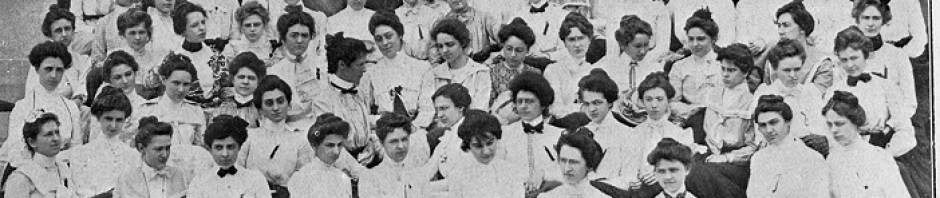
In the days before the founding of the National Panhellenic Conference (NPC), the organization of 26 women’s fraternities/sororities, and recruiting rules were written down and agreed upon, there was often a mad scramble to extend an invitation to membership as quickly as possible after a new student arrived on campus. “Rushing” refers to a time when there was a haste to pledge and initiate women as quickly as possible.
An endorsement from a member, i.e., “My cousin Tillie’s best friend from Oquawka is studying here in the fall. She’d be a great XYZ,” was sometimes all it took to invite a new student to membership in the late 1800s. There are stories of meeting an incoming coed at the train station, having been provided information about her arrival by friends and relatives, and giving her an invitation to membership. Sometimes she was escorted to campus and surrounded by chapter members so that other groups could not render an introduction.
That practice did not last very long, for the women’s organizations on a campus came together and set rules for themselves, even prior the NPC’s creation, but the name “rush” carried on for more than a century.
In 1870, only eight state universities were coeducational; the University of Kansas in Lawrence, Kansas, was one of these. By 1888, there were three chapters of women’s fraternities – Pi Phi, Kappa and Theta and these groups began discussing was to “avoid the ‘rushing,’ which has become such a crying evil of the fraternity system.”
The Pi Phi chapter (officially the I.C. Sorosis chapter – the name change to Pi Beta Phi took place that fall, too) had 20 members. It was noted, “With so large an active membership, Kansas Alpha feels that she can afford to be very careful and deliberate in making additions. The disadvantage of being obliged to receive girls before their work has been thoroughly tested has been so keenly felt of late years, that the three girl’s societies in Kansas State University have adopted an inter-fraternity pledge, which may in a measure, at least, do away with the” rushing” system,” read a snipped in the December 1888 Arrow of Pi Beta Phi.

The chapter correspondent added the following commentary, “The prescribed three months have not yet expired, but so far the pledge has been kept, and the new plan is working admirably. We hope this may furnish a suggestion to one or many chapters which shall be very helpful.”
The National Panhellenic Conference was founded in 1902; it took on the task of overseeing rushing, as it had come to be known Today, the process is called recruitment and, on almost all campuses, the recruitment process is like a finely tuned, well-oiled, machine.

Most of these women are college students. They are attending a women’s fraternity convention. Look at the white hat, the long dresses, the corseted waists, the parasols, and the women rushing to and fro. Can you imagine being dressed like that in the middle of June? Neither can I. But this is what I envision when I hear about “rushing” in the late 1800s and early 1900s.
