Phi Beta Sigma Fraternity, Inc. was founded on January 9, 1914, at Howard University in Washington, D.C., by three African American students, A. Langston Taylor, Leonard F. Morse, and Charles I. Brown.
On the occasion of Phi Beta Sigma’s centennial in 2014, the fraternity honored one of its members. A Phi Beta Sigma pin was placed on the wax likeness of George Washington Carver at the Griot Museum of Black History in St. Louis, Missouri.
In 1918, Carver was a charter member of the fraternity’s Gamma Sigma Alumni chapter at the Tuskegee Institute. President Harry Truman signed a joint resolution approved December 28, 1945 (Public Law 290, 79th Congress). In the resolution, Congress designated January 5, 1946 as George Washington Carver Day.
Carver once said, “It is not the style of clothes one wears, neither the kind of automobile one drives, nor the amount of money one has in the bank, that counts. These mean nothing. It is simply service that measures success.”
Having a birthday two weeks after Christmas and a week after New Year’s Day is not easy. I know it very well and so I want to highlight three others who share a birthday with me.
Kappa Sigma Dr. Charles Richardson, is a founder of Chi Omega. He became a Kappa Sigma at Emory & Henry College in Virginia and then studied dentistry at Vanderbilt University. Richardson was an active member of Kappa Sigma at both schools and later served his fraternity as a national officer. He set up a dentistry practice in Fayetteville, Arkansas. With his guidance, Chi Omega was founded on April 5, 1895 by four young women at the University of Arkansas. He was known as “Sis Doc” to generations of Chi Omegas and he is counted as a founder.
Dr. Charles Richardson, Kappa Sigma, and a founder of Chi Omega
Original Chi Omega badge crafted in dental gold by “Doc Sis.”
Kappa Sigma founder Frank Courtney Nicodemus was born on this date in 1853.
Elvis Aaron Presley, was born on this date in 1935. He was an honorary member of the Arkansas State College chapter of Tau Kappa Epsilon.
Rick Husky pins a TKE pin on his newest fraternity brother Elvis Presley. (Photo courtesy of Elvis Presley Enterprises)
Happy Founders’ Day to Kappa Alpha Psi Fraternity, Inc., founded on January 5, 1911 by ten students at Indiana University. Originally called Kappa Alpha Nu, the name was changed to Kappa Alpha Psi at the Grand Chapter meeting of December 1914. The change became effective April 15, 1915.
Kappa Alpha Psi’s founders are: Elder Watson Diggs; John Milton Lee; Byron Kenneth Armstrong;Guy Levis Grant; Ezra Dee Alexander; Henry Tourner Asher; Marcus Peter Blakemore; Paul Waymond Caine; Edward Giles Irvin; and George Wesley Edmonds.
Elder Watson Diggs as a young man.
Elder Watson Diggs later in life.
According to the organization’s website:
From its inception, and for the next six years, Brother Diggs served as the Grand Polemarch of KAPPA ALPHA PSI Fraternity. Through his leadership and indefatigable application, augmented by the efforts of B.K. Armstrong, and John M. Lee, who comprised the remainder of the original Grand Board of Directors, the infant Fraternity was guided through the most perilous years of its life. Accordingly, much of the credit for the organization’s survival through this period is shared by these three men.
***
Calvin Coolidge was a member of the Phi Gamma Delta chapter at Amherst College. His wife was a charter member of the Pi Beta Phi chapter at the University of Vermont. Together, they were the first President and First Lady initiated into Greek-letter organizations as college students.
After leaving the White House in 1929, Calvin and Grace Coolidge returned to the duplex they rented at 21 Massasoit Street in Northampton, Massachusetts. They moved into it after their October 1, 1905 wedding and prior to the September 7, 1906 birth of their son John. While it was a fine home for a Northampton lawyer, and even for Mayor Coolidge, it was not a suitable for a former president. The Coolidges needed a place with more privacy to keep away the gawkers and celebrity seekers in the days before Secret Service protection for former presidents.
In May 1930, they purchased “The Beeches,” a secluded 13-room home set on six acres. They also spent time at the Coolidge family homestead in Plymouth, Vermont. In a Round Robin letter to her Pi Phi friends dated September, 1931, written from Vermont, she wrote, “As he grows older I think he will turn more and more to these peaceful hills. It is in the Coolidge blood and I think you will all agree that where he leads I follow.”
On the morning of January 5, 1933, the 60-year-old President left for his office at 25 Main Street in Northampton. The chauffeur brought the President and his secretary, Harry Ross, back to the house a short time later. The January 6, 1933 New York Times gave details of the President’s death. In the article, Ross recounted the morning’s events:
We drove out to The Beeches, and went into his study on the ground floor. Mrs. Coolidge was getting ready to go downtown for her regular morning shopping. She came into the study and chatted with us awhile. As she got up to go out the door without calling the car, Mr. Coolidge said: ‘Don’t you want the car?’
‘No,’ she replied, ‘It’s such a nice day, I’d rather walk than ride.’ These were their last words together.
When the First Lady returned from her trip to town, she went upstairs to call her husband to lunch. That is when she found him dead on the floor. She became a widow two days after her 54th birthday.
The Times article told of the funeral arrangements:
In keeping with the simplicity of Mr. Coolidge’s nature and his life, Mrs. Coolidge decided that her husband would have preferred, if had been able to express his opinion, funeral services of the utmost simplicity. Such will be their nature.
Instead of having the body taken to Washington or to Boston, to lie in state in places where he exercised the power of government as President of the United States and previously as Governor of the Commonwealth of Massachusetts, Mrs. Coolidge ordered that her husband’s body remain in his home in this city, where he lived before and after his Presidential career.
The funeral services took place at the Edwards Congregational Church on Main Street, where the Coolidges were faithful members. The President was buried in the family plot in the small cemetery in Plymouth, Vermont.
Phi Gamma Delta refers to deceased brothers as being “Ad Astra.” It means “to the stars.” According to Towner Blackstock, Phi Gamma Delta’s Curator of Archives, the full saying is “Fratres qui fuerunt sed nunc ad astra” (Brothers who were, but are now with the stars).
January 3rd is the birthday of Grace Goodhue Coolidge. Gracious and humble, she was a dedicated Pi Phi, having been a charter member of the University of Vermont chapter. She also served as Alpha Province Vice President. One of my favorite letters written during her years as First Lady is a handwritten one to Pi Beta Phi’s Grand President, Amy Burnham Onken. She wrote it in response to an invitation to attend the 1927 convention.
On April 22, 1927 she wrote on White House stationery,
I should be happy indeed, were I able to write and tell you that I would see you all at the Convention at Breezy Point in June. Unfortunately it is most difficult if not absolutely impossible for me to step aside from the beaten path and I must therefore content myself with wishing for Pi Beta Phi the most successful Convention in its glorious history. From one of its loyal members.
As a collegian, Grace Coolidge was her chapter’s delegate to the 1901 Syracuse convention. There she met Anna Robinson, the representative from the chapter at Boston University. A lifelong friendship was formed. She was a founder and the first president of the Western Massachusetts Alumnae Club.
Mrs. Coolidge attended the 1915 Berkeley convention as a fraternity officer. She and a group of Pi Phis formed a Round Robin letter that lasted until the end of their lives.
In 1924, Pi Beta Phi presented to the nation the First Lady’s official portrait painted by Howard Chandler Christy. It was a glorious day in April when more than 1,100 Pi Phis visited the White House. Her Round Robin friends, including the Fraternity’s Grand Vice President, Anna Robinson Nickerson, whom she met in 1901, presented her with a diamond arrow badge.
An Arrow correspondent described the events:
The guests assembled in the historic East Room, forming a semi-circle about the panel on the west wall, where hung the curtains, in wine red velvet, with cords of silver blue, which covered the portrait. The presentation party was assembled in the Green Room. Promptly at four-thirty a section of the Marine Band began to play, announcing the opening the opening of the simple ceremony. The presentation group, led by Miss Onken and Mrs. Nickerson, came first from the Green Room, taking their places on the inner side of the circle, facing the portrait. On either side of the portrait stood the two active girls who were to draw the curtains.
Through the double doorway appeared the Army, Naval, and Marine Aides to the president. With the Senior Aides as escort, came Grace Coolidge, First Lady of the Land. She wore a soft grey georgette crepe afternoon dress trimmed with crystal, and, as jewels, a diamond eagle on her shoulder, a chain with a crystal pendant, a gold bracelet, her wedding ring, and the diamond studded arrow, which had been presented the day before by a group of personal friends in Pi Beta Phi. Wonderfully slim and straight, with arms at her side, she stood very still through the entire ceremony, except for a constant play of understanding appreciation, which lighted her expressive face.
The representatives of Vermont Beta and Michigan Beta drew the silver blue cords, the heavy wine-red curtains parted, and the portrait was revealed. Then, as Mrs. Nickerson put it, ‘to express a little of what was in their hearts,’ the Anthem was sung, with Mrs. Coolidge joining in. After the portrait was presented, the group moved to the Blue Room. A single line was formed and the guests were presented by name to the First Lady. To each she gave a smile, an individual word of greeting, and a warm handshake.
The lower floors of the White House were open, so that the attendees could tour the staterooms. At the conclusion of the reception, the group headed to the gardens, for a photo op. As the First Lady left the grounds after the picture, she spoke to the nearby Pi Phis. She said, “This is the loveliest thing I have seen here. I should like to keep you here always, to make beautiful the White House lawn.”
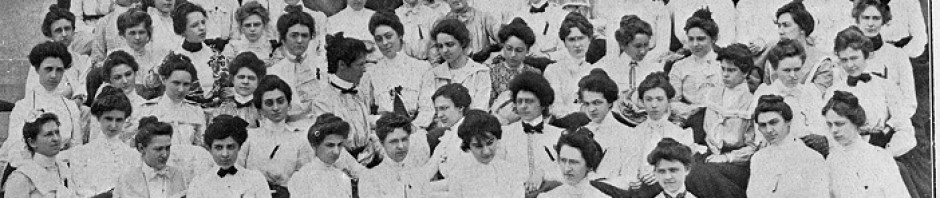
A portion of the picture taken on the White House lawn when the Pi Phis presented the official portrait of the First Lady. The only man in the picture is the artist, Howard Chandler Christy. Two of the Founders, who by then were in their 70s, attended. Also note that the First Lady is the only female without a hat since she was the one being visited and not a visitor.
The day the Pi Phis visited the White House remained one of the highlights of the First Lady’s life. Three month later the Coolidge’s world would be shattered. Their youngest son, Calvin Junior, died on July 7, 1924, from blood poisoning.
Alpha Omicron Pi was founded on January 2, 1897 at the home of Helen St. Clair (Mullan). She and three of her Barnard College friends, Stella George Stern (Perry), Jessie Wallace Hughan, and Elizabeth Heywood Wyman had pledged themselves to the organization on December 23, 1896. That first pledging ceremony took place in a small rarely used upstairs room in the old Columbia College Library.
It might come as a surprise to many that one of Alpha Omicron Pi’s founders Jessie Wallace Hughan, Ph.D., a lifelong educator, was a committed pacifist and social activist. In 1911, her dissertation was published as a book The Present Status of Socialism in America. It was later published with a revised title, America Socialism of the Present Day.
In the book’s introduction, John Spargo wrote:
Her warm sympathy so finely tempered by her critical spirit, enabling her to see both the noble and the ignoble in just perspective, makes her a trustworthy guide through the labyrinthian paths which confront the serious student of American Socialism as it is to-day. She gives a bird’s-eye view of the movement, sketches the political organization, noting its weak points as well as its strong ones; problems in theory and tactics are discussed with candor and discrimination, and the position of the leading spokesmen of the movement stated in their own words or impartial condensations of them. Thus the student who wants to understand the issues involved in the constant and often bitter conflict that is being waged between the so-called ‘Opportunist Socialist,’ on the one hand, and the so-called ‘Revolutionary Socialist,’ upon the other hand, is now provided with a convenient conspectus of the entire field of controversy.
In addition to being a founder of Alpha Omicron Pi, she was honored with membership in Phi Beta Kappa. In 1923, she was a founder and the first Secretary of the War Resister’s League. As a member of the Socialist party, she ran many times for office in the state of New York. All her efforts to be elected were unsuccessful.
Alpha Omicron Pi honors its four founders with named awards. The award named for Hughan recognizes the collegiate chapter deemed the most outstanding for the the two years between conventions.
Jessie Wallace Hughan, Ph.D. at about the time Alpha Omicron Pi was founded.
Sigma Nu official Founders’ Day is January 1, for it was on that date in 1869 that the fraternity was publicly announced at the Virginia Military Institute in Lexington, Virginia. In October 1868, three VMI cadets who were opposed to the physical abuse and hazing of VMI underclassmen discussed the situation. James Frank Hopkins, Greenfield Quarles, and James McIlvaine Riley formed the “Legion of Honor.” When the new society was announced on that New Year’s Day, it was known as Sigma Nu.
On the morning of January 1, 2019, 150 years after the founding of Sigma Nu, Justin Jacobs and Brock Baugher, the chapter president and vice president from the Mu Kappa chapter at Southeast Missouri State University paid tribute at Founder Riley’s grave in St. Louis, Missouri.
A celebration has taken place in Philadelphia and two are scheduled for California in the coming weeks.
The Gamma Mu Chapter of Sigma Nu was founded at the University of Illinois in 1902. Charles “Chic” Sale grew up in Champaign, Illinois. As a high school student, he hung out with his friends, some of whom were Sigma Nus, at the chapter house on the University of Illinois campus. In those early days of the 1900s, fraternities sometimes pledged men before they enrolled at the institution. Sale was pledged to the Gamma Mu chapter in 1906. The Sigma Nus gave him the nickname “Chic” when he entertained them at the chapter house. He had a way of making the chapter members laugh while entertaining them, and they encouraged to make his way as a performer. He left Champaign and tried his hand at vaudeville. He became one of America’s best-loved character actors and comedian on both stage and screen. During his travels, he frequently visited Sigma Nu chapter houses or attended alumni association meetings. One of his close friends was University of Wisconsin Sigma Nu alumnus Nick Grinde, who became his publicity man and later a renowned movie director.
Sale was an instant success in the film The Star Witness and his popularity grew with the publication of his humorous book, The Specialist. The book was published in 1929 and was a best seller (and this was before books of this type were published – vaudeville was rife with plagarism). It was a play about an outhouse builder. Sale, at a luncheon of the Sigma Nu Alumni Association, dined with a few lawyers who encouraged him to copyright and publish as a book the tale that he told them, the funny story about Lem Putt and his outhouses. He did just that.
Sale was initiated into the Gamma Mu chapter in 1927 by an act of the Sigma Nu High Council. He makes an appearance (at 8:06) in this promotional film for Rotary International. Sale died in 1936 at age 51. Sale was named to the Sigma Nu Hall of Fame in 1986. Milton Supman, better known as Soupy Sales, is said to have chosen his stage name as a nod to Sale.
Thanks for reading this blog. I appreciate your support and telling others about it. There are 1,100 posts here. The search tool can help new readers find posts about specific topics relating to fraternity and sorority history.
4. Vice Presidents Who Were Members of a Fraternity. If the Vice President doesn’t become President, chances are good that in a decade or two very few people will remember his name. Check out this list of Vice Presidents who belonged to fraternities and I think that more than once you will say to yourself, “Never heard of him!”
Oh, to have been in Mount Pleasant, Iowa, 150 years ago today, on December 21, 1868. Earlier that fall, Libbie Brook, a founder of I.C. Sorosis (now known by its Greek motto, Pi Beta Phi), enrolled at Iowa Wesleyan University instead of spending her junior year at Monmouth College, where her organization had been founded on April 28, 1867. It might have been because a chapter of Beta Theta Pi was established there and Libbie might have had a connection to Mount Pleasant. Perhaps her parents felt comfortable allowing her to be in Mount Pleasant. I often wonder why she chose to go to IWU rather than Knox College or Lombard College on her quest to establish the second chapter.
Libbie and her sister Mary took the train from Illinois. The bridge across the Mississippi River had opened for traffic on August 13, 1868. Mary became a student at IWU’s Preparatory School.
Libbie spent the fall getting acquainted with her fellow students. She had a plan and she kept to it. On December 21, 1868, the Gamma Chapter, I.C. Sorosis, was organized the home of Elijah Spry. Even though it was the second chapter, it took on the name of the third letter of the Greek alphabet. Legend has it that Libbie asked some of a group of friends, but not all seven, to become members of her organization.
Libbie Brook
A month later, on January 21, 1869, those seven, Franc Roads, Hattie Briggs, Mary Allen, Alice Coffin, Ella Stewart, Alice Bird, and Suela Pearson, chose to found a society of their own. They called it P.E.O.
P.E.O. Founders from a 1920s Record
As a P.E.O. and as Pi Beta Phi’s Historian, I am well aware of the early rivalry between the two groups. In fact, there is a section of Pi Phi’s centennial history titled “Rivalry Between P.E.O. and I.C. Sorosis at Mount Pleasant.” According to the report, some of it taken from the Story of P.E.O. written by Winona Evans Reeves, the two groups were for years “mortal foes yet each respected the steel of the other, for the societies were made up of much of the same type of girls. In Iowa Wesleyan they couldn’t even belong to the same literary societies; they had two societies in later years. The two boys’ fraternities (Beta Theta Pi, founded 1868, Phi Delta Theta, founded 1871 and perhaps Delta Tau Delta active 1875-80) had to be very careful in the way they divided their dates and their attentions.”
But the fact remains that the two organizations were intertwined. Had the event of December 21, 1868, not occurred, I likely would not be a P.E.O. today. I seriously doubt if P.E.O. would exist today. So I think it is fitting to celebrate the efforts of Libbie Brook on the way to celebrating the sesquicentennial of P.E.O. January 21st is but a month away!
Hazing is anathema to all the values and tenets of Greek-Letter Organizations. Yet, hazing is the stigma of GLOs. Would outlawing these organizations end hazing? I believe the answer is NO.
Are GLOs the only organizations in which hazing occurs? Hardly likely. Sports teams, bands, and the military have their share, as do other organizations. And it’s my opinion that Ph.D. committees and advisers have sent many a candidate chasing the elusive one more reference, fifty more pages, another revision, ad nauseam.
Waking at three last night, I did some light reading and stumbled across an article about America’s dominance in paper towel usage. This quote immediately attached itself to recent thoughts I had about hazing, “Perhaps the paper towel satisfies some deeper, uniquely American desire to be immediately rid of a problem, whatever the cost.” I’d been reading an argument that banning fraternities and sororities would end hazing once and for all.
Do I believe that? Not for a second. Currently, there are hundreds of inter/national GLOs whose existence depends on the behavior of their undergraduate members. These GLOs have prohibitions against hazing. Each time hazing occurs, the organization is tarnished and all the good done by its members is suddenly diminished. It hurts all of us who are members. So why is hazing still going on when there are laws and rules against it?
Group dynamics in these undergraduate organizations change as members come into and go out of membership. New members are initiated, older members graduate or leave. It’s a revolving door and the dynamics change at least once or twice a semester and maybe more often than that. And then there are all the variables of advisers, oversight by the international/organization, education about hazing, etcetera, etcetera, etcetera, not to mention the issue of alcohol and drug use among all college students, not just the ones belonging to GLOs.
Outlawing these organizations will merely drive the behavior underground. Local organizations will likely replace inter/national ones. An incident occurring in the rental house at the corner of Main and Green is likely to get less press coverage than one taking place in a large house bearing Greek letters, so maybe an incident wouldn’t get traction in the press. Closing every inter/national chapter and chapter house in North America is not going to make any problem disappear. Prohibition did not make alcohol use go away.
When done correctly, the experience of being a member of a Greek-Letter Organization can be a positive and productive one. I believe that wholeheartedly. But I also believe in “done correctly.” Chapters that have no clue about the GLO experience need to be educated or closed. Our future depends on it.
Fraternal Topmarks – Shenango Sample Plate from the 1930s-40s
It’s football bowl time apparently. I just texted my sons to see if the bowl teams had been chosen, and, yes they have. Fun to see Syracuse in the mix. The Orangemen are playing West Virginia University in the Camping World Bowl in Orlando, Florida on December 28. When I visited WVU earlier this fall and walked the campus early on a Sunday morning, the steep hills reminded me of the Syracuse campus.
My friend Penny Proctor, a Hillsdale College Pi Phi alumna, sent me this info in an email and I asked if she would mind if I shared it. Thanks, Penny, for writing it.
Milo J. “Mike” Lude, one of the most respected D-1 athletic directors of his time, is an alumnus of the Beta Kappa chapter of Alpha Tau Omega.
A native of Vicksburg, Michigan, his college career was interrupted by his service in the Marine Corps during WWII. After the War he returned to Hillsdale College to be captain of the football team and a student coach of baseball. Three days after graduation he married his beloved Rena (a member of Pi Beta Phi) and embarked on a coaching career that began at the University of Maine, then took him to 14 years as an assistant coach at the University of Delaware. He left there for his first, and last, head coaching position, at Colorado State University. His coaching record was not impressive, but he became the athletic director at Kent State University in 1970, and that is where his talents shone. While at Kent State, he hired head coach Don James who led the football team to the MAC championship.
In 1976 he became Athletic Director at the University of Washington, and during his tenure turned the $400,000 deficit into an $18 million surplus as well as overseeing the halcyon years of Washington football. His was the deciding vote that to admit the University of Arizona and Arizona State University to the PAC-10 (as it was then). When he left there, he became AD at Auburn and hired Terry Bowden as head football coach. After he “retired” in 1994, he became a private consultant to college football programs all over the country.
Mike is the recipient of many awards, including Colorado “Sportsman of the Year,” the NCAA Corbett Award (1988) for top athletic director and the National Football Foundation John L. Toner Award (2001), for demonstrated superior administrative skills and dedication to college athletics, particularly football. Mike penned his memoirs, Walking the Line, in 2004. He lost Rena in 2015 but at 96 he is still going strong.
There are many posts on this blog. Use the search button to find the posts about your organization.
Welcome!
Welcome! Chances are good you found this blog by searching for something about fraternities or sororities.
I was the last person anyone would have suspected of joining a sorority in college. I am sure I would have agreed with them, too.
When I made my way to Syracuse University, I saw the houses with the Greek letters that edged Walnut Park, and wished I could tour them. My roommate suggested I sign up for rush (as it was then called, today it’s known as recruitment) and go through the house tour round and then drop out of rush. It sounded like a plan. I didn’t realize that I would end up feeling at home at one of the chapters. And that I would become a member.
In this blog I will share the history of GLOs and other topics. I wrote a dissertation on “Coeducation and the History of Women’s Fraternities 1867-1902.″ It chronicles the growth of the system and the birth of the National Panhellenic Conference.
My Master’s thesis details the history of the fraternity system at Southern Illinois University Carbondale from 1948-1960. The dates are significant ones and the thesis is available on the top menu.
I have done research at the Student Life Archives and have written several histories of University of Illinois fraternity chapters for the Society for the Preservation of Greek Housing.