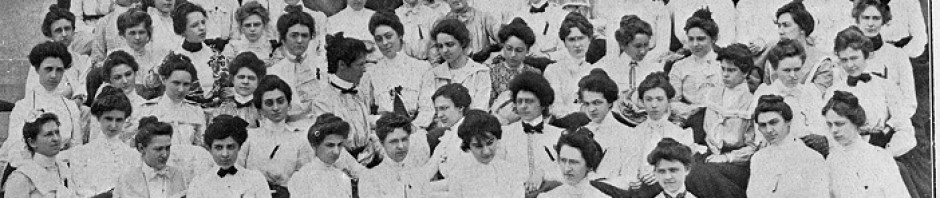
As a student at Northwestern University, Claudine Van Cleave (Mason) became a member of the Xi Chapter of Chi Omega. She served as president of both the sophomore class and her Chi Omega chapter. In addition, she was a member of the student council, Y.W.C.A. and Shi Ai, the honorary society for female junior students, and she had a part in the Junior Class play Within the Law.
She graduated in 1921 and on June 26, 1922, she married Frank M. Mason, from Northwestern’s Class of 1920. The couple, who would become parents to two daughters, lived in Indianapolis and St. Louis before returning to Evanston in the early 1930s. Mason became involved with the Xi Chapter and spent 16 years as adviser on personnel.
Claudine Van Cleave Mason (right) and Catherine Routon in 1935 at the Chi Omega Regional Fireside at Blowing Rock, NC. Both went on to serve as National Alumnae Officer. (courtesy of Chi Omega)
In 1948, she was hired by Northwestern as Counselor to Women. Four years later, the title changed back to its original one, Dean of Women. During her tenure at Northwestern, she was an advocate for the female students. In 1954, Syllabus yearbook, was dedicated to her. Northwestern honored her with service and merit awards.
She spoke at the University of Nebraska Chi Omega house in November 1953.
Chicago Tribune, November 1954
Grosse Pointe News, April 9, 1953
Stanford Daily, May 28, 1953
She retired in 1960. Mason “integrated student housing at Northwestern. There wasn’t any (housing) for black students before she did that,” according to her daughter’s quote in Mason’s obituary.
Mason served as a National Alumnae Officer for Chi Omega. The North Shore Chi Omega Alumnae established a scholarship in her name and awarded it to a collegiate member of Xi Chapter of Chi Omega at a tea in her honor every spring for a number of years. Kelly Brest van Kempen, a member of Xi Chapter House Corporation Board, said:
Claudine V. Mason was a fabulous woman and always came to the tea in her honor for as long as her health permitted. It was lovely seeing Claudine perched in a wing chair and chatting with the collegians sitting on the floor at her feet. After her death, her daughter, Wynn, a Xi special initiate, took her mother’s place at the tea.
She also was active in the Evanston community including the Women’s Club of Evanston, the University Guild, the Evanston Women’s Board of Northwestern University Settlement, Bryant Circle and the North End Mothers Club. Mason died on December 22, 1993.
Theo Fenton (Bird) and her sisters Polly and Ida were early initiates of the Theta Chapter of Alpha Xi Delta at the University of Wisconsin. The chapter was installed in 1905. Unlike her sisters, Bird did not finish her educational career at Wisconsin. She earned a degree from Stout Training School and taught domestic science at Madison High School, but she spent time with her Alpha Xi sisters whenever she could.
In March 1918, after the United States entered World War I, Base Hospital No. 22 was organized in Milwaukee, Wisconsin, and she joined the effort. She along with the other women who enrolled spent two weeks at the U.S. General Hospital in Lakewood, New Jersey. From there, they were ordered to New York where uniforms and equipment were distributed. Bird prepared for her work as a laboratory assistant by studying the Carrel-Dakin method of wound care at Cornell Medical and Bellevue Hospital.
In the first week of June, they boarded a ship bound for France, but spent a day in New York Harbor because of an enemy submarine scare. The ship made it to England without incident. From there, they traveled by train to Bordeaux, France. At first she was stationed with No. 6 at Bordeaux. In early August, No. 22 was ready to accept patients. Until November 11, it was a busy hospital. Although built for about 500 beds, at one time the unit handled the care of 4,500 sick and wounded.
Bird kept a diary during her service. On October 22, 1918, she wrote:
Our hospital has been made four times as large as it was in the beginning. No one could have made me believe that we could handle so much and we keep on handling more. You ask me why I don’t write more in detail. I have tried it and have had my letters returned. I get up at 6:30, eat, and go to work. Go out with whatever physician calls me. Go over wound after wound, some of them very serious and horrible, and some are superficial. I count bacteria for secondary suture work and culture for different infections. I am very busy but much interested.
Wisconsin State Journal, July 30, 1919
After she returned to the U.S., she married Wayne D. Bird and they had two daughters.
Capital Times, September 15, 1919
Bird seemed to remain involved in the Madison Alpha Xi alumnae organization. She hostessed events including the June 1919 picnic and the October 1926 dinner mentioned in these Wisconsin State Journal clippings.
On November 11, 1933, the Wisconsin State Journal had an article entitled “One Unknown Soldier” written by Mrs. Wayne D. Bird. This is the introduction to the article:
To us, Mrs. Bird’s article seemed particularly appropriate for publication on the Armistice day, the 15th anniversary of the official end of the great conflict that bathed the so-called civilized world in the blood of its finest manhood and womanhood. It tells the story of a young man who died just before the first Armistice day, his identity a mystery, the secrets of his brief existence carried to the rude grave of a soldier. There were others like him, some known, some unknown, – the millions of World war dead, gallant, courageous, reckless youngsters who fought the war that was to end all war.
Wisconsin State Journal, July 28, 1940
Bird died on Feb. 27, 1977 at the age of 90. Her sister Polly served as Alpha Xi’s editor from 1911-18 and as National President from 1918-20.
Mary Ellen Weber joined Phi Mu when she was a student at Purdue University. She earned her B.S. with honors in Chemical Engineering in 1984. Four years later, she became Dr. Weber after earning a Ph.D. from the University of California, Berkeley.
In 1992, she became a member of the fourteenth group of NASA astronauts. She spent 10 years at NASA.
Weber served on two shuttle missions. In July 1995, she helped deliver a communications satellite to orbit while on Discovery. She flew on Atlantis, on the third shuttle mission devoted to International Space Station construction.
In May 2018, the Cleveland, Ohio, Phi Mu alumnae hosted the Cleveland Panhellenic Scholarship Luncheon. Weber was the guest speaker at the event.
Mary Ellen Weber and the Cleveland Phi Mus at the Cleveland Panhellenic Scholarship Luncheon in May 2018.
Today happens to be Phi Mu’s Founders’ Day. Phi Mu was founded on January 4, 1852 at Wesleyan College in Macon, Georgia. It was first known as the Philomathean Society. Phi Mu and Alpha Delta Pi, also founded at Wesleyan College, are known as the “Macon Magnolias.” Phi Mu’s founders are Mary DuPont (Lines), Mary Myrick (Daniel) and Martha Hardaway (Redding). The founding was publicly announced on March 4, 1852, the day that is celebrated as Founders’ Day. The second chapter was founded at Hollins College in 1904. Phi Mu joined the National Panhellenic Conference in 1911.
It’s also International Badge Day! Wear your badge and be proud!
Marguerite Capen Hearsey was born and raised in East Orange, New Jersey. She enrolled at Hollins College in Roanoke, Virginia, where she became a member of Sigma Sigma Sigma. A report in the 1912-13 volume of the Triangle said of her:
Marguerite Hearsey of Hollins Institute deserves great mention and honor, for she is one of the most deserving girls Sigma has known. At Hollins she is gaining quite a reputation, her greatest honor being Editor-in-Chief of the college magazine. We are all proud of Marguerite and wish her greater success.
She also served as Secretary of the Y. W. C. A., and a member of the Student Council. When the Iota of Virginia chapter of Phi Beta Kappa was installed at Hollins College in 1962, Hearsey was one of eight alumnae invited to become a member. After graduation in 1914, she taught French and English at Georgetown College in Kentucky.
She was the first secretary treasurer of the Association of Pedagogical Sororities (later the Association of Education Sororities) when it began as an agreement between Tri Sigma and Alpha Sigma Alpha. The Panhellenic Representative of Sigma Sigma Sigma, she had spent the summer in Jeffrey, New Hampshire. On her way home, she stopped in Boston, where Ida Shaw Martin lived and they worked on formulating the necessary items for the organization.
During World War I, she worked for the Y.W.C.A. first in Honolulu, Hawaii, and then Boston and New York until 1921. She taught English composition at Bryn Mawr College in Pennsylvania from 1922-24, and earned a Master’s from Radcliffe College in 1923. From 1924-25, she taught at Wellesley College and then again from 1927-29.
She earned a Ph.D. from Yale in 1929. Hearsey was a Sterling Fellow and Elizabethan literature was her field. She also studied at the Sorbonne in France.
In 1929, Hearsey returned to Roanoke and taught English at Hollins, later becoming acting dean of women. While at Hollins, Margaret Wise Brown was one of Hearsey’s students. The author of Goodnight Moon credited Hearsey with encouraging her to pursue writing. Five years after her 1932 graduation, Brown gave Hearsey a copy of When the Wind Blew, her first published book. Brown inscribed it, “Remembering the stumbling words that led up to whatever clarity is here. And always thanking you for the first encouragement.”
Danville Bee, October 14, 1935
Hearsey moved to Massachusetts in 1936 where she became the 14th principal of Abbot Academy in Andover. During her tenure she served as president of the National Association of Principals of Schools for Girls and she was also on the board of the Headmistresses Association of the East.
She retired from Abbot in 1955. A dormitory on the campus bears her name. Abbot Academy merged with the formerly all-male Phillips Academy in 1973. In 2013, Head of Phillips Academy John Palrey closed his talk to the graduating class with the words Hearsey had spoken to Abbot’s Class of 1940 at their graduation:
We have come now to the real good-bye and there is little more that I can say or would say at such time in your personal loves and in this unprecedented and unpredictable world, than ‘good-bye’ with all its original, reverent significance – God be with you.”
Hearsey died on January 22, 1990 at the
age of 97.
Rowena Harvey joined Theta Phi Alpha when she was a student at Indiana University. Having served as editor of the Wednesday Echo at Shortridge High School in Indianapolis, she continued her interest in journalism at IU.
As an undergraduate, she was the second female editor in chief of the Indiana Daily Student. She was associate editor of the Crimson Bull humor magazine and the Hooiser literary magazine in addition to serving on the Board of editors for the 1921 Arbutus yearbook. Harvey was a member of the Women’s Athletic Association, Writers’ Club and the Marquette Club. She was a member of Theta Sigma Phi journalism fraternity and Pi Lambda Theta education fraternity. Elected to membership in Phi Beta Kappa, she ranked fourth in the class of 1921.
Rowena Harvey
Harvey began her graduate career at Indiana and earned a Master’s degree in 1922. She was hired to teach journalism and direct publications at the new South Side High School in Fort Wayne, Indiana.
She hit the ground running. In 1923, the Southside Times, the newspaper she advised, was judged the best high school newspaper in the nation. It consistently won awards during her tenure.
Indianapolis Star, November 23, 1930
She served on the board of the Indiana Journalistic Teachers and Advisers Association, the Columbia Scholastic Press Association and the Indiana High School Press Association. The National School Press Association named her one of its Pioneer Award winners.
Harvey was editor of the Compass of Theta Phi Alpha from 1930-35, and she established the sorority’s Chapter Publicity Award in 1935.
She died in 1971. In 1974, the Indiana High School Press Association established the Rowena Harvey Award. The award morphed into several awards in different categories and they are today known as Harvey Awards.
In 1913, Beulah Armstrong entered Baker University in Kansas. There she joined the Sigma chapter of Zeta Tau Alpha in a pledge class of eight women. According to a report inThemis of Zeta Tau Alpha:
While in school, Beulah took part in athletics, was a member of several religious and literary organizations, was on the Y. W. C. A. Cabinet, graded papers for the mathematics department, taught a mathematics class part of the time, was treasurer for the fraternity a year, and in addition to all that, she did as much work in the fraternity as any other girl, and much more than some girls even cared to do.
In 1917, Armstrong graduated with honors, and she was elected to Baker’s honorary scholastic fraternity, Alpha Delta Sigma. She won a fellowship to the University of Kansas where she earned a Master’s degree in 1918.
Wichita Beacon, March 7, 1917
Armstrong entered the University of Illinois where she began her doctoral studies. The first year she was on scholarship and for the following two years she had a fellowship. At Illinois, she was a charter member of its Sigma Delta Epsilon chapter, a fraternity for graduate women in science, now known as Graduate Women in Science. She was invited to join Kappa Delta Pi, which was then an honorary educational sorority. She was initiated as an associate member of Sigma Xi.
As she was in the midst of her doctoral work, a member of her chapter described Armstrong as:
ready for new fields of conquest, for wherever she may be, she will always be a worker. To be happy, Beulah must be busy, and as it is her habit to keep busy, she radiates happiness and contentment. All who know her love her, and are proud to be named among her friends.
She became Dr. Armstrong in 1921. Her dissertation was titled, Mathematical induction in group theory. She stayed where she was and began her career as an instructor. She worked her way up the academic ladder, retiring as associate professor emeritus. Many of her students became math teachers.
Beulah Armstrong, Ph.D.
At the University of Illinois, she continued to be active with Zeta Tau Alpha. She was an advisor, an alumnae association member and an ever present example of finer and nobler womanhood.
Beulah Armstrong is listed as ZTA faculty member
Armstrong retired in 1963 and she died on February 22, 1965, at the age of 64. The University of Illinois Zeta Tau Alpha chapter dedicated a study in the chapter house as a memorial to her.
On November 19, 1919, Kappa Kappa Psi, a “co-educational fraternal organization that advances college and university bands for the benefit of its members and society through dedicated service and support to bands, encouragement of musical growth, lifelong educational experiences, leadership opportunities, and recognition” was founded in Stillwater, Oklahoma, at Oklahoma A&M College, now Oklahoma State University. The organization is gearing up for its upcoming centennial.
Michael J Raymond, Ph.D., an alumnus of the Miami University chapter of Lambda Chi Alpha who has written extensively about his fraternity’s history, wrote this about the founding of Kappa Kappa Psi and its connection to Lambda Chi:
Music has been associated with Lambda Chi Alpha fraternity from its earliest years. In the past its chapter participated in campus songfests, Mother’s Day musicals, and serenades. In addition to the tradition of singing, it is a little-known fact that members of Lambda Chi Alpha played a major role in the founding of Kappa Kappa Psi Honorary Band Fraternity.
This fraternity was created to promote excellence in college and university band programs by providing leadership, recognition, and service opportunities to its members. The organization has approximately 180 chapters throughout the United States.
Kappa Kappa Psi was founded at Oklahoma A&M College, now Oklahoma State University, in Stillwater, on November 27, 1919. The organization has many famous alumni in its ranks including bandmaster John Philip Sousa, musician Ray Charles, composer John Williams, band leader Lawrence Welk, and former President Bill Clinton.
This story of Kappa Kappa Psi and Lambda Chi Alpha intersect at Stillwater, Oklahoma. Lambda Chi’s Alpha-Eta chapter was installed as the first national fraternity at Oklahoma A&M College on September 15, 1917. In less than two years following its establishment, the chapter would supply five of Kappa Kappa Psi’s ten founding members.
The following Lambda Chis were founders of Kappa Kappa Psi: William H. Coppedge, principal designer of the Kappa Psi membership badge; Andrew F. Martin, known as “Mr. Kappa Psi,” first grand president and long-time executive secretary of the fraternity; Dick Hurst, grand secretary of the fraternity; Clayton E. Soule; and Iron Hawthorne Nelson. It is interesting to note that these men were members of Alpha-Eta chapter at the same time Chester Gould, creator of the Dick Tracy strip, who was also a member of Kappa Kappa Psi.
Happy 167th to Phi Kappa Psi! It was founded on February 19, 1852 in Canonsburg, Pennsylvania, at Jefferson College (now Washington and Jefferson College in Washington, Pennsylvania). Phi Kappa Psi’s founders are William Henry Letterman and Charles Page Thomas Moore.
At Washington and Jefferson College
A few years ago, I wrote a history of the Illinois Delta Chapter of Phi Kappa Psi at the University of Illinois. In reading through the early Shield of Phi Kappa Psi issues, I discovered that there was once a chapter at Monmouth College, where Pi Beta Phi and Kappa Kappa Gamma were founded. It was the Illinois Gamma Chapter of Phi Kappa Psi.
According to the 1902 History of Phi Kappa Psi, Illinois Gamma was founded in April of 1871, not 1870 as had been noted in previous records. According to the history:
It was the outgrowth of a revolt of certain members of Delta Tau Delta and Phi Gamma Delta, who withdrew from these fraternities with the expectation of securing a charter from one of the leading eastern fraternities. Being disappointed in this hope, the band of petitioners investigated the merits of other fraternities represented in the West, and after this scrutiny petitioned Phi Kappa Psi for a charter. The petition was granted, and W.P. Kane was sent by the petitioners to Cornell College, Iowa, to be initiated into the chapter of Phi Kappa Psi there.
The new chapter began its career under most favorable auspices. The faculty was not hostile and the members were congenial, so that the true value of fraternity experiences was felt from the first. The members took practically all the college honors in sight, and nothing seemed to stand in the way of a most vigorous life.
In the 1870s, the administration, under pressure from the church authorities who helped fund the institution, turned against the organizations. They issued a ban. The chapters continued to operate sub-rosa for a number of years, but ultimately, all activity died out.
Monmouth College Courier, September 1, 1871
At the 1888 Grand Arch Council, the charter of “the only remaining sub-rosa chapter at Monmouth College”, was revoked. The chapter has been dormant ever since.
The first member in the list of initiates, J.A. Grier, was James Alexander Grier, who would go on to marry Ada Bruen, a founder of Pi Beta Phi. He served in the U.S. Army from 1861-65 before enrolling at Monmouth College. He became a Presbyterian minister and spent his career in his native Pennsylvania. One of the Grier’s sons, Rev. James Harper Grier, D.D., served as the fifth President of Monmouth College, from 1936-52. Neither of his parents lived to see him installed as President.
*Pi Beta Phi was founded in 1867 as I.C. Sorosis, Pi Beta Phi was its secret Greek motto. In 1888, the name change was made official by convention vote, although many chapter already were using the Greek letters. In the clipping I.C. is named alongside Kappa Kappa Gamma and not among the literary societies.
I’m a big fan of Mike Rowe’s Returning the Favor Facebook show. If you haven’t seen it, tune in now and make this one your first to view. It features, Megs Yunn, an Alpha Xi Delta alumna from the Marietta College chapter. The episodes are a great reminder that one person can make a difference. https://www.facebook.com/watch/?v=1822211364545179
***
A few weeks ago, at Pi Beta Phi’s College Weekend, I met Victoria Hempstead, the Vice President of Fraternity Development of the Texas Epsilon chapter at the University of North Texas. She told me about a Scraps and Snacks event she was planning for the chapter and its alumnae. I asked her to send me some pictures of the event and she did. Looks like it was a fun event!
***
Three P.E.O. friends, Susan Sellers, Anne Pettygrove, and Ruth Glancy, and I spent the last few years writing We Who Are Sisters, a coffee-table picture book history of the P.E.O. Sisterhood. In late October, we handed it off to the printer. After time at the printer and binder, it is finally done and copies are being mailed to those who pre-ordered the book. My copy arrived last week, and I was floored by its style and substance. Writing a book by committee was a bit of a challenge as we are all strong-willed creative people, but it was an exercise in making the best of the talents we possess. I hope the membership will enjoy the fruit of our labor.
As I was researching sorority women’s service during World War I, I came across this entry in a post WWI Banta’s Greek Exchange and it sent me down a rabbit hole. Who was Mother Cahill?
Ann, who was sometimes referred to as Anna, Cahill, moved from Massachusetts to Lawrence Kansas in 1892. An item in the society pages of the September 10, 1908 issue of the Daily Gazette, a Lawrence, Kansas, newpaper, read, “Mrs. Ann Cahill is in charge of the Phi Gamma Delta fraternity house as matron this year.”
In an article in the Phi Gamma Delta entitled My Life Among the Cannibals Being the Reminiscences of One Who Was ‘Mother’ of Fiji Chapter at Kansas for Seventeen Years, she described how she and a friend walked past the Phi Gam house on Louisiana Street one day. Cahill remarked that she would like to “fix the curtains that were hanging at all sorts of angles and lengths at the windows. There was a sort of desolate look about the place that seemed to demand the presence of a woman.”
Her friend, a Phi Gam wife, told her that the chapter was trying to find a woman to live in the house and serve as a hostess or chaperone. They had hired someone, but it was not a good match and she left. Cahill inquired about the job and was hired. According to a 1914 article, she took the job against her doctor’s wishes. However, “the work served as a tonic, by giving her an outlet for her nervous energy, and she immediately got better.”
Phi Gam Field Secretary C.C. Chambers stated that the President of Kansas University praised Cahill by saying, “A house matron like Mrs. Cahill is the most effective refutation of anti-fraternity sentiment that I know of.”
1910
Cahill reflected on her job, “It was not long until the boys found that I was no ogre and that I really wanted to be of assistance to them…. It very gradually grew to be a fashion for first one and then two or three or four at a time to ask permission to come to my room after dinner just to talk. Many and varied were the topics so gravely discussed in the small room I called mine. It was cluttered and crowded with a sewing machine, a day bed, a table on which were odds and ends of everything from party favors which I made with the boys’ help to table linen which needed darning. But there was always room for any of the boys even though they had to clear off a place to sit down. I would not take a prince’s ransom for the memories that cluster about that room.”
She also described how she was given the name “Mother Cahill.” At first she addressed each member as “Mr. So-and-So and in return was addressed as Mrs. Cahill. Some time after the beginning of the new school year I was informed at dinner one night there was to be a meeting in the north room and my presence was desired. I had no idea as to what was coming and decided that the boys had tired of the arrangement and that I was to be released. I felt upset for by this time I had grown very fond of the boys and was accustomed to their ways. I was more than ever interested in their welfare. The meeting was called to order and there was a feeling of general unrest in the air. I was reminded of nothing so much as a,lot of small boys who were in a tight place and did not know how to get out .of it. Finally the president said, ‘Mrs. Cahill, we want to ask you a question.’ ‘I shall be very glad to answer it if I can,’ was my reply. ‘Well, we want to know,’ and he took a long breath, ‘if you will allow us to call you Mother instead of Mrs. Cahill.'”
She added, “For a moment I was stunned and then told them that I thought they had paid me a very high compliment and that I should be glad indeed if they would call me Mother. From that day to this I have been Mother to every Phi Gamma Delta and to very many others who have been, or for that matter who are now, in Kansas University. I have been asked many times if I did not think the boys were unduly familiar in such a mode of address but my answer has been just what I told the boys — that I felt they were showing me signal honor and respect and that I enjoy being called Mother.”
1919
An article in the March 1929 Phi Gamma Delta, noted that although Cahill had not missed a pig dinner for 23 years. Moreover, she had followed the careers of “her boys,” had kissed their brides, made presents for their babies, and rejoiced in their achievements.
She described her experience working with the chapter, “They were wonderful years that I spent with Pi Deuteron and the memories are very precious to me. The most wonderful part of all is to know that I am held in kindly remembrance, for it is seldom that even one week goes by that I do not have a visit or a letter from some of the men who shared the tips and downs of those years. Each year I feel sure that I am a thing of the past but when Mothers’ Day and my birthday and Christmas bring the messages from all quarters of the globe I know I am not forgotten. And I shall be Mother to the end.”
Cahill died on March 24, 1933 and she is buried in Lawrence, Kansas.
There are many posts on this blog. Use the search button to find the posts about your organization.
Welcome!
Welcome! Chances are good you found this blog by searching for something about fraternities or sororities.
I was the last person anyone would have suspected of joining a sorority in college. I am sure I would have agreed with them, too.
When I made my way to Syracuse University, I saw the houses with the Greek letters that edged Walnut Park, and wished I could tour them. My roommate suggested I sign up for rush (as it was then called, today it’s known as recruitment) and go through the house tour round and then drop out of rush. It sounded like a plan. I didn’t realize that I would end up feeling at home at one of the chapters. And that I would become a member.
In this blog I will share the history of GLOs and other topics. I wrote a dissertation on “Coeducation and the History of Women’s Fraternities 1867-1902.″ It chronicles the growth of the system and the birth of the National Panhellenic Conference.
My Master’s thesis details the history of the fraternity system at Southern Illinois University Carbondale from 1948-1960. The dates are significant ones and the thesis is available on the top menu.
I have done research at the Student Life Archives and have written several histories of University of Illinois fraternity chapters for the Society for the Preservation of Greek Housing.