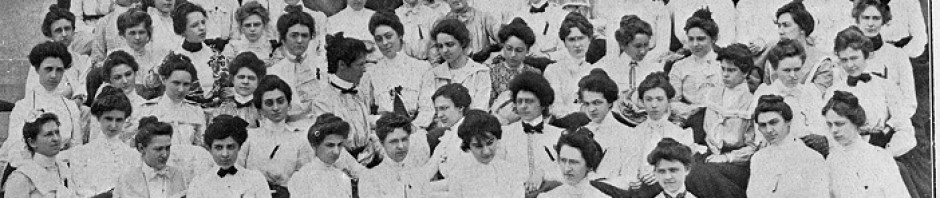
Julia Warner Snow joined Kappa Alpha Theta while she was undergraduate student at Cornell University.
The Iota Chapter of Kappa Alpha Theta (plus one Kappa Kappa Gamma and a few Theta Delta Chis), 1885
Sigma Xi was founded at Cornell University in 1886. In 1888, Snow along with her fellow Theta, entomologist Anna Botsford Comstock, and a few other women inducted by the Cornell Chapter.
Kappa Alpha Theta, 1886
Snow earned a bachelor’s and Master’s degree at Cornell in 1888 and 1889, respectively. The May 28, 1889, issue of the Cornell Daily Sun listed the eight candidates who were taking exams for graduate degrees with this explanation:
The examinations for advanced degrees in the University will be held from June first to June sixth. As has been the custom, all examinations will be oral and will be conducted by a committee selected for each subject. All theses for advanced degrees must be presented and accepted before candidates can be admitted to the examinations.
Snow’s thesis dealt with the Diseases of the Strawberry Plant. In a time when fellowship opportunities were few and far between, she received the Women’s Education Association Fellowship (it later became known as the AAUW European Fellowship). The $500 fellowship helped her study in Switzerland and she earned her Ph.D. from the University of Zurich in 1892.
In 1902, she was hired by Smith College and she spent the rest of her life in Northampton, Massachusetts. Between her years at Cornell and Smith, she taught at Coates College in Terre Haute, Indiana, Rockford College in Illinois, and the University of Michigan.
Michigan Daily, February 18, 1898
She spent her life teaching, doing research and traveling around the world.
Ithaca Journal, October 27, 1927
Snow bequeath 44 curios and articles to the Hillyer Art Gallery at Smith College.
Alice Shepard (Riggs) was born in Turkey when her parents were medical missionaries. Imagine how long she must have traveled to enroll at Syracuse University in the fall of 1905. There, she became a member of Delta Gamma.
She wrote the Rho Chapter report in Volume 26 of The Anchora and ended it with this:
One of the happiest times of the week in Rho house is the supper hour on Sunday evening when we all gather in the library where the grate fire sends out a homey glow and where the best ‘eats’ are passed around from chafing dishes, salad bowls and cake plates. The good old Delta Gamma song book holds its own with other music in these home parties.
Elected to Phi Beta Kappa, she graduated in 1910. Shortly afterwards, she married Ernest W. Riggs, a Princeton grad, in 1910. He also was the son of missionaries and the couple began serving college communities in Turkey, Lebanon and Greece. He was President of Euphrates College until 1915, when it was forced to close because of the turmoil.
A 1916 Anchora included this item about Riggs and her family. Her father had died in December 1915:
An article by Riggs, entitled “Cry of the Child,” appeared in 1919. This is the introduction:
In this Anchora you will find an article on Armenian children, written by a Delta Gamma who has spent the last eight and a half years in Armenia at Harpoot, where her husband is president of the Euphrates College. Alice Shepard Riggs (Rho) has been home only a few months, and has seen the Armenia atrocities at first-hand. She brought to America with her a charming young Armenian girl whom she and her husband have adopted in order to save her from the brutal hands of the German-inspired Turks. I believe Delta Gamma would be happy to help Mrs. Riggs in her work for these Armenian orphans. The fact that we would be helping a sister Delta Gamma will give to each one of us a special interest in the work.
In 1920, Riggs wrote Shepard of Aintab, a biography of Dr. Fred Douglas Shepard, her father.
In November 1942, while in California she spoke to the Santa Cruz Woman’s Club. Billed as a writer and lecturer, Riggs talk was called From Harem Life to Aviation. She, “in her girlhood, grew intimate with the life of Turkey, speaking its language, learning its folk-tales and songs.”
For a talk in February of 1950, the announcement promised, “Mrs. Riggs will tell many historical and personal experiences of life in the Near East.” In 1951, she spoke to the Delta Gamma who attended the District Convention in Ithaca, New York.
The American Board Mission newsletter of February 9, 1950, written in Istanbul, Turkey, carried this note about the couple visiting her brother. In 1933 Ernest Riggs became President of Anatolia College:
President Ernest Riggs of Anatolia College, Thessalonkiki, and Alice Shepard Riggs arrived in Istanbul on the 7th to spend a week with Dr. and Mrs. Shepard. The Riggses retire this summer from Anatolia College and this trip is perhaps a ‘once over’ farewell to this country, in which they both grew up, and where they served for so many years.
Courtesy of American Research Institute in Turkey-Istanbul personnel files
Ernest Riggs died in 1952, but his wife continued as a trustee of Anatolia College. She wrote a history of her years at the college.
In 1962, Riggs was honored with the Delta Gamma Rose Award for an “outstanding contribution to the world in her chosen field through her individual effort and talents.” Alice Shepard Riggs died in Vermont in 1983.
Today, March 15, is the date upon which Delta Gamma celebrates Founders’ Day. Happy Founders’ Day, Delta Gamma friends!
After graduation from high school in Machias, Maine, in 1899, Elydia Foss (Shipman) enrolled at Colby College in Waterville, Maine. She became a member of Sigma Kappa in the fall of 1900. After two years at Colby, she was called home because of her father’s health. She taught school for two years and then returned to her studies, this time a Boston University.
There, she met a group of women who belonged to a local
sorority. Xi Psi, which had been founded in 1900. She was asked to become a
member. Instead, she told them about Sigma Kappa. After much conversation, some
letter writing, and much deliberation, Sigma Kappa extended an invitation for
the local to become the first chapter of Sigma Kappa outside of the Colby campus.
The Delta Chapter of Sigma Kappa was installed on March 7,
1904 when 28 members of Xi Psi were initiated. A banquet took place at the
Hotel Bellevue in Boston. Addie Lakin, Evaline Salsman, and Elaine Wilson,
actives from the Alpha Chapter installed Delta Chapter. Founder Louise Helen
Coburn was in attendance.
Delta was the first chapter in which Shipman had a role in
establishing, but it was not the last. She served as Extension Chairman from
1905-08. She played a major role in the establishment of the Epsilon, Zeta,
Eta, Theta, Iota, and Kappa chapters.
She also helped established the Sigma Kappa Triangle and was on the first editorial board. She also served as Business Manager.
After 10 years teaching school in New Jersey, she enrolled
at George Washington University where she earned a Master’s degree. She was also
active with the chapter there. When she married Bertram Francis Shipman on
Tuesday January 23, 1917, in Washington D.C., the chapter was invited, and they
“enjoyed all the pleasant excitement that goes with weddings, with music by our
girls and the wedding cake boxes tied with lavender and maroon.’
The Shipmans had four children, two boys and two girls. The
oldest daughter, Elizabeth “Betty” became a member of the Rho Chapter at
Randolph-Macon Woman’s College.
The Shipman children. Elizabeth, who would become a member of the Rho Chapter, is holding the baby.
Elydia Foss Shipman was a force of nature. She kept herself very busy with her writing career, Sigma Kappa activities, and her community involvement. While living in New York City in the 1920s, she helped raise funds for the Panhellenic House residence for NPC women. She collected gifts for the Maine Mission and made sure they arrived.
She was a writer and began a journalism school before the field was taught in colleges. Shipman reported, taught, and wrote prose and poetry. She even copyrighted a song. In an article in the Sigma Kappa Triangle she is described as:
As a friend, Elydia is most engaging and enjoyable. She is able to project her keen mind to the point of even understanding the viewpoint of those who disagree with her. A keen sense of humor which is the spice of imagination even permits her to laugh at herself sometimes. She is self-expressive yet does not at all inhibit or repress others. She is so dynamic that she can plan and execute twenty steps while most of us are trying to make one decision about what to do first. She has a spirit that soars, a pen that sings, a heart that understands, and a faith that endures. She is a wonderful friend as well as wife, writer, citizen, and executive. I know, for I have been closely associated with her over a span of twenty years. Best of all she is a fine mother and the prospects of seeing her eldest daughter become a Sigma Kappa will fulfill one of the deepest and fondest dreams of her life.
Shipman and her daughter were in attendance on the 50th anniversary of the Delta Chapter in 1954.
It’s not often I write a #NotableSororityWomen post about someone I’ve met. Truth be told, I’m up against a deadline. For the past six months, I have been a caregiver to my father. Readers may have noticed that my posts were few and far between. My father passed away on Monday. My goal at the start of the year was to have the #WHM2019 posts appear without interruption. I tried my best to bank the posts so all I had to do was publish them early in the morning before he awoke. I researched and wrote in the rare few minutes I had to myself. I made it almost to the middle of the month. I told myself that a post about a notable Pi Phi shouldn’t be too hard to write today, but who could be the subject of a quickly written post, one that has to be done before I face this day of dealing with the things of my father’s death?
Mimi Baird came to mind, maybe because of the father connection. Her book, He Wanted the Moon, is about her father, one who disappeared from her life when she was a young child.
I met Mimi Baird when I presented a program on Grace Coolidge at the University of Vermont. Later, she and Cyndy Bittinger, former Executive Director of the Calvin Coolidge Memorial Foundation and an expert on Grace Coolidge, became alumnae initiates of Grace’s Pi Beta Phi chapter at the University of Vermont.
Mimi’s father, Perry Cossart Baird, Jr., a native Texan, studied at Southern Methodist University and the University of Texas. He was a member of Alpha Tau Omega at both SMU and the University of Texas and he served as an officer of the Texas chapter. He graduated from the University of Texas with honors and was inducted into Phi Beta Kappa. He attended Harvard Medical School and again graduated with honors.
Dr. Baird left Mimi’s life in 1944 when she was six-years-old. She and her younger sister attended her father’s funeral in 1959. His death was due to a seizure, likely caused by the prefrontal bilateral lobotomy he was subjected to a decade earlier. Between those years, Mimi had very little interaction with her father or his family. Due to her father’s manic depressive episodes, her mother was advised to divorce him. Divorce she did and she quickly remarried. No more was spoken of her father other than he was “ill” and was “away.”
Twenty plus years ago a box with a manuscript was sent to her from a Texas cousin. It was an accounting of her father’s life written during his hospitalizations. The pages were out of order and it took a great deal of effort to piece together. When she completed the puzzle, Mimi discovered what happened to her father. The primitive and cruel methods the mentally ill were subjected to in the 1940s and 1950s are described by the person who endured them. Her father had hoped that his manuscript, which he titled Echoes from a Dungeon Cell, would be published someday. Although it took more than half a century, his story has indeed come to life thanks to Mimi and Eve Claxton.
Brad Pitt, a Sigma Chi, purchased the film rights and it is said he will play Dr. Baird in the movie. Award winning screenwriter Tony Kushner is adapting the book for film.
This is a story of a daughter’s discovery of her father’s life. It tells a story that is compelling, heartbreaking, and eye-opening. And it is a triumph in that Dr. Baird’s story is finally told, by the daughter he barely knew. Thank you Mimi for your efforts in making your father’s story a reality.
Eleanor Jones (Wauchope) attended Simpson College in Indianola, Iowa, where she became a member of the Mu Chapter of Alpha Chi Omega.
Eleanor Jones (Wuachope)
Alpha Chi Picnic, May 1913
She married M. Stanley Wauchope in her hometown of Winterset, Iowa. They were wed at eight in the morning. Afterwards, they drove to Davenport, Iowa, in an automobile. She taught school at State Center, Iowa, before heading east.
State Center Teachers, 1918, Eleanor Jones Wauchope is in the middle
In D.C., the couple worked for the government work. Evelyn worked in the Quartermaster General’s Office of the War Department, according to the Alpha Chi Omega roster of members who did war work.
Quartermasters Corp., 1919
The Wauchopes had a home built in Brentwood, Maryland, and moved in around 1919. This information was garnered from snippets which appeared in issues of The Lyre of Alpha Chi Omega.
When I went searching for additional information, I came across a wonderful digital book about her early life. It was compiled by her granddaughter Jeannine Florance. I was impressed by the amount of work that went into producing the book and I was reminded how important it is to tell our stories and have them written. My thanks to Jeannine Florance for the use of the pictures and for allowing me to link to her grandmother’s life stories. Let it be the impetus for each of us to document some of our own life stories.
Fran Becque, www.fraternityhistory.com, 2019. All Rights Reserved. If you enjoyed this post, please subscribe up for updates. Also follow me on twitter @GLOHistory and Pinterest www.pinterest.com/glohistory/ and Focus on Fraternity History Facebook group
This is the first time in my years of writing #WHM posts that I am featuring a mother and daughter back to back. Yesterday’s post was about May Hurlburt Smith, an Alpha Phi. Today’s spotlight is on her daughter, Shelley Smith Mydans, a member of the Kappa Kappa Gamma chapter at Stanford University.
May Hurlburt and Everett W. Smith, Stanford University alums, had three children, two daughters and a son. Daughter Shelley was born on May 20, 1915. She grew up on the Stanford campus where her father taught journalism. She enrolled at Stanford and became a member of the Kappa Kappa Gamma chapter. Bid night was Friday, January 20, 1933. She was one of 15 pledged to the Kappa chapter, the largest pledge class on campus.
Shelley Smith’s name appears on the first line of the second column in the October 1933 Key of Kappa Kappa Gamma. Note how her hometown is listed as Stanford University.
October 1934
She attended Stanford from 1932-34, and she was a speech and drama major. The production mentioned in The Key was but one of many in which she played a role.
She went east to dance and perform, but ended up working in the field her father taught at Stanford – journalism. For a short time she was employed by The Literary Digest, a magazine which had its demise after the 1936 election. She then began working as a researcher and reporter for Life magazine, the weekly that chronicled world events through photojournalism. Its first issue was published in November of 1936. Among the photographers on staff was Carl Mydans. She sometimes accompanied photographers to get information about the pictures that were taken. She and Mydans met and they married in 1938.
Shelley Smith Mydans
With Europe at war, the Mydans headed across the ocean to document events. At the beginning of their time there they were separated, but after the fall of France they reunited and traveled together. They went to the Far East, to China, and were waiting for visas to visit Russia when they headed to the Philippines. When Manila fell in December 1941, the Mydans were taken as prisoners. They spent time interned in Santo Tomas and then in Shanghai. According to a report in the Stanford Daily, Shelley Mydan’s mother, May Hurlburt Smith received word from the U.S. State Department on October 14, 1943, that her daughter and son-in-law were among the 1236 prisoners released in a prisoner of war swap.
On December 2, 1943, the Gripsholm, an exchange ship on its second voyage home, deposited them in New York.
The March 8, 1945 Stanford Daily reported Shelley Mydans had been in Guam since November 1944. Her husband was in Manila with General Douglas MacArthur. He took the iconic photo of MacArthur’s return to the Philippines when the General strode to shore on the island of Luzon.
Perhaps she thought about writing a book during her time as a prisoner, or maybe on the ship coming home. The first draft of The Open City was written at her family’s home on the Stanford campus, according to a Stanford Daily article. Published in 1945, it was a novel based upon the couple’s treatment and experiences in the 22 months they spent in the internment camps.
The Key of Kappa Kappa Gamma, April 1945
After the war, they returned to New York. She was a commentator for a Time Inc. radio news program. In addition to writing for Time and Life, she also wrote two more novels. Thomas was based upon Thomas Becket’s life. The Vermilion Bridge was set in Japan in the eighth century. She and her husband collaborated on The Violent Peace.
Shelley Smith Mydans died on March 7, 2002, at the age of 86.
When it came time to chose a college, May Hurlburt (Smith), an easterner, chose to attend Stanford University. Today, one can get from New York City to California in several hours. In September of 1898, she must have been on trains for the better part of a week going across the country.
May Hurlburt (Courtesy of Stanford Archives)
May Hurlburt was a charter member of the Kappa Chapter of Alpha Phi which was installed at Stanford in 1899.
San Francisco Call, May 22, 1899
She was a sponsor of the Lambda Chapter of Alpha Phi at UC Berkeley. It was chartered in 1901.
An economics major, she graduated in 1902 and returned east to teach at the New York Institute of Applied Music. She had worked there before heading to Stanford. She taught piano, harmony, and music history. At least one song she wrote appeared in The Songs of Alpha Phi songbook.
From August of 1903 until sometime in 1908, she worked at the Armstrong Association of New York. In early 1908, the Association had a meeting about the Tuskegee Institute. It was held at Carnegie Hall and the Southern Workman reported that 2,000 people had to be turned away for lack of space. She was named in an article as having played a prominent role in that event. This 1906 article gives some information about the Association.
Los Angeles Herald, November 27, 1906
During some of the time she was working for the Armstrong Association, she was serving as Alpha Phi’s National Secretary. A chapter had been chartered at Barnard College in 1903 and she worked with the chapter and was a member of the NYC Alpha Phi Alumnae Chapter. When her chapter celebrated its sixth birthday in 1905, she sent a letter which was read. The chapter enjoyed her sentiments and it “made her in her far away New York home seem less distant to us.” The chapter toasted her as was their custom of “drinking a toast to each and every one of our absent sisters.”
Alpha Phi Quarterly, May 1906
At this point, in the period of time before her marriage to Everett W. Smith, things get murky. They met at Stanford. He graduated in 1899 and she in 1902. He spent time as a reporter in San Francisco and New York City. In 1906, he became Director of the Editorial Department of the U.S. Forest Service in Washington, D.C.
In December 1907, this article with the title “Will be assistant secretary to Dr. Jordan” appeared in the San Francisco Chronicle. The article stated she would come to Stanford “next January.” Did that mean 1908 or 1909?
San Francisco Chronicle, December 22, 1907
She was still with the Armstrong Association in early 1908. Although she was appointed to this post at Stanford, I am not sure if she ever served. In the May 3, 1908 San Francisco Examiner, there is an announcement that she would wed Everett W. Smith in July and move to D.C. where he was working.
In 1910, Stanford hired Smith’s husband to teach journalism, which was a new field of study at the time. He spent his career at his Alma Mater. Their home on Alvarado Drive was “an open house for all Stanford journalists, from students to returning alumni,” according to May Hurlburt Smith’s obituary.
In 1913, an article written by Smith appeared in the Alpha Phi Quarterly. She reported on Mary Lockey’s Castilleja School. Lockey was also a charter member of Kappa Chapter. She opened it with:
When I returned to Stanford and Kappa chapter three years ago, after having been away from California since 1902, about the keenest pleasure I had, of course, was meeting the old girls who live in the vicinity. After I had seen perhaps half a dozen of them, it struck me that every single girl had asked me the same question: ‘Have you seen Mary’s new school?’ Although I knew that Mary Lockey (Kappa, ’02) had been at the head.of Castilleja School, at Palo Alto, for two or three years, and that she was beginning the fall term in new quarters just finished, I had not seen it; but knowing Mary’s unfailing good judgment I felt sure that it must be a very pleasant little place.
The Smith’s had a son and two daughters, one a Kappa Kappa Gamma who will be profiled for #WHM2019, too. She was active in the campus, community and with her Alpha Phi chapter. She served as President of the Stanford Alumni Council and as Editor of the Illustrated Review alumni magazine. When Stanford ordered the NPC groups to leave campus in the early 1940s, the former Alpha Phi house became Hurlburt House in her honor.
Hurlburt House, circa 1970
She likely kept herself busy in her later years. This 1953 clipping from a Santa Maria, California, newspaper mentions that she was Secretary of the Women’s International League for Peace and Freedom’s Palo Alto branch. She was 81 at the time.
Santa Maria Times, June 15, 1953
May Hurlburt Smith died on December 30, 1963 at the age of 91. She had been a widow for 30 years. Both she and her husband spent most of their adult lives on the Stanford campus.
When I was deciding upon an Alpha Gamma Delta to profile, I took a look at the Wikipedia page. There appeared the name of English author and suffragist Elizabeth Burgoyne Corbett as an Alpha Gam. I know it’s Wikipedia after all, but it made no sense to me that someone born in 1846 in England would be a member of Alpha Gamma Delta, an organization founded in Syracuse, New York, in 1904. I went sleuthing, found the correct Elizabeth Corbett and I fixed the Wikipedia page, too.
Elizabeth Corbett, the poet, short-story writer, novelist and author, was born in Aurora, Illinois. She grew up in a house on the property of the National Soldiers’ Home, her father’s place of employment, near Milwaukee, Wisconsin. He was the chief financial officer for the home. In 1941, she wrote Out at the Soldiers’ Home, a memoir written more in the style of a novel. In it, she describes her father’s work as a “complicated bookkeeping system which was such an extraordinary mixture of expert accounting and simple red tape.”
Corbett enrolled at the University of Wisconsin where she was a member of Alpha Gamma Delta’s second chapter. She graduated Phi Beta Kappa. This Elizabeth Corbett was a suffragist, too.
Elizabeth Corbett as a young child. She was called “Bebby.”
Corbett lived in a house on the National Soldiers’ Home grounds. At least one meeting of the Alpha Gamma Delta Milwaukee Alumnae Chapter was held on the grounds, too.
Alpha Gamma Delta Quarterly, 1911
After graduation, she served as Press Chairman of the Milwaukee Country Woman’s Suffrage Association. Her mother was Corresponding Secretary. In 1912 she spent July on a suffrage trip through the northern part of the state. She served on the Vocational Opportunities Committee and the Education Committee of the Milwaukee Branch of the National Association of Collegiate Alumnae (later known as AAUW).
Corbett served Alpha Gamma Delta in a number of ways, including being part of its National Panhellenic Conference (NPC) delegation. She chaired the committee to select a book plate for the organization. An article in the July 1912 To Dragma of Alpha Omicron Pi discussed the NPC organizations’ positions on fraternity examinations. Alpha Gam believed “fraternity examinations are necessary in order to have well-informed fraternity women who take an intelligent interest in fraternity questions.” Corbett added, “Personally, I believe most heartily in Pan-Hellenic questions, which help to spread knowledge of itself and its possibilities and which emphasize the Pan-Hellenic idea in concerted and appreciable form.”
At the 1913 NPC meeting, two Elizabeth Corbetts, one from the Alpha Gam delegation and the other from the Kappa Delta delegation, had a namesake “hobnob.”
In 1919, the Alpha Gamma Delta Quarterly included information about Corbett’s new book The Vanished Helga, “All Beta girls should prize this copy of her work and wish her continued success.”
1919 – by “Our” Elizabeth F. Corbett
A 1922 issue of the Quarterly noted that Corbett “a writer, public speaker, newspaper woman and novelist is listed in Who’s Who.”
After her father died in 1927, Corbett and her mother moved to New York City. In her later years, at least two of her poems appeared in the Quarterly. The Winter 1960 issue included My Testimony. The following summer, Ripe for Demolition debuted. It also appeared in the November 1966 issue of Fraternity Month.
Corbett wrote at least one story which included a sorority woman, 1969’s The Three Lives of Sharon Spence.
When Corbett died in 1981 at the age of 93, this appeared in the press:
For more than 50 years Miss Corbett wrote a succession of historical or period novels that were consistently popular, particularly among women. Reviewers often termed her nostalgic works ”entertaining” and ”friendly” without being ”significant.”
A partial list of books written by Elizabeth Corbett
Mary Donlon (Alger) joined Alpha Omicron Pi at Cornell University. She spent one year doing general classes and the following three as a law student, when Cornell’s law school only required one year of college study to enroll as a law student. Her older sister Joanna, who was two years ahead of her, was a member of the chapter, too.
Years later, she was asked why she chose to study law at a time when that was not done often. She recounted that in 1915 someone may have told her “the professions, especially the law, were very difficult for women,” and she wanted to challenge that theory.
While at Cornell, she was president of Student Government and played an active role in several organizations. She was tapped for Raven and Serpent, a junior women’s secret society based on extracurricular activities, and Mortar Board. Donlon was elected Editor in Chief of the Cornell Law Quarterly from a field of 13 men and herself. This gave her the distinction of being the first woman to serve as editor of a law review at any U.S. law school.
After graduation, she was hired by Burke & Burke, a Wall Street law firm. She spent the next 25 years at the firm. Donlon made partner in 1928, and was the first and only woman to do so for decades. She was both a trailblazer and rarity.
Mary Donlon
In 1923, Donlon began a six-year term as a Trustee of Alpha Omicron Pi’s Anniversary Endowment Fund. In 1957, she received its Elizabeth Heywood Wyman Award.
Donlon was also a loyal Cornellian and served the institution in a number of ways. In 1932, she began a two-year term as director of the Cornell Alumni Corporation. The next year, she was President of the nationwide Federation of Cornell Women’s Clubs. In that capacity, she started a conference for Cornell women, bringing professional women to campus to meet with female students and offer career advice. It was networking before networking was a word. Among the committee members planning the event was R. Louise Fitch, Dean of Woman and a former Tri-Delta officer.
Cornell Alumni News, April 22, 1937
In 1937, she was elected an alumni trustee and served in this capacity until 1966 when she was elected Director Emeritus. Throughout her life, she was an advocate for women. Donlon was named a Presidential Councillor, one of Cornell’s highest alumni honors.
She was breaking ground for women in public service at the same time as she was serving Cornell. A staunch Republican, New York Governor Thomas E. Dewey appointed her as chairman of the NY State Industrial Board in 1944. The next year she was appointed chairman of the Workmen’s Compensation Board, a position she held for a decade until she became a judge.
Brooklyn Daily Eagle, October 17, 1940
President Dwight D. Eisenhower appointed her as Judge of the United States Customs Court in 1955. Her Cornell Law School colleague and friend Judge Elbert Tuttle swore her in. She retired in 1969 and moved to Tucson, Arizona.
Attorney General Herbert Brownell, Jr., congratulates Judge Mary Donlon as Judge Elbert P. Tuttle looks on. Tuttle, who was a key figure in advancing civil rights in the south was a Cornell classmate of Donlon’s. He was a founder of the Pi Kappa Alpha chapter at Cornell. Brownell was a member of Delta Upsilon at the University of Nebraska.
She left her mark on Cornell, and in 1961, a women’s dormitory was named in her honor. She established a professorship, a scholarship, a lecture series, and a fund to honor the widower she married in 1971, Martin Joseph Alger. When she was 78, they wed and she took his last name. They spent winters in Tuscon and summers at the Lake Placid Club in upstate New York. She died on March 5, 1977.
In 1904, Grace Erb was a student at Michigan State Normal College when she became a member of Alpha Sigma Tau. It was the sorority’s Alpha and only chapter. After graduation she taught in Grand Rapids, Michigan.
Normal News, May 27, 1905
She remained close to her sorority. In 1923, she played a role in the organization of the Grand Rapids Alumnae Chapter. She was a delegate to Alpha Sigma Tau’s first convention which was held in Detroit on October 8, 1925. There she became the first National President. She was reelected at the second convention.
As National President, she served as the delegate to the Association of Education Sororities. She recounted her effort in an early Anchor article:
On Sunday, January 23, 1927, I made a very hurried trip across state to meet Miss Mabel Lee Walton (Sigma Sigma Sigma), president of the Association of Educational Sororities. It was a pleasure, particularly as four of the national presidents were present upon that occasion, so that we had an opportunity to see and hear the leaders in the nationalizing movement of educational sororities.
Upon Ritchie’s resignation, Ada Norton, an early Alpha Sigma Tau advisor, wrote in the June 1928 Anchor:
The first years of an organization are vital ones in its history and to be willing to assume the responsibility of leadership at such a time shows the true worth of Mrs. Ritchie [Grace]. The two and one half years have been marked by steady growth and stabilization so that today we are on a much stronger national basis than when she accepted the responsibility of leadership in November 1925. The topic assigned to her at the ‘open’ meeting of the AES Conference in Denver was ‘Sorority Friendship.’ Her treatment of it revealed her high ideal of friendship and reflected great credit upon her and Alpha Sigma Tau. May I express our heartfelt thanks to her for the time she has done, and ask her to lend us her wise counsel to the furtherance of our efforts to attain the highest standards possible for women in the field of education.
Grace Erb Ritchie
From 1929 through 1951 she was principal of Stocking Elementary School in Grand Rapids. Although she was not an Alpha Sigma Tau founder, she was certainly a builder. The foundation she laid has served her sorority well.
Ritchie died on March 2, 1954 from amyotrophic lateral sclerosis (ALS).
There are many posts on this blog. Use the search button to find the posts about your organization.
Welcome!
Welcome! Chances are good you found this blog by searching for something about fraternities or sororities.
I was the last person anyone would have suspected of joining a sorority in college. I am sure I would have agreed with them, too.
When I made my way to Syracuse University, I saw the houses with the Greek letters that edged Walnut Park, and wished I could tour them. My roommate suggested I sign up for rush (as it was then called, today it’s known as recruitment) and go through the house tour round and then drop out of rush. It sounded like a plan. I didn’t realize that I would end up feeling at home at one of the chapters. And that I would become a member.
In this blog I will share the history of GLOs and other topics. I wrote a dissertation on “Coeducation and the History of Women’s Fraternities 1867-1902.″ It chronicles the growth of the system and the birth of the National Panhellenic Conference.
My Master’s thesis details the history of the fraternity system at Southern Illinois University Carbondale from 1948-1960. The dates are significant ones and the thesis is available on the top menu.
I have done research at the Student Life Archives and have written several histories of University of Illinois fraternity chapters for the Society for the Preservation of Greek Housing.