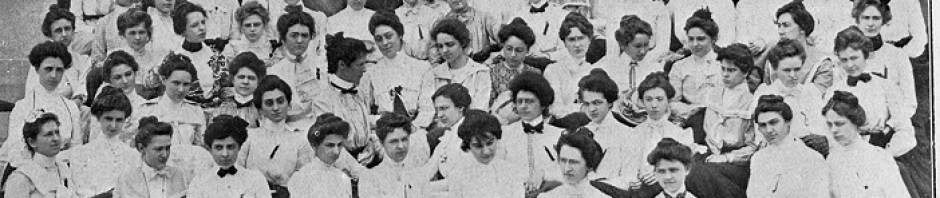
Lois Miles Zucker, Alpha Delta Pi, #NotableSororityWomen, #WHM2019

Lois Miles (Zucker) was born in Colorado in 1889 and grew up in Bushnell, Illinois. She enrolled at the University of Illinois where she became a member of Alpha Delta Pi. At Illinois, she earned a Bachelor’s in 1910 and a Master’s in 1914. It appears she was involved in the chapter during her graduate studies. She earned Phi Beta Kappa honors.

Sigma Chapter GPAs, May 1914 Adelphean

She married Adolph E. Zucker, a fellow student, on January 2, 1915. A native of Fort Wayne, Indiana, he earned his undergraduate degree in 1912 and a Master’s the following year. He earned his Ph.D. at the University of Pennsylvania in 1917.

1914 Illio

Frances Morehouse, a National Vice President of Alpha Delta Pi, who was in the chapter with Zucker reminisced in a 1912 Adelphean:

I remember in passing how one erudite classmate of mine, (pointed glance at Lois Miles) who was supposed to spend a good deal of time in the stacks, used to meet me, sometimes, where the dog-eared but still efficacious old files of Life are kept, for the delectation of sober-sided old P. G’s.

A 1918 Adelphean noted that Zucker was in Peking, China, where her husband was teaching at Tsing Hua College. She, too, was teaching English there. For one year, she worked at the Presbyterian Mission School for Boys in Peking and then taught English at the Government University where she was the first female instructor. She also worked at the American Embassy.

Two of Zucker’s letters to her mother appeared in Volume 12 of The Adelphean. Dated May 5 1918, Zucker discussed an invitation to have dinner with a prominent businessman at his factory:

I had been taking lessons in Chinese etiquette for two weeks previous to the event, and was armed to the teeth with phrases and rules of conduct. As he speaks not one word of any language but Chinese and Manchu, I needed to be. There were six other guests beside ourselves, making nine in all, four foreigners and five orientals, of whom M. Chih was the only Manchu. First we sat in a magnificent room and drank tea till all the guests assembled, after which we went to the dinner, which I may as well tell you now I have no power of describing. It was twenty-five courses long. We had all the delicacies, ancient eggs, bamboo shoots, shark’s fins, bird’s nests, pigeon eggs, etc., beside duck, chicken, pork, lamb, turkey, beef, and everything else imaginable. The way they do is to place a number of things around the table which resemble somewhat our idea of salad, pickles, and so on; these remain throughout the dinner. Then in the center they place a piece de resistance of which one is supposed to eat very little. This is then removed and another brought on, ad infinitum. It is all accompanied by wine, which one must, according to etiquette, at least taste. The wine is very thin, vinegary stuff, usually, with a very low percent of alcohol, and served steaming hot, as I think I have told you before. On this occasion it was much stronger, also much hotter. The coming of the rice is always a signal for the conclusion of the feast, and that one must eat, whatever else one takes or leaves.

On this occasion, as on the several preceding of which I have told you, I was the only feminine guest, and was given the seat of highest honor, facing the door. If I had not been taking lessons in Chinese etiquette I would have been unconscious of the great compliment paid me. Also I was the first one served every time, the host himself taking his own chop sticks and placing a portion on my plate, so that I was obliged to eat some of everything, whereas the others could sometimes omit something. I was also denied the privilege of seeing how others did it first, which was very embarrassing, you may be sure. I sat between a Frenchman with whom I essayed to talk French and a Chinese who essayed to talk German to me as he knew no English. With the host I actually managed some conversation in Chinese with much applause from the others. It is not so difficult to open a conversation in Chinese because it is the height of politeness to ask the name of things and all about them, and that is not so involved. It is even quite correct to inquire what the cost was.

The dinner service was of solid silver, plates, cups, and all, beautifully decorated and chased, and the chopsticks were ebony with silver handles. It is no joke to learn to use chopsticks, either. Well, at last it was over, and we made our adieus very shortly, as is also custom after a Chinese dinner. The ride home was very lovely.

Circa 1930s

The April 1923 Adelphean had this information about her:

You’ll be interested to know that Mrs. Lois Miles Zucker, who has been with the Peking Union Medical College, is now on her way back to the States by way of the Mediterranean and Europe. She expects to arrive here by the beginning of the school year, 1923-1924.

When the couple returned to the United States, they headed to College Park, Maryland, where her husband became a Professor in German and head of the Department of Foreign Languages at the University of Maryland. This job was facilitated by an introduction to a University of Maryland administrator his wife had made while she was employed by the American Embassy in Peking.

The couple spent a few years at College Park, then hopscotched to a couple of other universities before landing back at the University of Maryland in 1938, where husband accepted the Chairmanship of the Department of Humanities. He retired from Maryland in 1961.

Lois Miles Zucker did graduate work at the University of Paris in 1923 and 1927. She taught French at the University of Maryland, and then taught classics at American University. In 1933, she earned a Ph.D. from Catholic University.

Upon her husband’s retirement from Maryland, it was said that the Zucker’s home and garden were “well-known by the generations of Marylanders who during the thirty-eight years of his association with the University have been received there with gracious hospitality.” One can surmise that Lois Miles Zucker had a great deal to do with this as she seemed to have a zest for life.

Circa 1960s

The Zuckers also had a hand in awarding of the 1950 Alpha Delta Pi Fellowship grant to Simone Fastres of Brussels Belgium. He recommended Fastres for the $250 fellowship. According to the article in The Adelpehan:

Announcement of the grant and presentation of the check to Miss Fastres took place at a dinner at the Beta Phi chapter house on the Maryland campus, Wednesday, Feb. 15. Alpha Delta Pi is indebted to Dr. A .E. Zucker, head of the department of Foreign Languages and Literature, College of Arts and Sciences, for his recommendation of Miss Fastres for the grant. Her brilliant work in his class and her sincerity of purpose won his attention. Dr. Zucker was present at the dinner at which the award was announced and the sorority was particularly happy to have present also on this occasion, Mrs. Zucker, better known to Alpha Delta Pis as Dr. Lois Miles Zucker, Sigma chapter.

In the 1960s, Lois Miles Zucker taught at the University of North Alabama. She died in March 1982.

Posted in Alpha Delta Pi, University of Illinois | Tagged , , , , | Comments Off on Lois Miles Zucker, Alpha Delta Pi, #NotableSororityWomen, #WHM2019

Leontyne Price, Delta Sigma Theta, #NotableSororityWomen, #WHM2019

Opera star Leontyne Price was born in 1927.  As a young girl, she sang in the church choir. Price enrolled in the music education major at Wilberforce University. As a member of the glee club, she had many opportunities for her voice to shine. She was encouraged to study vocal performance.

After graduating from Wilberforce in 1948, she continued her education at Juilliard in New York City. She had a full tuition scholarship and it was at Julliard that she began her opera career in earnest.

In 1952 she made her debut in Four Saints in Three Acts. In 1955, she became the first African American to sing a leading role on NBC Opera Theater. The production was Puccini’s Tosca.

In 1957, she made her debut with the San Francisco Opera. Four years later she became the prima donna the the Metropolitan Opera House in New York City, she was the first African America to have this honor.

In 1955, she stared in a recital in Louisville, Kentucky sponsored by Delta Sigma Theta. She did the same in Los Angeles, California, in 1957.


Louisville Journal Courier, October 9, 1955
Louisville Journal Courier, October 31, 1955
Los Angeles Times, March 17, 1957

It was perhaps because of these opportunities for Delta Sigma Theta chapters to fund scholarships that Price was offered and accepted an Honorary Membership.

Price sang at both the inauguration and funeral of President Lyndon B. Johnson, for a Papal visit, and at the Camp David Accord. She was awarded more than a dozen and half Grammy Awards including a Lifetime Achievement recognition. In 1964, Price was honored with a Presidential Medal of Freedom. In addition, she was the recipient of Kennedy Center Honors in 1980, the National Medal of Arts in 1985, and Opera Honors given by the National Endowment for the Arts in 2008.

She retired from the opera  in 1985, but she continued to perform in recitals and orchestral concerts for another 12 years.

Posted in Delta Sigma Theta | Tagged , , | Comments Off on Leontyne Price, Delta Sigma Theta, #NotableSororityWomen, #WHM2019

Marianna Obermiller, Alpha Sigma Alpha, #NotableSororityWomen, #WHM2019

A goodly number of sorority women answered the call to volunteer for service in World War II. Here is the Service Roll as printed in the November 1945 Phoenix of Alpha Sigma Alpha.

Among the names of the WAVES is Marianna Obermiller. She grew up in Jackson, Missouri. In the fall of 1936, she pledged the Alpha Sigma Alpha chapter at Maryville Teacher’s College (now Northwest Missouri State University) and was initiated on September 17, 1937. The chapter was installed in 1928, a year after Sigma Sigma Sigma became the first sorority on campus.

She graduated in 1940 and was hired as a teacher. In 1943, she was sworn into the WAVES. It appears that she did her service in Bloomington, Indiana, where she was an Activities Director.

Maryland Daily Forum, March 15, 1943
Marianna Obermiller in her WAVES uniform. There are shadows on her arms.
Marianna Obermiller


She taught in Paola, Kansas, Shenandoah, Iowa, and Jefferson City, Missouri. In 1952, Obermiller was one of two Missouri teachers nominated to compete for McCall’s Magazine’s Teacher of the Year Award.

Obermiller died on March 20, 2002 at the age of 84.

Posted in Alpha Sigma Alpha, Fran Favorite | Tagged , , , | Comments Off on Marianna Obermiller, Alpha Sigma Alpha, #NotableSororityWomen, #WHM2019

Mary Gray Peck, Gamma Phi Beta, #NotableSororityWomen, #WHM2019

Mary Gray Peck’s name is familiar to me. A copy of her biography of Carrie Chapman Catt is on display in Pi Beta Phi Headquarters. I am almost certain that she is standing next to Catt in the photo taken on the White House lawn when the portrait of Grace Goodhue Coolidge was given to the United States in April of 1924. I did not know, however, that she was a member of Gamma Phi Beta. How elated I was to discover this fact.

Peck was born on October 21, 1867 in Seneca Castle in the Finger Lakes region of upstate New York. In 1889, she graduated from Elmira College. She headed to the University of Minnesota to do post-graduate studies in philology. There that fall, she became a member of the Kappa Chapter of Gamma Phi Beta.

Mary Gray Peck at Elmira College. Although that looks like a Gamma Phi badge, I do not think it is. Elmira College had local organizations, Kappa Sigma and Phi Mu (not to be confused with the current organizations with these names – these were strictly locals) and perhaps she is wearing one of the badges of a local organization.

Kappa Chapter Directory, The Crescent of Gamma Phi Beta, June 1905

Peck graduated from the University of Minnesota in 1890. Volume 5 of The Crescent of Gamma Phi Beta (1905) noted that she was granted a year’s leave of absence. She headed to England to study at the University of Cambridge. Her friend and colleague Frances Squire Potter as well as Potter’s children accompanied her.

A Directory of University of Minnesota faculty members published in 1924 noted:

The next notable woman’s name in the faculty list is that of Mrs. Frances Squire Potter, a graduate of Elmira College, New York. She came to the university as instructor in English in 1900, and was later advanced to a professorship. During her incumbency she, and her friend and co-worker, Miss Mary Gray Peck, were outstanding figures in the college life. Their classes were crowded with enthusiastic students and their home was a center of hospitality alike to students and faculty.

A 1907 The Crescent of Gamma Phi Beta included this information:

We recently had occasion to be very proud of one of our Kappa alumnae, Mary Gray Peck, under whose direction the old Elizabethan play, ‘The Knight of the Burning Pestle,’ was given in chapel by her class in ‘Modern Drama.’ Its presentation marks an epoch in our university drama, as every detail was carried out in true Elizabethan fashion. In every respect the play was a marked success, and interest in it extended far beyond college circles.

Mary Gray Peck is listed as a Gamma Phi Beta on the faculty.

In 1908, it was reported that she returned to her English department teaching duties “after a pleasant summer at her home in Seneca Castle, New York.”

Mary Gray Peck, circa 1920s

She left Minneapolis in 1909 and headed to New York. There she joined the National American Woman Suffrage Association as corresponding secretary. Working closely with Carrie Chapman Catt, she was on the front lines of the women’s suffrage movement. With her skills and her knowledge of her subject, she wrote a biography of Pi Beta Phi Carrie Chapman Catt, published in the 1940s.

She was a member of many organizations. A 1917 publication of the Association of Collegiate Alumnae (later known as AAUW) reported:

Several lines of activity have been started by the Mohawk Valley Branch of the Association of Collegiate Alumnae. One is that of “Better Films for Young People.” The chairman of the committee in charge corresponded with many experiments in this field in other cities. It was found that all kinds of organizations were concerning themselves with the moving picture problem and that all considered it a most important and worthy work for us to undertake. Through the National Committee on Films for Young People we secured Miss Mary Gray Peck who, on Feb. 8th, lectured on this subject before an audience comprising representatives of many organizations concerned with social betterment throughout the Mohawk Valley. As a result of this meeting there will be appointed a local committee to affiliate with the National Committee in furthering this work in our vicinity.

Peck died on January 12, 1957 at the home of her niece in Jenkintown, Pennsylvania at the age of 89. She is buried in Seneca Castle, New York.

Carrie Chapman Catt is on the right in the front row. I am almost certain that Mary Gray Peck is second from the right, next to the artist Howard Chandler Christy and his wife (in light dress from head to toe).

Posted in Carrie Chapman Catt, Fran Favorite, Gamma Phi Beta, Grace Coolidge, University of Minnesota | Tagged , , , , , | Comments Off on Mary Gray Peck, Gamma Phi Beta, #NotableSororityWomen, #WHM2019

Etta May Budd, Tri Delta, #NotableSororityWomen, #WHM2019

On March 7, 1889, Delta Delta Delta at Boston University held a special initiation at the home of Mattie Carter. She lived at 195 Walnut Street in Chelsea. At the time, it was the first and only Tri Delta chapter. Thirteen members were present to initiate four women, one of whom was Etta May Budd of Ames, Iowa.

Budd graduated from Iowa State University in 1882. After graduation she did advanced studies in art in New York, Chicago and Boston. In Boston, she boarded at the Young Women’s Christian Association. There she met Josephine Centre, an early initiate of the Alpha Chapter of Delta Delta Delta.

Etta May Budd with her parents and brother. (Photo courtesy of Iowa State University Library Special Collections)

Budd could be labeled as Tri Delta’s first extension chairman. Prior to her initiation in Boston, she belonged to two local organizations, one at Simpson College in Indianola, Iowa, and another at Iowa State University in Ames, Iowa.

The organization Budd belonged to at Simpson College was called L.F.V. It stood for “Lovers of Fun And Victory.” The men on campus called the group the “Light Footed Virgins.” L.F.V. was founded in 1871 and by 1889, it had 95 members. On April 25, 1889, nine L.F.V. members signed pledges to become members of Delta Delta Delta. A charter was secured and L.F.V. became the Delta Deuteron Chapter of Tri Delta. An initiation followed on May 10, 1889. In 1897, it became known as the Delta chapter when the first national convention changed the system of naming chapters. She was also involved in the establish of the short-lived chapter at Iowa State which was installed in 1890. It closed due to anti-fraternity sentiment and was not reinstalled until after the turn of the century.

Budd taught art at Iowa State University for the 1889-90 academic year and then began teaching at Simpson College. During her tenure at Simpson, Budd became acquainted with a student named George Washington Carver. He was a good gardener and Budd helped him find gardening in Indianola. Simpson’s website includes this info:

After another college refused to admit him because he was black, Carver matriculated at Simpson College, Indianola, Iowa, where he studied art and piano (1890-91). His art teacher Etta Budd, seeing his talent for painting flowers and plants, encouraged him to study botany at Iowa State Agricultural College in Ames, where he received a bachelor’s degree in agricultural science in 1894 and a master of science degree in 1896. 

Budd sensed that Carver’s first love was art. Her father was the Head of the Horticulture Department at Iowa State University. She must have felt that Carver could be much more successful pursuing plant science. She must have had a hand in his transfer to Iowa State where he earned two degrees and later taught.

On one of her visits to Ames, she realized that Carver was eating meals in the kitchen rather than the dining hall. This upset Budd and she took him into the dining hall and she ate with him and kept eating meals with him until the students accepted his presence there.

Painting by Etta May Budd, 1901, (Courtesy of Iowa State University Museum) 

Painting by Etta May Budd, 1900, (Courtesy of Iowa State University Museum)
Ames Daily Tribune, August 25, 1938

Budd died on June 12, 1952 at the age of 89. The house in which the Budd family lived while Joseph Lancaster Budd was employed at Iowa State is now the Farm House Museum. To read more about the effect that Budd’s interest in an art student had on the world, see this post by Tom Morain.

In 1918, George Washington Carver was a charter member of Phi Beta Sigma’s Gamma Sigma Alumni chapter at the Tuskegee Institute.

Posted in Boston University, Delta Delta Delta, Iowa State University, Simpson College | Tagged , , , , | Comments Off on Etta May Budd, Tri Delta, #NotableSororityWomen, #WHM2019

Etta May Budd, Tri Delta, #NotableSororityWomen, #WHM2019

On March 7, 1889, Delta Delta Delta at Boston University held a special initiation at the home of Mattie Carter. She lived at 195 Walnut Street in Chelsea. At the time, it was the first and only Tri Delta chapter. Thirteen members were present to initiate four women, one of whom was Etta May Budd of Ames, Iowa.

Budd graduated from Iowa State University in 1882. After graduation she did advanced studies in art in New York, Chicago and Boston. In Boston, she boarded at the Young Women’s Christian Association. There she met Josephine Centre, an early initiate of the Alpha Chapter of Delta Delta Delta.

Etta May Budd with her parents and brother. (Photo courtesy of Iowa State University Library Special Collections)

Budd could be labeled as Tri Delta’s first extension chairman. Prior to her initiation in Boston, she belonged to two local organizations, one at Simpson College in Indianola, Iowa, and another at Iowa State University in Ames, Iowa.

The organization Budd belonged to at Simpson College was called L.F.V. It stood for “Lovers of Fun And Victory.” The men on campus called the group the “Light Footed Virgins.” L.F.V. was founded in 1871 and by 1889, it had 95 members. On April 25, 1889, nine L.F.V. members signed pledges to become members of Delta Delta Delta. A charter was secured and L.F.V. became the Delta Deuteron Chapter of Tri Delta. An initiation followed on May 10, 1889. In 1897, it became known as the Delta chapter when the first national convention changed the system of naming chapters. She was also involved in the establish of the short-lived chapter at Iowa State which was installed in 1890. It closed due to anti-fraternity sentiment and was not reinstalled until after the turn of the century.

Budd taught art at Iowa State University for the 1889-90 academic year and then began teaching at Simpson College. During her tenure at Simpson, Budd became acquainted with a student named George Washington Carver. He was a good gardener and Budd helped him find gardening in Indianola. Simpson’s website includes this info:

After another college refused to admit him because he was black, Carver matriculated at Simpson College, Indianola, Iowa, where he studied art and piano (1890-91). His art teacher Etta Budd, seeing his talent for painting flowers and plants, encouraged him to study botany at Iowa State Agricultural College in Ames, where he received a bachelor’s degree in agricultural science in 1894 and a master of science degree in 1896.

Budd sensed that Carver’s first love was art. Her father was the Head of the Horticulture Department at Iowa State University. She must have felt that Carver could be much more successful pursuing plant science. She must have had a hand in his transfer to Iowa State where he earned two degrees and later taught.

On one of her visits to Ames, she realized that Carver was eating meals in the kitchen rather than the dining hall. This upset Budd and she took him into the dining hall and she ate with him and kept eating meals with him until the students accepted his presence there.

Painting by Etta May Budd, 1901, (Courtesy of Iowa State University Museum)

Painting by Etta May Budd, 1900, (Courtesy of Iowa State University Museum)
Ames Daily Tribune, August 25, 1938

Budd died on June 12, 1952 at the age of 89. The house in which the Budd family lived while Joseph Lancaster Budd was employed at Iowa State is now the Farm House Museum. To read more about the effect that Budd’s interest in an art student had on the world, see this post by Tom Morain.

In 1918, George Washington Carver was a charter member of Phi Beta Sigma’s Gamma Sigma Alumni chapter at the Tuskegee Institute.

Posted in Boston University, Delta Delta Delta, Fran Favorite, Iowa State University, Simpson College | Tagged , , , , , | Comments Off on Etta May Budd, Tri Delta, #NotableSororityWomen, #WHM2019

Pearl Sydenstricker Buck, Kappa Delta, #NotableSororityWomen #WHM2019

Although Pearl Sydenstricker (Buck) was born in West Virginia, she spent most of her childhood in China where her parents were Presbyterian missionaries. After graduating from high school in Shanghai, she traveled to Lynchburg, Virginia, where she became a student at Randolph-Macon Woman’s College. What a journey that was in 1910!

Although the adjustment from life in China was an adjustment, she seemed to adapt. She participated in student activities including the Young Women’s Christian Association, student government, Helianthus yearbook, The Tattler literary magazine, and as a member of the Theta Chapter of Kappa Delta.

Courtesy of Randolph College

The Theta Chapter report in a 1914 Angelos of Kappa Delta, included this snippet about the chapter:

Theta has recently adopted the plan of having informal debates at fraternity meeting on various subjects of vital interest to the Greek girl. A broader knowledge of sororities at large can be acquired in this way. The subject discussed at the last meeting was ‘The Value of the Sorority.’
Pearl Sydenstricker argued from the standpoint of its faults and Florence Barry from the standpoint of its benefits.

In the Forum section of Volume 10 of The Angelos, she and Gamma chapter had a debate. Gamma chapter discussed the advantages of sophomore pledging and she discussed the disavantages. Her summation was:

The best solution, I think, is in pledging at mid-year of the Freshman year. This leaves half a year to know the girls, and half a year free from rushing in which to enjoy each other. The mid-year examinations could be used as a basis of scholarship, if desired. The girls, both rushees and rushers, are not wearied with months of rushing, and the harmful effects of rushing are minimized as far as possible.

A senior that year and it was noted that “Pearl Sydenstricker will leave in August for China.” However, before she left to take up missionary work, she spent the summer with friends in Virginia.

After graduating with a philosophy degree in 1914, she indeed left for the long journey to China. She became the wife of John Lossing Buck, another missionary, in 1917. They spent the first years of marriage in North China.

The Angelos of Kappa Delta, Volume 17, 1920-21, note the typo in her husband’s name.


In 1921, they headed to Nanjing. She taught at the university and became a mother. The family survived a 1927 attack of westerners with the help of a Chinese woman Buck had befriended. The marriage would end in 1935, the year she married Richard J. Walsh, who worked in publishing.

Buck led a most fascinating life. Here is how she is described on the Kappa Delta website:

Pearl Sydenstricker Buck Pearl is the renowned author of over 70 books. She is the first American woman to win the Nobel Prize in literature, and she also won a Pulitzer Prize. In 1942, Pearl and her husband founded the East and West Association, dedicated to cultural exchange and understanding. In 1949, she established Welcome House, the first international, interracial adoption agency.

It is noted that she graduated Phi Beta Kappa, but that needs an asterisk. The Phi Beta Kappa chapter at Randolph-Macon Woman’s College was not established until 1917. She was elected to member in 1939. By Buck’s own admission in her autobiography, she was not a competitive student.

Posted in Fran Favorite, Kappa Delta | Tagged , , | Comments Off on Pearl Sydenstricker Buck, Kappa Delta, #NotableSororityWomen #WHM2019

Stephanie Abrams, Delta Phi Epsilon, #NotableSororityWomen #WHM2019

Stephanie Abrams grew up in West Palm Beach, Florida. When it was time to choose a college, she enrolled at the University of Florida in Gainesville. There she enrolled in as many science classes as she could. She fell in love with meteorology.

A 1999 initiate of the Delta Phi Epsilon chapter at the University of Florida, she served as Chapter President. Elected to Phi Beta Kappa, she graduated with honors. Her major was geography with a minor in mathematics. She also earned a second Bachelor’s in meteorology from Florida State University.

While at Florida State, Abrams honed her on-air skills doing weather forecasts on FSU Live, a student production. Her first job as a meteorologist was at the ABC affiliate in Tallahassee, Florida, WTXL. She began working for The Weather Channel in the summer of 2003. She has been there ever since and has also done some work for NBC News.

Today happens to be Delta Phi Epsilon’s founding date. On March 17, 1917, five coeds at New York University School of Law founded Delta Phi Epsilon. The DIMES, as they are referred to, are Dorothy Cohen Schwartzman, Ida Bienstock Landau, Minna Goldsmith Mahler, Eva Effron Robin, and Sylvia Steierman Cohn. Delta Phi Epsilon was formally incorporated under New York State law on March 17, 1922.

That these five women were law students back in the day before women could vote in a federal election is impressive. Today, one must have a bachelor’s degree to apply to law school. In 1917, this was not the case. The American Bar Association was formed in 1878, but the first two women to join the organization did so a year after Delta Phi Epsilon was founded.

Delta Phi Epsilon’s founders were between the ages of 17 and 19 when they formed the organization. I suspect they were working on an undergraduate degree in law, rather than what Delta Phi Epsilon members of today aspiring to be lawyers would do, spend additional years of study after obtaining a bachelor’s degree.

© Fran Becque, www.fraternityhistory.com, 2019. All Rights Reserved. If  you enjoyed this post, please subscribe up for updates. Also follow me on twitter @GLOHistory and Pinterest www.pinterest.com/glohistory/ and Focus on Fraternity History Facebook group

Posted in Delta Phi Epsilon, Fran Favorite | Tagged , , | Comments Off on Stephanie Abrams, Delta Phi Epsilon, #NotableSororityWomen #WHM2019

Julia Warner Snow, Kappa Alpha Theta, #NotableSororityWomen, #WHM2019

Julia Warner Snow joined Kappa Alpha Theta while she was undergraduate student at Cornell University.

The Iota Chapter of Kappa Alpha Theta (plus one Kappa Kappa Gamma and a few Theta Delta Chis), 1885

Sigma Xi was founded at Cornell University in 1886. In 1888, Snow along with her fellow Theta, entomologist Anna Botsford Comstock, and a few other women inducted by the Cornell Chapter.

Kappa Alpha Theta, 1886

Snow earned a bachelor’s and Master’s degree at Cornell in 1888 and 1889, respectively. The May 28, 1889, issue of the Cornell Daily Sun listed the eight candidates who were taking exams for graduate degrees with this explanation:

The examinations for advanced degrees in the University will be held from June first to June sixth. As has been the custom, all examinations will be oral and will be conducted by a committee selected for each subject. All theses for advanced degrees must be presented and accepted before candidates can be admitted to the examinations.

Snow’s thesis dealt with the Diseases of the Strawberry Plant. In a time when fellowship opportunities were few and far between, she received the Women’s Education Association Fellowship (it later became known as the AAUW European Fellowship). The $500 fellowship helped her study in Switzerland and she earned her Ph.D. from the University of Zurich in 1892.

In 1902, she was hired by Smith College and she spent the rest of her life in Northampton, Massachusetts. Between her years at Cornell and Smith, she taught at Coates College in Terre Haute, Indiana, Rockford College in Illinois, and the University of Michigan.

Michigan Daily, February 18, 1898

She spent her life teaching, doing research and traveling around the world.

Ithaca Journal, October 27, 1927

Snow bequeath 44 curios and articles to the Hillyer Art Gallery at Smith College.

Posted in Cornell University, Fran Favorite, Kappa Alpha Theta | Tagged , , | Comments Off on Julia Warner Snow, Kappa Alpha Theta, #NotableSororityWomen, #WHM2019

Alice Shepard Riggs, Delta Gamma, #NotableSororityWomen #WHM2019

Alice Shepard (Riggs) was born in Turkey when her parents were medical missionaries. Imagine how long she must have traveled to enroll at Syracuse University in the fall of 1905. There, she became a member of Delta Gamma.

She wrote the Rho Chapter report in Volume 26 of The Anchora and ended it with this:

One of the happiest times of the week in Rho house is the supper hour on Sunday evening when we all gather in the library where the grate fire sends out a homey glow and where the best ‘eats’ are passed around from chafing dishes, salad bowls and cake plates. The good old Delta Gamma song book holds its own with other music in these home parties.

Elected to Phi Beta Kappa, she graduated in 1910. Shortly afterwards, she married
Ernest W. Riggs, a Princeton grad, in 1910. He also was the son of missionaries and the couple began serving college communities in Turkey, Lebanon and Greece. He was President of Euphrates College until 1915, when it was forced to close because of the turmoil.

A 1916 Anchora included this item about Riggs and her family. Her father had died in December 1915:

An article by Riggs, entitled “Cry of the Child,” appeared in 1919. This is the introduction:

In this Anchora you will find an article on Armenian children, written by a Delta Gamma who has spent the last eight and a half years in Armenia at Harpoot, where her husband is president of the Euphrates College. Alice Shepard Riggs (Rho) has been home only a few months, and has seen the Armenia atrocities at first-hand. She brought to America with her a charming young Armenian girl whom she and her husband have adopted in order to save her from the brutal hands of the German-inspired Turks. I believe Delta Gamma would be happy to help Mrs. Riggs in her work for these Armenian orphans. The fact that we would be helping a sister Delta Gamma will give to each one of us a special interest in the work.

In 1920, Riggs wrote Shepard of Aintab, a biography of Dr. Fred Douglas Shepard, her father.

In November 1942, while in California she spoke to the Santa Cruz Woman’s Club. Billed as a writer and lecturer, Riggs talk was called From Harem Life to Aviation. She, “in her girlhood, grew intimate with the life of Turkey, speaking its language, learning its folk-tales and songs.”

For a talk in February of 1950, the announcement promised, “Mrs. Riggs will tell many historical and personal experiences of life in the Near East.” In 1951, she spoke to the Delta Gamma who attended the District Convention in Ithaca, New York.

The American Board Mission newsletter of February 9, 1950, written in Istanbul, Turkey, carried this note about the couple visiting her brother. In 1933 Ernest Riggs became President of Anatolia College:

President Ernest Riggs of Anatolia College, Thessalonkiki, and Alice Shepard Riggs arrived in Istanbul on the 7th to spend a week with Dr. and Mrs. Shepard. The Riggses retire this summer from Anatolia College and this trip is perhaps a ‘once over’ farewell to this country, in which they both grew up, and where they served for so many years.

Courtesy of American Research Institute in Turkey-Istanbul personnel files

Ernest Riggs died in 1952, but his wife continued as a trustee of Anatolia College. She wrote a history of her years at the college.

In 1962, Riggs was honored with the Delta Gamma Rose Award for an “outstanding contribution to the world in her chosen field through her individual effort and talents.” Alice Shepard Riggs died in Vermont in 1983.

Today, March 15, is the date upon which Delta Gamma celebrates Founders’ Day. Happy Founders’ Day, Delta Gamma friends!

© Fran Becque, www.fraternityhistory.com, 2019. All Rights Reserved. If  you enjoyed this post, please subscribe up for updates. Also follow me on twitter @GLOHistory and Pinterest www.pinterest.com/glohistory/ and Focus on Fraternity History Facebook group

Posted in Delta Gamma, Fran Favorite, Syracuse University | Tagged , , | Comments Off on Alice Shepard Riggs, Delta Gamma, #NotableSororityWomen #WHM2019