Willey Denis on Chi Omega’s Founding Day, #NotableSororityWomen

Today is the day upon which Chi Omega was founded at the University of Arkansas in 1895. Ina May Boles, Jean Vincenheller, Jobelle Holcombe, and Alice Simonds, with guidance from Dr. Charles Richardson a Fayetteville dentist and a Kappa Sigma alumnus, created the organization. Dr. Richardson, with the sobriquet “Sis Doc,” was beloved by Psi Chapter members. He, too, is a founder. The Psi Chapter is the founding chapter at Arkansas.

One of my favorite ways to waste time is to peruse century old GLO magazines. I came across this in the second volume of The Eleusis of Chi Omega.

The H. Sophie Newcomb Memorial College was the home of Chi Omega’s Rho Chapter. Josephine Louise Newcomb established the college in 1886 as a memorial to her daughter who died in 1870 at the age of 15. It was the women’s coordinate of Tulane University. The entry for Gertrude Kerr (above) illustrates this distinction.

The second entry for Willey Denis piqued by curiosity. What an unusual name! And what a long journey for a young woman to travel from New Orleans to Bryn Mawr, Pennsylvania, about 15 miles from Philadelphia. (In case you were wondering, “bryn mawr” means “large hill” in Welsh.)

In 1893, Pi Beta Phi chartered a chapter at Newcomb College. Alpha Omicron Pi’s second chapter debuted there on September 8, 1897. That year a local society, P.K.E.C. was formed and in 1898 it became Sigma Delta. This organization:

flourished ‘like a green bay tree,’ and finally on Friday, March 30, 1900, the members formally announced to the College that they had joined the national fraternity of Chi Omega and would be known as the Rho Chapter.

After I realized that Willey Glover Denis, Ph.D., was another among a plethora of #NotableSororityWomen, I contacted Lyn Harris, Chi Omega’s Archivist. She confirmed Denis was indeed a member in good standing.

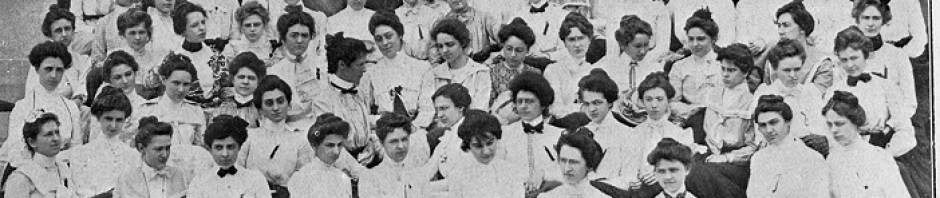
Willey Denis is listed as a member of Sigma Delta, which would become Chi Omega’s Rho Chapter soon after this yearbook was published.

Willey Glover Denis was a native of New Orleans from an old and respected family. There was no need for her have a career. Women of her social standing typically strove to “marry well.” In 1902, she was Queen of the New Orleans Mardi Gras krewe Proteus. The third oldest parade krewe in New Orleans, the theme that year was “Flora’s Feast.” While that might have been the pinnacle of life for some of her contemporaries, it appears she merely tolerated the experience.

Denis was a pioneer among biochemists, at a time when it was difficult and rare for a woman to do so. It appears her interest in science did not begin until she arrived at Bryn Mawr. In addition to the degrees from Newcomb and Bryn Mawr, she earned a Master’s from Tulane University in 1902. Denis took additional classes at Tulane until 1905 when she entered the University of Chicago, the new institution funded by Rockefeller money. She graduated from Chicago in 1907 with a Ph.D., cum laude.

The Eleusis of Chi Omega, 1905

Denis’ dissertation was titled On the Behavior of Various Aldehydes, Ketones and Alcohols Toward Oxidizing Agents. From there she taught for a short time at Grinnell College. At the end of 1907, she joined the USDA’s Bureau of Chemistry where she spent almost two years. For the next decade she was a prolific researcher, collaborating with others and publishing many studies. She toiled at Tulane, Chicago, Harvard Medical School, and Massachusetts General Hospital.

In 1920, Denis returned to New Orleans. That June, she joined the Tulane Medical School faculty as an Assistant Professor in the Department of Physiology. She continued a heavy research agenda. In 1925, the Chemistry Department became the Biochemistry Department. She was the department chair and likely the first woman to chair a major department in a major medical school.


Metastatic breast cancer cut short her life and Denis died in 1929 at the age of 49.
Her sister, Aimee C. Denis, died in 1943. Aimee left a bequest of $30,000 to establish the Willey Glover Denis Fellowships in Biological Chemistry at the Tulane University School of Medicine.

Posted in Chi Omega, Fran Favorite | Tagged , , , | Comments Off on Willey Denis on Chi Omega’s Founding Day, #NotableSororityWomen

#WhatsMyName

How does one write about loss, especially the loss of one so young? College students should not die while in college. It breaks my heart every time I read of college students whose lives are cut short. The death of Samantha Josephson was especially heartbreaking. My condolences to her family, friends and Alpha Gamma Delta sisters.

#WhatsMyName should become second nature to anyone who is waiting for a ride.

***

Earlier this week while mired in all the paperwork and sorrow of my father’s passing, I had the strangest twitter contact.

@GLOhistory Hey Frandy. Could I please get a follow little sister.

Frankly, the name of the account gave no clue as to who was asking, but that nickname is one only college friends know. There were two Frans in the chapter and me being the younger of the two made me “Frandy.” And so I blindly followed the account. How fortuitous that I did. It turns out it was my Pi Phi big sister and the woman who initiated me. We spent half a day catching up on 40 years. Picking up where you left off decades ago is something that is so heartwarming and it always brings tears to my eyes when I’ve seen it happen at chapter celebrations. Having it happened to me Monday morning was just what my soul needed.

Posted in Alpha Gamma Delta, University of South Carolina | Tagged , | Comments Off on #WhatsMyName

Effie Hoffman Rogers, P.E.O., #WHM2019

Effie Hoffman Rogers was not a founder of the P.E.O. Sisterhood, but she was a builder. Few people know the names of the builders, those who came after the founders and worked on making the organization into what it is today.

She grew up in Oskaloosa, Iowa. While at the Young Ladies Seminary in Mount Pleasant, Iowa she became a member of the second chapter of the P.E.O. Sisterhood, founded two years earlier at Iowa Wesleyan University. Graduating in 1872, she returned to Oskaloosa where in early 1873, she established Chapter D of the P.E.O. Sisterhood. Chapter A minutes do not mention her being given permission to do so, but at some point she let Chapter A know there was a Chapter D.

A young Effie Hoffman Rogers

She worked as a reporter until she married John Franklin Rogers on April of 1880. She relocated to Concordia, Kansas, where her husband was a bank cashier. In December 1882, the couple moved to Great Bend, Kansas where her husband organized a bank. The following March, a daughter Emily Jozelle, was born. That year, while she was pregnant with another child, Franklin Ripley, her husband died suddenly. Young Franklin lived but two months and Effie Hoffman Rogers along with her young daughter Emily returned to Oskaloosa. She became Editor of the Oskaloosa Times and then worked for the Globe.

Chapter D was dormant after Rogers left town and it reorganized in October 1884. At the 1886 Convention of Grand Chapter, Rogers seemed to take center stage. She spoke from the floor, volunteered for committee work, and moreover, when it came time to vote on small revisions to the initiation ceremony, she had made revisions to it although she was not on the committee charged with the task.  She was also elected as President of the Grand Chapter and was reelected twice, serving three terms.

She wrote the P.E.O. Creed. She chose the name of the P.E.O. Record and was Editor when it debuted in 1889. She stitched the first copies together on her sewing machine and then wrote the addresses by hand. Although she resigned in 1890, she again took on the Editor title from 1913 until her death in 1918.

She won election as Mahaska County Superintendent of Schools in 1889. Other jobs which she held included being a commercial traveler for two publishing houses. She also edited an educational journal, Schoolmaster, and was owner of a pickles and preserves company.

Rogers was living with her daughter in Colorado at the time of her death on February 7, 1918, at the age of 62.

Posted in Fran Favorite, Iowa Wesleyan College, P.E.O. | Tagged , , | Comments Off on Effie Hoffman Rogers, P.E.O., #WHM2019

Pessa Polasky Kandinoff, Phi Sigma Sigma, #NotableSororityWomen, #WHM2019

In 1909, Pessa Polasky (Kandinoff) was born in Cincinnati, Ohio. She attended the University of Cincinnati where she became a member of the Lambda Chapter of Phi Sigma Sigma. She earned a Bachelor’s in 1931 and a Master’s in Pyschology a year later.

Cincinnati Enquirer, March 7, 1931

The Phi Sigma Sigma Sphinx, May 1930

In 1931, she was elected as Secretary of Tau Pi Epsilon, a professional household administration sorority. In March 1933, she spoke at the sorority’s banquet.

Cincinnati Enquirer, April 2, 1933

She headed to New York where she studied at the New York School of Social Work. In 1935 she was a caseworker for Cincinnati’s Department of Public Welfare and the Department of Aid to Dependent Children. In 1941, she worked for the Ohio State Department of Public Welfare, a job she held until 1944.

During World War II, she went to Europe where she was a welfare officer in refugee camps in Italy and Palestine. The camps were under the auspices of the United Nations Relief and Rehabilitation Administration, and they house primarily Greek and Yugoslav refugees. The Sophia Smith Collection at Smith College houses some of the case histories and personal accounts of the World War II refugees with whom she worked.

After the war she was Psychiatric social worker in Cincinnati, first at Longview State Hospital and then at Cincinnati General Hospital. In 1956, Pessa Polasky married Meir Kandinoff in New York City. The next year, she began teaching at the Albert Einstein College of Medicine. She retired in 1971 and moved to Israel where she died in 1994.

Posted in Phi Sigma Sigma | Tagged , , | Comments Off on Pessa Polasky Kandinoff, Phi Sigma Sigma, #NotableSororityWomen, #WHM2019

Etta Moten Barnett, Alpha Kappa Alpha, #NotableSororityWomen, #WHM2019

Etta Motten Barnett was born in Weimar, Texas on November 5, 1901. She first enrolled at Western University, a historically black college in Quindaro, Kansas. In 1918, she married Lieutenant Curtis Brooks, a former teacher. They moved to Oklahoma and had three daughters. The couple divorced in 1924 and she returned home to Kansas where her parents helped raise her daughters.

She enrolled at the University of Kansas. In 1931, she earned a Bachelor’s in voice and drama. While in Kansas, she became a member of Alpha Kappa Alpha Sorority, Inc. She left her daughters in Kansas and headed to New York City where she joined the Eva Jessye Choir.

In 1933, she was in two big screen musicals. In Flying Down to Rio, she sang “The Carioca.” She was also in the Busby Berkeley musical Gold Diggers of 1933.

She married Claude Albert Barnett, the founder and director of the Associated Negro Press, in 1934. It is said she sang at the White House for one of President Roosevelt’s birthday celebration. (However, I could find no definite date – they ranged from 1934 until 1944. If anyone has primary source information, please let me know and I will edit this.)

In the 1942 revival of Porgy and Bess, Barnett had the title roll and performed on Broadway and with the national touring company until 1945.


Barnett received a Citation of Merit from her Alma Mater, the University of Kansas, in 1943.

She retired from performing in 1952. She hosted a Chicago based radio show, I Remember When. The recordings still exist including one of her interview with Dr. Martin Luther King, Jr.

Her husband died in 1967 an she became a philanthropist in the Chicago community. Barnett was active in the National Council of Negro Women, the Field Museum, the Chicago Lyric Opera, the DuSable Museum, and the South Side Community Art Center. She served on the Board of Alpha Kappa Alpha Sorority, Inc. Five honorary degrees were awarded to her.

In 2001 Barnett was inducted into the Kansas University Emily Taylor Center for Women and Gender Equity. She died in 2004, at the age of 102.

Posted in Alpha Kappa Alpha, Fran Favorite, University of Kansas | Tagged , , | Comments Off on Etta Moten Barnett, Alpha Kappa Alpha, #NotableSororityWomen, #WHM2019

Lillian Copeland, Alpha Epsilon Phi, #NotableSororityWomen, #WHM2019

Lillian Copeland was born Lillian Drossin on November 25, 1904, in New York City. Her parents were Polish immigrants. After her father’s death, her mother remarried and Lillian took her stepfather’s name. As a child she moved to the west coast. She graduated from Los Angeles High School and entered the University of Southern California, where she was a member of the Xi Chapter of Alpha Epsilon Phi.

Los Angles Times, February 28, 1926. In addition to track and field, she also played field hockey and is second from the let in the above picture.

It is said that she won every women’s track event in which she participated while a student at the University of Southern California.

In 1927, she had a role in Marion Davies’ film The Fair Co-ed, although she is not credited in any of the movie databases.

Daily Record, November 12, 1927

In 1926, she had National Amateur Athletic Union championships in shot put, discus throw, and javelin throw. The discus and javelin throws were world records. As per her 1930 USC yearbook entry, she was the American Champion and American and World record holder.

The first year that women were able to participate in track and field events in the Olympics was 1928. Shot put was not yet an Olympic sport, so even though Copeland was a four-time national champion in that event, she participated in discus instead. She won a silver medal for discus at the 1928 Olympics, making her one of the first women to win a medal at the Olympics. Copeland also ran on the 400 meter relay team during the Olympic trials, but did not run the relay in the Olympics.

After graduation, Copeland began studies at USC Law School. She returned to competition in 1931 in preparation for the 1932 Olympics. Teammate Ruth Osburn of Shelbyville, Missouri, broke the women’s record. Copeland broke Osburn’s record a few minutes later. Copeland won a gold medal in the discuss throw and Osburn took the silver.

Los Angeles Times, August 3, 1932
Great Falls Tribune, August 31, 1932

Although she said she was through with competition after winning the gold in 1932, she must have changed her mind. In 1935 she traveled to Tel Aviv at her own expense to participate in the World Maccabiah Games. She won in the discus throw, javelin throw, and shot put competitions. Copeland boycotted the 1936 Berlin Olympics because of Hitler and his stance on Jewish athletes.

Copeland worked for the Los Angeles County Sheriff’s Department from 1936 until her retirement in 1960. She died on July 7, 1964.

In 1980, Copeland became a member of the International Jewish Sports Hall of Fame in Netanyah, Israel. Eleven years later, she was inducted into the Southern California Jewish Sports Hall of Fame in Los Angeles.

Posted in Alpha Epsilon Phi, Fran Favorite, University of Southern California | Tagged , , , | Comments Off on Lillian Copeland, Alpha Epsilon Phi, #NotableSororityWomen, #WHM2019

Madame Lillian Evanti, Zeta Phi Beta, #NotableSororityWomen, #WHM2019

Opera star Madame Lillian Evanti was born Annie Lillian Evans in Washington, D.C. in 1890. Her mother, a music teacher, must have nutured Evanti’s singing talent at an early age.

Photo courtesy of the Evans-Tibbs Collection, Anacostia Community Museum Archives, Smithsonian Institution, gift of the Estate of Thurlow E. Tibbs, Jr.

She graduated from Howard University in 1917 three years before the Zeta Phi Beta Sorority, Inc. was founded. In 1918, she married Roy Tibbs, a Howard University music professor. She took parts of the names Evans and Tibbs to create her stage name, Madame Evanti.

When she debuted in the title role of Lakmé with the Paris Opera she became the first African American to sing with a European opera company. She toured with opera companies throughout the U.S., Europe, South America and the Caribbean. In 1934, she performed for the Roosevelts at the White House.

Madame Evanti was the first Honorary Member of Zeta Phi Beta. She often performed for her sorority sisters. Zeta Phi Beta celebrated its 15th Birthday with a Boule held at Howard University from December 27-30, 1935. One of the social events held in conjucnction with the Boule was a private recital and team at Evanti’s home. (Attorney Violette N. Anderson presided at this Boule.)

Pittsburgh Courier, January 21, 1956

Madame Evanti died on December 6, 1967 at age 77

Posted in Fran Favorite | Comments Off on Madame Lillian Evanti, Zeta Phi Beta, #NotableSororityWomen, #WHM2019

Ruth Whitehead Whaley, Sigma Gamma Rho, #NotableSororityWomen, #WHM2019

Ruth Whitehead (Whaley) was born in Goldsboro, North Carolina. The daughter of teachers, she attended Livingstone College in Salisbury, NC. She graduated in 1919 and worked for a few years as a teacher of the deaf.

On July 3, 1920, she married Herman S. Whaley. The couple lived in Harlem, New York, where they raised their two children. Her husband encouraged her to study law. She was the first Black woman to enroll at Fordham Law School, and she graduated in 1924 at the top of her class. In 1925, she was the third Black woman admitted to New York Bar, and in 1933, she became the first Black woman admitted to the North Carolina Bar.

Whaley was a member of Sigma Gamma Rho, and she was a frequent speaker at Sigma Gamma Rho regional meetings and Boules (conventions).

Sigma Gamma Rho’s Boule took place in Birmingham, Alabama, between Christmas and New Year’s Eve of 1940. “Cooperation through service” was the theme of the Boule and:

in an effort to stress the educational significance of the National meeting a special program will be given….One of Sigma’s most outstanding members in the person of Soror Ruth Whitehead Whaley of Kappa Sigma of New York City will speak at the Historic 16th Street Baptist church on Sunday morning, December 29. Soror Whaley has been a practicing attorney in NYC for the past 15 years. Actively engaged in practice in all the courts of NYS including the highest court of Appeals of Albany, NY specializing in Appeals and Civil Service. She is the first Negro woman admitted to the bar of NC. First Negro to actively engage in the practice of law in New York.

When she was Industrial Commissioner of New York, she won a case against Frances Perkins, the Secretary of Labor.

In 1943, she attended Sigma Gamma Rho’s southeastern regional conference. Whaley also attended the Northeast Regional meeting when she served as basileus (president) of the Kappa Sigma Chapter of Sigma Gamma Rho.

In 1944, at the 16th Boule, she served as parliamentarian and was also a guest speaker at the educational session at Quinn Chapter church on August 20, a Sunday afternoon. In 1948, she was in Cleveland for the Boule and spoke at a public meeting on August 19 at St. James AME Church.

From 1951 until her retirement in 1973, she was Secretary to the New York City Board of Estimate.

Whaley spoke in Philadelphia at the 1961 Boule and was legal counsel at the 1965 Boule. In August of 1971, she spoke at the 33rd Boule in Dallas, Texas. It appears that she attended decades worth of Sigma Gamma Rho Boules and regional events and played a role in each of them.

In addition to her service to Sigma Gamma Rho, she served as first president of the Negro Business and Professional Women’s Club and a Vice President of the National Council of Negro Women.

She died on December 23, 1977 at the age of 76. Shortly after her death, Fordham University’s Black Law Students Association named their annual award the Ruth Whitehead Whaley Award. She was elected to Fordham Law School’s Hall of Fame in 2014.

Posted in Fran Favorite | Tagged , | Comments Off on Ruth Whitehead Whaley, Sigma Gamma Rho, #NotableSororityWomen, #WHM2019

Jacquie E. Hirsch, Sigma Delta Tau, #NotableSororityWomen, #WHM2019

Jacquie Hirsch joined Sigma Delta Tau at SUNY Geneseo. She was a gymnast, diver and dancer. An Early Childhood Education major, she finished her coursework during the spring 2007 semester. Two months of student teaching that fall was all that was needed for Hirsch to be ready for a career as a teacher.

Her student teaching assignment was in Rochester. On September 28, 2007, she woke up feeling sick and her vision was blurry. Instead of heading to student teaching, she went to the campus health center. An eye specialist realized something was clearly amiss. Blood tests revealed an extremely elevated white blood cell level. Twelve hours after she woke up with blurry vision, she was at Roswell Park Cancer Institute waiting for her first round of chemotherapy. The diagnosis was Acute Lymphocytic Leukemia. A search for a bone marrow donor began.

According to a press release:

A donor was found and on February 11, 2008, Jacquie was admitted into Memorial Sloan-Kettering Cancer Center in New York City. She spent three months at Hope Lodge after receiving a genetic altering bone marrow and stem cell transplant. Eleven days short of her discharge date, the leukemia returned. She was flown back to Buffalo to receive chemotherapy. Jacquie overcame infections, fevers, and pills to receive her second transplant in time. This new transplant resulted in a significant amount of Graft vs. Host Disease (GVHD), and her organs began shutting down from the radiation, chemotherapy, and medication. After spending weeks on a ventilator in a drug-induced coma, the organ failure, return of leukemia, and GVHD became too much for her body to handle.


Hirsch died with her family at her side on September 6, 2008, a little less than a year after her diagnosis. Her family and friends created a foundation, the Jacquie Hirsch For A.L.L. Foundation. Its purpose is to honor “the memory of Jacqueline E. Hirsch by improving and saving the lives of those affected with life threatening cancers.” It is committed to “increasing community awareness, funding research, hosting events, and providing patient and family support. We Believe that someday, we will have a world without cancer.”

Hirsch’s Sigma Delta Tau chapter still supports these efforts even though no one who is currently a collegian was in the chapter with her.

Today is Sigma Delta Tau’s Founders’ Day. On March 25, 1917, seven Cornell University students founded the organization, which was originally called Sigma Delta Phi. They changed the “Phi” to “Tau” once they discovered the name belonged to another Greek-letter organization.

Sigma Delta Tau’s founders are Dora Bloom (Turteltaub), Inez Dane Ross, Amy Apfel (Tishman), Regene Freund (Cohane), Marian Gerber (Greenberg), Lenore Blanche Rubinow, and Grace Srenco (Grossman).

A male involved in the beginnings of Sigma Delta Tau. Bloom asked Nathan Caleb House  to write the ritual. “Brother Nat”  is the only man to honored with the organization’s gold membership pin.

© Fran Becque, www.fraternityhistory.com, 2019. All Rights Reserved. If  you enjoyed this post, please subscribe up for updates. Also follow me on twitter @GLOHistory and Pinterest www.pinterest.com/glohistory/ and Focus on Fraternity History Facebook group

Posted in Cornell University, Fran Favorite, Sigma Delta Tau | Tagged , , , , | Comments Off on Jacquie E. Hirsch, Sigma Delta Tau, #NotableSororityWomen, #WHM2019

Gail Patrick, Delta Zeta, #NotableSororityWomen, #WHM2019

Margaret Fitzpatrick and Augusta Platte were Delta Zeta sorority sisters at Howard College (now Samford University). That connection seems to have been very fortuitous.

Margaret Fitzpatrick grew up in Birmingham, Alabama. She graduated from Howard College (now Samford University) where she and Platt were members of the Alpha Pi Chapter of Delta Zeta.

She ended up in Hollywood on what must have seemed like a lark. Paramount Studios was looking for “Miss Panther Woman,” and she entered the acting contest at the Alabama Theater. She did not win that part, but Paramount offered her an acting contract. She took it and headed west in 1932. Her stage name became Gail Patrick.

Tampa Times, December 11, 1936

Her first role was a small part as a secretary in If I Had a Million. Perhaps at the time she said to herself that if she had a million she would give it to Delta Zeta. I like to believe she did.

When Patrick had a short stop at the airport in Jackson, Mississippi, she spent most of it trying to track down her friend Augusta Platt, who was serving as an inspector for Delta Zeta. Today’s crop of Delta Zetas could probably not understand how difficult it was to connect with someone in 1936 when cell phones and find a friend apps were but science fiction folly.

Daily Clarion-Ledger, December 16, 1936

Augusta Platt’s engagement to Fred Kelleway was announced in a November 1938 Oakland, California newspaper. After the 1938 Delta Zeta convention in Pasadena, she spent some time in the Bay area and it was then that she met Kelleway. Did her long-time friend have anything to do with the match-up? I do not know, but the couple’s wedding took place in Patrick’s Hollywood home on December 31, 1938.

Patrick retired from acting in the late 1940s. She said it was because she had stillborn twins. She began designing children’s clothes and for eight years had a small shop, the Enhanted Cottage, on Rodeo Drive.

In 1947, Patrick married for the third time. Her husband, Cornwall Jackson, was Earle Stanley Gardner’s literary agent. Gardner was the author of the Perry Mason series of books. Although Gardner’s character had been brought to the big screen in the 1930s, Gardner did not like the way Mason was portrayed and wanted no further attempts at it. Jackson, however, secured the film rights to the books. Patrick apparently talked Gardner into letting her produce the Perry Mason books as television productions. From 1957 until 1966, Raymond Burr portrayed Mason in the successful courtroom drama.

In 1962, Delta Zeta named Patrick their Woman of the Year. She was also elected to the first Board of Directors of the newly created Delta Zeta Foundation. I suspect Kelleway was in the audience as she was a national officer and may have had a hand in this appointment. That is speculation on my part, but I think it might be a good bet.

In October of 1963, Gail Patrick and her sorority sister came together again at the Delta Zeta Founders’ Day brunch held at the Kaiser Center in Oakland, California. At the Brunch, Patrick spoke of the “Warmth of the Flame.”

Patrick and her husband divorced in 1969. Five years later she married John E. Velde, Jr. She died of leukemia on July 6, 1980, and Valdez died in 2002.

After her husband’s death, a $1 million bequest from the Gail Patrick Velde Trust was given to the Delta Zeta Foundation, on whose board she served decades before. It established Delta Zeta’s Gail Patrick Women of Distinction Program. Patrick’s legacy provides scholarships, both undergraduate and graduate, as well as the honorarium awarded to Delta Zeta alumnae designated as Woman of the Year.

To learn more about Patrick in her own words, read a transcript of this 1979 interview with her.

Posted in Delta Zeta, Fran Favorite | Tagged , , , , , , , | Comments Off on Gail Patrick, Delta Zeta, #NotableSororityWomen, #WHM2019