On May 21, 1997, Claudia Kennedy, a Kappa Delta, became the first woman to hold the rank of three-star general in the United States Army. Kennedy attended Southwestern at Memphis, now known as Rhodes College, where she majored in philosophy. After graduating in 1969, she was commissioned as a second lieutenant in the Women’s Army Corps. She retired as the Deputy Chief of Staff for Army Intelligence in 2000.
She received many awards and decorations during her 31 years of service. These include the Legion of Merit, the Defense Meritorious Service Medal, the Meritorious Medal, the Army Commendation Medal, the Army Staff Identification Badge and the Living Legacy Patriot Award.
Kennedy has served as a Rhodes College Trustee since 2000. She wrote Generally Speaking: A Memoir by the First Woman Promoted to Three-Star General in the United States Armywhich was published in 2008.
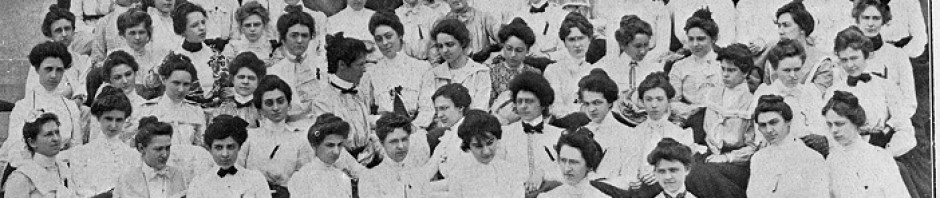
Florence Marguerite Patterson graduated from Burlington High School in Burlington, Wisconsin, in 1893. She enrolled at Northwestern University where she became a member of Gamma Phi Beta.
The Gamma Phi Beta Chapter at Northwestern University. Florence Patterson is in the picture.
A 1904 Crescent of Gamma Phi Beta reported, “Mary Bunting Gamma and Florence Patterson Epsilon are both taking courses at the Johns Hopkins Hospital. Zeta (Goucher College) was glad to have them at fraternity meeting not long ago.” In 1907, she graduated from the Johns Hopkins School of Nursing.
October 1911, The Crescent of Gamma Phi Beta
Florence M. Patterson
1914, The Crescent of Gamma Phi Beta
Between graduation from Hopkins and America’s entry into World War I, Patterson had several jobs in medical social service work and public health nursing including as assistant superintendent of nurses at the Allegheny General Hospital, in Pittsburgh, Pennsylvania.
She joined the staff of the American Red Cross in June of 1917. The following month she became the chief nurse of the first American Red Cross Commission for Roumania (now Romania). An article in the March 15, 1918 issue of the Oshkosh Northwesternstated that she was “believed to be in Odessa, reported captured by the Germans. She is with a Red Cross unit.”
In June 1918, the unit was recalled from the Balkans and she was assigned to the Paris headquarters of the American Red Cross. She returned to Roumania with the second Red Cross Commission. She was its chief nurse and assistant director of civilian relief. Patterson was awarded Roumania’s Regina Maria Cross and France’s Medal of Honor for Epidemics for her efforts as well as the Florence Nightingale medal from the Japanese Red Cross.
An article in a 1921 Crescent of Gamma Phi Beta told this story:
While Florence M. Patterson, Epsilon, was assistant director of nursing for the American Red Cross at Washington, a cabled request for aid came from Queen Marie of Roumania. In response to this request, a special commission whose task it was to make a medical and social survey and to recommend reconstruction was sent with Miss Patterson as head of the nursing unit which on arrival at once took over a hospital of five hundred beds and gave both civil and military relief. When the German peace with Roumania was signed the Red Cross workers returned to London by way of an Arctic port and Miss Patterson left England for service in France where she was assistant to Miss Julia Stimson chief American Red Cross nurse in that country. While in Roumania, Miss Patterson was decorated by the Queen with the Regina Marie medal and from many quarters came enthusiastic words of praise for her wonderful work.
In 1934, she was awarded an honorary master of arts degree from Northwestern University. It was given for these reasons:
One of the most prominent women graduates of the College of Liberal Arts at Northwestern, a quiet and serious worker for the welfare of society; an officer of the Red Cross who has brought both efficiency and imagination even to administrative duties; a humanitarian who has built her sense of the spirit and of justice into improved living conditions for the American Indian, the soldier in Europe, and the citizen in America; a woman, in brief, of vision, judgment, tact, and competence, a wise and inspiring leader who has made the world a better place for her living in it.
Patterson died in 1962 and is buried in Wisconsin. In 2016, she was honored at the Wall of Inspiration ceremony at Burlington High School, 123 years after she graduated.
Violette Neatley Anderson, a member of Zeta Phi Beta was the first female African-American attorney admitted to practice before the U.S. Supreme Court. The year was 1926. Her journey to that Court was circuitous. She was born in England, but moved to Chicago with her parents when she was young In 1899, she graduated from high school. In 1903, she married, but it ended quickly in divorce, and in 1906, she married Dr. Daniel H. Anderson, a general practitioner.
Violette Neatley Anderson worked as a court reporter for 15 years before she enrolled in the Chicago Law School*. When she graduated in 1920, she passed the bar and went into private practice. She became an assistant prosecutor in Chicago, making her both the first woman and the first African-American to hold that job. She was one of the forces behind the Bankhead-Jones Actm which was signed into law in 1937.
Violette Anderson
While she was Grand Basileus of Zeta Phi Beta, she asked Lambda Zeta, a graduate chapter in Houston, Texas, to host the 1937 Grand Boule’ (national convention). It was the first time any African-American Greek-Letter Organization held a convention below the Mason-Dixon line.
The meetings took place in Houston’s black business area. The Y.W.C.A. cafeteria provided the meals because downtown Houston had no restaurants available to blacks. The delegates were housed with members and friends in their black neighborhoods.
Violette Anderson
And although she had made the connections to make the event happen, Anderson died before it took place. She had given the last four years of her life to Zeta Phi Beta as its 8th Grand Basileus.
After her death on December 24, 1937 at the age of 55, her summer home in Idlewild, Michigan was bequeathed to Zeta Phi Beta. Each April, the sorority remembers her with “Violette Anderson Day.”
*This post originally stated that the Chicago Law School was now part of the University of Chicago Law School. I was in error. The Chicago Law School existed in the early 1900s. The Chicago Law School and the University of Chicago Law Schools were separate entities. When it ceased operations, the Chicago Law School did not merge into the University of Chicago Law School. My apologies for this error.
Fannie Rose Shore, better known as Dinah Shore, became a member of Alpha Epsilon Phi at Vanderbilt University and she served as the chapter’s president. Graduating with a degree in sociology she founded the Athenian Sing, an a capella contest between fraternities and sororities.
In a 1940 Vanderbilt yearbook, Fannye Rose Shore is listed as an alumna of the chapter.
Her stage name “Dinah” came from her stint singing on WSM radio, in a day when radio stations created their own content. She sang Dinah, the theme song of the radio show, Rhythm and Romance. It was the song she used at auditions in New York City.
Dinah Shore early in her career.
She had a career on Broadway and in Hollywood. She recorded more than 80 songs which appeared on the song charts. She hosted her own primetime television show, The Dinah Shore Show, in 1951, giving her the distinction of being the first woman to have that experience. She hosted Dinah’s Place, a lifestyle show which was unique for the 1970s, and two other shows.
Emily Helen Butterfield is a name revered by Alpha Gamma Deltas. Butterfield was a founder of the organization, but she was much more than that. She studied architecture at Syracuse University in a time when a female architect was an anomaly.
When she graduated, she and her architect father established Butterfield and Butterfield, making her Michigan’s first licensed female architect. She was also an accomplished artist.
The Methodist Church in Farmington, Michigan, was designed by Butterfield and Butterfield. It was built in 1922. The Butterfields were members of the congregation. (Photo courtesy of the Farmington Community Library)
Her best known sketches are the ones she did of “Skiouros,” Alpha Gamma Delta’s squirrel mascot when she was editor of The Quarterly. To Skiouros was the name of the “secret edition” of The Quarterly. (FYI – the secret editions of GLO magazines contained membership numbers and information about chapter strengths and weaknesses and not anything having to do with ritual matters. These editions were not included in the exchange copies sent to the other GLOs. )
Butterfield also designed the organization’s Armorial Bearing, and wrote the Alpha Gamma Delta Purpose:
To gain understanding that wisdom may be vouchsafed to me; to develop and prize health and vigor of body; to cultivate acquaintance with many whom I meet, to cherish friendships but with a chosen few, and to study the perfecting of those friendships; to welcome the opportunity of contributing to the world’s work in the community where I am placed because of the joy of service thereby bestowed and the talent of leadership multiplied; to honor my home, my country, my religious faith; to hold faith inviolable, sincerity essential, kindness invaluable; to covet beauty in environment, manner, word and thought; to possess high ideals and to attain somewhat unto them; this shall be my Purpose that those who know me may esteem Alpha Gamma Delta for her attainments, revere her for her purposes, and love her for her Womanhood.
In the late 1920s, she designed the Alpha Chapter house at 709 Comstock Avenue. It was completed in the fall of 1928.
As much as I adore her, she wasn’t my Alpha Gam choice to spotlight for #WHM2018 post until two days ago when I received an email from Ken Klemmer. He owns a home designed by Butterfield.
The house was commissioned by real estate developer Edward Beals of Farmington Hills, Michigan, in 1925. She designed it in the Storybook Tudor style which was used in California’s Hollywood Hills, but not often in the midwest. The Oaklands subdivision, where the home is located, was one of the first Detroit exurb developments. Beal, President of the Great Lakes Land Corporation, was in partnership with Issac Bond, a local farmer. By 1930, 11 homes were built in the subdivision but the Depression put an end to further building there. Vacant lots in the subdivision became farmland and stayed that way for the next 20 years. Beals lost the home in foreclosure by 1935. It was a rental until the house became owner-occupied again in 1945.
In 1989, the home was placed on Farmington’s register of historic homes, which appears to have saved it from demolition. Ken and Melody Klemmer purchased it in 2013 and began the process of restoring the house to its original appearance.
In the fall of 2015, this video was produced and it is worth watching:
Oakewood Cottage , 31805 Bond Boulevard, Farmington Hills as it appears today. A website, www.oakewoodcottage.com offers more details about the house.
In the 1930’s when architecture commissions were scarce, Butterfield turned to writing books, the Young People’s History of Architecture and College Fraternity Heraldry. After her father died, she moved from Farmington to Algonac, Michigan, where she continued painting and taught art classes. She also served as postmaster of Neebish Island, Michigan. Butterfield died in 1958, but her art and design skills live on.
A watercolor by Emily Butterfield owned by the Klemmers
Dr. Martha Isabel “Mattibelle” Boger Shattuck was born in West Virginia. She seems to have been a woman ahead of her time. She graduated from Marietta College in 1908 when there were no sororities there.
Dr. Martha Isabel “Mattibelle” Boger Shattuck
During the summer of 1913, she was enrolled in the University of Michigan Homeopathic School. In 1915, she graduated from Boston University Medical School. While at Boston University, she became a member of the Alpha Chapter of Delta Delta Delta.
From the Trident of Delta Delta Delta
Florence Rachel Belyea was also a member of the Alpha Chapter of Tri Delta
After graduation she returned to Parkersburg to work in association with her father, who was also a doctor. She returned to Massachusetts to work at the Talitha Cumi Hospital.
On May 24, 1921, she married Lieutenant Gerald A. Shattuck. The Journal of the American Institute of Homeopathy, Volume XIV, 1921-22, noted:
Announcement is made of the marriage of Dr Martha Isabel Boger Portsmouth to Lieutenant Gerald A Shattuck of the Supply Corps of the United States Navy Dr Boger will continue practice at 145 Middle Street Portsmouth continuing her former name professionally.
From the Trident of Delta Delta Delta
Dr. Boger-Shattuck was the first female doctor in Portsmouth, New Hampshire and she kept up her practice as the mother of two young children. A son was born in 1923 and a daughter in 1927. In 1929, she helped established the Ranger Chapter of the Daughters of the American Revolution.
The 1930 census has the family living in Washington, D.C., but perhaps it was a temporary assignment.
In 1940, she was Chairman of Portsmouth Finnish Relief Fund. Dr. Boger-Shattuck and daughter Nancy were visiting Hawaii in 1941 as her husband was stationed there. On December 7, 1941, she put her medical training to use and was in charge of admission of Ward 3; 287 causalities came in after the bombing. In a newspaper account, she recounted that on the night of December 7, as they had evacuated to the hills, she, her daughter, and another woman and her daughter, made sterilized bandages. For 10 days, they made 1,000 bandages, and all the bandages were put to use in Ward 3.
As a volunteer, she took charge of vaccines for typhoid and tetanus of the junior high school and high schoolers. She worked with the Japanese children in Waipahu, giving physical exams and gaining the moniker, the “Peek and Poke Lady.” When she and her daughter returned to New Hampshire in May, 1942, they took with them a large monkey pod hors d’oeuvres tray with the inscription “Given to Dr. Boger-Shattuck from the school children of Waipahu. Aloha.”
It appears she worked until almost to the time of her death in 1959. There is an ad in a 1957 Portsmouth newspaper announcing that her office would be closed for a week. She is buried in Arlington National Cemetery, alongside her husband.
Meta Turley Goodson graduated from Randolph-Macon’s Woman’s College in 1908. She was a member of the Gamma Chapter of Sigma Sigma Sigma.
Goodson is on the bottom right in this photo of the RMWC Panhellenic Council .
In 1912, she compiled a directory of the sorority’s members.
In 1913, she served as Editor Pro Tem for the February 1913 issue of the Triangle of Sigma Sigma Sigma. The editor, Lucy Lykes Downey, married J. J. Eaton on November 14, 1912. Goodson served as maid of honor and also took her friend’s place and served as editor for an issue.
Goodson’s hometown was Morristown, Tennessee. She earned a Master’s of Arts at Columbia University in 1916 and a Library Science degree from Columbia in the early 1930s.
Throughout her life she was involved in civic organizations including the Daughters of the American Revolution and the Hamblem County Chapter of the Association of the Preservation of Tennessee Antiquities, an organization she help to found in 1952.
In 1925, Hamblen County’s first library was established by the community women’s organizations. Talk of starting a library had begun more than a decade before when the local women’s organizations discussed the possibility of a community library. The community tried to be the recipient of a Carnegie Library. Goodson was the community member who investigated this possibility. In 1925, a women’s clubhouse was acquired and a library was started in this building. For a membership fee of $1 per year, each patron could borrow books. The city gave $100 to this effort. The women’s organizations involved in this project were identified as the Ladies Reading Circle, Somo Sala Circle, Sam Davis U.D.C. and Samuel Doak D.A.R. Goodson served as Chairman to the Library Board from 1947-50.
In 1959, the Morristown Library location moved from the Women’s Clubhouse to an old Bell South Telephone and Telegraph Company building on West Second North Street.
Morristown-Hamblen Library when it opened in 1969
In 1965, Goodson gave a gift of $350,000 for the building of a new library, but she stipulated that the City of Morristown and Hamblen County should provide operating costs.
Ground was broken in May 1967, but Goodson did not live to se the library completed; she died suddenly on July 30, 1968. Some in the community thought the library should be named in her memory and the movement acquired some steam. The library board finally agreed to abide by Goodson’s wish when she made the donation, and not name it for her. There is a plaque in her memory on display in the library and, in 1987, her nieces commissioned a local artist to paint a portrait of Goodson that is on display in the main room.
Dr. Condoleezza Rice was born in Birmingham, Alabama. When she was a teenager, her family moved to Denver, Colorado. In 1971 she entered the University of Denver where her father was an assistant dean, and there she became a member of Alpha Chi Omega. Until her senior year, she was the only African-American member of the chapter.
She was 19-years-old when she graduated cum laude from the university in 1974. She was named outstanding senior woman and is a member of Phi Beta Kappa and Mortar Board. Rice earned a Masters from the University of Notre Dame and a Ph.D. from the University of Denver’s Graduate School of International Studies.
In 1993, she became Stanford University’s first woman provost and served in that position until 1999. In 2001, President George W. Bush appointed her national security advisor. Rice later was named the U.S. Secretary of State, the first female African-American to serve in that capacity.
A professor, consultant, and author, she has won many awards. She and is an articulate speaker, accomplished pianist, and a football aficionado.
Condoleezza Rice (on the top step to the right) and her Alpha Chi sisters (photo courtesy of Denver University Archives)
The Delta Chapter of Phi Sigma Sigma was founded on November 6, 1920 at the University of Buffalo. At that time it was a private institution. Today it is the University at Buffalo and has been part of the SUNY system since 1962.
Bella Maisel (Rock) was initiated on March 20, 1921. She served as the chapter’s Archon (President) and she attended a convention.
Buffalo Jewish Review, April 8, 1921
Buffalo Jewish Review, December 22, 1922
She studied law as an undergraduate when that was an option, before law school became a post-graduate degree. She graduated at the age of 19 but had to wait until she was 21 to take the bar exam.
Bella Maisel is third from left in the front row. This is a photo of her graduating class at the University of Buffalo Law School.
Sphinx 1923
When Bella Maisel entered into a partnership with Dorothy M. Anthony, it was one of the first, if not the first, legal partnership with women owners. At that time, less than 2% of America’s lawyers were female.
Maisel married on November 27, 1930. A chapter report in the Sphinx said she was engaged to Alfred Rockowitz. The April 1931 issue noted that she married Dr. Abe I. Rock on Thanksgiving Day. Perhaps they are the same person, and I suspect that they are one and the same. The couple had two children.
In 1954, she joined an established Buffalo law firm and became a partner in 1957, again being one of the pioneers in the field of law.
When she died in 1974, women had begun to make inroads into traditionally male professions. She did not have the opportunity to bask in the glory of her accomplishments. Maryann Saccomando Freedman paid tribute to her and her testimony is on YouTube.
Phi Mu was founded on January 4, 1852 at Wesleyan College in Macon, Georgia. Originally known as the Philomathean Society, it and Alpha Delta Pi, also founded at Wesleyan College, are known as the “Macon Magnolias.” Phi Mu was founded by Mary DuPont (Lines), Mary Myrick (Daniel) and Martha Hardaway (Redding). The founding was publicly announced on March 4, 1852, the day that is celebrated as Founders’ Day. On August 1, 1904, the group received a charter from the state of Georgia and was established as Phi Mu Fraternity. The second chapter was founded at Hollins College in 1904. Phi Mu joined the National Panhellenic Conference in 1911.
Hazel Hartzog (Tow) was initiated into the University of Southern California chapter of Phi Mu. In addition to her membership in Phi Mu, she was the Daily Trojan’s women’s page editor and a was a staff member of the El Rodeo yearbook. A member of the Class of 1941, she was also a staff member of Wampus, the campus humor magazine, president of Theta Sigma Phi journalism sorority, and a member of Amazons, a service honorary society.
January 1940
She joined the Los Angeles Bureau of United Press in 1943. Two years later, she was one of only 117 female war correspondents.
The first American war correspondent to arrive in occupied Japan, she interviewed Countess Satoko Otani, the younger sister of the Japanese Empress.
October 10, 1945
She became Mrs. Wallace Tow in 1947. From 1958 until her retirement in 1984, she was involved in journalism. She was one of the first female members Sigma Delta Chi (today known as the Society of Professional Journalists).
L.A. Times, February 3, 1984
Tow died on September 14, 2001, at the age of 81, from complications from lung cancer.
There are many posts on this blog. Use the search button to find the posts about your organization.
Welcome!
Welcome! Chances are good you found this blog by searching for something about fraternities or sororities.
I was the last person anyone would have suspected of joining a sorority in college. I am sure I would have agreed with them, too.
When I made my way to Syracuse University, I saw the houses with the Greek letters that edged Walnut Park, and wished I could tour them. My roommate suggested I sign up for rush (as it was then called, today it’s known as recruitment) and go through the house tour round and then drop out of rush. It sounded like a plan. I didn’t realize that I would end up feeling at home at one of the chapters. And that I would become a member.
In this blog I will share the history of GLOs and other topics. I wrote a dissertation on “Coeducation and the History of Women’s Fraternities 1867-1902.″ It chronicles the growth of the system and the birth of the National Panhellenic Conference.
My Master’s thesis details the history of the fraternity system at Southern Illinois University Carbondale from 1948-1960. The dates are significant ones and the thesis is available on the top menu.
I have done research at the Student Life Archives and have written several histories of University of Illinois fraternity chapters for the Society for the Preservation of Greek Housing.