Alice Babb Ewing, Alpha Xi Delta, #WHM2018, #notablesororitywomen

I have written posts about the connection between P.E.O. and Alpha Xi Delta, and it’s a special story. The P.E.O. Sisterhood was founded on January 21, 1869, at Iowa Wesleyan University in Mount Pleasant, Iowa. Alpha Xi Delta was founded on April 17, 1893, at Lombard College in Galesburg, Illinois. Over the years, P.E.O. became a community organization and the sole remaining collegiate chapter at Iowa Wesleyan, Chapter S, Iowa,* became an anomaly within the organization. Anna Gillis (Kimble) lived in Mount Pleasant and was an Alpha Xi Delta at Lombard College. She helped facilitate the action that made P.E.O. a strictly community organization and Alpha Xi Delta, a national sorority. On June 9, 1902, Alpha Xi Delta’s Beta Chapter was installed at Iowa Wesleyan. The chapter had been the P.E.O. collegiate chapter.

In 1904, Alice Babb, the daughter of P.E.O. founder Alice Bird Babb, was initiated into P.E.O.’s Chapter A, Iowa (before it became known as Original Chapter A). She enrolled at Iowa Wesleyan University in the fall of 1905. She and her friend Mildred Brady were initiated into the Beta Chapter of Alpha Xi Delta on Friday, February 23, 1906. Alice’s mother celebrated the event by entertaining the Alpha Xi Delta members and pledges, along with their gentlemen friends, at the Babb’s home on March 10. It was a surprise birthday party for the younger Alice and “every one had a splendid time.”

Alice served as the chapter’s Quill of Alpha Xi Delta correspondent; for a 1906 issue she wrote about sorority expansion:

How proud we all are of Alpha Xi Delta! and why should we not be when the quill is worn by so many worthy girls in such worthy universities?

The time has come, far sooner than was dreamed, when we can carefully select the schools where chapters of Alpha Xi Delta shall be placed, and we can still more carefully maintain our ideal standard of womanhood in these schools.

But at the same time there is a great room for work, and for hard work. We are still young and our name is not so widely known as that of other sororities; so while we take for our motto ‘Quality not Quantity’ we must remember there are splendid schools from the Atlantic to the Pacific, and in many of them typical Alpha girls are waiting eagerly for some standard sorority to add their names to its ever-increasing roll.

In July 1906, the 16 members of the chapter received invitations to a house party at the Richland, Iowa, home of Mildred, Lucile, and Louise Brady. Alice Babb’s report in The Quill gave this account of the activities:

The second floor of the hospitable home had been vacated for our use, and here we bunked, holding midnight revels and exchanging confidences until the wee small hours of the morning.

What glorious days those were, and why should they not have been with such perfect weather, such congenial girls and such unlimited hospitality to make them so?

Each day we were invited to the home of some Alpha sister or college friend who chanced to live in the vicinity, wither for a meal or to spend the afternoon ro evening. One of our favorite pastimes at these gathering was to get up impromptu theatricals, and by the end of the week we were in such perfect training that I doubt if the scenes both comic and tragic could be surpassed on any stage.

When no other recreation was afforded, the piano and our local Alpha song books were always ready; never were songs sung with such spirit and enthusiasm as those. I am sure that it was with a feeling of envy that the passerby heard the merry voices with which theirs could not join.

Today that July week is but a memory and is stored away in our minds with many of the other happening of a student’s life, yet I speak the sentiments of sixteen g when I say that it will ever hold a prominent place among these recollections both for the good time’s sake and for an example of true hospitality.

While she was enrolled at Iowa Wesleyan, the Babbs moved to Aurora, Illinois. Perhaps this entered into the decision to transfer to Northwestern University in Evanston, Illinois. The November 1907 Quill of Alpha Xi Delta reported that young Alice was enrolled at Northwestern, but she spent Thanksgiving week with her Alpha Xi sisters at Iowa Wesleyan. A chapter meeting was held the day after Thanksgiving and it was “the best we have had for some time. Alice Babb of Aurora was one of the present sisters.”

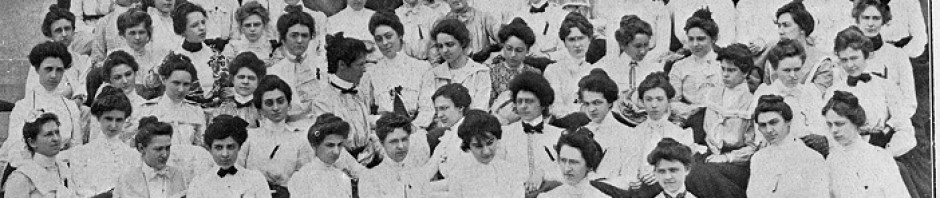
Alice Babb is fourth from the left in the middle row in this photo of a Northwestern University literary society.

Martha Foote Crow, a founder of Alpha Phi, was a patroness of the senior sorority at Northwestern University.

Alice Babb had an article published in the Northwestern Magazine during the 1907-08 academic year.

Alice included her Alpha Xi membership in her class listing even though there would not be a chapter at Northwestern until 1921.

When Iowa Wesleyan’s class of 1909 graduated, she was in Mount Pleasant for the June 14, 1909, festivities. She was there when the chapter entertained the alumnae and patroness at the home of Florence Stephen. And she visited her friends May Johnson and Mabel Duncan during commencement and the weeks which followed it. The chapter report noted, “Alice Babb was undecided as to what she will direct her energies” as a Northwestern graduate.

In 1909, she attended a Panhellenic luncheon in Chicago and she was in Mount Pleasant for the P.E.O. Convention in October 1909. She visited with the chapter during that visit.

On Feb 11, 1910, the Alpha Xi chapter held an initiation ceremony at Mabel Duncan’s home. A “spread” followed and The Quill reported, “the alumnae present were Alice Babb of Aurora and Lucile Brady of Richland, Iowa.” 

When Iowa Wesleyan alumni met in Chicago in 1913, she was among the guests who attended. Even though she did not graduate from Iowa Wesleyan, she kept up her connections to Mount Pleasant and the institution.

When a bronze tablet was place in the music room in Iowa Wesleyan’s Old Main in 1917, Alice Babb was in attendance and helped with the unveiling.

On September 11, 1918, Alice Babb married Donald Ewing, “a brilliant chemist of Aurora,” according to the chapter’s report in The Quill.

Only one P.E.O. founder, Alice Bird Babb, became a member of Alpha Xi Delta. The initiation took place in 1924, when she was 74 years old. Perhaps her daughter-in-law, Vida Kemble Babb, wife of Max Babb, was there, too. Vida, an 1895 graduate of Iowa Wesleyan and a member of the P.E.O. chapter there, became an alumna initiate of Alpha Xi in 1913.** 

When the cornerstone was laid for the P.E.O. Memorial Library in 1927, Ewing was in attendance, too, and placed the deed to the library of her parents, Alice Bird and Washington Irving Babb, into the box. In 1929, when the iconic portraits of the seven P.E.O. founders were unveiled, she was there.

1932-33 Northwestern Alumni News

On February 2, 1942, she spoke to Chapter A, Illinois, as at meeting at the Palmer House in Chicago. Ewing’s topic was the “P.E.O. Founders and Education.”

Mount Pleasant News, May 22, 1948

A February 22, 1951 issue of the Mount Pleasant News carried a report about the Ramblers; they were a loosely knot group of former Mount Pleasant residents. Ewing sent a letter telling of her club work. Her long-time friend, Lillian Rogers, read the letter. Ewing was closely following the movements of the newly formed United Nations. The newspaper account added, “Alice is so retiring, she would never mention her fine reputation as a lecturer on many subjects, but the truth is known among her old-time friends.”

Alice Babb Ewing died in 1983 at the age of 95.

*Chapter S, Iowa,  had been Chapter AJ before State Chapters were established.

** The wife of Alice Bird Babb’s son Miles was a Pi Beta Phi at Iowa Wesleyan if anyone is keeping score.

Posted in Alpha Xi Delta, Fran Favorite, P.E.O. | Tagged , , , , , | Comments Off on Alice Babb Ewing, Alpha Xi Delta, #WHM2018, #notablesororitywomen

Dr. Olga Neymann, Kappa Alpha Theta, #WHM2018, #notablesororitywomen

Olga Neymann was born in 1860 in Janesville, Wisconsin. Her parents took her abroad when she was very young. She attended schools in Switzerland and Germany as well as Miss Anna Brackett’s private school in New York City. She earned a bachelors in literature at Cornell University. On January 29, 1881, Kappa Alpha Theta’s Iota Chapter was chartered at Cornell and she was one of its three founding members. Her time as a collegiate member was relatively short as she graduated later that year.

The charter members of the Kappa Alpha Theta chapter at Cornell University

Neymann had hoped to attend dental school in NYC, but women were not accepted there, so she enrolled in the Pennsylvania College of Dental Surgery in Philadelphia. She earned her D.D.S. in 1886.

Good Housekeeping, 1889

Dental Cosmo, 1892

On October 24, 1893, she married Carol Glucksmann. An article which appeared in many newspapers around the world in 1899, called her “the feminine pioneer of her profession in New York city, where she established herself more than half a dozen years ago. Modest and retiring shrinking from attracting any undue publicity, she has pursued her vocation in the face of the prejudice and opposition with which a woman usually contends when she enters a path of labor untrodden by sister workers, with courage, industry and perseverance, united to ability. She now commands an extensive and increasing practice that cannot fail to be gratifying to herself and encouraging women to how her example.”

A daughter Vanessa was born in 1894. When asked why she chose dentistry as a profession, the article stated “she considered it an excellent field for intelligent and industrious women who are compelled to earn an independence and one of the higher callings that enables a woman to pursue a vocation and superintend a home under the same roof – a union that to one who possesses her fondness for a domestic life presents irresistible attractions.”

She attended Cornell’s 1907 Commencement.

She was a member of the First District Dental Association of New York, the Woman’s Dental Association of Philadelphia, and a myriad of other organizations.

Her husband died in 1913. In 1916, she attended her 35th class reunion at Cornell. The May 3, 1923 Cornell Alumni News reported she was “a teacher of speech improvement, in charge of the correction of all speech defects, such as stammering, lisping, etc., in the speech clinic of the Department of Neurology, Cornell Medical College, New York, and the clinic of speech defects, Bellevue Hospital, New York, and teacher of speech improvement in the Children’s Hospital, Randall’s Island, New York.”

Olga Neymann Glucksmann died in 1927.

Posted in Fran Favorite | Tagged , , | Comments Off on Dr. Olga Neymann, Kappa Alpha Theta, #WHM2018, #notablesororitywomen

Dr. Janet Pierson Cooper, ZTA, #WHM2018, #notablesororitywomen

Janet Pierson Cooper was born in Nova Scotia, Canada, in 1891. At the age of 16, she went to Boston hoping to be a nurse, but she was rejected because of her age. She was hired as a companion for Dudley Page’s daughter, a diabetic. She lived with the Page family in Stoneham, Massachusetts. After his daughter’s death, Page encouraged Cooper to pursue medical studies and he made the offer to pay for her expenses.

She enrolled at Boston University School of Medicine to become a homeopathic physician, and there she became a member of Zeta Tau Alpha. Cooper earned a bachelor’s degree in 1916 and her medical degree in 1917.

When she heard of an opportunity to be a resident at the Melbourne Homeopathic Hospital in Australia, she applied and was accepted. It was to be a three-term.

When she arrived in October 1917, she was the hospital’s first female physician. On October 22, 1918, she married Robert Jensen.

In the November 1921 Themis, signing her letter, “Yours in ZTA, Janet Cooper Jenson,” she told of her life in Australia:

After three years as resident at the Melbourne Homeopathic Hospital last November I began private practice plus housekeeping. The two work in very well as when practice is busy the housekeeping waits and when practice is dull the housekeeping is a vent for surplus energy and depressed spirits. Even so, I am very happy busy although a long way from home, but that doesn’t matter for the world is much the same everywhere. There are numbers of Americans or exiles, as they term themselves, in Melbourne and it is very pleasant occasionally to discuss among ourselves how we would run Australia along Yankee lines to which the Aussie being usually an Englisher does not take very kindly. Australians on the whole take life much easier than the Americans.

She ended with an offer of hospitality to any visiting sorority sister:

Any Zeta who decides to see this part of the Southern Hemisphere may be sure of an interesting experience and it would be a pleasure for me to show her Melbourne. I appreciate receiving Themis and am sorry I have not contributed earlier. The Boston Alumnae notes always bring on an attack of nostalgia, but I read and reread them just the same.

Robert Jensen died in 1934. On April 6, 1939, she married Frank Swifte. She had two daughters, one of whom was adopted, and she was a “lively grandmother,” according to a 1958 newspaper article.

Professionally, she used her maiden name. She was a dedicated physician and anesthesiologist, and she was active in many community and charitable organizations including the League of Women Voters and the Business and Professional Women’s Club.

In 1950, Cooper was elected to the South Melbourne City Council, the first woman to hold the position. She lost reelection in 1953, but was successful in her 1956 attempt to regain the seat. She served as  mayor in 1958-59 and again in 1965.

Cooper died on June 6, 1984.

Posted in Fran Favorite | Tagged , , | Comments Off on Dr. Janet Pierson Cooper, ZTA, #WHM2018, #notablesororitywomen

Dr. Sara Branham, Alpha Delta Pi, #WHM2018, #notablesororitywomen

Sara Branham graduated from Wesleyan College in Macon, Georgia, in 1907. Her grandmother, Elizabeth Flournoy Stone, was a member of the Class of 1840. Her mother, Amanda Stone Branham, graduated in 1885, and was a member of the Adelphean Society, which became Alpha Delta Pi. Sara and her mother shared the Alpha Delta Pi bond.

Teaching was one of the few professions open to women in the early 1900s, and she spent 10 years teaching in Sparta, Decatur and Atlanta, Georgia. In 1908, she was a member of the Oxford ADPi Alumnae Association. During those then years teaching in Georgia, she had several mentions in The Adelphean. There was the report of her spending the winter in Mexico with her brother an the one that she attended the Grand Opera in Atlanta with a group of ADPis. 

Branham attended the establishment of the Lambda Chapter of ADPi in 1910.

In 1917, she headed to Boulder, Colorado to study at the University of Colorado. With men leaving the campus to fight in World War I, she was hired by the university as a bacteriology instructor. She once quipped, “When I had had about six weeks of bacteriology, they offered me a job to teach it!”

In the meantime she earned a second bachelors in 1919. She then enrolled at the University of Chicago where she earned a Ph.D. and M.D. while studying influenza outbreaks. She worked as an instructor there until she took a job at the University of Rochester School of Medicine in 1927.

A meningococcus outbreak in  California led Branham to take a job with the Hygienic Laboratory of the United States Public Health Service (now National Institutes of Health) in Bethesda, Maryland. She remained with the agency until her retirement in 1958.

Dr. Sara Branham (Courtesy of the Oxford Histoical Society)

She discovered and isolated the virus which is the cause of spinal meningitis, Neisseria meningitidis. She also discovered that sulfa drugs could treat the infection. She was the expert on this strain of the disease. She discovered other anti-toxins and had a hand in the classification of microorganisms. In 1970, Neisseria catarrhalis was renamed in her honor; it became Brahamella catarrhalis.

Branham was a diplomate of the National Board of Medical Examiners and the American Board of Pathology. She achieved fellow status in the American Association for the Advancement of Science, the American Public Health Association, and the American Academy of Microbiology. 

In 1950, she was a commencement speak at her undergraduate alma mater and received the first Distinguished Achievement Award given by the Wesleyan College Alumnae Association. She also served as an Alumnae Trustee at Wesleyan and was a loyal contributor to the college’s Loyalty Fund.

She had a brief marriage to Philip S. Matthews. They married in 1945, but he died four years later; professionally she was always Sara Branham.

In the late 1950s, she visited Wesleyan College and spoke about her career, which included publishing 80 papers. She died in 1962. Among the items in the Wesleyan College archives is a dress she donated which belonged to her family.

Photo and caption courtesy of Wesleyan College.


Posted in Alpha Delta Pi, Fran Favorite, Wesleyan College | Tagged , , | Comments Off on Dr. Sara Branham, Alpha Delta Pi, #WHM2018, #notablesororitywomen

Dr. Achsa Bean, AOPi, #WHM2018, #notablesororitywomen

Achsa Bean was a member of the Alpha Omicron Pi chapter at the University of Maine, where she earned two degrees.

Achsa Bean when she was a member of the Alpha Omicron Pi chapter.

Posted in Alpha Omicron Pi, Fran Favorite | Tagged , , , | Comments Off on Dr. Achsa Bean, AOPi, #WHM2018, #notablesororitywomen

The Andersch Sisters, Ph.D.s and Theta Phi Alphas, #WHM2018, #notablesororitywomen

Theta Phi Alpha has two sets of sisters among its founders. How fitting that sisters Elizabeth G. Andersch and Marie A. Andersch are the #notablesororitywomen profiled today.

Marie, the elder of the two, was born in 1905. Elizabeth, “Betty,” was born in 1913. Marie earned a degree from the University of Illinois, where she was active in campus activities including the Newman Club.

Marie Andersch at the University of Illinois

After earning her undergraduate degree, Marie enrolled at the University of Iowa for graduate work. During the time Marie was there, Elizabeth became a member of Theta Phi Alpha.  Marie was initiated, too. In a 1934 Hawkeye yearbook, Marie is listed as a graduate member of the chapter.


Marie is listed as a graduate member of Theta Phi Alpha.

Elizabeth is on the right in the bottom row.

Elizabeth was elected to membership in Phi Beta Kappa and Mortar Board. Marie was a member of Sigma Xi, and both sisters earned Ph.D.s from the University of Iowa.

Elizabeth joined the faculty at Ohio University in 1943. She was the first woman to earn tenure within the School of Communication Studies. Each year, Ohio University gives the Elizabeth G. Andersch Award. It it awarded to a member of the communication discipline who is “acknowledged as an outstanding teacher, scholar, and mentor.” The award was established in 1973, a year before her death and it honors “the tradition of excellence in teaching, research, and service she embodied as a member of our faculty.”

Marie spent most of her professional career at the University of Maryland School of Medicine teaching biochemistry. She retired to Florida where she died in 1999.

Posted in Fran Favorite, Ohio University, Theta Phi Alpha | Tagged , , | Comments Off on The Andersch Sisters, Ph.D.s and Theta Phi Alphas, #WHM2018, #notablesororitywomen

Phyllis Kossoff, Delta Phi Epsilon, #WHM2018, #notablesororitywomen

On March 17, 1917,  five women at New York University School of Law founded Delta Phi Epsilon. The DIMES, as they are called, are Dorothy Cohen Schwartzman, Ida Bienstock Landau, Minna Goldsmith Mahler, Eva Effron Robin, and Sylvia Steierman Cohn. Delta Phi Epsilon was formally incorporated under New York State law on March 17, 1922.

Phyllis Lostfogel entered Hunter College at the age of 16, and became a member of the Delta Chapter of Delta Phi Epsilon. She graduated in 1946, completing the course in three years, and she was teaching in the New York City school system before she was 20. On June 20, 1947, she married Burton Kossoff.

In the early 1950s, as young parents, the Kossoffs noticed that their daughter Stephanie was wheezing and had a chronic cough. Moreover, she was not thriving as others her age were. The Kossoffs were told she had Cystic Fibrosis and the prognosis wasn’t good, with a life expectancy of three to five years. In 1954, the Kossoffs sought out the parents of other children with CF who were in the New Your City area. Together they formed what was chartered as a Not-for-profit in 1955 and is today the Cystic Fibrosis Foundation. In a time when the public knew little about Cystic Fibrosis, it was a bold and far reaching idea.

At the 1957 Delta Phi Epsilon Convention, Phyllis Kossoff addressed her sisters and asked for their assistance in her quest to educate the public and foster research and support. She asked that Delta Phi Epsilon adopt CFF as the organization’s philanthropy. Since 1958, Delta Phi Epsilon chapters have raised funds for CFF. In doing so, they have increased the public’s awareness of Cystic Fibrosis. Through the decades, Delta Phi Epsilon has contributed millions of dollars for the Cystic Fibrosis Foundation. In turn, the Cystic Fibrosis Foundation named a research fellowship in honor of Delta Phi Epsilon.

The mission of the Foundation is to “cure cystic fibrosis and to provide all individuals with the disease the opportunity to lead full, productive lives by funding research and drug development, promoting individualized treatment, and ensuring access to high-quality, specialized care.”

On March 11, 2016 Phyllis Kossoff was awarded the Spirit of American Award at the Cystic Fibrosis Volunteer Leadership Conference in Washington, DC. Take a few minutes and listen to Kossoff speak eloquently about her life’s work. Remember that she became a member of Delta Phi Epsilon in the 1940s. What a remarkable woman she is!

Posted in Delta Phi Epsilon, Fran Favorite | Tagged , | Comments Off on Phyllis Kossoff, Delta Phi Epsilon, #WHM2018, #notablesororitywomen

Maritza Correia McClendon, Sigma Gamma Rho, #WHM2018, #notablesororitywomen

Maritza Correia McClendon became a member of Sigma Gamma Rho in 2013. As the first African-American woman to be a member of an Olympic swim team, she is an integral part of Sigma Gamma Rho’s Swim 1922 program, a partnership between the sorority and USA Swimming. According to USA Swimming, 70% of African-American children and 60% of Hispanic children do not know how to swim.

The goal of Swim 1922 is to “increase swim participation and decrease drowning rates in the community. In keeping with USA Swimming’s core objectives: Build the Base – Promote the Sport – Achieve Competitive Success and the Sigma Gamma Rho motto of Greater Service, Greater Progress, these organizations come together to effect change and influence the community of black women and girls.”

Before she was on the U.S. Olympic team, she swam for the University of Georgia. In 2002, at the Women’s NCAA Championships, McClendon was the first African-American swimmer to break an American swimming record. She is a member of the Georgia Aquatics Hall of Fame, and she won a silver medal at the 2004 Athens Games, in the 400 freestyle relay. 


Posted in Fran Favorite, Sigma Gamma Rho | Tagged , , | Comments Off on Maritza Correia McClendon, Sigma Gamma Rho, #WHM2018, #notablesororitywomen

Edith and Grace Abbott, Delta Gamma, #WHM2018, #notablesororitywomen

March 15 is the date upon which Delta Gamma celebrates Founders’ Day. The organization was founded by Anna Boyd Ellington, Eva Webb Dodd and Mary Comfort Leonard, students at the Lewis School for Girls. Due to inclement weather and difficult travel conditions, they were unable to return to their homes for the Christmas holiday in 1873. In forging a bond together, they left a legacy for the 230,000 women who have worn the anchor.

Among those women are a pair of sisters, both initiates of the Kappa Chapter at the University of Nebraska. Edith and Grace Abbott were born two years apart, with Edith being the eldest.

A downturn in family fortunes prohibited Edith from entering college, so at 16 she worked as a teacher. She later enrolled at Nebraska. The sisters went on to earn post-graduate degrees, they worked at Jane Addam’s Hull House in Chicago, and they were both influential social workers on the ground floor of the profession.

Edith earned a Ph.D. and  her dissertation was published in the Journal of Political Economy. With the assistance of two fellowships, she did postdoctoral work at the London School of Economics. She became the first woman to serve as dean of an American graduate school, the University of Chicago’s School of Social Service Administration; it was  also the country’s first school of social work.

For more than a decade Grace was the highest ranking woman in the United States government. From 1921-34, she served as head of the United States Children’s Bureau.


1924 Anchora


1924  Anchora

Edith (left) and Grace (right)

Grace died in 1939 at age 60 from multiple myeloma. In her memory, for a number of years, Delta Gamma awarded a Grace Abbott fellowship in Public Welfare. Edith was a member of the committee which chose the recipient.

January 1948 Anchora

After Edith retired from her position as dean at the University of Chicago, she taught and edited Social Service Review, an academic journal. She retired to her family home in Grand Island, Nebraska, and there, in 1957,  she died.

Posted in Delta Gamma, Fran Favorite, University of Nebraska | Tagged , , | Comments Off on Edith and Grace Abbott, Delta Gamma, #WHM2018, #notablesororitywomen

Althea Gibson, Alpha Kappa Alpha, #WHM2018, #notablesororitywomen

In 1927, Althea Gibson, was born in rural South Carolina. Three years later, her parents moved to Harlem, New York, where the opportunities must have seemed better than being sharecroppers on a cotton farm. Gibson learned to play paddle tennis at a Police Athletic League play area, and she became the city’s paddle ball champion at the age of 12. She was a natural-born athlete and played many sports and was musically talented, too, winning a prize for singing in an Apollo Theater contest. However, she was not the best student and often was truant. At one point, she dropped out and went to night school.

Althea Gibson was the first African American to appear on the cover of Sports Illustrated

Althea Gibson was the first African American to appear on the cover of Sports Illustrated.

Many mentors and other supporters who recognized her athletic talent spurred her on. She moved to North Carolina to train and give high school another try. In 1949, in her 20s, she entered Florida A&M College (now University) on a basketball scholarship because there were no tennis scholarships. She played basketball, tennis, and golf on the men’s team. She became a member of the Beta Alpha chapter of Alpha Kappa Alpha, Sorority, Inc.

She went on to win numerous titles, including Wimbledon and the U.S. Nationals. She was the first African-American to win both of those championships. Unfortunately, tennis at that time did not come with a means of making a living. There were no big prizes and it was difficult to make ends meet. 

Aug 23, 2013. The Althea Gibson commemorative stamp went on sale today. The stamp is part of the United States Postal Service's Black Heritage Series. It recognizes Gibson, the first African American to win a Grand Slam.


Gibson died in 2003. Ten years later. as part of the United States Postal Service’s Black Heritage Series, the Althea Gibson commemorative stamp debuted. 

Posted in Alpha Kappa Alpha | Tagged , | Comments Off on Althea Gibson, Alpha Kappa Alpha, #WHM2018, #notablesororitywomen