Ring, Ching! and Le Fictitious Local Café

The other day someone asked what was up with that “Ring, Ching” thing that Pi Phis sing, say, tweet, and use in e-mails. It has also puzzled wait staff at hotels across the country when, as a group, grown women pick up their spoons and start singing, clanging on their water glasses or coffee cups.

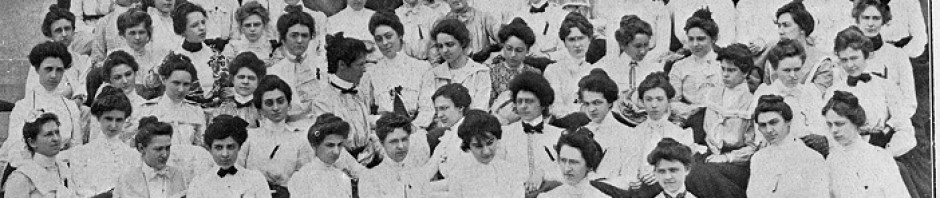
In 1888, Louise “Lulu” Sawyers (Linn), a student at Iowa Wesleyan College, wrote the words to Ring, Ching, Ching in response to a request from The Arrow editor asking for song submissions to publish. It was sung to the tune of When I Was a Student at Cadiz. The adoption of Ring, Ching, Ching at the 1892 Lawrence, Kansas, Convention did much to encourage singing.

It was not until 1915 that Linn, living in Portland, Oregon, learned from Grand Vice President Nina Harris Allen that the words she had written some 27 years earlier had become famous as a Pi Phi song. Then the yellowed piece of tablet paper on which the poem was written was taken from an old college album. Linn presented the paper to the Pi Phi chapter at the University of Oregon. The framed paper is now located at the Pi Beta Phi Headquarters.

In 1933, Linn told The Arrow, “I remember quite well my freshman year, when with schoolgirl enthusiasm I wrote some words, never dreaming they would be sung beyond the walls of my own chapter, Iowa Alpha. If I had known that the song was going to be preserved in the hearts of many Pi Phis I would have made an effort to write something more worthwhile. When I was told that Ring, Ching, Ching was sung at all national conventions, I felt like making an apology for its poor construction.”

I had originally looked for the words to When I was a Student at Cadiz in the early 1990s when I was working on the first version of the Fraternity Heritage Manual. I could not find anything. A recent search not only found me the words, but there were a few YouTube sound bites. The tune is also called Spanish Guitar. 

RING CHING CHING

When I was a student at college,

I belonged to the Pi Beta Phi.

I wore the gold arrow so shining,

The symbol of sisterhood ties.

Chorus

Ring ching ching—ring ching ching

Pi Beta Phi, Pi Beta Phi, Pi Beta Phi,

Ring ching ching — ring ching ching Pi Beta Phi — I belong to the Pi Beta Phi, Ring ching!

No longer a student at college, 

I still love the name of Pi Phi. 

I still wear the arrow so shining. 

It brings back fond mem’ries to me.

Pi Beta Phi, Pi Beta Phi, Pi Beta Phi,

Ring ching ching — ring ching ching Pi Beta Phi — I belong to the Pi Beta Phi, Ring ching!

Monogram on a Panhellenic House demitasse spoon


***

My Pi Phi friend Jane is wonderful at leading Pi Phis in song. It was so much fun spending time with her this past weekend.

Jane has three adult children (her daughter is a Pi Phi, too), including her 23-year-old non-verbal autistic son. Jane has started blogging about her educational adventures with her son. I encourage you to take a look at her blog http://janescoolschool.wordpress.com. Her lesson plans are fun and include a Le Fictitious Local Café story problem and a classical music component. I think you’ll find it highly informative, educational and enjoyable.

© Fran Becque, www.fraternityhistory.com, 2014. All Rights Reserved. If  you enjoyed this post, please sign up for updates. Also follow me on twitter @GLOHistory and Pinterest www.pinterest.com/glohistory/

Posted in Fran Favorite, Pi Beta Phi | Tagged , , | Comments Off on Ring, Ching! and Le Fictitious Local Café

Miss America 2015 – The Sorority Women Who Competed in 2014

Congratulations to Kira Kazantsev, Miss America  2015! She is not a current member of a sorority. 

After Kira Kazantsev was crowned Miss America, the first runner up of the Miss New York competition became Miss New York. She is Jillian Tapper, Alpha Delta Pi from Florida State University. 

For information on former Miss Americas who are sorority women, please see http://wp.me/p20I1i-zK. For information about the 2014 pageant, see http://wp.me/P20I1i-SQ.

Sorority Women in the Top 5

Miss Arkansas – Ashton Campbell, Chi Omega, University of Arkansas (Performed in talent competition)

10351804_10152616679947221_3319534569292374425_n

Miss Florida – Victoria Cowen, Kappa Delta, Florida State University** Preliminary Lifestyle Fitness Award Winner  (Performed in talent competition) 3rd Runner Up.


Sorority Women in the Top 12 and Top 10!

Miss Alabama – Caitlin Brunell, Phi Mu, University of Alabama* Quality of Life Scholarship Award for Community Service  (Performed in talent competition)

Miss Arkansas – Ashton Campbell, Chi Omega, University of Arkansas (Performed in talent competition)

Miss Florida – Victoria Cowen, Kappa Delta, Florida State University** Preliminary Lifestyle Fitness Award Winner  (Performed in talent competition)

Miss Tennessee – Hayley Lewis, Phi Mu, Belmont University  (Performed in talent competition)


Sorority Women in the Top 16 

Miss Alabama – Caitlin Brunell, Phi Mu, University of Alabama* Quality of Life Scholarship Award for Community Service

Miss Arkansas – Ashton Campbell, Chi Omega, University of Arkansas

Miss Florida – Victoria Cowen, Kappa Delta, Florida State University** Preliminary Lifestyle Fitness Award Winner

Miss Texas – Monique Evans, Alpha Delta Pi, University of Texas

Miss Tennessee – Hayley Lewis, Phi Mu, Belmont University


On September 14, 2014, Miss America 2014, Nina Davuluri, Sigma Kappa, will crown her successor. These women belong to National Panhellenic Conference (NPC) or National Pan-Hellenic Council (NPHC) sororities. I’ll be live blogging the pageant, so please check back.

Sorority women who are competing for the Miss America 2015 crown are:

Miss Alabama – Caitlin Brunell, Phi Mu, University of Alabama* Quality of Life Scholarship Award for Community Service

Miss Alaska – Malie Delgado, Alpha Sigma Alpha, University of Alaska, Anchorage

Miss Arkansas – Ashton Campbell, Chi Omega, University of Arkansas

Miss California – Marina Inserra, Delta Zeta, San Diego State University

Miss Delaware – Brittany Lewis, Alpha Kappa Alpha, Temple University 1st Runner Up Quality of Life Scholarship Award for Community Service

Miss District of Columbia – Teresa Davis, Kappa Alpha Theta, University of Georgia

Miss Florida – Victoria Cowen, Kappa Delta, Florida State University** Preliminary Lifestyle Fitness Award Winner

Miss Georgia – Maggie Bridges, Alpha Delta Pi, Georgia Institute of Technology, $5,000 STEM Scholarship

Miss Kansas – Amanda Sasek, Alpha Sigma Alpha, University of Central Missouri.

Miss Louisiana – Lacey Sanchez, Phi Mu, Southeastern Louisiana/Louisiana State 

Miss Maryland – Jade Kenny, Alpha Delta Pi, University of Alabama 2nd Runner Up Quality of Life Scholarship Award for Community Service, Preliminary Lifestyle/Fitness Award Winner

Miss Nebraska – Megan Swanson, Alpha Sigma Tau, Belmont University

Miss Pennsylvania – Amanda Smith, Alpha Delta Pi, Florida State University Preliminary Talent Award Winner

Miss Rhode Island – Ivy Depew, Delta Gamma, University of Memphis

Miss South Carolina – Lanie Hudson, Alpha Delta Pi, Clemson University

Miss Tennessee – Hayley Lewis, Phi Mu, Belmont University

Miss Texas – Monique Evans, Alpha Delta Pi, University of Texas

Miss Vermont – Lucy Edwards, Delta Delta Delta, University of Vermont, $5,000 STEM Scholarship

Miss Washington – Kailee Dunn, Gamma Phi Beta, Eastern Washington University

*Caitlin’s grandmother, Sherrie Pendley Liebsack, is a Pi Phi and she serves as a Pi Beta Phi Foundation Ambassador. And I just found out that Caitlin’s mom is a Pi Phi, too!
 
** Miss Florida Elizabeth Fentchel, Alpha Delta Pi, University of Florida was disqualified after she had been named the winner.

redroses

© Fran Becque, www.fraternityhistory.com, 2014. All Rights Reserved. If  you enjoyed this post, please sign up for updates. Also follow me on twitter @GLOHistory and Pinterest www.pinterest.com/glohistory/


Posted in Fran Favorite | Tagged | Comments Off on Miss America 2015 – The Sorority Women Who Competed in 2014

Sarah Ida Shaw Martin and the Triangle Windows at 5 Cobden Street

As Sarah Ida Shaw she studied, as best she could with the resources that were available at the time, the other men’s and women’s fraternities. She was an excellent student. In 1885, she was valedictorian of her Girls’ Latin School class. She would graduate from BU as a Phi Beta Kappa. When she unveiled her plans to start a new women’s fraternity, Delta Delta Delta, her planning and preparation were clearly evident to those with whom she shared this decision. She served as Tri Delta’s Grand President from 1889-93. 

She taught high school classical languages and German classes until her marriage in 1896. After her marriage, she began using Ida Shaw Martin as her name. She holds a unique place in the women’s fraternity world. Not only was she a founder of Delta Delta Delta, but she was also an influential voice in the history of several other women’s fraternities/sororities, most notably the early years of Alpha Sigma Alpha. She helped found the Association of Pedagogical Sororities which soon afterwards became the Association of Education Sororities. She was a consultant to these groups through her “Sorority Service Bureau.”  She helped Alpha Epsilon Phi develop its first formal Constitution and guided the organization in formulating its Ritual.

She also authored one of my favorite books, the Sorority Handbook, which was a directory to the women’s fraternities/sororities of the day. I suspect it was a  resource she started compiling many years before when she was doing her own research prior to founding Delta Delta Delta.

Yesterday was the 147th anniversary of her birth. To celebrate her birthday, albeit a day late, I offer you pictures of her home on Cobden Street. Note the two little “kitten ears” on the turret at the left of the house. There is an additional one on the back side of the house (better visible in the second picture). They are not kitten ears; they are triangles/deltas. And there are three of them. Sadly, there was a fire at the house after these photos were taken. I am not sure if the home is still standing.

Screenshot (3)

Screenshot (1)

This is from the Tri Delta website and it gives a little more insight:

On the corner of Cobden and Cardington Streets in the Boston neighborhood of Roxbury there sits a yellow wooden home, ivy growing up the side, a turret on one side with three delta-shaped windows at the top. For 30 years, Tri Deltas all over the country received letters and correspondence from 5 Cobden Street, the home of Sarah Ida Shaw. It was here where she married William Holmes Martin in 1896. It is here where she gave her radio address to the 50th Anniversary Convention attendees who gathered at the Hotel Vendome in 1938, and it was here were she passed away on May 11, 1940.  

However, if you drive up to the house today, the turret’s windows are boarded up, and the top, near the deltas, is very badly burned. The house sits empty and abandoned. If you speak to a neighbor, he will tell that the house caught fire and burned. And he will tell you when it happened: Thanksgiving 2012.

sorority handbook flyer page 2 cropped

© Fran Becque, www.fraternityhistory.com, 2014. All Rights Reserved. If  you enjoyed this post, please sign up for updates. Also follow me on twitter @GLOHistory and Pinterest www.pinterest.com/glohistory/

Posted in Boston University, Delta Delta Delta, Fran Favorite, Ida Shaw Martin | Tagged , , , , | Comments Off on Sarah Ida Shaw Martin and the Triangle Windows at 5 Cobden Street

1887 – When Illinois Was the West

It always catches me off guard when I see Illinois referred to as “the West.” In 1867, when Pi Beta Phi was founded and in 1870 when Kappa Alpha Theta and Kappa Kappa Gamma were founded, Illinois was the western frontier. Coeducation began in the west, at Oberlin College in 1837. The established eastern colleges tended to create separate coordinate institutions for women (Radcliffe/Harvard, Barnard/Columbia, Pembroke/Brown) to keep the original institution all male. The younger, usually church-affiliated institutions in the west tended to operate on a shoestrings. The tuition from a female student was exactly the same as tuition from a male student. Add the upheaval of the Civil War into the mix, and the western institutions were thankful for any student, male or female, who would pay tuition and help keep the institution afloat.

Recently, I came across this opinion piece which ran in an 1887 Arrow of Pi Beta Phi. The introduction read, “The following matter was handed us by the retiring editor for· future ARROW use. It was written by Miss Lillie Selby.” Selby was a member of the Iowa Zeta chapter at the University of Iowa. In 1887, she was a speaker at commencement. She later married Dr. Alexander Moor. She died in California in 1945.

A WESTERNER’S REPLY.
Our contemporaries have occasionally referred to Pi Beta Phi as a ‘western’ organization in a connection evidently meant to imply some possible inferiority on that account. We are a western organization in origin and extension, having at present no chapter east of Ohio. But what of that? Are we not all the better for this fact?

‘The west’ is the synonym for thrift, energy and intelligence. The Mississippi valley, the representative section of the west, is the practical base of supplies for the whole United States, and yields to no section in wealth, education and progress. Iowa, with its lowest percentage of illiteracy and excellent school system, is the banner educational state
of the Union.

It is only in the minds of untraveled inhabitants of the extreme east that the people of Illinois and Indiana are in danger of being scalped by the Indians; that cook stoves are
not yet introduced into Kansas, or that Minnesota is in the frigid zone. So much cannot, of course, be said of the development of the newer states and territories of the extreme
west; but that they are one whit behind us in culture and native resources, no one who has been there, or who reads, will for a moment believe.

Especially does it seem inappropriate that the term western should convey any idea but the most noble and honorable when applied by a student of a western college to a western college society, as was recently the case. We can only attribute such· a feeling either to jealousy, or a lack of proper sectional patriotism and eyes dazzled by the glamour of the reputed splendors of eastern hyper-culture. But we are not now concerned with the relative merits of east and west as to commerce or wealth; the question is on the motion that the western fraternity or sorosis (women’s fraternity/sorority) may be, and has every reason to be the equal of a similar organization founded and centered in eastern colleges.’

While the western colleges may lack the prestige and the inspiration drawn from old traditions, which give favor to life in the olden and more celebrated institutions of the east, yet they certainly go far toward supplying all needed advantages for the education and culture of the earnest young men and women who crowd their halls, and for sturdy manly and womanly character and intellectual force, the students of western colleges need acknowledge no superiors. The best schools and the best students make the best fraternities. This would lead us to expect to find good fraternity material and good chapters in our best colleges, and such is unquestionably the case.

With soroses (women’s fraternities/sororities), this should be even more strikingly true, for it is only in the west that co-education is the rule, and it is in co-educational schools that the strongest and noblest characters are developed among girls. Even if we were an eastern institution, but with western chapters; we are inclined to think that our greatest strength would lie in the western chapters.

But aside from the fact that our ‘western’ sorosis is so rich in resources and opportunities, there are prudential reasons why we ought not to be in haste to extend its limits. In the convention of Kappa Alpha Theta, held at Madison (sic – it should read Hanover), Indiana, in February last, nine chapters were represented, of which seven were western, and two eastern-one in Vermont and one in Pennsylvania. They also have a chapter at Cornell College, N. Y., and one at Los Angeles, Cal. It does not take a mathematician to figure out that to pay the expenses of delegates from California and Vermont even to some central point,with so small a number of chapters, would be ruinous to the pocket-books of the members without a corresponding benefit derived from the distant chapters.

This is only one example of the inconvenience of too great expansion. The difficulties in the way of intercommunication or social intercourse are also apparent. The younger and weaker of the boys’ fraternities are principally confined to one section, east, west, or south; only the oldest and wealthiest spread themselves over all the country. It really seems a much better policy for Pi Beta Phi to let her growth be gradual and outward, occupying desirable territory compactly, and pushing outward as she gains strength. Since we were born in the west, let us stay in the nest until our wings are strong enough to fly in any direction we choose without danger of disaster. 

1009 - 1888 convention - smaller

photo (22)

photo (35)

© Fran Becque, www.fraternityhistory.com, 2014. All rights reserved. If  you enjoyed this post, please sign up for updates. Also follow me on twitter @GLOHistory and Pinterest www.pinterest.com/glohistory/

Posted in DePauw University, Fran Favorite, Kappa Alpha Theta, Kappa Kappa Gamma, Monmouth College, Pi Beta Phi | Tagged , , , | Comments Off on 1887 – When Illinois Was the West

Born in 1910 – A Lifetime in Gatlinburg!

Tuesday’s mail had the most pleasant surprise. The envelope was from Marie Maddox in Gatlinburg, Tennessee. I immediately recognized the name. Marie is a teacher at Pi Beta Phi Elementary School in Gatlinburg, Tennessee. For Pi Beta Phi’s Centennial of Literary Service celebration in 2012, Marie wrote a play “Then and Now.” It starred students, teachers, and community members and it was topped by an appearance by Glenn Bogart, who was then the school’s principal (he has since retired). Glenn’s delightful daughter Rachel and his wife Vada were convention initiates at the 2013 Pi Beta Phi Convention.

photo 1 (4)

Marie tells the story of Martha Cole Whaley. Martha and Marie met when Martha was 100. She is now 104. Martha grew up in the Gatlinburg area. She attended the Pi Beta Phi Settlement School, not the one in Gatlinburg, but the one in Sugarlands. The Sugarlands school wasn’t there long; it closed when the National Park Service started buying up the property for the Great Smokies National Park. Martha says, “I loved the Pi Beta Phi teachers who came to teach us up in the Sugarlands.” She says that teacher Ruth Chew, a Pi Phi from Ohio University, was the other “most  influential” person in her life.

photo 2 (3)

Before she married, Martha worked as a cook at the Pi Beta Phi Settlement School. There are a few other mentions about the Pi Beta Phi Settlement School, but this is a book about Sevier County’s oldest citizen. The Gatlinburg of 1910 is worlds away from the Gatlinburg of 2014. It’s wonderful to read Marie’s story.

“This book is more than a history of the area. It is a book filled with wit and wisdom, tributes from her friends and  family to introduce the chapters, and the most-requested Martha recipes at the end because Martha has cooked her way through life. It is her talent and her means of showing people she cares about them.” wrote Marie in her letter to me.

Marie added, “Martha is still alive and well. I breakfast with her Saturday, and we just did our first book signing last Sunday.” Marie also said that when the play was staged two years ago, Martha was in a rehab center recuperating from some broken bones. Oh how I would love to have met her during that Gatlinburg trip!

I first visited Gatlinburg in 1992. I had read accounts of May Lansfield Keller’s trek to Gatlinburg after the vote to establish a Settlement School had been taken at the 1910 Swarthmore Convention. I quickly became well aware that the Gatlinburg I visited in 1991 was not the same one that May visited nearly 90 years before me. The Greystone Hotel still stood on the property where the aquarium is now. For years, Martha and her husband owned and ran the Greystone Hotel. Martha has lived Gatlinburg’s history. Anyone who has been to Gatlinburg and wondered about the history of the area would love the stories Martha tells of her life in the area.

photo 3 (3)The book is published by the History Press and I© Fran Becque, www.fraternityhistory.com, 2014. All rights reserved. If  you enjoyed this post, please sign up for updates. Also follow me on twitter @GLOHistory and Pinterest www.pinterest.com/glohistory/‘ve added a link to it on the right hand side of this page near the top. And here is a link to a post about the Centennial of Literacy Service celebration http://wp.me/p20I1i-rM.


Posted in Fran Favorite, Pi Beta Phi | Tagged , , | Comments Off on Born in 1910 – A Lifetime in Gatlinburg!

A Messy Desk Must Mean I’m Laboring on Labor Day

I’ve been writing. In fact, I’ve been writing a lot. Ice pack and Advil a lot.

As a freelance project, I am writing about the history of a chapter of a men’s fraternity at a particular university. I love learning more about that organization and that campus, so it has been a fun, albeit long and tedious, process. Telling more than a century of history in an informative, yet easy to read fashion, is not as easy as one might think. Making sure the facts align can be a bit challeging, too.

For fun I am writing these blog posts. I can’t say I am making any money off of them as the cheezy advertising is not very productive (although if you need to order anything from the ubiquitous on-line merchant, please go through the links on the side and I might be thrown a few pennies). I keep doing it because I love to tell stories. And I love getting e-mails and comments from old friends and new ones. And I enjoy hearing stories from them, too. In response to the post on the G.I. Bill a few days ago, my friend Betsy told me this wonderful story.

My Dad came home from WWII  (he joined right out of high school well before Pearl Harbor) after serving on a Navy carrier in the Pacific theater. My Mom and her family encouraged him to get his college degree while my Mom taught school. I was 2 1/2 and my brother a newborn when Dad began college at the University of Maine in Orono, Maine utilizing the G. I. Bill!

He joined Lambda Chi Alpha at the urging of my Mom’s Dad who was initiated into Lambda Chi Alpha at Worcester Tech College somewhere around 1910 or so. Lambda Chi at U of Maine reached out to the returning vets at U of Maine and encouraged them to join as did most of the fraternities on campus.

One of my earliest memories is attending the Sunday dinners that were held for the Lambda Chi members and their families to help them out. The housemother became like surrogate grandmother for each of us!

This was typical of each of the fraternities on campus at that time as my Mom told me. It provided an excellent meal and social interaction and friends for the “older” students/ returning vets and their families. This made a huge difference in their lives at that time. The bonds of brotherhood forged by this membership in Lambda Chi made a big difference as the vets return to civilian lives. It also provided a path to friendship for their wives with other veterans’s wives who had similar experiences while their husbands were at war providing a needed outlet for them too!

To pay it forward, I am working on a few Pi Phi things – a talk at Officer’s Worskhop which needs a  good deal of fun research, some archives projects, and three upcoming posts for Pi Phi blog. I love what I do for Pi Beta Phi and I am grateful for the opportunity to do it.

photo (41)

The items pictured above are some of the things that are on my desk right now. The coaster with the old school Syracuse logo was purchased 100 years ago, most likely when I was a freshman during the Ford Administration. It’s not the best coaster for a glass of ice water; the water just pools up and overflows, but I use it anyway. The Mount Holyoke calendar on the left features on the cover the Dale Chihuly sculpture which was recently installed in the library. I need to make it my business to see it in person (when the Missouri Botanical Gardens  hosted a Chihuly exhibit we were able to get up before it closed and I am so glad we did. I love blown glass!).

There’s a card to hand to prospective members of the Carbondale Rotary Club – Breakfast inviting them to a meeting. I haven’t been very successful in that regard, but it is a good idea. There’s a place card for the wedding of my daughter’s best friend, Katharine (a Delta Gamma, by the way). It’s funny because I often forget I have a Ph.D. and I am usually startled when someone addresses me as “Dr. Becque.” Katharine’s mom has a Ph.D., so I wasn’t surprised when I saw “Drs.” on the place card. Just be warned that I am not good in medical emergencies.

Happy Labor Day!

P.S. That’s a staged photo. You really don’t want to know what my desk looks like right now!

© Fran Becque, www.fraternityhistory.com, 2014. All rights reserved. If  you enjoyed this post, please sign up for updates. Also follow me on twitter @GLOHistory and Pinterest www.pinterest.com/glohistory/

Posted in Fran Favorite, GLO, Greek-letter Organization, Greek-letter Organization History, Lambda Chi Alpha, Mount Holyoke College, Syracuse University, University of Maine | Tagged , , | 1 Comment

8/30/1912 + Bishop Kelly + 10 Founders = Happy 102 Years Theta Phi Alpha!

A few men have had roles in the founding of National Panhellenic Conference (NPC) sororities. Dr. Wellesley P. Coddington (Syracuse Triad), George Banta (Delta Gamma), and Dr. Charles Richardson (Chi Omega) are some whose names quickly come to mind. Of that small fraternity of men involved in the founding of NPC organizations, there is only one Catholic Bishop. 

On August 30, 1912, Theta Phi Alpha was founded at the University of Michigan. Although founded on August 30, Theta Phi Alpha celebrates Founders’ Day on April 30, the Feast Day of St. Catherine of Siena.* St. Catherine is the patroness of the organization and her motto, “Nothing great is ever achieved without much enduring, ” is Theta Phi Alpha’s motto as well.

In 1909, Father Edward D. Kelly, a Catholic priest and the pastor of the university’s student chapel organized Omega Upsilon. He believed that the Catholic women at the university should have the opportunity to belong to an organization  that “resembled the Catholic homes from which they came.” At that time, Catholics were not always welcome in the other fraternal organizations on campus.

After Father Kelly left campus and became the Auxiliary Bishop of Detroit, Omega Upsilon was struggling.  There were no alumnae to guide the organization. Bishop Kelly’s vision that the Catholic women at Michigan should have a place to call their own was still alive even though he was not on campus. He enlisted the assistance of Amelia McSweeney, a 1898 University of Michigan alumna. Together with seven Omega Upsilon alumnae, plans were made to establish a new organization, Theta Phi Alpha.

Theta Phi Alpha’s ten founders are Amelia McSweeney, Mildred M. Connely, May C. Ryan, Selma Gilday, Camilla Ryan Sutherland, Helen Ryan Quinlan, Katrina Caughey Ward, Dorothy Caughey Phalan, Otilia Leuchtweis O’Hara, and Eva Stroh Bauer Everson.  Seven of them were Omega Upsilon alumnae and two were undergraduate members of Omega Upsilon.

Theta Phi Alpha remained a local organization until 1919 when the Beta Chapter was formed at the University of Illinois. In addition, chapters at Ohio State University, Ohio University and the University of Cincinnati were chartered that year.

In 1921, Pi Lambda Sigma was founded as a Catholic sorority at Boston University. On June 28, 1952, Pi Lambda Sigma merged with Theta Phi Alpha. Its members at Boston University and the University of Cincinnati became members of the Theta Phi Alpha chapters on the two campuses. The chapter at Creighton University became the Chi Chapter of Theta Phi Alpha in the fall of 1952 and the Quincy College chapter became the Psi Chapter of Theta Phi Alpha in 1954.

Today, just as other organizations have accepted Catholic women, Theta Phi Alpha is open to women of all religions. 

Bishop Edward Kelly as a young priest. He was in his 50s when he helped found Theta Phi Alpha.

Bishop Edward Kelly as a young priest. He was in his 50s when he helped found Theta Phi Alpha.

** Saint Catherine was canonized in 1461. From 1597 until 1628, the feast of Saint Catherine of Siena was celebrated on April 29, the date she died. In 1628, due to a conflict with the feast of Saint Peter of Verona, hers was moved to April 30. In 1969, the Catholic Church reinstated her feast date as April 29. 

© Fran Becque, www.fraternityhistory.com, 2014. All rights reserved. If  you enjoyed this post, please sign up for updates. Also follow me on twitter @GLOHistory and Pinterest www.pinterest.com/glohistory/

Posted in Founders' Day, Fran Favorite, Theta Phi Alpha, University of Michigan | Tagged , , , | 1 Comment

The G.I. Bill Changed Higher Education

Monday’s post, “A Memory of Fraternities” came back to me as I was reading a 1945 report from a fraternity chapter at the University of Illinois, “As did everyone, we had the strange problem during rushing of not knowing some of our brothers, as well as the rushees, for we have men back from as far as the class of ’42.” 

The two institutions from which I graduated, Syracuse University and Southern Illinois University Carbondale, owe much to the men who took advantage of the Servicemen’s Readjustment Act of June 22, 1944, commonly known as the G. I. Bill. It had six titles, only one of which dealt with the education and training of veterans. Yet, the educational benefits of the G. I. Bill have become a benchmark for higher education. More than two million World War II veterans attended college courtesy of the G. I. Bill. Both Syracuse and SIUC met the challenge of enrolling and educating those returning G.I.s and both institutions changed and grew from the utter chaos the challenge brought with it.

Economics, not education, was the original intent behind the legislation. The nation had been through an economic depression prior to its involvement in World War II. The wartime economy had improved, but President Roosevelt was aware that unleashing significant numbers of returning veterans into a peacetime economy at the war’s end might prove disastrous. Roosevelt’s first mention of educating returning veterans was on November 13, 1942, the day he signed into law a Selective Service Act amendment lowering the draft age to 18.

On December 19, 1945, the Senate approved several amendments to Title II, the education component of the G.I. Bill. The benefits were no longer restricted to those servicemen under 25 years of age, more time was allotted for the completion of a degree, and monthly subsistence allowances were raised $15 per month. Single veterans would get $65 per month allowance and those with dependents would receive $90.

The American Council on Education [ACE] aided the institutions by providing information on the 800 training courses taught by the armed forces. George P. Tuttle, Registrar at the University of Illinois, headed the committee which produced A guide to the evaluation of education experiences in the Armed Services. It first appeared in loose-leaf format and was released as a completed edition in 1946. Tuttle’s guide provided the institutions a standard for granting credit based on military training.

The influx of servicemen to American colleges and universities following their discharge from the armed forces caused significant growth of several major universities and made higher education available to a greater number of Americans. During the later half of the 1940s accommodating veterans, and in many cases, their families, became a challenge for universities such as the University of Wisconsin, Syracuse University, and the University of Michigan.

The peak of veteran enrollment occurred in the fall of 1947; institutions scrambled to find housing, instructors, and classrooms to accommodate the record numbers of students. Not all institutions were affected, however. Since Uncle Sam was footing the bill, many veterans sought out the best institutions their academic records would allow. Ivy League schools, large state universities, and prestigious small liberal arts schools were popular with the returning veterans.

The benefits were not always fair to the Black servicemen. Segregationist John Elliott Rankin, a democrat from Mississippi, chaired the committee which drafted the bill. He made sure the distribution of the funds was controlled by local Veterans Administrations. This was a hindrance to many Black servicemen, especially those in the south. The benefits could be denied by an unsympathetic V.A. official or the G.I. could be forced into enrolling in a vocational program rather than a college course and those who enrolled in college programs were limited to Historically Black Colleges and Universities and institutions which did not practice segregation.

The G.I. Bill spawned several changes on college campuses. Many of the veterans were the first in their family to ever attend college. This opened higher education’s door those who would not have previously attended college. Married students became an accepted part of higher education. As older students, the veterans proved that one did not have to be a teenager to enroll and excel. The Korean War and the Vietnam War had their own G. I. Bills. Today the Veteran’s Administration provides educational benefits to those veterans who qualify. 

A post-World War II quonset at Syracuse University. It was there when I attended Syracuse and was torn down in the early 1980s. (Photo courtesy of the Syracuse University Archives) A post-World War II quonset at Syracuse University. It was there when I attended Syracuse and was torn down in the early 1980s. (Photo courtesy of the Syracuse University Archives)

© Fran Becque, www.fraternityhistory.com, 2014. All rights reserved. If  you enjoyed this post, please sign up for updates. Also follow me on twitter @GLOHistory and Pinterest www.pinterest.com/glohistory/

Posted in Fran Favorite, Southern Illinois University Carbondale, Syracuse University | Tagged , , , , | Comments Off on The G.I. Bill Changed Higher Education

2014 Emmys and the 19th Amendment

Congratulations to the winners of the 2014 Emmy Awards. Phi Gamma Delta Seth Meyers hosted the event which took place yesterday, on a Monday night. Congratulations to the members of Greek-letter organizations who won Emmys. They include:

Ty Burrell, Sigma Chi, Modern Family, Best Supporting Actor in a Comedy Series. 

Jim Parsons, Pi Kappa Alpha, Big Bang Theory, Outstanding Lead Actor in a  Comedy Series.

Kathy Bates, Alpha Delta Pi, American Horror Story: Coven, Best Supporting Actress in a Miniseries or Movie.

Julia Louis-Dreyfus, Delta Gamma, Veep, Outstanding Lead Actress in a Comedy.

For the list of sorority women who have won Emmys, see http://wp.me/p20I1i-17T

***

Carrie Chapman Catt

Carrie Chapman Catt

It’s Women’s Equality Day! The 19th Amendment giving women the right to vote was certified on this date in 1920. The House of Representatives passed the amendment on May 21, 1919. The Senate followed two weeks later. On August 18, 1920, the amendment passed its final hurdle of obtaining the agreement of three-fourths of the states as Tennessee became the 36th state to ratify it. Secretary of State Bainbridge Colby certified the ratification on August 26, 1920. Colby was a member of the Alpha Delta Phi chapter at Williams College.

Sorority women including Carrie Chapman Catt and E. Jean Nelson Penfield worked for the passage of the 19th Amendment. There are several posts about women’s suffrage on this blog including http://wp.me/p20I1i-c2.

© Fran Becque, www.fraternityhistory.com, 2014. All rights reserved. If  you enjoyed this post, please sign up for updates. Also follow me on twitter @GLOHistory and Pinterest www.pinterest.com/glohistory/

Posted in Alpha Delta Pi, Delta Gamma, Fran Favorite, Phi Gamma Delta, Pi Kappa Alpha, Sigma Chi | Tagged , , , , , , | Comments Off on 2014 Emmys and the 19th Amendment

A “Memory of Fraternities” and Nile Kinnick in a 1945 Hawkeye

As I was working the Friends of Carbondale Public Library book sale on Saturday, I took a break and looked through the yearbooks we have for sale. Most are Obelisks from Southern Illinois University, but there was a copy of the 1945 Hawkeye from the University of Iowa. I turned to the sorority section to see if there was anything interesting on the Pi Beta Phi page. Each sorority had a two-page spread. When I turned to the fraternity section, all that was included was this page, titled “A Memory of Fraternities” followed by a page about the Interfraternity Council and another page listing the fraternities.

photo 4 (3)

For a second, it caught me off-guard. Then I remembered that by 1945, most college-aged men were out of classes and in the armed forces. That is the likely reason that the fraternities did not have individual pages. 

photo 5 (1)

The Interfraternity Council page above includes this information, “The Council set up the Nile Kinnick Memorial Award in memory of the great All-American of ’39 who was killed in the Pacific war theatre. It is to be given each year to the boy seeming to best exemplify the standards of leadership, scholarship, and athletic ability.”

Of course, I had to find out more about Nile Kinnick. Not being a football fan (an understatement!), I had to do a quick google search. It turned up the text of his 1939 Heisman Trophy speech which included this line, “I thank God I was warring on the gridirons of the Midwest and not on the battlefields of Europe.” 

Was he a fraternity man? When I found out he was a member of Phi Kappa Psi, I knew that there would be more information courtesy of my Phi Psi friends, Historian Mike McCoy and Archivist Timothy Tangen. I did a quick search of the @PhiPsiArchives twitter feed and voila! 

1939 Heisman Trophy recipient Nile Kinnick, Iowa Alpha 1939, born 7/9/1918 in Adel, Iowa.
 

This tweet includes a link to a YouTube video produced by the University of Iowa. Although it is a bit long, it is worth it to see a 1930s pep rally, vintage football moves, the football star getting on a train to New York City, and it is a chance to listen to his humble Heisman speech. My husband was drinking his coffee when he heard me start the video. “What’s that?” he asked. When I mentioned that it was about “some football player named Nile Kinnick,” he said, “Kinnick Stadium at Iowa?”

Yes, the Iowa football stadium is named in his honor. There is a larger than life statue of him in front of it. The Iowa Alpha Chapter of Phi Kappa Psi is also proud of their brother. Kinnick a Phi Beta Kappa graduate, was enrolled in law school at Iowa and helping to coach the football team when he answered his call to serve the country.

Phi Psi Archives ‏@PhiPsiArchives Nov 7 On display at Iowa Alpha: Nile Kinnick-signed football, recently purchased by chapter, shown with a Kinnick bust.

“On display at Iowa Alpha: Nile Kinnick-signed football, recently purchased by chapter, shown with a Kinnick bust.” (picture and text from the @PhiPsiArhives November 7 tweet)

There is a big celebration in the works! This is from the website of Phi Psi’s Iowa Alpha Chapter:

Celebrate Brother Kinnick’s Legacy at the 2nd Annual Phi Psi Alumni Reunion
This upcoming football season marks 75 years since Nile Kinnick and the 1939 Ironmen squad stunned the nation. During the Ball State football game on September 6th, Iowa Alpha will be recognized for their contribution to the legacy of Nile Kinnick and the University of Iowa. In front of over 70,000 avid Hawkeye fans, Iowa Alpha’s intent to loan the original bust of Nile Kinnick and the football autographed by the 1939 Ironmen squad to the University for display will be announced. Phi Psi’s $100,000 endowment of the Nile C. Kinnick Scholarship Fund and the opportunity to apply for the scholarship will also be announced at the game. Don’t miss this important moment in Iowa Alpha history. 

For more information about Kinnick, see the links in these @PhiPsiArchives tweets:

 2 Jun 2013

This lengthy article, “Nile Kinnick: An American Hero,” is from Sports Illustrated in 1987.  

Kinnick was a prolific letter writer and his family gave his letters to the library. The University of Iowa Library’s Special Collections include the Nile C. Kinnick papers. The collection has been digitized and is available at http://digital.lib.uiowa.edu/kinnick/

© Fran Becque, www.fraternityhistory.com, 2014. All rights reserved. If  you enjoyed this post, please sign up for updates. Also follow me on twitter @GLOHistory and Pinterest www.pinterest.com/glohistory/
Posted in Fran Favorite, Phi Kappa Psi, University of Iowa | Tagged , , , , | 1 Comment