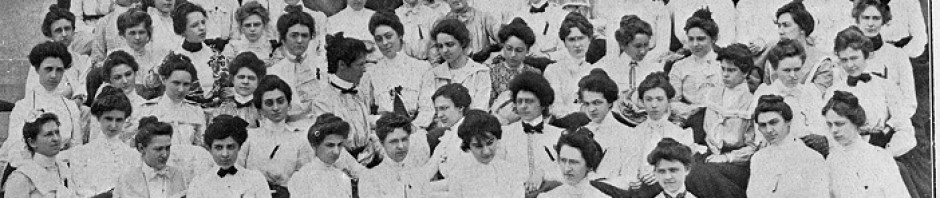
Irvington, Indiana, and the Sad Story of Madge Oberholtzer, Pi Beta Phi

On Saturday, I had the opportunity to meet a fellow Pi Phi with whom I have shared e-mail conversations. (July 2021 – She has written a book about Madge and it is available here or on amazon.com) She loves history, too. She lives in Irvington, Indiana. From 1875-1928, Irvington was the home of Butler College (now University). Today, the only Butler University school building which survives on the Irvington campus is the former Bona Thompson Memorial Library, now known as a center rather than a library. The Center has a model of the former Butler campus as well as pictures of the campus buildings and a map of where they were located.

The first e-mail I received from my  history buff friend years ago was about verifying the membership of Madge Oberholtzer, a former resident of Irvington. She is listed in a Butler yearbook as a pledge of the Indiana Gamma chapter of Pi Beta Phi. I confirmed that she was initiated in 1916.

Madge

Madge Oberholtzer

Oberholtzer’s story is a sad one, but through her death, she played a role in the rapid decline of the Ku Klux Klan in Indiana which took place in the 1920s. We drove by the Stephenson mansion and the home a few blocks away where Oberholtzer lived with her parents. When she and David Curtiss Stephenson crossed paths, Oberholtzer was manager of the Indiana Young People’s Reading Circle, a special section of the Indiana Department of Public Instruction.

Stephenson, who was Grand Dragon of the Indiana Branch of the Ku Klux Klan, and Oberholtzer met in 1925 at a gala honoring Indiana Governor Edward L. Jackson. She was helping with the distribution of name tags. Stephenson hired her to help write a book, One Hundred Years of Health. His plan was for it to be the book that would be used when the legislature required that a course in diet and health be taught in the public schools. He would make sure that the only text which filled the requirements set forth in the bill would be his book.

Some say he lured Oberholtzer to meet with him late in the evening on March 15, 1925 by saying he needed to talk about the book. Others say he told her they needed to discuss the Reading Circle program and her job, which she thought was about to be eliminated. Sometime after 10 p.m., Stephenson sent a bodyguard to Oberholtzer’s home to escort her to Stephenson’s home. After being forced to drink alcohol, she was kidnapped and put on Stephenson’s private train to Chicago. 

The Graham Stevenson House as it appears today.

The Graham Stephenson House as it appears today.

While on the train she was raped repeatedly and Stephenson bit her all over her body. There were many deep wounds from her face and neck down to her ankles. The alcohol she was forced to drink affected her ability to fight back. They never made it to Chicago. They got as far as Hammond, Indiana, where they checked into a hotel.

Oberholtzer ingested poison which she was able to purchase while being chaperoned by Stephenson’s henchmen. She became violently ill and the group headed back to Irvington. After hiding her for a short time in an apartment above Stephenson’s garage, she was taken to her family home and deposited in a bedroom. Two days had elapsed since the rape.

Her family was told she had been in a car accident. The Oberholtzers summoned a doctor. On March 28, 1925, she recounted her ordeal and signed a statement attesting to its truth so that it could be used in future legal actions. The statement of her ordeal was ultimately used to convict Stephenson. 

She died on April 14, 1925. The cause of death was a staph infection attributable to the bites. There was also kidney failure from the mercury poisoning.

During the trial her Pi Phi sisters sat in the courtroom, making the trek from Irvington to Noblesville, where the trial was held. Stephenson was convicted of second-degree murder on November 14, 1925. He was sentenced to life in prison. He was paroled in 1950 but spent a little more time in prison for violating parole. His accomplices, Earl Klinck and Earl Gentry, were acquitted.

Stephenson’s home was built in 1889 for William H. H. Graham. Before Stephenson purchased it in 1923, it was rented by the members of the Butler chapter of Kappa Kappa Gamma for use as the chapter house. Stephenson added the the Ionic portico after he purchased it. After his conviction, the home was rented to Chi Rho Zeta fraternity and Phi Delta Theta fraternity.  Soon afterwards, the chapters moved along with the rest of the University to the new location.

The Graham-Stevenson home when it was the chapter house of the Butler Unversity chapter of Kappa Kappa Gamma. (Photo courtesy of vintageirvington)

The Graham-Stephenson home when it was the chapter house of the Butler University chapter of Kappa Kappa Gamma. (Photo courtesy of vintageirvington)

(c) Fran Becque, www.fraternityhistory.com, 2014. All Rights Reserved. If  you enjoyed this post, please sign up for updates. Also follow me on twitter @GLOHistory and Pinterest www.pinterest.com/glohistory/


Posted in Butler University, Fran Favorite, Kappa Kappa Gamma, Pi Beta Phi | Tagged , , , , , , | Comments Off on Irvington, Indiana, and the Sad Story of Madge Oberholtzer, Pi Beta Phi

Happy Founders’ Day, Alpha Phi!

The first women’s fraternity/sorority to own its own home? It’s the same organization that is the oldest of the Syracuse Triad. The home belonged to the Alpha chapter of that organization. And that organization celebrates Founders’ Day on October 10. Alpha Phi it is!

In September of 1872, Martha Foote (Crowe), Clara Sittser (Williams), and Kate Hogoboom (Gilbert) pondered the thought of women having fraternal organizations comparable to those of the men.  They invited all the college women to discuss the possibility.

Ten women – the original three plus Jane Higham, Clara Bradley (Burdette), Louise Shepherd (Hancock), Florence Chidester (Lukens), Ida Gilbert (Houghton), Elizabeth Grace (Hubbell), and Rena  Michaels (Atchinson) met and pledged allegiance to the sisterhood. Minutes from the first meeting noted that Michaels was chosen president, plans were made for weekly meetings at which literary exercises would be part of the  program, and a 25¢ tax was levied for the purchase of a secretary’s book.  The first debate was “Resolved – that women have their rights.”

At first, the chapter met in the homes of chapter members. Dr. Chidester, Florence’s father, allowed the use of his Irving Avenue home office on Monday evenings. The first chapter room was on Salina Street, over Sager and Grave’s carpet store. The chapter room remained there for six years until it was moved to a suite of rooms on the fourth floor of the Onondaga County Savings Bank Building.

In 1884, the Alpha Phi chapter gave up the meeting rooms it rented in the bank.  Plans were made to rent a house “where the out-of-town girls could live and where one room could be used for a chapter hall.  The experiment proved a success, and at the end of a year it was suggested that the girls build and own a chapter house.”

Jennie Thornburn (Sanford), an 1887 Alpha Phi initiate, recounted the story of Alpha Phi’s chapter house and she gave credit to Grace Latimer (Merrick), for “making practical by figures, by argument and by enthusiasm the possibility of building and owning a house.  At first we thought it a crazy idea; it was certainly novel – no girls had ever owned a chapter house.”

In May of 1886, a 56’ x 178’ lot at 17 University Place was purchased by the members of Alpha Phi for $1,400, or $25 a front foot. A few Alpha Phi fathers acted as a Board of Trustees. A $2,500 bank mortgage was arranged and another Alpha Phi dad loaned the chapter $2,700.  The father of a chapter member was  a building contractor.  He contributed his services and asked the firms with which he dealt to contribute some materials. An eyewitness described the start of the building process, “At 2 P.M. June 22, 1886, on the lot opposite the campus of Syracuse University, which had already been purchased by the Alpha Chapter of Alpha Phi, were held the exercises attending the laying of the corner stone of the first chapter house owned by the society.  Ida Gilbert DeLamater Houghton, ‘76, one of the founders of the organization, struck the gavel upon the unfinished foundation wall.  Carrie Shevelson Benjamin, ‘81, read a paper, at the conclusion of which a song composed by Lydia Thompson ‘83 was sung.  After a short address by Chancellor Sims (an Alpha Phi father), Dr. W. P. Coddington laid the corner stone in the name of the Alpha Chapter of Alpha Phi.  In closing all joined in a familiar college song and the interesting ceremonies were completed.  This was the first chapter house built by women and the day was the fourteenth anniversary of the founding of the Alpha Phi society.”

The Alpha Phi chapter house on University Avenue in Syracuse. It was the first house built and owned by a women's fraternity. The house was sold in 1902 and the chapter moved to its current home on Walnut Place.

The Alpha Phi chapter house on University Avenue in Syracuse. It was the first house built and owned by a women’s fraternity. The house was sold in 1902 and the chapter moved to its current home on Walnut Place.

The chapter moved into its new home in November.  The chapter hall was dedicated in January, 1887, and on Washington’s birthday, the chapter opened the house to 300 invited guests.  In order to pay the mortgages, “it was decided to have the members make an annual subscription to a house fund, each girl giving what she thought she could afford.  This was done, the largest amount given being fifty dollars.” In 1896, the chapter house was redecorated at a cost of $600.  By 1902, the debts had been paid.  It was time to move again.”

As the house became too small, the Bacon residence on Walnut Park, the home of an Alpha Phi family, became available and it was purchased.  The old chapter house was sold to the university for dormitory use. Thirty women could live in the new house.” That home on Walnut Place is the home in which Alpha Phi still resides.

(c) Fran Becque, www.fraternityhistory.com, 2014. All Rights Reserved. If  you enjoyed this post, please sign up for updates. Also follow me on twitter @GLOHistory and Pinterest www.pinterest.com/glohistory/


Posted in Alpha Phi, Fran Favorite, Syracuse University | Tagged , , , | Comments Off on Happy Founders’ Day, Alpha Phi!

R.I.P. Jerrie Mock, Phi Mu, the First Woman to Circumnavigate the World Alone

Geraldine “Jerrie” Fredritz Mock, the first woman to fly solo around the world, died on September 30, 2014 at the age of  88. Mock, an initiate of the Phi Mu chapter at The Ohio State University, “shared her stories, always modestly, with Phi Mu so we could celebrate her accomplishments,” according to a post on Phi Mu’s Facebook page.

She took her first plane ride at age seven, in a Ford Trimotor airplane. In 1958, she earned a private pilot’s license. Her flight around the world began on March 19, 1964. She left from Columbus, Ohio and returned on April 17, 1964. She called the single engine Cessna 180, “Charlie,” although its official name was the “Spirit of Columbus.” 

columbus

The 22, 860 mile trek took 29 days and it had 21 stopovers. And it was not without its challenges. Shortly after take-off she realized her long-range radio was not working properly. And then she realized the brakes were a little off, too. She was able to get both problems fixed along the way.

mrs mockAmong her stops was one in Saudi Arabia where the men who greeted her kept waiting for a male pilot to emerge from the plane. They were a little shocked when they realized that she was the pilot.

sets matk

Mock set many records and was the recipient of numerous awards. There are two life size statues of her Ohio. Both are the works of Renate Burgyan Fackler. The first was unveiled in Mock’s hometown of Newark, Ohio. It is in the courtyard of The Works Museum. On April 17, 2014, another statue was unveiled at the Port Columbus International Airport. Mock’s plane, “Spirit of Columbus,” is in the Udvar-Hazy Center of the National Air and Space Museum in Virginia. 

jerri

 (c) Fran Becque, www.fraternityhistory.com, 2014. All Rights Reserved. If  you enjoyed this post, please sign up for updates. Also follow me on twitter @GLOHistory and Pinterest www.pinterest.com/glohistory/


Posted in Fran Favorite, Notable Fraternity Women, Phi Mu | Tagged , , | Comments Off on R.I.P. Jerrie Mock, Phi Mu, the First Woman to Circumnavigate the World Alone

In a NY State of Mind…The Union Triad and Other Thoughts

On Thursday afternoon we left for New York State and a family wedding. We made it as far as Erie, Pennsylvania. The next morning we headed off the rest of the way to our destination, Skaneateles, New York. While the weather could have been a bit sunnier and the leaves a bit more colorful, we were indeed happy to be together for a little while.

I first heard of Skaneateles in high school when I told one of my teachers that I was going to Syracuse University. He was a Saint Bonaventure alumnus and told me to make sure I made it to Skaneateles and Cazenovia during my years in Syracuse. I followed his advice. In later years when our daughter was in grad school, we made it a point to visit these villages and share a meal at the Sherwood Inn in Skaneateles. When we realized our niece’s wedding would take place closer to Skaneateles than Syracuse, we remembered the lake houses available for rent. It was wonderful to be able to spend some time with my husband’s mom, sisters and their families.

The water in Lake Skaneateles is clearer than any lake I’ve ever seen. If you ever visit Skaneateles you can walk on the public pier and see for yourself. When I posted the picture below to Facebook, a friend said:

I went sailing on Skaneateles a couple of times with a sorority sister and it was the clearest water I’d ever seen, even at 8-10 feet deep.

The water off the dock at the lake house. I suspect it is at least two feet deep there.

The water off the dock at the lake house. I suspect it is at least two feet deep there.

Sad to say, there wasn’t very much time to do anything other than attend the wedding. No side trip to Syracuse to see Phi Delta Theta letters on my Pi Phi house. No chance to take pictures of favorite sites. We did manage a lunch at the Sherwood Inn before the Connecticut and Maryland contingents arrived.

To make this more than a Becque family travelogue, I offer this excerpt from a history of higher education course pack I wrote with my dissertation advisor.

Union College in Schenectady, New York, is called the birthplace of the American fraternity system. It was there that the founding of the three “Union Triad” fraternities: Kappa Alpha Society (1825), Sigma Phi (1827), and Delta Phi (1827) became the model for the American fraternity system.

Prior to the emergence of the fraternity system, debating clubs and literary societies provided extracurricular activities for the students. Most schools had two societies and the membership of both clubs roughly equaled the number of students enrolled. The societies had grand sounding names, Adelphian, Diognothian, Alexandrian, Socratic and Zetetic, to name just a few.

The societies provided educational and social opportunities outside of the oftentimes monotonous recitations and class work. The literary societies were noted for their extensive libraries whose collections sometimes outnumbered the college’s volumes.

The rise of the fraternities, or Greek letter societies as they are also known, heralded the descent of the debating and literary societies.Phi Beta Kappa was founded in Williamsburg, Virginia, at the College of William and Mary in 1776. Although Phi Beta Kappa is now a scholastic honorary, it was at the time of its founding similar to the present day fraternity. By 1825 when Kappa Alpha Society was founded at Union College, the five chapters of Phi Beta Kappa already had become scholastic honoraries.

Other men’s national fraternities were founded prior to the Civil War. The war, however, put a damper on fraternity activities and expansion. After the war, several fraternities were founded in southern colleges and they expanded throughout the south. One southern fraternity, Alpha Tau Omega, was founded at Virginia Military Institute with the prime objective being to “restore the Union by uniting fraternally the young men of the South with those of the North” (Anson & Marchesani, 1991, p. III-20).

New York State is also home to the Syracuse Triad, the three women’s organizations founded at Syracuse – Alpha Phi, Gamma Phi Beta, and Alpha Gamma Delta. For a post about them, see http://wp.me/p20I1i-6h.

Sunrise on the lake before we left on the 13 hour ride home.

Sunrise on the lake before we left on the 13-hour ride home.

 (c) Fran Becque, www.fraternityhistory.com, 2014. All Rights Reserved. If  you enjoyed this post, please sign up for updates. Also follow me on twitter @GLOHistory and Pinterest www.pinterest.com/glohistory/

Posted in Delta Phi, Fran Favorite, Kappa Alpha Society, Sigma Phi, Union College | Tagged , , , , , | Comments Off on In a NY State of Mind…The Union Triad and Other Thoughts

Mary Love Collins, 1915, “Sequestered Ignoramuses to Intelligent Young Animals”

One of my favorite ways to waste time, and forgive me if I’ve said this before, is to page through fraternity and sorority magazines. Reading the old Arrows in the Pi Phi house was how I started down this path of Greek-letter organization history.

Last week, I came across a report of the 1915 National Panhellenic Conference (NPC) meeting held at the Claremont Hotel in Berkeley, California. The Panama–Pacific International Exposition took place in San Francisco that year, so it’s a good bet that some of the delegates visited the Exposition before or after the meeting. (Remember this was in 1915 and getting to Berkeley from Chicago or any eastern city meant several days aboard a train.) It is titled Morals and Dress:

Mrs. Mary C. Love Collins, national president of Chi Omega and that fraternity’s delegate to the NPC, as chairman of the NPC Committee on Conference with College Presidents, reports that on many of her visits to college presidents she was confronted with the questions, ‘Well what do you think of the dress of our young women of today?’ And ‘what do you think of their morals?’ To the former, Mrs. Collins replied that if the modern dress is open to severe criticism it is a sad commentary on the men of today. To the second question she replied that she believed their morals are better. Mrs. Collins backed up this statement with the fact that any age is judged by its accumulative contribution and that she believed that the young women of today in the process of their evolution from sequestered ignoramuses to intelligent young animals were making an accumulative contribution to the world which would be the ultimate judge of their morality.

While a student at Dickinson College in Carlisle, Pennsylvania, Mary Love belonged to a local organization, Omega Psi. In 1907, it became the Delta Chapter of Chi Omega. Mary Love, as she was known to her Chi Omega and NPC friends, was initiated into Chi Omega as an alumna. She graduated Phi Beta Kappa and became a lawyer. She served as Chi Omega’s National President from 1910-52. Mary Love began her stint as Chi Omega’s NPC delegate in 1909 and she served as NPC Chairman of the 1919 meeting.  

Omega Psi at Dickinson College. It came the Delta Chapter of Chi Omega in 1907. She is included in this photograph.

Omega Psi at Dickinson College. It came the Delta Chapter of Chi Omega in 1907. She is included in this photograph, middle row, left side. (photo courtesy of the Dickinson College Archives)

Mary Love Collins, 1914

Mary Love Collins, 1914

Mary Love Collins at her cabin in Pennsylvania with her dog, "Frolic," c 1932 (photo courtesy of Chi Omega Archives)

Mary Love Collins at her cabin in Pennsylvania with her dog, “Frolic,” c 1932 (photo courtesy of  the Chi Omega Archives)

© Fran Becque, www.fraternityhistory.com, 2014. All Rights Reserved. If  you enjoyed this post, please sign up for updates. Also follow me on twitter @GLOHistory and Pinterest www.pinterest.com/glohistory/

Posted in Chi Omega, Dickinson College, Fran Favorite, Mary Love Collins | Tagged , , | Comments Off on Mary Love Collins, 1915, “Sequestered Ignoramuses to Intelligent Young Animals”

The Importance of Indiana and Other Monday Morning Musings

All weekend, I have been jumping between projects. I’ve been writing my talk for the 100th anniversary of the Indianapolis Alumnae Panhellenic (http://wp.me/s20I1i-indy). The celebration is Sunday, October 12, 2014, and if you haven’t reserved a spot, you might still have a chance to join in this historic event. The title of my talk is “The Importance of Indiana.” Of course I didn’t have anything prepared when I chose that title, but I knew I could work with it. It has been fun because Indiana is very important in the history of the women’s fraternity system, and not just because Kappa Alpha Theta and Alpha Chi Omega were founded in the state. That story is just the tip of the iceberg.

Part of my weekend was spent try to give a final proofing to a history of the Gamma Mu chapter of Sigma Nu. It is a project sponsored by the Society for the Preservation of Greek Housing (SPGH). In 2000, the SPGH, in conjunction with the Student Life and Cultural Archival Program, began a project to document the history of the fraternities and sororoities at the University of Illinois. The SPGH hopes to complete a chapter history for each social Greek-letter organization on the campus. The histories are available on line at http://archives.library.illinois.edu/slc/researchguides/fraternitychapterhistory/

So far these organizations have been chronicled:

Alpha Delta Pi
Alpha Gamma Delta
Alpha Phi
Alpha Tau Omega
Chi Omega
Delta Tau Delta
FarmHouse
Kappa Alpha Theta*
Kappa Kappa Gamma
Pi Beta Phi*
Sigma Chi*
Sigma Phi Delta

*I wrote these three. I suspect Sigma Nu will join the list of available pdfs in the next few weeks.

It has been so much fun to learn more about the history of Sigma Nu as well as the University of Illinois. And I love it when I find facts having to do with Pi Beta Phi. Sigma Nu’s current house on Pennsylvania Avenue, near the President’s house, was built by A.W. Stoolman. Stoolman was the husband of one of Pi Beta Phi’s Grand Treasurers, Lois Franklin Stoolman. He also built the Virginia Theater in Champaign – that story is at http://wp.me/p20I1i-Jm.

During the World War I years, before the Sigma Nu chapter owned  a home of its own, the chapter found itself without a house, because they didn’t know who would be back in the fall and who would be in the armed forces. The landlord leased their home to someone else. Luckily, the Pi Phis had just moved into their present home on South Wright Street and had their old home available. That house was rented to the Sigma Nus for a time. I also discovered that my husband’s grandfather was a Sigma Nu. A career Army man, he was in the list of Sigma Nus who perished in World War II.

***

Speaking of Sigma Nu….My friend Kevin Hunsperger, morning anchor at WSIL-TV in Southern Illinois, reflects on his role as a founding father of the Southeast Missouri State University chapter of Sigma Nu. His wife is an Alpha Xi Delta, for those of you who know the story of the early Sigma Nu – Alpha Xi Delta connection. His chapter is coming up on its 20th anniversary and Kevin talks about his experience at http://www.my123cents.com/2014/09/love-truth-honor.html.

10714477_10203024155065330_2124978228763912993_o

***

My twitter feed tells me it’s Mountain Day for both Mount Holyoke College (my daughter’s Alma Mater) and Smith College (my son’s employer).

. — It’s your Mountain Day? It’s ours, too! See you at , and in the hills.

I am not sure how many times over the past 130+ years the two Mountain Days have fallen on the same date, but I am sure it’s not a common occurrence. For more about Mountain Days, see http://wp.me/p20I1i-nO

And as always, thanks for reading my blog and for letting others know about it. I appreciate it!

(c) Fran Becque, www.fraternityhistory.com, 2014. All Rights Reserved. If  you enjoyed this post, please sign up for updates. Also follow me on twitter @GLOHistory and Pinterest www.pinterest.com/glohistory/

Posted in Fran Favorite, Mount Holyoke College, Smith College, University of Illinois | Tagged , , , , | Comments Off on The Importance of Indiana and Other Monday Morning Musings

#NHAW14 – My Thoughts (Hazing Is Nuts!)

What if all you knew about fraternities and sororities you learned through films, television and through the news? Would you allow your son or daughter to join a Greek-Letter organization? I certainly wouldn’t. (“Fat, drunk and stupid is no way to go through life, son!”)

If you joined a fraternity or sorority knowing only what you saw or read, what would you expect from your experience? Would you expect wild parties, hazing, and a dumb as doorknobs group of friends? (“Who dropped a whole truckload of fizzies into the varsity swim meet? Who delivered the medical school cadavers to the alumni dinner? Every Halloween, the trees are filled with underwear. Every spring, the toilets explode.”)

If you joined a Greek-letter organization knowing only what you saw or read, would you even realize that there are standards and expectations about behavior, scholarship, community service and your role as a member of a college community? Would you know that you would always be wearing your letter whether they were on your chest or not? That every act of yours would reflect on your organization, whether it was a good action or a bad one?

I write this at the end of National Hazing Awareness Week (#NHAW14) when Greek-letter organizations and campuses across the country promote an awareness of hazing through social media and on-campus events. Speakers have been making the rounds talking about hazing and how to spot it and change the culture when it does exist. Banners are displayed, events take place, and members sign a written pledge not to haze. The vast majority of those members taking the pledge have never, nor will ever, haze. It feels, at least to me, that there is a lot of preaching to the choir going on.

And how ironic that during NHAW, the recently crowned Miss America had to respond to allegations that she hazed members and was dismissed from Alpha Phi because of it. Her response was something akin to she had hazed because she had been hazed, she made a joke which was misunderstood, and she missed a standards board meeting to discuss the situation. Forgive me if that story doesn’t make sense to me. I also found it amusing that she threw “crafting,” the hobby of making items with the sorority symbols and letters on them, into her explanation. (“More glitter, fewer feathers, enough with the puffy paint!!!)

If you didn’t know about the history of the Greek-letter organizations, what the organizations value and espouse, and what resources they put into keeping the organization healthy and viable for future generations, you would think that each and every one of them was run by a bunch of nit-wits.

Each organization is faced with the challenge of undergraduate chapters with a yearly turnover of members, a need for constant education regarding the GLO’s values, policies, and procedures, and the availability of committed and knowledgeable alumni/ae advisors. Those undergraduate members are the face of the organization on college campuses in the U.S. and Canada, although they are the member with the least knowledge of the organization.

Is hazing an issue in some GLOs? Probably. Is it an issue in most GLOs? Probably not. Making members aware that hazing has no part in any of our GLOs is a yearly activity and event because the membership changes every year, if not every semester. Constant education of values and expectations of membership is the key. And, I, too, like Skiouros, the Alpha Gamma Delta squirrel, think hazing is nuts.

My very favorite #NHAW14 poster. Alpha Gamma Delta's symbol is the squirrel, thanks to AGD Founder, Emily Butterfield, an architect who liked to draw squirrels

My very favorite #NHAW14 poster. Alpha Gamma Delta’s symbol is the squirrel, thanks to AGD Founder, Emily Butterfield, an architect who liked to draw squirrels

© Fran Becque, www.fraternityhistory.com, 2014. All Rights Reserved. If  you enjoyed this post, please sign up for updates. Also follow me on twitter @GLOHistory and Pinterest www.pinterest.com/glohistory/

Posted in Fran Favorite | Tagged , , | Comments Off on #NHAW14 – My Thoughts (Hazing Is Nuts!)

Betty Buckley, ZTA, the Public Theater, and Sweeney Todd

When I am in the car, I usually listen to the Broadway Channel on satellite radio. I remember hearing Seth Rudetsky, one of the channel’s hosts, tell a story about Betty Buckley. As I was driving at the time, I couldn’t write it down or try to memorize it because, after all, driving is a dangerous business. Here is the gist of it as I recall. Betty Buckley’s mother encouraged her to be in the Miss Fort Worth pageant. She won that title in 1966 and competed in the Miss Texas competition where she was first runner-up. For some reason, as I recall Rudetsky saying, the Miss America pageant people invited Buckley to perform at the pageant that year even though she was not competing for the Miss America title.

RetroTCU0029

She went, she sang, she left Atlantic City and went back to Texas Christian University where she was a member of Zeta Tau Alpha. But she had been spotted by a talent agent and when she returned to New York to give Broadway a go, almost immediately she was cast in the role of Martha Jefferson in 1776.

Buckley won a Tony Award for her portrayal of Grizabella in Cats. A tweet on my twitterfeed made me rue the fact that I live in the exact middle of nowhere, because I would love to go to see her in person.

rt The Betty Buckley Page “Debuting the music from my new GHOSTLIGHT CD , Oct. 7-11, (7…

From October 7-11, 2014, Buckley will be debuting the music from her new album, Ghostlight. She’ll be at Joe’s Pub in New York City in the Public Theater’s building. It was originally the Astor Library at 425 Lafayette Street at Astor Place.

I loved the fact that in a Texas Monthly article about the things she keeps on the piano at her home, Buckley describes one of the pictures. She said, “These are my two best friends from TCU, Harriett Adams and Cherry Haymes. We were Zeta Tau Alpha sorority sisters together.” In another article about her dressing room for the 1995 performance of Sunset Boulevard, the room’s designer was Dallas decorator Harriet Adams, Buckley’s ZTA big sister, and one of the women in that picture.

To get info on the concert and to hear her sing a selection from the album, visit http://bit.ly/1sXAsyW

Also on the page about Buckley’s performance there is a note that the “LuEsther T. Mertz Charitable Trust provides leadership support for The Public Theater’s year-round activities.” Mertz, a co-founder of The Publisher’s Clearinghouse, was initiated into my chapter of Pi Beta Phi at Syracuse University in 1924. One of the spaces in the Public Theater is named the LuEsther in her honor.

 ***

And in another musical connection, the Live from Lincoln Center series on PBS opens this Friday Friday, September 26, 2014 with a performance of Stephen Sondheim’s Sweeney Todd, the Demon Barber of Fleet Street in Concert with The New York Philharmonic. Check your local PBS listings for the time it will be airing. The previews are wonderful and I can’t wait to watch it!

For a post about Stephen Sondheim, a member of Beta Theta Pi, see http://wp.me/p20I1i-be

 © Fran Becque, www.fraternityhistory.com, 2014. All Rights Reserved. If  you enjoyed this post, please sign up for updates. Also follow me on twitter @GLOHistory and Pinterest www.pinterest.com/glohistory/

Posted in Beta Theta Pi, Fran Favorite, Texas Christian University, Women's Fraternity History, Zeta Tau Alpha | Tagged , , , , , , , , , | Comments Off on Betty Buckley, ZTA, the Public Theater, and Sweeney Todd

A Church, a Library, a Masonic Temple, and a Governor’s Home – Repurposed Buildings – GLO Style

A quick look at the photo on my twitter feed told me that this wasn’t an ordinary fraternity house. It looked like a lodge building. And in fact it was. The Marquette University chapter of Kappa Sigma has just moved into the former Kilbourn Masonic Temple building. A Youtube video mentioned that the back part of the building contained apartments.

kappa sig marquette

And that reminded me of something I read in my husband’s Sigma Phi Epsilon magazine. A few years ago the Sig Ep chapter at the University of Michigan purchased and renovated a former church. When the congregation of the Memorial Christian Church outgrew their building, they sought a buyer for their property at the corner of Tappan Avenue and Hill Street. When the Sig Ep Alumni Board showed interest in purchasing the property, the issue had to be taken up by the city’s Zoning Board. That process took about two years. Offices in an addition built in the 1950s were turned into bedrooms. The former worship area was repurposed as common areas for the fraternity.

sig ep michigan

***

This past weekend a most interesting event took place at the Kappa Kappa Gamma Headquarters in Columbus, Ohio. It was part of the Kappa Croquet Soiree: Wickets in Wonderland, a fundraiser for the Topiary Park and the Snowden-Gray House. As part of the soiree’s events, a Mad Hatter’s Tea Party took place at the Snowden-Gray House and Heritage Museum of Kappa Kappa Gamma. It looked like such fun!entrance

tea party

Kappa’s  headquarters in Columbus, Ohio, was  the home of Governor David Tod during the 1860s. In 1923, the Columbus Women’s Club purchased it to use as a headquarters. During the Depression, the club could no longer afford the upkeep and the building fell into private hands. It was used for offices, a candy making operation, and several other business until it fell into disrepair and was used as a poorly-kept rooming house.

Clara O. Pierce, an Ohio State Kappa, was appointed Kappa’s Executive Secretary in 1929 and served in that position for 40 years. It was her influence that brought the fraternity’s Central Office to a suite of offices in Columbus’ Ohio State Savings Building. In 1951, it was her vision that led the fraternity to purchase a large distressed, yet historic, mansion in what is now the Town-Franklin Historic District.

Three rooms serve as the Heritage Museum. Incorporated in 1981, the Heritage Museum was renovated and redecorated through the late 1990s.

***

And this from an earlier post. In creating a page about GLO Headquarters (http://www.pinterest.com/glohistory/), I came across this wonderful picture of Triangle Fraternity’s headquarters in Plainfield, Indiana. It was originally built in 1912 as the town’s Carnegie Library (do today’s colleges students even know about Carnegie Libraries?). In 1968, when a new library was constructed, this old library was turned into a private home. In 1991, Triangle purchased the property and turned it into its Headquarters. Libraries are one of my favorite things. I also like touring GLO headquarters. Something tells me touring this would be double the fun!

Triangle Fraternity Headquarters, Plainfield, Indiana.

Triangle Fraternity Headquarters, Plainfield, Indiana.

© Fran Becque, www.fraternityhistory.com, 2014. All Rights Reserved. If  you enjoyed this post, please sign up for updates. Also follow me on twitter @GLOHistory and Pinterest www.pinterest.com/glohistory/

Posted in Kappa Kappa Gamma, Kappa Sigma, Sigma Phi Epsilon, Triangle, University of Michigan | Tagged , , , , , , , | Comments Off on A Church, a Library, a Masonic Temple, and a Governor’s Home – Repurposed Buildings – GLO Style

The Roosevelts – Theodore, Franklin, and Eleanor – and their GLO Connections

Currently, PBS stations are airing The Roosevelts: An Intimate History. The seven part, 14 hour long series, is another of Ken Burns’ epic works. The series covers the fascinating lives of Theodore, Franklin and Eleanor Roosevelt.

Growing up on Long Island, I remember many trips to tour Sagamore Hill, Theodore Roosevelt’s summer home in Oyster Bay. I always tried to envision what it was like when TR was alive and the home and grounds were bustling with family activity.

Both Theodore and Franklin attended Harvard University. Theodore was a member of Delta Kappa Epsilon and Alpha Delta Phi. Franklin was a member of Alpha Delta Phi. He was also a member of  Delta Kappa Epsilon (known as the “Dickey Club”) at Harvard, but by that time, the DKE national organization did not recognize the chapter because of the chapter’s stance on dual membership.

At the time she came of age, women in Eleanor Roosevelt’s social class did not typically attend college. They might have attended “finishing schools” as Eleanor did, but their main purpose in life seems to have been to “marry well.” She was, however, active with the Junior League in its early years. The Junior League for the Promotion of Settlement Movements, as it was first known, was founded by Mary Harriman (Rumsey), Kappa Kappa Gamma. Eleanor taught dancing and calisthenics in the East Side slums.

Later in life, Eleanor became an Honorary Member of Alpha Kappa Alpha. That story is told in a post at http://wp.me/p20I1i-A5R. She was also involved with the awarding of the Chi Omega National Achievement Award. That story is told by my Chi Omega friend, Lyn Harris. It is at http://wp.me/p20I1i-mw.

Theodore Roosevelt was instrumental in the founding of the National Collegiate Athletic Association (NCAA). See http://wp.me/p20I1i-10A for that story.

I recently wrote about Franklin Roosevelt’s involvement in the G.I. Bill, one act of which opened wide the doors of higher education. That story is at http://wp.me/p20I1i-10t.

Another of my favorite obscure facts is that after his mother died, Franklin Roosevelt inherited her stock in the Beekman Tower (Panhellenic) Hotel. The story of the Beekman Tower (Panhellenic) is at  http://wp.me/P20I1i-1n

Other random GLO tie-ins to the Roosevelts:

Genevieve Forbes Herrick, Kappa Alpha Theta, Northwestern University, was a noted reporter of the day and several histories talk about Herrick being part of Eleanor’s inner circle. 

Doris Kearns Goodwin, Delta Delta Delta, Colby College, won a Pulizer Prize in History (1995) for No Ordinary Time: Franklin and Eleanor Roosevelt: The Home Front in World War II.

Edward Herrmann, Phi Kappa Psi, Bucknell University, gives voice to FDR in the Ken Burns series. He also portrayed FDR in two made for television movies, Eleanor and Franklin (1976) and Eleanor and Franklin: The White House Years (1977). Both performances earned him Emmy Best Actor nominations. He also played FDR in the film, Annie. Younger viewers might recognize him for his work in The Gilmore Girls. He portrayed family patriarch Richard Gilmore.*

A letter from the Chi Omega Archives. This letter was written before her husband became President. During her White House years, Eleanor and Chi Omega National President Mary Love Collins, took part in the Chi Omega National Achievement Award festivities.

A letter from the Chi Omega Archives. This letter was written before FDR became President. During her White House years, Eleanor and Chi Omega National President Mary Love Collins took part in the Chi Omega National Achievement Award festivities.


*  (I hear a Gilmore Girls movie might be in the works. It has my vote. The series is one which helped cement my daughter’s love for the study of television series. She is currently ABD and is writing a dissertation for a doctorate in Mass Communications.)

© Fran Becque, www.fraternityhistory.com, 2014. All Rights Reserved. If  you enjoyed this post, please sign up for updates. Also follow me on twitter @GLOHistory and Pinterest www.pinterest.com/glohistory/

Posted in Alpha Delta Phi, Delta Kappa Epsilon, Fran Favorite, Harvard University, Phi Kappa Psi | Tagged , , , , | Comments Off on The Roosevelts – Theodore, Franklin, and Eleanor – and their GLO Connections