#WHM – Julia Peachy Harrison, Ph.D., ZTA and Chemist

Julia Peachy Harrison’s middle name was a family name, and not an adjective. My goal for #WHM was to spotlight one sorority woman a day. I didn’t want to write about the well-known women who appear on the lists of “famous alumnae.” Rather, I wanted to concentrate on the women who joined the organizations and went on to do amazing, yet largely unsung, work. I think these women find me. In researching Harrison, I found out something about Richmond College I had not known. Richmond College is now the University of Richmond. I know the story of Westhampton College, the coordinate of Richmond College, which was founded in 1914, because May Lansfield Keller, Ph.D., Pi Beta Phi’s Grand President from 1908-1918, was Westhampton’s founding dean and served in that role for decades. I did not know that Richmond College, for a short time, was coeducational and that a chapter of Zeta Tau Alpha was in existence there. The first woman graduated from the college in 1899 and there were a number of women graduates, including Harrison, before the class of 1914 became the first Westhampton College graduates.

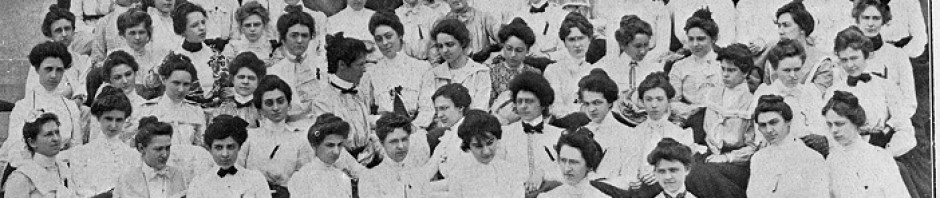
The charter members of the Iota Chapter of Zeta Tau Alpha.

The charter members of the Iota Chapter of Zeta Tau Alpha. (courtesy of ZTA). According to Patti Cords Levitte, she didn’t use her first name in any of the chapter records. She was known as Peachy.

Enter Julia Peachy Harrison, Virginia Binford, Lorena Boyd Mason, Marie Bristow, Mary Tyler. There were six men’s fraternities on campus. The ratio of men to women was 9:1, and of the 10 percent of students who were women, there were some who wanted to share the same bonds that the men had as members of a fraternity. During the 1904-05 academic year, there were 20 or so women enrolled in the college. The five who came together had been friends, some of them from childhood, and they had a friend who was a Zeta at Randolph Macon Woman’s College.

The Iota Chapter of Zeta Tau Alpha was installed on March 11, 1905 in Harrison’s home at 104 North Monroe Street. It was followed by a banquet in the same home. For the first year, chapter meetings were held in the Harrison home, but a room was obtained for the following year. More women were initiated and an alumnae chapter was chartered in Richmond. The Iota Chapter charter was withdrawn at the 1908 convention due to the small number of women at the college and the attitude of the administration towards the organization.

Harrison earned her B.A. in June 1906. A year later, she earned an M.A., the first woman at Richmond College to earn that degree. The November 1908 Themis of Zeta Tau Alpha told of an honor bestowed on Harrison and took the account from an article which appeared in the October 25, 1908 Richmond Dispatch. Her Master’s thesis, The Fluidity of Liquids, was being translated into German by the Head of the University of Leipsic so that it could appear in one of the leading chemical journals of Europe. Her study was an “original investigation into the reciprocal relations of fluidity and viscosity.” She taught high school chemistry for a year before she returned to Richmond College to earn a B.S. in 1909. The article goes on to state, “In connection with her work in chemistry, Miss Harrison is also doing advanced work in integral calculus and the calculus of variations. Miss Harrison is one of the most popular students of the college and her wide circle of friends wonder how she finds time for so much painstaking and successful scientific work. She is as vivacious of spirit and charming in manner as if she did not know a parabola from a circle or had never soiled her hands with the acids and alkalis of a laboratory.”

In 1909, she entered Johns Hopkins as a graduate student in chemistry. She earned a Ph.D. in 1912. Her dissertation was titled, On the Reversible Addition of Alcohols to Nitriles Catalyzed by Sodium Ethylate, II.

peachy 2

She is listed in the third edition of American Men of Science: A Biographical Directory, published in 1921. She is not the only female who has biographical data in there, so it is odd, but not surprising for 1921, that the title of the book makes no mention of the women.

She was a Carnegie Fellow and a Bryn Mawr Fellow. She taught at a number colleges including Bryn Mawr, Sweet Briar, Agnes Scott, Carnegie Institute of Technology, Skidmore, and Wilson College.  The last mention of her that I could find was from a Harrisburg, Pennsylvania, newspaper in the early 1930s when she was teaching at Wilson College. 

She died in Richmond, Virginia, on November 19, 1962. If anyone has any information on her whereabouts and activities from the 1930s until her death, I would love to add it to this post.

P.S. Shirley Gee, the Kappa Delta archivist, sent me this info on “Peachy:”

In the 1940 census records she was living in a boarding house in Cincinnati, Ohio with close to 50 other people.  A majority of the others were salesmen, store employees or teachers.  She was by far the most educated.  Most listed reported an 8th grade education, no high school.  She had lived in Cincinnati over five years.  I am assuming she was teaching in one of the colleges at this time.  In 1939 she worked 38 weeks with an income of $3,300.  As for later in life, we can verify that she traveled.  There were three entries where she boarded a boat in New York to travel abroad:  1949-France; 1953-Denmark; and 1956-Oslo.  She is buried in Hollywood Cemetery in Richmond, Virginia.

© Fran Becque, www.fraternityhistory.com, 2016. All Rights Reserved. If you enjoyed this post, please sign up for updates. Also follow me on twitter @GLOHistory and Pinterest www.pinterest.com/glohistory.

Posted in Fran Favorite, Johns Hopkins University, University of Richmond (Westhampton College) | Tagged , , | Comments Off on #WHM – Julia Peachy Harrison, Ph.D., ZTA and Chemist

#WHM – Ruth Johnson Colvin, Kappa Delta and Literacy Advocate

Ruth Johnson Colvin is 99 years young. She became a member of Kappa Delta while attending Northwestern University. She left Northwestern before graduation and she married Robert Colvin in 1940. After raising two children, she earned an undergraduate degree from Syracuse University in 1959. Three years later, in 1962, she started Literacy Volunteers of America because she was aghast when she found out that more than 11,000 Syracuse residents were at the lowest level of literacy.

She spent the next 50 years trying to tackle the problem, first at home and then globally. Today, the non-profit organization that she founded is known as ProLiteracy Worldwide.

The book Ruth Colvin wrote about her travels (Photo courtesy of Syracuse University Press)

The book Ruth Colvin wrote about her travels (Photo courtesy of Syracuse University Press)

She has been awarded nine honorary doctorates. Among the awards she has recieved are the President’s Volunteer Action Award (1987), induction into the National Women’s Hall of Fame (1991), and the Presidential Medal of Freedom (2006). The last award she was given on her 90th birthday.

This wonderful video (https://vimeo.com/158403652), produced by Kristen Archer, Kappa Delta’s Senior Multimedia & Technology Manager, was sent to me by a Kappa Delta friend, Shirley Gee. It is worth your time to view it. Ruth Colvin is an #amazingsororitywoman!

Ruth and Robert Colvin (courtesy of Syracuse University Press)

Ruth and Robert Colvin (courtesy of Syracuse University Press). Robert Colvin died in 2014 at the age of 99.

© Fran Becque, www.fraternityhistory.com, 2016. All Rights Reserved. If you enjoyed this post, please sign up for updates. Also follow me on twitter @GLOHistory and Pinterest www.pinterest.com/glohistory.

Posted in Fran Favorite, Kappa Delta, Northwestern University, Syracuse University | Tagged , , , , , | Comments Off on #WHM – Ruth Johnson Colvin, Kappa Delta and Literacy Advocate

#WHM – Grace Wilkie, Chi Omega

Grace Wilkie grew up in Wichita, Kansas, and spent most of her life living and working there. She was educated at the University of Kansas, where, during her undergraduate years, she became a member of Chi Omega. She served her chapter as president and delegate to the convention at Lexington, Kentucky in 1910. She was a charter member of KU’s Mortar Board chapter and she graduated Phi Beta Kappa.

After graduation in 1912, Wilkie was hired as the head of home economics at Fairmount Congregational College (today it is Wichita State University) in Wichita. Nine years later, she was appointed Dean of Women. In 1926, she earned a Master’s degree from Columbia University. In between, during 1919-20, she spent time in post-World War I France as Chi Omega’s representative to the American Committee for Devastated France. She sailed for France on November 21, 1919.

The February 1920, Eleusis of Chi Omega, had this write up:

The fraternity is unusually fortunate in having Grace Wilkie, Lambda, working in France as Chi Omega’s representative with the American Committee for Devastated France. Miss Wilkie is a thoroughly capable and efficient worker ideally adapted to this kind of work and we are glad that it is Chi Omega’s War Work Fund which is making her achievements possible. As an undergraduate member of Lambda Chapter,  Miss Wilkie brought her marked, power of organization and rare enthusiasm to all her fraternity interests making hers one of the personalities not soon forgotten. Since graduation, her interests have been mainly in her school work and along social service lines, in which her tact and understanding of people have been invaluable. With this unusually fine combination of qualities, we know the work of Miss Wilkie will be remarkably successful. While in New York, before sailing, she promised the ELEUSIS Editor to send an article to the ELEUSIS telling of the particular work she has gone to France to do and of her life there. We hope to have some news from her by the time our next magazine appears.

After having visited with Wilkie in France, Katherine W. Carson of Pi chapter, wrote a report which appeared in the September 1920 Eleusis:

The Committee carries on work in the Cantons of Vic-sur-Aisne, Coucy-le-Chateau, and Soissons, and it is in the former that we are most interested, for it is there that Grace Wilkie, Lambda, is stationed, having been sent overseas in December on the Chi Omega Service Fund. Here there is a unit of twenty or twenty-five splendid young women, among them a child welfare specialist, a nurse, four or five chauffeurs, two recreation leaders, and the rest are ‘general workers.’ It is to this last group that Grace belongs. They are not only ‘general workers’ but ‘willing workers’ also, and stand ready to do anything that needs doing, no matter how difficult or how menial.

Vic is a tiny, almost ruined, village near Soissons, with a population, before the war of, only nine hundred and thirty-nine, and its inhabitants are the best type of French peasants, who have lost their all in the war, and have known the terrors of German occupation for three years. The home of the Committee is a stone country house – damaged by shell fire, but now repaired so that it is quite habitable – which contains office, living- and dining-rooms and kitchen, and a few bedrooms, but most of the girls are housed in two wooden barracks at the rear. There is also a well-stocked dispensary, where a children’s clinic is held, and a large ‘magasin’ or store house, in which everything from a baby’s bottle to a spade may be found.

It was my pleasure to meet Grace Wilkie in Paris when she first arrived, and later I had the privilege of visiting twice at Vic-sur-Aisne, where I saw something of the work being done there. Let me mention a few of the things Grace does, as a ‘general worker’ – and she has no doubt lengthened this list considerably since I was there in February! – financial work in the office, kept important statistics of the families in the villages of the three counties, kept records of the sick and under nourished children who have been brought to the clinic,  fumigated houses after scarlet fever epidemic, ran the cinema, had charge of live stock, hundreds of baby chickens, besides rabbits and goats with which the Committee is aiding returning peasants to restock their farms – all this, in addition to having as her own particular charge the little village of St. Christophe,  for which she is ‘marrain’ and is entirely responsible.

Grace Wilkie

Grace Wilkie

Until her retirement in 1953, Wilkie served as Dean of Women, although the institution was then known as the Municipal University of Wichita. That year, the Grace Wilkie Scholarship was established and a new residence hall was named in her honor. The cafeteria wing was called the Grace Wilkie Annex. In 1980, Grace Wilkie Hall became the offices of the Division of Student Affairs.

Wilkie died in 1967. She was honored in Wichita State University’s Plaza of Heroines in 1999. Her home at 4230 East English Street was nominated to the Kansas and National Registers of Historic Places in 2007. Many of the students were invited to an annual tea at the home in which Wilkie lived with her sister Sophronia. “Phrone,” as she was known, was a teacher.

© Fran Becque, www.fraternityhistory.com, 2016. All Rights Reserved. If you enjoyed this post, please sign up for updates. Also follow me on twitter @GLOHistory and Pinterest www.pinterest.com/glohistory.

Posted in Chi Omega, Fran Favorite, The Eleusis of Chi Omega, Wichita State University | Tagged , , , | Comments Off on #WHM – Grace Wilkie, Chi Omega

#WHM – Mary Elizabeth Lasher Barnette, Journalist and ΠΒΦ

Mary Elizabeth Lasher was a 1939 initiate of the Ohio Alpha chapter of Pi Beta Phi at Ohio University. She died March 9, 2016 at Friends Fellowship Community in Richmond, Indiana, a few days short of her 94th birthday.

I met Mary Lib, as she was known to family and friends, at several Pi Phi events. She was an elegant, charming, and gracious woman. In 1989, she moved back to Athens, Ohio, There, in her retirement years, she was a stalwart member of her chapter’s Alumnae Advisory Committee.

Her father was George Starr Lasher, founder and first director of the Ohio University School of Journalism. He was also a dedicated member of Theta Chi. He served as its national president and was editor of The Rattle of Theta Chi for almost four decades. He also served as vice-chairman of the North-American Interfraternity Conference.
Mary Lib was also a pioneer in many ways. In the 1942 issue of The Rattle, her proud father included this news:

The distinction of being the first woman to edit the campus newspaper at Ohio University, the oldest university west of the Alleghenies, went this year to Mary Elizabeth Lasher, daughter of George Starr Lasher, editor of The Rattle of Theta Chi, and director of the School of Journalism at Ohio University. She is one of the few women to edit campus newspapers in the country, especially papers that issue more frequently than once a week, and have circulations exceeding 3000. The Ohio University Post is published three times a week and its circulation is 3100.

Miss Lasher resigned the presidency of the local Pi Beta Phi chapter to accept the editorship, as a campus regulation limits a person at Ohio University to one major position. She is a member of Mortar Board, Phoenix, Theta Sigma Phi, journalism professional sorority, and Kappa Tau Alpha,  journalism honor society.

Mary Eliz

Mary Elizabeth Lasher. This was the photo her father included with the story which appeared in The Rattle of Theta Chi.

In 1942, after graduating from Ohio University, she became a reporter for Editor & Publisher, a trade journal. When she took that job she became the first female reporter for a newspaper trade journal. She was also the first woman in the retail advertising division at the American Newspaper Publishers Association.

Mrs. Kenneth A. Barnette

Mrs. Kenneth A. Barnette

She married Kenneth A. Barnette on Saturday, June 8, 1946; the reception took place at the Ohio University Theta Chi chapter house. According to another news item in The Rattle, 200 guests attended the reception after the church wedding.

Screenshot (21)

From the 1940s until the 1970s, Mary Lib edited the From Pi Phi Pens feature in The Arrow of Pi Beta Phi. Pi Beta Phi’s first Chapter Loyalty Day took place on January 9, 1947. It was Carrie Chapman Catt’s 88th birthday and Chapter Loyalty Day was Pi Beta Phi’s way of thanking one of its most loyal and prominent members. Mary Lib interviewed Carrie Chapman Catt and that interview was published in the March 1947 Arrow:

Both pen and voice, guided by a keen mind and a progressive spirit, have been the tools used by Carrie Chapman Catt to achieve many long denied rights for women. By virtue of her successful fight in behalf of the voting privilege for women in the United States and abroad she has earned the gratitude of all womankind, and for her still continuing fight for world peace she deserves the support of all mankind. For these reasons and because her birthday, January 9, has been designated as Chapter Loyalty Day for Pi Phis everywhere, it is fitting that this column carry some of her messages.

The firmness of her voice, the erectness of her carriage, and the clarity with which she remembers the past and perceives the requirements of a peaceful and civilized future belie the eighty-eight years for which she was honored at a birthday dinner given for her by the American Association for the United Nations at the Hotel Roosevelt, New York, in January. Pi Phi alumnae in New York were given a similar opportunity two days later when they entertained her at a tea.

The following statements, which New York’s daily newspapers published in extensive articles covering the AAUN dinner, indicate the responsibilities which Mrs. Catt believes women should accept along with the rights for which she and others of her generation fought.

She urged the women of the world, “each and every one of them,” to become soldiers for peace, declaring that the best way to avert war is not to be prepared for it, but to oppose war preparation.

Recognizing that this is not an easy task, Mrs. Catt asserted: “It will be a great, tortuous effort to persuade the masses of people that war should be stopped, that it can be stopped, and that it will be stopped when they are ready for it.”

In a further statement she explained her beliefs regarding the causes of war, saying: “Everyone is asking if the United Nations is going to be able to stop war. I think it will not stop war unless something bigger and stronger makes it move faster than it now does. There is one cause of war, to my mind, and that is the rivalry and competition in armaments between nations. When one nation goes far enough in armaments and the other is afraid of it, out of the confusion then arising comes war.”

Pi Phis can well be proud of the bond that joins them to Mrs. Catt, who has distinguished the fraternity by her membership and who has always worn her Pi Phi badge whenever she was opening an important convention or association meeting. They can be equally proud of the United Nations scroll which Thomas J. Watson, president of the International Business Machines Corporation, presented to her for her devotion to the cause of world peace and her efforts on behalf of international cooperation.

And, they can agree with Mrs. Eleanor Roosevelt who in paying tribute to the pioneer suffragist, said: ‘I think it s wonderful, Mrs. Catt, that you can look back and feel you have accomplished so much not only for your country but for countries throughout the world. In our hearts, we give you our gratitude and respect and deep admiration.’

On a more personal level, it should be of delight her fraternity sisters that, though vitally active in national and international affairs, Mrs. Catt has maintained an unflagging interest in Pi Beta Phi, which was known as I.C. Sorosis when she became a member. To this reporter she expressed her particular satisfaction in the work accomplished by the Settlement School, saying, ‘I think the Gatlinburg development has done more than anything else to give Pi Phi the standing it has today.’

Indeed, Carrie Chapman Catt is a Pi Phi who has given far more than lip service to the fraternity’s ideals, who in fact has made them an essential part of her life’s work.

The Barnettes and their three daughters were living in the Buffalo, New York, area when Kenneth Barnette was diagnosed with cancer. After his death in 1969, Mary Lib married again and took the name Myers. Several years ago, she chose to revert to the name from her first marriage. For 11 years, Mary Lib served as the New Director at SUNY Buffalo State. In 1999, the E.W. Scripps School of Journalism at Ohio University honored her with the L.J. Hortin Distinguished Alumna Award.

Mary Lib’s grandson, Justin Watt, wrote a post on his blog about his grandmother. It includes a wonderful picture of her in her later years (see http://justinsomnia.org/2016/03/my-grandmother-passed-away/).

As one last gracious gesture, Mary Lib’s brain was donated to the Indiana Alzheimer Disease Center.

© Fran Becque, www.fraternityhistory.com, 2016. All Rights Reserved. If you enjoyed this post, please sign up for updates. Also follow me on twitter @GLOHistory and Pinterest www.pinterest.com/glohistory.

Posted in Fran Favorite, North-American Interfraternity Conference, Pi Beta Phi, Theta Chi | Tagged , , , , | Comments Off on #WHM – Mary Elizabeth Lasher Barnette, Journalist and ΠΒΦ

#WHM – Ida Bienstock Landau, Delta Phi Epsilon Founder

On March 17, 1917, five coeds at New York University School of Law founded Delta Phi Epsilon. The DIMES, as they are referred to, are Dorothy Cohen Schwartzman, Ida Bienstock Landau, Minna Goldsmith Mahler, Eva Effron Robin, and Sylvia Steierman Cohn. Delta Phi Epsilon was formally incorporated under New York State law on March 17, 1922.

That these five women were law students back in the day before women could vote in a federal election is impressive. Today, one must have a bachelor’s degree to apply to law school. In 1917, this was not the case. While the American Bar Association was formed in 1878, the first two women to join the organization did so a year after Delta Phi Epsilon was founded. In 1906, the Association of American Law Schools adopted a requirement that law be a three-year course of study.

Delta Phi Epsilon’s founders were between the ages of 17 and 19 when they formed the organization. I suspect they were working on an undergraduate degree in law, rather than what Delta Phi Epsilon members of today aspiring to be lawyers would do, spend additional years of study after obtaining a bachelor’s degree.

Ida Landau later in life

Ida Landau later in life

In 1920, Ida Bienstock graduated and was admitted to the New York Bar. In 1921, she married an Austrian, Jacob Landau, who, in 1917, founded the Jewish Telegraph Agency in The Hague. Landau lost her citizenship and her right to practice law when she married a foreigner (men who married foreigners at this time did not forfeit American citizenship). This case attracted national attention and it led to the adoption of the Cable Act (or the Married Woman’s Act) on September 22, 1922, allowing women who marry foreigners to keep their United States citizenship.

Ida Landau served as the assistant general manager of the Agency for many years. From 1942-51, she served as manager of the Overseas News Agency. She also served as a war correspondent. In 1943, she covered the Bermuda Refugee Conference. In 1945, she toured the liberated countries of Europe and reported on the plight of Jewish refugees. In 1950, she organized the Transworld Features Syndicate.

The Landau’s son, Albert Einstein Landau, was born in 1933. He was named for his godfather, the esteemed scientist. 

© Fran Becque, www.fraternityhistory.com, 2016. All Rights Reserved. If  you enjoyed this post, please sign up for updates. Also follow me on twitter @GLOHistory and Pinterest www.pinterest.com/glohistory.

Posted in Delta Phi Epsilon, Fran Favorite, New York University | Tagged , , | Comments Off on #WHM – Ida Bienstock Landau, Delta Phi Epsilon Founder

#WHM – Evelyn Blankstein, ΦΣΣ, Sportswoman and Architect

Phi Sigma Sigma became an international sorority in 1930 with the founding of its Upsilon chapter at Canada’s University of Manitoba. The University’s second female architecture graduate was a Phi Sigma Sigma, Evelyn Blankstein; she was born on March 5, 1913. Her father was an architect and that may have influenced her choice of major at the University of Manitoba. In addition to being a member of Phi Sigma Sigma, she was a talented athlete in the 1930s when athletic opportunities for women were limited. She was even named Woman Athlete of the Year while at the University. 

When she graduated, Blankstein was the only female to graduate in architecture that year and she was the first Jewish woman in Manitoba to earn a bachelor’s of architecture. She served her chapter officially as social chairman and generally as a good spirit and chapter cheerleader.

Blackstein

Blankstein spent her career as an architect, “when there were few if any women in a profession that was considered a male preserve — for close to 40 years, first in her brother Cecils office and then for Hobbs Glass (later Canadian Pittsburgh Industries) where she designed and facilitated the use of architectural glass for stores, movie theatres, offices and factories designed in the architectural offices of Winnipeg,” according to her obituary.

She was one of the first women golfers with a full membership at the Glendale Golf Club. The full membership allowed her to golf with the men. In addition, she was a competitive Duplicate Bridge player, earning Life Master status with the American Contract Bridge League.

Her obituary included this touching memorial, “Auntie Evelyn was the recent matriarch of our family. To her, her 17 nieces and nephews, her 32 great-nieces and nephews and her 15 great-great-nieces and nephews – all were the centre of her world. We were all her children. She traveled extensively to be with us for every Bar Mitzvah, Bat Mitzvah and Wedding.”

The Jewish Foundation of Manitoba administers an Evelyn Blankstein Athletic Assistance Fund for area young people.

© Fran Becque, www.fraternityhistory.com, 2016. All Rights Reserved. If  you enjoyed this post, please sign up for updates. Also follow me on twitter @GLOHistory and Pinterest www.pinterest.com/glohistory.

Posted in Fran Favorite, Phi Sigma Sigma, University of Manitoba | Tagged , , , | Comments Off on #WHM – Evelyn Blankstein, ΦΣΣ, Sportswoman and Architect

#WHM – Mary Thompson Stevens, M.D., Delta Gamma

Today is the date on which Delta Gamma and Phi Delta Theta celebrate Founders’ Day. (For information about the connection these two organizations share, see http://wp.me/p20I1i-AS). I wish them both a very Happy Founders’ Day, but it is an amazing Delta Gamma I’d like to highlight during #WHM (Women’s History Month).

The November 1949 Anchora told of Dr. Steven’s death with the headline “First Anchora  editor dies in Detroit.” She was born on January 29, 1864 and she was initiated into Eta chapter at Buchtel College. It was during her junior year that the second convention made the decision to publish a Delta Gamma magazine. The duty fell to Eta chapter and Mary Thompson became the first editor. She edited the April and November 1884 issues. She then transferred to the University of Michigan where she founded the Xi chapter. In 1885 she received her bachelor’s from Michigan and, in 1889, her medical degree. On March 16, 1892 she married Dr. Rollin H. Stevens.

In a 1935 Anchora, Helen Jo Ramsdell Parker wrote about Dr. Mary Thompson Stevens:

At the age of sixteen Mary Thompson left her home in Lapeer, Michigan, with one hundred dollars in her possession (which was all of the outside financial assistance which she was destined to receive during her entire collegiate career) and matriculated, in 1881, at Antioch College in Ohio. After one year there she left for Buchtel College (now Akron University) where she was initiated into Delta Gamma, and where she became the first Anchor editor. In 1884 she went to the University of Michigan with the prospect of better pay for her necessary work as assistant in the Library and Chemistry Laboratory. Mary took from Buchtel the fond hope of establishing Delta Gamma at Ann Arbor. This she did with the help of her great chum, Frances Thompson Mulliken, and so began Xi Chapter in the fall of 1885. The following June she received her B.A. degree, and three years later was awarded her M.D. The next year she assisted two professors in their work and received the munificent sum of $200 for her efforts.

With all of this wealth she left Ann Arbor for the great city of Detroit and confidently opened her office there in 1889. Her specialty was obstetrics, and I may say here that this small woman of five feet one had to impress the world by her ability rather than by stature. She was greatly aided, of course, by her exceptional smile, her understanding of people, and her grand sense of humor which is illustrated by her acceptance of a quart of hickory nuts as her fee for her first obstetrical case.

In 1892 Dr. Thompson married Dr. Rollin H. Stevens, and they spent their honeymoon at Leland Stanford where they continued their studies for a year. When they returned to Detroit, Dr. Stevens might have  been content to be the well-known wife of an eminent husband, but instead they both decided to become famous. Dr. Rollins Stevens is noted for his work in dermatology and cancer, x-ray, and radium. He is a member of the staff at Grace Hospital where Dr. Mary Stevens, for fifteen years, was a pediatrician – a unique achievement in those days. She was also a pioneer in the study of social hygiene and was the first to speak educationally to mothers on that subject.

After leaving her beloved sorority at Ann Arbor, Dr. Stevens and a few other college women, Frances T. Mulliken among them, formed the Detroit branch of the Association of Collegiate Alumnae, now known as the A.A.U.W. She was its first treasurer and was also a sectional vice president from 1902 to 1904, and again from 1926 to 1930. It was in the Association of Collegiate Alumnae that she began her intensive study of penology. After working in the State Legislature to pass a woman’s reformatory bill, she was appointed first woman commissioner of the Board of the Detroit House of Corrections and later served as its president. It was while in this office that she became warden of nearly nine hundred prisoners when the acting superintendent and his associates resigned. From the Sing Sing Prison Star Bulletin in May, 1919, one learns that “Detroit has a woman prison warden…meaning a new regime in prison management…Dr. Mary Thompson Stevens, one of the great pioneers in prison reform…” Her successor was found after her unremunerated month-long stay in office, but during that time she introduced reforms, nearly all of which have been continued.

Always a leader, Dr. Stevens in 1908 formed the Equal Suffrage League of College Women over which she presided until woman’s suffrage became an accomplished fact. She is also a charter member of the Twentieth Century Club and is director of two of its four departments: i.e., the department of philosophy and science, and the department of philanthropy and reform. Dr. Stevens has attended two conventions of the Federation of Women’s Club as delegate.

Included in her philanthropic activities is her work in the Girls’ Protective League since its inception twenty-four years ago, and her active service on the Board of the Children’s Aid Society for twenty years. She has also presided over Priscilla Inn, Detroit’s hotel for business girls, for the past ten years.

Since Dr. Stevens’ retirement from medial practice two years ago, because of a heart ailment, she has traveled extensively with her husband, attending medical congresses and seeing countries she no chance to see before. Of all her travels she prefers her journeys to Alaska and Lapland.

She still contributes to medical and club magazines and she is still loyal to our Alumnae Chapter here. In fact when one considers the multitude of responsibilities that has filled her life, it seems that this alumna’s love for our sorority must have been exceedingly deep. So we take this occasion to pay homage to this Detroit Delta Gamma, who has not only helped alleviate pain, but also continues prominent in civic affairs and is still devoted to progressive reform in welfare work.

Delta Gamma, however, is most fortune that in spite of Dr. Steven’s active professional life, she has found time to raise a daughter (Frances Stevens Harris, Xi) to Delta Gammahood, and this, to her mind, is her greatest contribution to her sorority.

Anchor purchased at a DG Convention

© Fran Becque, www.fraternityhistory.com, 2016. All Rights Reserved. If  you enjoyed this post, please sign up for updates. Also follow me on twitter @GLOHistory and Pinterest www.pinterest.com/glohistory.

Posted in Delta Gamma, Fran Favorite, University of Akron, University of Michigan | Tagged , , , , | Comments Off on #WHM – Mary Thompson Stevens, M.D., Delta Gamma

#WHM – Mildred Doran, Alpha Sigma Tau Aviator, #notablesororitywomen

Mildred Doran was a member of Alpha Sigma Tau’s Alpha chapter at Michigan State Normal College (now Eastern Michigan University). After graduation Mildred Doran taught school in Caro, Michigan.

According to her nephew, Richard A. Durose, while Doran was in college, she and a friend attended an airshow. They were offered a ride in a plane. While Doran was a bit apprehensive, she later told a newspaper, “I could have just prayed for someone to forbid me to go.” In an interview with the Detroit Times before the Dole race she said, “I am nothing of a hoyden and yet the first time I went up, I wasn’t a bit afraid.”

According to an article written by her nephew:

The wisdom of the day questioned permitting a woman to fly, even as a passenger. Mildred shrugged off the issue, saying ‘A woman should fly just as easily as a man.… Women certainly have the courage and tenacity required for long flights. ‘On the hazards of the long flight over water, she told the Flint Journal: ‘Life is nothing but a chance.’


Mildred Doren wearing her Alpha Sigma Tau badge upon her flying uniform.

It’s hard for any of us who can get from the east coast to the west coast in several hours on a commercial flight to imagine a time when flying was a new and sometimes dangerous adventure.

In 1927, during the Coolidge administration, Mildred Doran’s name was in the newspapers. An aspiring pilot, she attempted to be the first woman to fly from the west coast to Hawaii as part of the Dole Transpacific Air Race. She was not in the pilot’s seat; perhaps if she had been history would have been different. Charles Lindbergh’s flight from Long Island to Paris was in the news when James Dole, the “Pineapple King,” announced his race, from California to Hawaii, 2,400 miles over the Pacific Ocean. The $25,000 top prize was the equivalent of more than $300,000 in 2016 dollars.

The Dole Air Race, which began on the morning of August 16, 1927, offered the prize to the crew of the plane which crossed from Oakland, California, to Hawaii. Between the time the race was announced and the planes took off, two planes were able to complete the feat. However, the race took place as scheduled.

That morning, eight planes with a total of 15 crew members departed from Oakland Airport. One pilot was attempting it solo and two planes had three crew members. The Miss Doran, with Mildred Doran among the crew, was the only plane to have a woman on board. The plane on which Doran crewed was a Buhl CA-5 Airsedan. Its pilot was Augie Pedlar and its navigator was Vilas Knope. The plane first departed at 12:34 p.m.  The plane quickly returned due to engine problems. After a some maintenance, it took off again at 2:30 p.m.

Of the eight planes, four aborted the attempts and returned to Oakland. Two, including the Miss Doran, were lost at sea. Two made it to Hawaii, the winner received a $25,000 prize and the second place winner took a $10,000 prize. One of the planes that returned to Oakland took off a few days later to help with the rescue attempt and was then lost at sea. Of the 15 race participants, seven died in the attempt to get from California to Hawaii.

Mildred Doran died on August 16, 1927. She was 22 years old. The Anchor of Alpha Sigma Tau included a memorial to her:

Posted in Alpha Sigma Tau, Fran Favorite | Tagged , , | Comments Off on #WHM – Mildred Doran, Alpha Sigma Tau Aviator, #notablesororitywomen

#WHM – Grace Smith Richmond, ΓΦΒ and Author

Grace Smith Richmond, an 1884 initiate Gamma Phi Beta’s Alpha chapter, was a much-loved author. The daughter of a clergyman, she married Nelson Guernsey Richmond, a doctor, in 1887. Two of her more memorable characters had these professions – Robert McPherson Black was the clergyman and Redfield “Red” Pepper Burns was the doctor.

Grace Smith Richmond

Grace Smith Richmond

A resident of Fredonia, NY, her first short story debuted in print in 1891. Her second short story was published in 1898. Her first book, The Indifference of Juliet, appeared in 1905.

The January 1905 Crescent of Gamma Phi Beta carried this note, “Short stories by Grace Smith Richmond, Alpha, ’84. are appearing frequently in the best magazines. In the January McClure’s appeared Billy’s Orgy, a cleverly written story. In addition, several other magazines have announced Mrs. Richmond as a contributor for the coming year.”

The Exchanges section of the January 1909 Anchora of Delta Gamma carried this about the author, “Grace Smith Richmond, the author of many pleasing short stories for girls, and a Gamma Phi Beta from Syracuse, has two new books out for the holidays. Round the Corner in Gay Street and Christmas Day in the Morning are published by Doubleday, Page & Co.grace richmond

One of her characters was Mrs. Redding. According to this account in the 1921 Story of Gamma Phi Beta, “Grace Smith Richmond, Alpha, engaged in a splendid and unique service of her own with Mrs. Redding as medium. In regard to Mrs. Redding Sees It Through, Mrs. Richmond wrote, ‘Dear me what shall I do with your question? As fast as Mrs. Redding can earn it, she sends her checks to one war fund after another because that’s what she’s for. Royalties from books and other work do other things but Mrs. Redding works for the war alone. Well she’s sent an ambulance and driver to France, the ambulance bears the brass name plate, Carry On. This July, she is financing my daughter Marjorie in going into YMCA work as an assistant secretary at Camp Upton, regular canteen work entertaining the boys, etc. These positions, though difficult enough to get, bring no salary or upkeep. It is all voluntary work. I am very happy about this. In fact, Mrs. Redding gets her hand in wherever she can and is mighty happy, too, about the letters she gets telling her that people are a bit the stronger in courage for her words. Those words do surely come out of her heart for my boy is in the air in the most dangerous of all possible service and of course she is very much influenced by me. But I assure you she keeps my own pluck up. I couldn’t have done it without her.’”

grace richmond 2

She published about a book a year for more than two decades. This snippet from the 1921 History of Gamma Phi Beta seems to sum it up, “Many a Gamma Phi star twinkles in the literary heaven. Grace Smith Richmond, Alpha, has endeared herself to thousands of households through her charming stories.” Amazon.com has made many of her books available for free in kindle format.

grace rich

© Fran Becque, www.fraternityhistory.com, 2016. All Rights Reserved. If  you enjoyed this post, please sign up for updates. Also follow me on twitter @GLOHistory and Pinterest www.pinterest.com/glohistory/

Posted in Fran Favorite, Gamma Phi Beta, Syracuse University, The Anchora of Delta Gamma | Tagged , , | Comments Off on #WHM – Grace Smith Richmond, ΓΦΒ and Author

#WHM – Bessie Leach Priddy, Dedicated ΔΔΔ and Dean of Women

The women I am writing about for #WHM seem, at least to me, to be about 100 years ahead of their time. One wonders what they could accomplish today!

Bessie Leach was born in Illinois on January 18, 1871. She graduated from Belvidere (IL) High School in 1887, where she took top honors. Although scholarships were few and far between back then, she was awarded the Adrian College Scholarship. She took a year and taught school before she used the scholarship. At Adrian College, in Adrian, Michigan, she became a member of the Gamma chapter of Delta Delta Delta. The chapter was installed on February 22, 1890 in the Women’s Christian Temperance Union parlors with nine charter members. Mrs. Lotta A.W. Stevens, a charter member of the Alpha chapter, installed Gamma chapter.

Twenty-five years after their first meeting, Elizabeth Gibbs Palmer wrote this about her, “My earliest and latest impression of her is her ability to work under pressure and many a time Latin and German or Psychology was accurately and definitely crammed into a scanty quarter of an hour before class time, while her productions for literary society were hastily written during the supper hour preceding performance.”

She graduated in 1891. That year she was a delegate to the meeting at Boston University called by Kappa Kappa Gamma with seven women’s fraternities/sororities present. She was also in attendance at the 1893 World’s Fair Fraternity Congress in Chicago, and was one of the speakers on the program.

After graduation, she spent two years as Principal of the Capron, Illinois, schools. On August 15, 1893, she married Frank E. Priddy, a member of Sigma Alpha Epsilon whom she dated in college. They had three children, Irene, Allan, and Frances. Her daughters were both Tri Deltas. Frances attended the 1906 Convention at Syracuse as an infant. She later served the Fraternity as National President when she was known as Frances Priddy McDonald.

In A Detailed Record of Delta Delta Delta, 1888-1907, written by her during her tenure as Tri Delta’s Historian, she wrote:

To the Editing Committee, R. Louise Fitch, Editor of the Trident and Amy Olgen Parmelee, Grand President, the present Historian owes a double debt, first of all for constant inspiration and eager interest, and second for entire readiness to render all manner of aid and services outside of the technical duties devolving upon them. The interest and counsel of her husband. Frank E. Priddy, a member of Sigma Alpha Epsilon, have also been drawn upon freely and often.

In 1907, her husband, an attorney and postmaster, became ill. He died on February 25, 1909. Palmer described the situation:

Prominent as an attorney, both in political and business circles, postmaster of Adrian for seven years, he had won and was still winning many laurels and cut off as he was in the very fullness of his prime, the loss was almost overwhelming, and is wholly irreparable. As (his wife was) executrix of the estate, many problems have been presented and cared for in a most competent and painstaking manner.

Palmer wrote of her friend:

From March 1910, Mrs. Priddy’s life has been crowded with work in the schoolroom. A severe operation during the summer did not deter her from her school in the fall and up to June 1915, she was teacher of History in the Adrian High School, at the same time taking additional scholastic work and rapidly acquiring fresh honors. In June 1911, the degree of A.B. and a State Teachers Certificate from Adrian College were conferred upon her and in August 1913 the degree of A.M. from the University of Michigan special work being taken in History and Political Science in courses leading to a Ph.D. for which she is at present working.

Priddy taught history at the Michigan State Normal College (now Eastern Michigan University) in Ypsilanti, Michigan where she was later named Dean of Women. She also served as Dean of Women at the University of Missouri.

Bessie Leach Priddy in the 1920s

She remained a dedicated Tri Delta, having joined the organization when it was in its infancy. She lived most of its history and she wrote and produced another volume, A Detailed Record of Delta Delta Delta 1888-31.

In her introduction to the 1907 volume, she wrote:

No space has been taken for words of self-praise or gratulation for it has been thought that the achievements of Tri Delta will speak for themselves to all who may care to read. While a task of many days, interrupted sometimes for months by family cares, yet the compilation of this history has nevertheless been a source of pleasure to one who has worked in the ranks of the fraternity since the third year of its history….Kindly indulgence is asked for the multitude of errors that must be made by one who attempts to compile nearly twenty years of history from such scattered records as were to be commanded. More time and more labor could have brought this to greater perfection but as time passes history is making and already enough of labor upon it has been added to a busy life to equal the working hours of a year. May these humble efforts open the way for some future historian to perfect the task and also to inspire in all Tri Deltas who read an abiding resolution to make a history worthy of preservation.

In 1931, she was elected National President. She presided at the 17th National Convention in Virginia Beach, Virginia in June 1934.  According to a 1934 November Trident article, the convention attendees were “acutely conscious of the long years of service given by Bessie Leach Priddy.” It was also noted that “because of serious illness, Bessie Leach Priddy relied on her devoted workers to help her preside.” At the final banquet at that 1934 convention, she was given a diamond studded wrist-watch for her devotion to Tri Delta through much of its history, she had served as a national officer.  She died on May 27, 1935. At the 1936 convention which took place at the Broadmoor in Colorado, she was honored at the memorial service.


Posted in Delta Delta Delta, Fran Favorite, The Trident of Delta Delta Delta | Tagged , , , | Comments Off on #WHM – Bessie Leach Priddy, Dedicated ΔΔΔ and Dean of Women