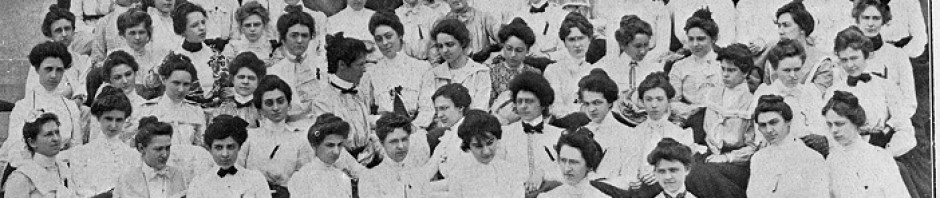
It’s hard for today’s collegians to contemplate spending December 24 through January 2 on campus. Most higher education institutions shut down for the holiday week. However, that week has been a significant one in the history of Greek-letter organizations.
Delta Gamma was founded over the 1873 Christmas holiday when three young women were unable to go home from the Lewis School. Alpha Omicron Pi began on January 2, 1897. Delta Gamma celebrates Founders’ Day on March 15, the date of Eta Chapter’s founding at Akron University. It is Delta Gamma’s oldest continuous chapter. Alpha Omicron Pi celebrates on or around December 8, founder Stella George Stern Perry’s birthday.
Chi Phi traces its history to the Chi Phi Society established on December 24, 1824 by Robert Baird at the College of New Jersey (later known as Princeton University). Phi Delta Theta, one of the Miami Triad, was founded on December 26, 1848. Its Founders’ Day is celebrated on March 15, the birth date of founder Robert Morrison.
Zeta Beta Tau was created on December 29, 1898 when a group of young men attending several New York universities met at the Jewish Theological Seminary. They formed an organization called ZBT. Sigma Nu became a Greek-letter organization on January 1, 1869. It was founded at Virginia Military Institute in Lexington, Virginia by three young men opposed to the hazing that was a part of a cadet’s life at VMI.
It is also hard to believe that any organization would plan a convention during the holiday season, but I know of several that occurred at that time. A convention that took place in Troy, New York from December 26-28, 1931, resulted in the creation of Phi Iota Alpha, the oldest Latino fraternity still in existence.
One of Pi Beta Phi’s conventions started in 1907 and ended in 1908. It took place in New Orleans over New Year’s Eve. (Am I the only one who thinks risk management nightmare about such an event happening in 2019?). Phi Gamma Delta held an Ekklesia that took place from December 31 through January 3, 1925 in Richmond, Virginia; there were 374 registrants. Another Ekklesia took place from December 29, 1933 through January 1, 1934 in Washington, D.C. Phi Gam held several Ekklesiai in the week between Christmas and New Year’s; these took place in 1916, 1917, 1920 and 1921.
I’d also like to take this opportunity to thank all of you who read these posts.
I never heard the name Austin Peay until I moved to southern Illinois. It’s mentioned frequently on local news, especially the Paducah station, during the sports update. Austin Peay State University, or “Austin P.” as some sportscasters call it, is located in Clarksville, Tennessee. I figured the university was named for a person, but I gave it little thought. It turns out that the person it is named for was initiated into the Centre College chapter of Kappa Alpha Order.
Kappa Alpha Order was founded at Washington College, now Washington and Lee University, in Lexington, Virginia on December 21, 1865. Its founders are James Ward Wood, William Archibald Walsh, William Nelson Scott and Stanhope McClelland Scott. Samuel Zenas Ammen, an 1866 initiate, who had fought in the war, is revered as a “Practical Founder.” Ammen’s “constant refinement of the ritual and creation of the constitution, by-laws, grip, symbols and regalia of the Order, along with his lifelong commitment,” afforded him that honor, according to the fraternity’s website. Robert E. Lee, the President of Washington College when the fraternity was founded, was named a “Spiritual Founder” at the 1923 convention.
Its original name was Phi Kappa Chi. Phi Kappa Psi was the first fraternity to have a chapter at Washington College and that organization protested the similar sounding name. The fraternity took on the name Kappa Alpha in April of 1866. Although the organization changed its name early in its history, it is sometimes confused with Kappa Alpha Society, one of the Union Triad, founded at Union College in 1825.
Austin Peay was the Governor of Tennessee from 1923 until 1927 when he died in office. Austin Peay Normal School was established in 1927 as a two-year junior college and teacher-training institution. In 1943, its name was changed to Austin Peay State University. Its sports teams are the Governors and the Lady Governors.
On November 19, 2011, the Zeta Tau chapter of Kappa Alpha Order was chartered at Austin Peay State University. It is the fraternity’s first active chapter on a campus bearing the name of an alumnus of the fraternity. Additionally, the fraternity was given Peay’s Kappa Alpha Order badge by the family and it is on display in the fraternity’s headquarters in Lexington, Virginia.
Congratulations to Camille Schrier,Miss America 2020, who was Miss Virginia 2019. She is a Kappa Delta and was initiated into the chapter at Virginia Polytechnic Institute and State University (“Virginia Tech”).
Second Runner Up – Miss Missouri 2019, Simone Esters, Alpha Chi Omega, University of Missouri
Second Runner Up – Miss Missouri 2019, Simone Esters, Alpha Chi Omega, University of Missouri
Third Runner Up – Miss Oklahoma 2019, Addison Price, Pi Beta Phi, Oklahoma State University
Five of the Top Seven were sorority women. It would be wonderful to have a group picture of the sorority women who competed. Can someone in the know please arrange that for next year’s contest. The women who competed were an impressive bunch as they all spoke about themselves in their intros as the beginning of the show.
Miss America 2020 will be chosen tomorrow, Thursday, December 19. More than a third of the state winners are sorority women. I think it’s a win for all of us if a sorority woman wins.
A friend asked if I saw this ad for ancestry.com. She knew it was right up my alley. My best guess is that her grandmother was a Delta Sigma Epsilon and she’s a Delta Zeta. If anyone has proof of the affiliations, please let me know. Thanks.
Do we decorate our trees with our organization’s ornaments? Of course we do!
Lu Ann Riegl Daniel’s collection of official Tri Delta ornaments
Caitlin Mae’s Tri Sigma tree
Lambda Chi Alpha Ornaments
One of Susan Norman’s Delta Zeta ornaments
Nann Blaine Hilyard’s Alpha Gamma Delta ornaments
Raggedy Ann Hannah, courtesy of Staige Davis Hodges
Heather Wilson Miller’s Pi Phi tree
Bonnie Myshrall’s ornaments
Franci Rocco Bayes’ Zeta Tau Alpha tree. The topper is a crown.
Chi Omega
Heather Wilson Miller’s Pi Phi angel ornament
Ellen Wenzel’s squirrel tree
Karen Gunther’s tree topper made by her mother. The angel has an arrow and a wine and silver blue dress. – Pi Beta Phi
Dana Moreland’s Alpha Omicron Pi ornament
Wanda Barton Yeatts was housemother at the Delta Zeta chapter at the University of Georgia where this was the chapter’s tree.
Wanda Barton Yeatts’ Delta Zeta tree
Leanne Sim Nickel’s Delta Gamma ornaments
Chi Omega
Christopher Radko anchor Santa, c. 1995 – Delta Gamma, courtesy of Staige Davis Hodges
Toni Clark Fletcher, Alpha Delta Pi
Toni Clark Fletcher, Alpha Delta Pi
Bonnie Myshrall’s ornaments
Toni Clark Fletcher, Alpha Delta Pi
Delta Gamma ornament – moon with Hannah fishing with an anchor. Custom made by J. Brandt, courtesy of Staige Davis Hodges
Beverly Hatcher’s ornament from her Alpha Omicron Pi chapter at the University of Toledo. She also has lots of panda and rose ornaments.
Anchor purchased at a Delta Gamma Convention, courtesy of Staige Davis Hodges
Chi Omega
Dana L. Moreland’s Alpha Omicron Pi tree
Alpha Gamma Delta
Caroline Cardwell’s Kappa Kappa Gamma tree
Modern day glass anchor, from a Delta Gamma ornament exchange, reverses to clipper ship, c. 2003, courtesy of Staige Davis Hodges
Cotton batting anchor ornament, c. 1895 – Delta Gamma, courtesy of Staige Davis Hodges
Delta Gamma, courtesy of Staige Davis Hodges
Chi Omega
Football Dresden candy container signed by players from Albion College in Michigan (1921-24) and also by their girlfriends, all of whom were Delta Gammas from Zeta Chapter-Albion. Tag attached has embossed Greek Delta Gamma letters. It has been sent to the Delta Gamma Archives, courtesy of Staige Davis Hodges
Pi Beta Phi
Chi Omega
Tara Wheeler Prather’s squirrel tree
Ceramic anchor commemorating a year as a Delta Gamma Field Consultant (CDC), courtesy of Staige Davis Hodges
Chi Omega
Blown glass anchor, c. 1910-20 – Delta Gamma, courtesy of Staige Davis Hodges
Chi Omega
Hand painted ivorine anchor, c. 1900 – Delta Gamma, courtesy of Staige Davis Hodges
Chi Omega
Delta Gamma, courtesy of Staige Davis Hodges
Chi Omega
An angel given to Fran Becque by Evelyn Peters Kyle, early 1990s – Pi Beta Phi
Margaret Furlong anchor angel – Delta Gamma, courtesy of Staige Davis Hodges
Chi Omega
Delta Gamma, courtesy of Staige Davis Hodges
“This angel was given to me by my Grandmother as a child. She had the ornaments made for her granddaughters ( all who later followed her footsteps and joined Pi Phi) she is joined by other angels collected over the years on my angel tree.” Annemarie Long Wilson
Elisabeth Long Young’s angel ornament from her Grandmother Long (a charter member of the University of Louisville chapter).
Cotton batting anchor, c. 1890 – Delta Gamma, courtesy of Staige Davis Hodges
Delta Gamma, courtesy of Staige Davis Hodges
Hannah and her anchor – Delta Gamma, courtesy of Staige Davis Hodges
Delta Gamma, courtesy of Staige Davis Hodges
Anchor ornament – c.1860 – Delta Gamma, courtesy of Staige Davis Hodges
KA Sullivan
KA Sullivan, a gift from a Grand Council member when KA was on Council.
KA Sullivan’s first Theta Phi Alpha ornament
Centennial ornament belonging to KA Sullivan
Alpha Delta Pi ornaments
KA Sullivan
Amy Novara Murphy’s Alpha Gamma Delta squirrel tree
Alpha Sigma Tau
Deb Scarlett’s Pi Phi tree
Ronda Doane Deer’s Chi Omega tree
Shelly Sheehy Troll’s Theta Phi Alpha ceramic penguin tree
Just a few of Rene Matz Thompson’s Gamma Phi Beta ornaments with a KD (Suzy’s Zoo) on the side.
Nikki Selander Heyd’s Kappa Alpha Theta tree with ornaments from Theta sisters participating in an ornament exchange
Kristin Windeshausen Henkenius
Kristin Windeshausen Henkenius
Caroline Cardwell’s Kappa Kappa Gamma tree
Kristin Windeshausen Henkenius
Kristin Windeshausen Henkenius
Kristin Windeshausen Henkenius
Kristin Windeshausen Henkenius
Eryn Lynn Hackett Fisher’s Chi Omega owl tree
Sherri Bledsoe Halford’s Alpha Delta Pi ornament
Jane Horling’s Theta tree with many kite, pansy, and black and gold ornaments.
Marla Schroeder’s angel and arrow tree
Sharon Kern Wiechman’s Alpha Omicron Pi tree
Julie Dunn Eichenberg’s Gamma Phi house
Julie Dunn Eichenberg’s Gamma Phi Beta tree
Linda Miller Murphy’s Pi Phi and P.E.O. tree
A sampling of some of the official Phi Mu ornaments offered through the Fraternity. Some dating back to the late 80’s/early 90’s. Two limited edition ornaments were created through a partnership with Radko and remain cherished keepsakes for many of our members.
Kathy Stebleton Schultz‘s Kappa Alpha Theta tree
My thanks to Carolyn McFarland Hunter, Staige Davis Hodges, Keri Smathers Pye, Lisa Tegels, Karen Chevalier, Karen Gunther, Nann Blaine Hilyard, Ellen Wenzel, and Penny Procter, Amy Novara Murphy, Logan Tootel, Sally Belknap, Deb Scarlett, Ronda Doane Deer, Jessica Strange, Shelly Sheehy Troll, Rene Matz Thompson, Annemarie Long Wilson, Bonnie Myshrall, Dana Moreland, Beverly Hatcher, Ellen Wenzel, LuAnn Riegl Daniel, KA Sullivan, Elisabeth Long Young, Tara Wheeler Prather, Sharon Kern Wiechman, John Tilden, Charlie Ball, Caroline Cardwell, Sherri Bledsoe Halford, Nikki Selander Heyd, Kristin Windeshausen Henkenius, Marla Schroeder, Eryn Lynn Hackett Fisher, Linda Miller Murray, Julie Dunn Eichenberg, Lynn Storlien McGraw, Kathy Stebleton Schultz, Jane Horlings, Robin White Fanning, Tori Clark Fletcher, Franci Rocco Bayes, Susan Norman, Heather Wilson Miller, Lisa Gebken Thibault, Karen Ann Yaksich Kurlander, Leanne Sim Nickel, Wanda Barton Yeatts, Ginger Hicks Smith, Kelly Brest van Kampen, Caitlin Mae, Lu Ann Riegl Daniel
“Wish I felt better about my own chapter which is now on probation. Received a letter from Nat’l regarding that. So sad!” That message was on a holiday car in yesterday’s mail. The card’s cover had “joy” written on it, but my friend’s note about her chapter was anything but joyful. Her organization and her chapter doesn’t matter. She knows that I advocate for GLOs and wanted me to know that she was hurting about her chapter’s fate. Truth be told, it’s getting harder and harder to advocate for GLOs when members do not understand how their actions reflect on all of us.
My friend initiated in the 1950s. In the six decades since her initiation she has treasured her membership. I know plenty of sorority volunteers, but my friend isn’t one of them. She’s one of the rank and file members who love and support, but never served as an inter/national volunteer. I say this only to provide evidence that when some members – or maybe the entire chapter – through their actions or their neglect place the chapter’s existence in jeopardy, it hurts all the way down the line.
Living in the chapter house is one of her treasured memories. I recall a conversation we had when she visited the house a few years ago. She said it was like going back in time to a favorite place. As she stood in the front hall, memories flooded her, she said.
Those of us whose chapters no longer exist know where we were when we heard the news that our chapter would or had closed. Certainly it’s a little more tolerable when one receives a letter or email rather than have the fact splashed on the news because of a particularly egregious crime. No one wants to know that the current members of one’s chapter have no regard for human life or the care and concern to get medical attention for a member. Or have no idea about the bounds of public decency.
I often tell the collegiate members I speak with that they are one little link on a very long chain. A chain is only as strong as its weakest link. They need to value and respect those who came before them and they need to be cognizant of those who will come after them. It is each current member’s responsibility – a responsibility they chose to accept willingly when they chose to become a member – to leave the organization better than they found it.
I think about what to tell my friend when I send her a holiday card. Knowing nothing of her chapter’s affairs I suppose I could go internet digging, but I will not. I will tell her I hope the chapter follows through on putting it back in good standing. Learning from one’s mistakes is a valuable lesson. We can hope that the chapter members truly learn something from this episode.
Last night, Cindy Marina, Miss Albania, made it to the top 20 in the Miss Universe contest. Marina is a volleyball player for the University of Southern California. She initiated into the Pi Beta Phi chapter at Duke University and affiliated with the chapter at USC when she transferred. Zozibini Tunzi, Miss South Africa, is the newly crowned Miss Universe 2019.
An afternoon spent watching Harper Lee’s book come to life
One of my P.E.O. sisters is supportive of the arts and she always brings tickets to local productions as her auction item in support of P.E.O. projects. I tend to win the items because I usually bid higher than face value. We used the tickets yesterday afternoon to see SIU Theater’s production of Harper Lee’s To Kill a Mockingbird. Lee was a Chi Omega. The production was adapted by Christopher Sergel and it was directed by our friend and fellow Rotarian Segun Ojewuyi. It was an excellent performance. Kudos to all involved!
I suspected she was a sorority woman and I was right!
As I sat in the car waiting for my husband, I flipped through Life and Style of Southern Illinois, a slick magazine that comes quarterly with our newspaper subscription. I read this paid advertorial (that is a real thing, apparently) and was certain the doctor is a sorority woman. And she is! Dr, Kelli Webb, a plastic surgeon in southern Illinois, is a Sigma Kappa and an Order of Omega member. She includes that information on her official bio. I thank her for being a proud sorority woman!
I’d bet she was one of the Top 25 Seniors her graduation year, but I couldn’t find that info anywhere. SIUC you might want to take a clue from the University of Illinois and put those lists of Top 25 Seniors somewhere where people can see them, just like the Bronze Tablets.
Alpha Omicron Pi was founded on January 2, 1897, at the home of Helen St. Clair (Mullan). She and three of her Barnard College friends, Stella George Stern (Perry), Jessie Wallace Hughan, and Elizabeth Heywood Wyman had pledged themselves to the organization on December 23, 1896. That first pledging ceremony took place in a small rarely used upstairs room in the old Columbia College Library.
Celebrating a Founders’ Day on the second day of the new year proved to be a challenge for the organization, so Alpha Omicron Pi now celebrates Founders’ Day on December 8, Stella George Stern Perry’s birthday.
Stella George Stern Perry
Alpha Omicron Pi’s second chapter was halfway cross the country and to the south, 1,300 miles away from Manhattan. Stella contacted Evelyn Reed, a classmate from New Orleans. Evelyn’s sister, Katherine, was a student at H. Sophie Newcomb Memorial College.
On September 8, 1898, Katherine Reed became the first pledge of the Pi Chapter at Newcomb College. Not only was it Alpha Omicron Pi’s second chapter, but it was also the second women’s fraternity at Newcomb. A Pi Beta Phi’s chapter was established in 1891. “The little Greek community at Newcomb was very delightfully entertained at a charmingly original birthday party, given by the Alpha Omicron Pi girls, to celebrate the first anniversary of the founding of their chapter,” reported the Pi Phi chapter in the January 1900 Arrow of Pi Beta Phi.
Years later, Perry reflected on the founding of Pi Chapter and the differences between the institution in New Orleans and the one at which AOPi was founded, Barnard in New York City. She said:
If Alpha Omicron Pi can bring a closer connection between the beauty and kindliness of the Newcomb spirit, and the sane bluff stability that marks colleges farther North and West we shall do a good work in making the sweetness of the one a little more filled with the light of common sense and the light of the other a little softer with the sweetness of courtesy.
On December 5, 1776, five College of William and Mary students founded the Phi Beta Kappa Society. The first meeting of the organization took place in the Old Raleigh Tavern’s Apollo Room.
As the first Greek-letter collegiate society, it led the way for the other organizations, both social and honorary, which followed it. Among its hallmarks were a badge, an oath of secrecy, a Greek motto, an initiation ceremony, and a handshake. Phi Beta Kappa’s motto is “Love of learning is the guide of life.”
The chapter at the College of William and Mary might have been a footnote in history had it not been for Elisha Parmele, a former Yale College student and Harvard College alumnus. While in Williamsburg, he became associated with Phi Beta Kappa and obtained charters from the society to establish chapters at Harvard and Yale. When William and Mary faced a temporary closure in 1781, prior the British invasion, the Phi Beta Kappa chapter disbanded. However, Parmele had used the charters to establish the chapter at Yale in 1780 and one at Harvard in 1781. The Dartmouth chapter was founded in 1887 and the society became an honorary academic association.
Parmele became a minister; in those days, most Yale and Harvard grads pursued the ministry. He died at the age of 31. The most lasting accomplishment in his short life was likely establishing those two Phi Beta Kappa chapters in New England.
The first two women to become Phi Beta Kappa members were University of Vermont Kappa Alpha Thetas. In 1875, Lida Mason and Ellen Hamilton Woodruff became the first of many fraternity women who have been members of the organization. The first Phi Beta Kappa chapter at a women’s college was established in 1893 at Vassar College.
The Phi Beta Kappa “keys” presented to Lida Mason and Ellen Hamilton (Photo courtesy of University of Vermont Special Collections and University Archives)
Some Phi Beta Kappa members of Pi Beta Phi, 1906
From November 27-December 1, 1951, the National Panhellenic Conference (NPC) met in Williamsburg. Edith Reese Crabtree, Kappa Kappa Gamma, served as chairman. Alpha Phi Margaret Hutchinson served as secretary and Delta Gamma Mavis Mann was treasurer.
The 11 associate members – Alpha Epsilon Phi, Phi Sigma Sigma, Delta Phi Epsilon, Sigma Delta Tau, Theta Phi Alpha, Alpha Sigma Alpha, Alpha Sigma Tau, Delta Sigma Epsilon, Pi Kappa Sigma, Sigma Sigma Sigma, and Theta Sigma Upsilon – were admitted to full membership. Thus, NPC took on its modern face. The total number of NPC members was 31 (today it is 26 due to several mergers).
On December 1, the delegates gathered into Phi Beta Kappa Hall at the College of William and Mary. They were there to commemorate the 175th anniversary of Phi Beta Kappa’s founding on December 5, 1776. The Phi Beta Kappa Hall that the delegates visited is not the one that exists today on the campus; the one they visited was built in 1926. On December 29, 1953, a fire destroyed the auditorium. It was rebuilt and the building is now known as Ewell Hall.
Ewell Hall was known as Phi Beta Kappa Hall when the 1951 NPC meeting took place in Williamsburg and the delegates visited it.
December first harkens to the end of the fall semester and the holiday break at most colleges and universities. For three GLOs, it also marks the day on which the organizations were founded.
According to the Lambda Theta Alpha website, Kean introduced bilingual and Latino/Caribbean studies in 1975. Seventeen women talked about forming a sorority for Latina women. They wanted an organization which would “integrate itself into the social, political and community service arena.” The sorority’s purpose is:
to provide a sisterhood based on unity, love and respect in an effort to foster the development of strong leaders who will then provide and practice political, social and cultural activities. It shall also be the purpose of Lambda Theta Alpha to promote unity through charitable and educational programs, maintain a higher standard of learning and serve as a voice for all students.
Lambda Theta Phi honors two Kean faculty/administrators who played integral roles in the founding of the organization. These men, Cayetano J. Socarrás, Ph.D., and José A. Quiles, Ph.D., are the Fraternal Fathers who mentored and guided the 14 Founding Fathers.
Sigma Lambda Upsilon/Señoritas Latinas Unidas Sorority, Inc., provides “sisterhood and support while also promoting academic achievement, service to the community, leadership, and cultural enrichment.”
There are many posts on this blog. Use the search button to find the posts about your organization.
Welcome!
Welcome! Chances are good you found this blog by searching for something about fraternities or sororities.
I was the last person anyone would have suspected of joining a sorority in college. I am sure I would have agreed with them, too.
When I made my way to Syracuse University, I saw the houses with the Greek letters that edged Walnut Park, and wished I could tour them. My roommate suggested I sign up for rush (as it was then called, today it’s known as recruitment) and go through the house tour round and then drop out of rush. It sounded like a plan. I didn’t realize that I would end up feeling at home at one of the chapters. And that I would become a member.
In this blog I will share the history of GLOs and other topics. I wrote a dissertation on “Coeducation and the History of Women’s Fraternities 1867-1902.″ It chronicles the growth of the system and the birth of the National Panhellenic Conference.
My Master’s thesis details the history of the fraternity system at Southern Illinois University Carbondale from 1948-1960. The dates are significant ones and the thesis is available on the top menu.
I have done research at the Student Life Archives and have written several histories of University of Illinois fraternity chapters for the Society for the Preservation of Greek Housing.