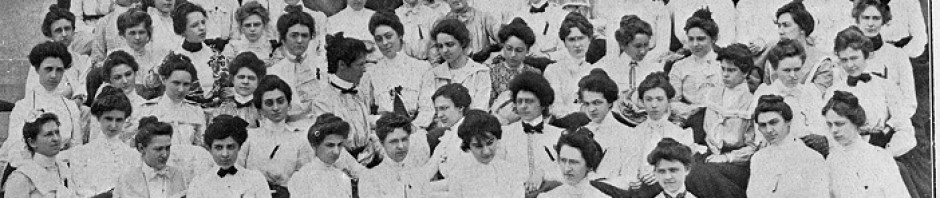
Next Monday, it’s International Badge Day. Sorority women (and fraternity men, too) are encouraged to wear their badges/pins or letters.
Congratulations to the Penn State University fraternity and sorority members who participated in THON 2020. More than $11 million was raised. Amazing!
And a photo for all the sorority women and fraternity men who attended their organization’s winter conferences. Kudos to the Sig Eps at Arkansas on their recruiting efforts.
#WHM2020 is coming up and I’ve been working on posts – one for each NPC and NPHC group. I try not profile the women listed as notables on each organization’s website, so each post takes a good deal of research. I get caught up in a rabbit hole or two. Sometimes there are questions that I cannot answer despite all the internet resources at hand. Yesterday’s rabbit hole was a husband who seemed to disappear leaving no trace of life. I combed several sites looking for something about his death and found absolutely nothing. If fiction were my forte, there would be a mystery book that came out of that rabbit hole. Sometimes I get hours into a person’s life and have to admit defeat because there are too many unanswered questions. Other times, things seem to go off on a rail like the doctor who lost her medical license in one state and then was arrested for an expired car tag in another state. Needless to say, she did not make the cut. Hope you will follow the posts. If you do not want to subscribe to email updates when a post is published, join the facebook group where each blog post will be linked to the page.
The women who fought for suffrage are on my mind. Tomorrow is the 100th anniversary of the founding of the League of Women Voters. Carrie Chapman Catt was one of the founders of that organization. A friend sent me links to Catt and Eleanor Roosevelt speaking. It’s a treat to hear their voices.
On August 25, 1945, Roosevelt wrote this in her My Day newspaper column:
Many women today take for granted their right to vote, and some years ago I remember a very young newspaper girl in upstate New York who asked me who Susan B. Anthony was. It is so easy for us to forget those who made the fight for the things today we feel we have always had by right. On this anniversary, therefore, I should like to mention not only Miss Anthony, but Elizabeth Cady Stanton, Lucretia Mott, Lucy Stone, Anna Howard Shaw and Mrs. Carrie Chapman Catt.
Mrs. Catt not only fought for suffrage, but after we had gained it devoted years of her life to bringing about better understanding among women of different nationalities. Her work—which not only gave the women of this country finally the right to vote, but which has made them conscious of the responsibility which accompanies that vote—will never be forgotten by any of us who are aware of the latent power which has not yet been used by women. This power is going to be more important in the next few years than it has ever been. Mrs. Catt’s work in organizing women in different countries, and making them work together, must be carried on, since I believe it is going to depend more than ever on women to build a peaceful world.
Carrie Chapman Catt was a member of Pi Beta Phi. She joined the organization while a student at Iowa State University. Eleanor Roosevelt was an Honorary Member of Alpha Kappa Alpha. Anna Howard Shaw who is mentioned in the column was an Honorary Member of Kappa Alpha Theta.
Roosevelt also presented Catt with the Chi Omega’s National Achievement Award in 1941.
Memorabilia from the Chi Omega archives. Mrs. Collins is Mary Love Collins, an influential Chi Omega who was at the helm of the organization for decades.
Mrs. Roosevelt presents the National Achievement Award to Carrie Chapman Catt. Mrs. Catt’s dress was navy and the corsage was given to her by Pi Beta Phi’s Grand President, Amy Burnham Onken who attended the presentation at the White House.
I recently came across an issue of a magazine for which I wrote an article on a suffragist who was a sorority woman. In the heading was the word “suffragette.” I had not noticed that when the article was published, but I know I did not include the word in my original copy. I suspect the editorial board made that change. Being incensed a few years after the fact does no good. But it does give this post a title, so something good has come of it.
To explain the difference, I offer these two explanations from the interwebs:
Some of the 26 NPC groups have more suffragists than others. One needs to look at numbers to explain this. Alpha Delta Pi and Phi Mu have founding dates in the 1850s, but did not expand beyond the Wesleyan campus until the 1900s. The groups founded between the 1860s and 1880s tend to have suffragists among their number. One part of the reason for this is the type of woman who attended college at a time when few of her contemporaries even contemplated that notion. It took a special type of woman to face the obstacles those early female students faced. Some were likely the type to question the status quo and work for change.
The other part is the number of chapters that were established and the number of members. Chapters in pre-1900 might have had a dozen or maybe two dozen women as active members. The number of women under discussion – suffragists who were sorority women – is not a very large pool because there weren’t that many woman who were sorority women as opposed to the female population. But having even a small amount of members gives an opportunity to have at least some representation.
As new sororities were formed in the 1890s and into the early 1900s, more sorority women were added to the total of women supporting suffrage.
Co-eds from George Washington University. In 1913, there were three NPC organizations on campus – Pi Beta Phi (1889), Chi Omega (1903), and Sigma Kappa (1906).
One of the first things the founders of Delta Sigma Theta did was to march in the DC Suffrage parade. Mary Church Terrell, an Honorary Member, joined them in their efforts.
I wrote this a few years ago, but it is timely now. If offers a first hand account of the Suffrage Parade and how some women were targeted.
I have several posts about suffragists planned for my #WHW2020 posts when I spotlight an alumna from each of the 26 NPC and 4 NPHC groups. Subscribe for updates to have these posts delivered to you. I have also written several posts about suffragists. This site is searchable I wrote this last month for Alpha Kappa Alpha’s Founders’ Day, but it, too, is timely in this post.
Wish I could be in Ames on Friday. It will be a day of celebrating. By the way, Dr. Jane Cox, who is performing as Carrie Chapman Catt, is an alumna initiate of Catt’s Pi Phi chapter at Iowa State.
Until the advent of social media, staying connected to the people who mattered in our lives took effort. Calling on the phone, visiting in person, or writing notes and letters usually required planning and doing.
I love to talk about Grace Goodhue Coolidge’s Round Robin letters, the ones she wrote with the Pi Phis who attended the 1915 Convention in California together. The letters lasted until the end of their lives. They told of everyday events in their lives. They shared recipes, books read, the ups and downs of life and in the process stayed connected even though they lived in different places.
This fall, the Wall Street Journal published an article about a group of Iowa State Gamma Phi Betas who vowed to stay connected. And that they have!
Jenna Bush, Kappa Alpha Theta, and Hoda Kotb, Delta Delta Delta, interviewed the women on the Today show this week. (Many of us wish they would have mentioned their own affiliations, but perhaps they did and it was cut from the final version.) The women were surprised by a group of Gamma Phis who traveled to New York, paying their own ways, to surprise the alumnae of their chapter. I hope these young women make the decision to stay connected.
The weekend was a full one, from AFLV in Indy to a Super Bowl in Miami with celebrations across Missouri and Kansas and everywhere in between.
Super Bowl Sunday Congratulations!
Best Use of History in Super Bowl Tweets
And a P.E.O. Connection
Cottey College in Nevada, Missouri, is owned by the P.E.O. Sisterhood.
And a Superb Owl to You, Too.
One of my offspring texted me and the auto check changed Super Bowl to Superb Owl which immediately made me think of my owl mascot friends who belong to Chi Omega and Kappa Kappa Gamma. How could I resist this Superb Owl tweet from the Smithsonian?
And then my favorite Chi Omega, Archivist Lyn Harris, had some very special moments at the Fireside Leadership Training. Congrats, Lyn, and I love the emoji!
The Association of Fraternal Leadership & Values (AFLV)
This weekend, members of fraternities and sororities gathered in Indianapolis for AFLV-Central. Educational, motivational, intense and incredible all rolled into one. I hope those who attended will bring the excitement and commitment of the weekend back home with them and work to improve their own communities. Kudos to those who put it all together and made it work.
Happy Friday! January has been a longgggggggggg month, but the days are getting longer.
Someone asked about reading the magazines of GLO organizations. Most current issues are available on-line. Visit the organization’s website and do some poking around. Some organizations have the full run available. And now you know one of my favorite ways to waste time.
An Update Regarding Harvard University
An Infuential Kappa Alpha Theta
Although her talk already happened, I was happy to see that she is a Kappa Alpha Theta.
Calling D.C. GLO Members
Here’s something to put on your calendars. Edith Mayo is a Kappa Kappa Gamma. Carrie Chapman Catt was a Pi Beta Phi and Anna Howard Shaw was an honorary member of Kappa Alpha Theta.
While researching my crop of #WHM2020 profiles, I came across this snippet about Anna Howard Shaw in an Alpha Delta Pi magazine.
Kappa Alpha Theta turns 150 today! In 1867, 17-year-old Bettie McReynolds Locke (Hamilton) was the first female to enroll in Indiana Asbury College (now DePauw University) in Greencastle, Indiana. Although the first decision to allow women to attend Asbury was made in 1860, it was rescinded several times with debate following each decision.
Bettie was the daughter of Dr. John Wesley Locke, a mathematics professor, and she was a formidable student. During her sophomore year, she received an invitation to wear a Phi Gamma Delta badge. The badge did not come with a dating arrangement as later tradition would have it, nor did it come with the benefits given to men who were initiated into the fraternity. When she declined the badge because it did not come with full membership rights and responsibilities, the Phi Gamma Delta chapter substituted a silver cake basket, inscribed with the Greek letters “Phi Gamma Delta.”
Bettie Locke
With encouragement and prodding from her father, a Beta Theta Pi alumnus, and her brother William, a Phi Gamma Delta, she began plans to start her own fraternity. She and Alice Allen, another female in the first coeducational Asbury class, studied Greek, parliamentary law and heraldry with an eye towards founding a fraternity for women.
The Kite will debut later today. I’ll put the link in here as soon as I have it.
On January 27, 1870, Bettie Locke stood before a mirror and repeated the words of the Kappa Alpha Theta initiation vow she had written. She then initiated Alice Olive Allen (Brant), Bettie Tipton (Lindsey), and Hannah Fitch (Shaw). Five weeks later, Mary Stevenson, a freshman, joined the group. Badges larger than the current Kappa Alpha Theta badges were painstakingly designed by the founders and made by Fred Newman, a New York jeweler. The badges were first worn to chapel services by the members of Kappa Alpha Theta on March 14, 1870.
Kappa Alpha Theta’s extension quickly took place. Locke’s father had a friend who was a trustee at Indiana University in Bloomington. The friend had a daughter, Minnie Hannamon, who was college age. In April, a letter was written to Hannamon and Locke visited Bloomington in early May. On May 18, 1870, Locke installed Kappa Alpha Theta at Indiana University with the initiation of the three charter members. It was evidence of the policy outlined in the original constitution giving the mother chapter at Indiana Asbury University the power to establish other collegiate chapters.
The next three chapters were short-lived. In December of 1870, a chapter was established at Cincinnati Wesleyan University, an experiment that only lasted six months. A chapter at Millersburg College in Kentucky lasted less than a year. The one at Moore’s Hill College in Indiana existed for five years. The latter was the first Theta chapter to feel the pressure of faculty opposition as well as a limited number of women at the institution.
Northwestern Christian College, today known as Butler University,
became home to the Indiana Delta chapter of Kappa Alpha Theta on February 27,
1874. When Kappa Alpha Theta changed the
naming system of chapters, it became the Gamma chapter. Two members of the chapter at Indiana
University, Teresa Luzadder Gregory and Laura Henly, assisted in the formation
of the chapter. The chapter was inactive
from February 25, 1886 through November 3, 1906.
The Epsilon chapter at Wooster College was known as Ohio Alpha when it was chartered on May 12, 1875. The chapter ceased to exist in 1913 when the college administration ordered all the fraternities to close.
The second national convention was held in Indianapolis on May 14, 1875, with delegates from four chapters in attendance. Due to the efforts of University of Indiana Thetas, a chapter was founded in 1875, at Illinois Wesleyan College. It was known as Illinois Alpha. Twenty years later, the determination was made that there were not enough fraternity-minded students to continue at Illinois Wesleyan. The charter was transferred to the chapter at the University of Illinois which became known as the Delta chapter.
Kappa Alpha Theta, along with I.C. Sorosis (Pi Beta Phi), Kappa Kappa Gamma, and Delta Gamma expanded throughout the midwest in the 1870s and early 1880s, setting the stage to the Panhellenic system we know today. In 1881, Alpha Phi expanded to Northwestern University, quickly followed by Gamma Phi Beta’s second chapter at the University of Michigan. These six and Delta Delta Delta, founded the National Panhellenic Conference in 1902.
On January 21, 1869, the P.E.O. Sisterhood was founded by seven young women. They were among the 85 or so collegiate level students enrolled at Iowa Wesleyan University. Legend has it that some, but not all of the seven had been asked by Libbie Brook to join the new chapter of I.C. Sorosis (now known by its Greek motto, Pi Beta Phi). On that unseasonably warm January day, Franc Roads and Hattie Briggs were sitting on the steps of a wooden stile at the southeast entrance to the campus and made the decision to start a society of their own. They gathered five others, Mary Allen, Ella Stewart, Alice Bird, Alice Coffin, and Suela Pearson, and took the 35-word oath that Alice Bird had written.
Many P.E.O.s think these seven had a hand in all that is done in P.E.O. today. When someone says that they want to do things exactly as the founders did in 1869, I usually chuckle to myself. The initiation ceremony and the meeting procedures, save for those 35 words that Alice Bird wrote in 1869, have been created over the past 151 years,
Five of the seven founders graduated in June, six months after the founding. Ella Stewart did not graduate because she was needed at home. Suela Pearson, the sophomore among the seven, could have hardly kept the organization going by herself in the fall of 1869. Luckily a few others had become members. After Suela graduated, she moved to Cleveland and had little opportunity to interact with P.E.O.s. Hattie died in 1877, Alice Coffin in 1888, and Ella in 1894.
Mary Allen Stafford and Franc Roads Elliott became involved again as mature women. Alice Bird Babb was the only Founder involved in P.E.O. for decades, from its beginnings to its North American prominence.
Alice Bird Babb
The P.E.O. Founders were not expansionists. They did not take the organization to locations outside Mount Pleasant. From 1869 through 1885, all 17 new chapters were established by those other than the founders. It was the women who followed in the founders’ footsteps who built and nurtured the Sisterhood. These women, whom I call the Builders, worked for the organization and helped it continue on when its future was tenuous. And truth be told, PEO’s future was precarious in the 1870s.
The first PEO convention took place in January 1875. There were only 6 chapters and 3 were in collegiate institutions – Iowa Wesleyan, Mount Pleasant Female Seminary and the Jacksonville Female Seminary in Illinois. The latter two chapters would soon close.
That the organization is here today is a testament to those who came after the seven founders. While I am grateful to those seven for founding P.E.O., I also give my gratitude to those who followed in the founders’ footsteps and devoted themselves to making it what it is today, a Philanthropic Educational Organization, helping women pursue their educational goals. Few know their names and their stories are generally unknown. They, along with the founders, deserve gratitude. Let’s remember them too, today!
There are many posts on this blog. Use the search button to find the posts about your organization.
Welcome!
Welcome! Chances are good you found this blog by searching for something about fraternities or sororities.
I was the last person anyone would have suspected of joining a sorority in college. I am sure I would have agreed with them, too.
When I made my way to Syracuse University, I saw the houses with the Greek letters that edged Walnut Park, and wished I could tour them. My roommate suggested I sign up for rush (as it was then called, today it’s known as recruitment) and go through the house tour round and then drop out of rush. It sounded like a plan. I didn’t realize that I would end up feeling at home at one of the chapters. And that I would become a member.
In this blog I will share the history of GLOs and other topics. I wrote a dissertation on “Coeducation and the History of Women’s Fraternities 1867-1902.″ It chronicles the growth of the system and the birth of the National Panhellenic Conference.
My Master’s thesis details the history of the fraternity system at Southern Illinois University Carbondale from 1948-1960. The dates are significant ones and the thesis is available on the top menu.
I have done research at the Student Life Archives and have written several histories of University of Illinois fraternity chapters for the Society for the Preservation of Greek Housing.