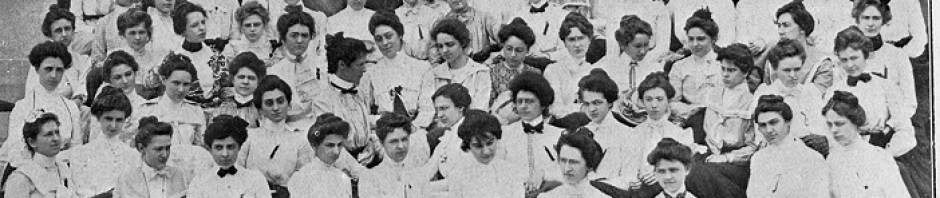
Happy 118th Birthday, NPC!

May 24, 1902, is a special day for the National Panhellenic Conference (NPC), the umbrella organization of 26 women’s fraternities/sororities. I’m posting this a day early, so tomorrow can be a celebration. A first meeting of seven women’s organizations happened in Boston in 1891, but little was accomplished. There was also a day at the 1893 Columbian Exposition in Chicago. However, little happened to foster cooperation between the women’s fraternities and sororities.

Kappa Kappa Gamma organized the meeting in 1891, but it was Alpha Phi that called the 1902 meeting. Margaret Mason Whitney, Alpha Phi’s National President, sent a postcard to the women scheduled to attend the first meeting.

The postcard reads:

Inter-sorority Conference, Chicago

On May 24 (Saturday) at 2:30 p.m. (sharp) the following representatives of Greek letter national college fraternities will meet at Mandel’s Tea Room to discuss rushing and pledging.

Pi Beta Phi, Miss Gamble, Detroit, Mich

Kappa Alpha Theta, Miss Laura Norton, 2556 N. Ashland Ave., Chicago

Kappa Kappa Gamma, Miss Margaret Jean Paterson, 6117 Kimbark Ave.

Delta Gamma, Miss Nina F. Howard, Glencoe, Ill.

Gamma Phi Beta, Miss Lillian Thompson, 326 W. 61st Place

Delta Delta Delta, Miss Kellerman

Alpha Phi, Miss Ruth Terry, 1812 Hinman Ave., Evanston

We trust nothing will prevent your being present.

Margaret Mason Whitney, President Alpha Phi

May 17, 1902

Among the women who attended the 1902 meeting was Delta Delta Delta’s Grand Treasurer Ivy Kellerman (Reed, Ph.D.). At the time, she was a doctoral student at the University of Chicago and a Phi Beta Kappa. She would become a linguist, lawyer, wife and mother who was an ardent proponent of the international language Esperanto.

Delta Gamma’s delegate, Nina Foster Howard, wrote for her family’s publication Farm, Field and Fireside. In 1905, she and a friend started a violet farm in Glencoe, Illinois.

Minnie Ruth Terry was Alpha Phi’s delegate. She was a Phi Beta Kappa at Northwestern, and she studied in Europe after graduation and then taught French. She is the one who made the arrangements for the site of the meeting at the Columbus Safe Deposit Vaults. Also known as the Columbus Safety Vaults, the fee was the yearly $5 safe deposit box rental. The room could seat 40 comfortably, and the building was located at 31 North State Street. 

Lillian W. Thompson, Gamma Phi Beta, served as Chairman at the 1913 meeting. She attended the 1902 meeting and shared her experiences in an article in The Crescent of Gamma Phi Beta. It was reprinted in many of the other magazines in 1913:

This sort of meeting was quite new to me. I had only the vaguest idea of what the delegates were expected to do; and having been brought up in the good old school in which those who were not of were against us, I had no great desire to meet my friends the enemy. There was no time to debate, however, and nothing to do but to go, so one afternoon in September [sic], I entered the lunch room at Mandel’s looking for a group of women wearing fraternity pins. I easily found them, introduced myself, and then racked my brains for topics of conversation which should be both polite and safe; for I had a most uneasy feeling that some fraternity secret might escape me unawares, and fall into hostile hands.

Mandel Brother’s, Chicago, Illinois, Early 1900s

The group moved from Mandel’s to the site of the meeting itself:

Miss Terry, the delegate from Alpha Phi, whose duty it was to make all the arrangements, had found a most appropriate place for our meeting — a safety deposit vault; and before long we were admitted through heavy iron gratings to a long passage way, which led at last to a director’s room, closed by a massive wooden door which seemed amply able to keep the biggest secrets from escaping to the outer world. We all sat down at the big table, and for the first few minutes there seemed to be a be a vague feeling of insecurity — of suspense. We were waiting, I think, for that illusive, and yet most potent thing, ‘the tone of the meeting’ to be established, and until some one supplied it we were ill at ease.

This duty fell to Miss Terry, our chairman, and as I look back on that first meeting, I can plainly see that the whole Pan-Hellenic movement was given its successful start by her. Miss Terry is one of those calm, well balanced, fair-minded women, who state business in such a clear unbiased way that one feels impelled at once to consider things without prejudice.  Gradually we all warmed to the work, forgot our strangeness, and talked over Alpha Phi’s rushing agreement with the utmost interest and frankness. Before we left, a most friendly spirit had developed; we had enjoyed our afternoon, saw plenty of work ahead of us, and looked forward with pleasure to meeting again.

In a year or so, the director’s room became too small for us. A morning meeting was added to the afternoon session, and we decided to meet at a hotel and to take lunch together, that we might have more opportunity to get acquainted. By this time I had begun to discover a number of ‘typical Gamma Phis’ who had mysteriously strayed into other fraternities. The discussions, too, had been bringing out the strong points of the various societies….At each meeting we learned some scheme which we longed to try in our own fraternity, and went home full of plans for introducing it.

With 11 years of experiences on which to reflect, she added:

As year after year went by, we were delighted to see the work of our conference succeeding, though slowly. Our own meetings seemed like the chapter meetings of some fraternity, rather than a gathering of delegates from so many different groups. It is astonishing to me, as I look back, to note the unruffled peace and good will of our conferences. Even when there were disputes to settle, there was no bitterness or suspicion. Everyone knew that every one else was trying to find out what was best and how to do it. This feeling of kindliness and confidence has been the greatest result of our meetings. If we can pass this on to the fraternity world, we shall have done the one thing necessary to remove all criticisms of fraternities.

Posted in Fran Favorite, National Panhellenic Conference | Tagged , , | Comments Off on Happy 118th Birthday, NPC!

RIP Phyllis George, Zeta Tau Alpha

Phyllis George “brought great honor to both local and national Zeta chapters when she was first crowned Miss Dallas, then Miss Texas and finally Miss America,” according to the Zeta Tau Alpha page in the 1971 Yucca, the yearbook of North Texas State University.

Miss America 1971, Phyllis George, initiated into the Gamma Phi chapter at NTSU (now University of North Texas). However, a scholarship to Texas Christian University came with the Miss Texas crown. She transferred her membership to the Gamma Psi chapter at TCU.

In 1974, she said “yes” and became a co-host of The NFL Today, a pregame show on CBS. She was a pioneer as a woman in television sports reporting. She was also an entrepreneur, author, and former First Lady of Kentucky. Her greatest achievement was as a mother to daughter Pamela and son Lincoln according to a Themis interview.

At the 2012 ZTA Convention in Louisville, Kentucky, George was named an Outstanding Alumna. Due to illness, she was unable to be at the convention to accept the award. She died on May 14, 2020 at the age of 70 from complications of a blood disorder.

Posted in Fran Favorite, The Themis of Zeta Tau Alpha, Zeta Tau Alpha | Tagged , , , , | Comments Off on RIP Phyllis George, Zeta Tau Alpha

On Alpha Delta Pi’s Founders’ Day

Alpha Delta Pi was founded as the Adelphean Society on May 15, 1851 at Wesleyan Female College in Macon, Georgia. In 1905, the sisterhood changed its name to Alpha Delta Phi and installed its second chapter at Salem College in Winston-Salem, North Carolina. A third chapter was founded at Mary Baldwin Seminary, in Staunton, Virginia, in 1906.

The Delta chapter at the University of Texas was installed on June 6, 1906. It is the oldest, continuous Alpha Delta Pi chapter and it was the sixth sorority chapter on campus. Alpha chapter member Jewel Davis (Scarborough) went to the University of Texas as a graduate student with the intention of creating a chapter there. She composed the first whistle and served as National President from 1913-17. Dean Helen Marr Kirby was an Adelphean and proved herself as a valuable friend of the chapter.

During 1908-09, the Delta chapter lived in an eight-room house with a professor and his wife as chaperons and the chapter owned most of the furniture in the house. Mabelle Fuller (Sperry), who served three terms as National President from 1921-27, was an early initiate of the chapter. During 1911-12, the non-sorority women were “the cause of considerable disturbance throughout the year, finally petitioning the state legislature to put the Greek letter societies out of school. The move was unsuccessful and was voted down at a special session of the legislature,” according to the 1930 History of Alpha Delta Pi.

Mabelle Fuller Sperry

Alpha Delta Phi joined the National Panhellenic Conference in 1909. The Sigma chapter at the University of Illinois was chartered in 1912. It followed the installation of the Illinois chapter of Alpha Delta Phi, a men’s fraternity founded in 1832, whose chapters were primarily in the northeast. The women made their organization aware of this duplication of name and the problems that surfaced because of it. In 1913, the convention body voted to change the name  to Alpha Delta Pi.

The Alpha Delta Pi Memorial Fountain is located in the center of Wesleyan College’s quadrangle; it was a gift to celebrate the college’s centennial in 1936. Made of Georgia marble, the Alpha Delta Pi coat-of-arms is engraved on the large slanting block at center. The names of the Alpha Delta Pi founders are engraved on the stairs leading up to the fountain. Other elements of the fountain were added on other commemorations including two lions, the mascot of Alpha Delta Pi, given in 2011 to celebrate the College’s 175th anniversary.

This image has an empty alt attribute; its file name is IMG_5917.jpg
Alpha Delta Pi Fountain
This image has an empty alt attribute; its file name is IMG_5915.jpg
This image has an empty alt attribute; its file name is IMG_5914.jpg

undefined

Posted in Alpha Delta Pi, Fran Favorite, Wesleyan College | Tagged , | Comments Off on On Alpha Delta Pi’s Founders’ Day

The Sorority Quad at Northwestern University

The first time I saw the sorority quadrangle at Northwestern University in the early 198os, I was enthralled by its vibe. I had the opportunity to work with the Pi Phi chapter at Northwestern and fell further in love with the buildings on the sorority quad. When I attended the chapter’s centennial, I met a few women who were in the chapter when the fundraising effort took place to build the chapter house. They were in their late 80s and 90s and they told stories of selling sandwiches to fraternity members to contribute to the house building fund. I’ve been intrigued ever since.

Sorority Quad 1930s

The 1930 History of Kappa Kappa Gamma (one of my absolute favorite GLO histories!) gives this account:

When President Walter Dill Scott announced in 1921 that sororities at last should be allowed to build their own houses he imposed two conditions. The houses were to be built on University property and each sorority should lease for 99 years the ground for its house. Two quadrangles were planned for the houses and sororities were allowed to choose sites in order of their age in the University. The second condition required was that each sorority raise $15,000.00 before the University broke ground for the buildings in 1925.

The early 1920s were a whirlwind of fundraising efforts for the groups at Northwestern. The $15,000 requirement is equal to nearly $217,000 in today’s funds.

Chapters and their alumnae hosted bridge parties, fashion shows, lectures, dances, movies, and rummage sales. Many sold food including cake, candy, sandwiches, etc. The Kappa Kappa Gammas had a hot dog wagon called the Kappa Kitchen. The Pi Phis sold wreaths at Christmas and put fine money towards the building fund. On December 28, 1921, the Pi Phis served at one of the Evanston restaurants. They earned 10% of the day’s proceeds which added $52 to their coffers. The Zeta Tau Alpha and Chi Omega alumnae each published a cookbook to raise funds. The Kappa Alpha Thetas magazine for Novermber 1923 included this tidbit, “We all draw extra books from the Theta book shop to put the house fund another shingle nearer the requirement.”

(Photo courtesy of Nann Blaine Hilyard)

On April 1, 1924, the chapters with the required 25% of the funds turned over their financial records to the university. Kappa Alpha Theta, as the first to reach the goal, had the pick of which location it desired on the quad. On June 12, 1926, a groundbreaking ceremony took place during graduation weekend.

The houses are made of Joliet limestone and have a similar appearance on the exterior. Each group had input into the design on the interior of the house. The chapters moved into the house in the fall of 1927. There were 14 chapter houses. Alpha Chi Omega, Alpha Gamma Delta, Alpha Omicron Pi, Alpha Xi Delta, Alpha Phi, Chi Omega, Delta Gamma, Delta Delta Delta, Delta Zeta, Kappa Alpha Theta, Kappa Delta, Kappa Kappa Gamma, Gamma Phi Beta, and Pi Beta Phi celebrated their new houses. (Today, Alpha Gamma Delta, Alpha Xi Delta, and Alpha Omicron Pi are no longer at Northwestern. Zeta Tau Alpha and Evans Scholars have rotated into the sorority quad.)

The 1931 Alpha Gamma Delta history described the inside of its home:

In the basement is a carefully designed chapter room with fireplace. The living room is large and the furniture is beautiful and in exquisite taste. The dining room, furnished with refectory tables and matching chairs, opens from the living room and the two rooms can be thrown together to make a splendid arrangement for entertaining large parties. The housemother’s suite and the kitchen and butler’s pantry are also on the floor. One the second floor are bed rooms, a guest room, a utility room, and a lounge room for town girls. The third floor is entirely devoted to bedrooms. The floors throughout the house are terrazzo and the walls are of buff-colored sandstone. Steam heat and hot water are provided from a central plant by the university at cost. As a unit the chapter houses fulfill the most exacting requirements for the modern and attractive fraternity homes. Viewed as a whole the quadrangles present a picture of beauty.

The 99-year leases discussed in the early 1920s were renegotiated at some point.

Kappa Kappa Gamma as it appears today
Each house has special touches like this crest that is on the Chi Omega house. (Photo courtesy of Lyn Harris)
Posted in Fran Favorite, Northwestern University | Tagged , | Comments Off on The Sorority Quad at Northwestern University

May 4, 1970, Kent State University

On a rather sad note, today is the anniversary of the Kent State University shootings which took place in the midst of anti-Vietnam War protests. On May 4, 1970, four Kent State University students, Allison Krause, Jeffrey Miller, Sandra Lee Scheuer, and William Knox Schroeder, were killed by the National Guard. Nine others were injured. The Kent State campus closed for six weeks after the shootings. Protests and a national student strike led to demonstrations at other college and universities. The Kent State campus remained closed for six weeks.

Alpha Xi Delta Sandy Scheuer, an honors student studying nursing, was shot walking between classes. Jeffrey Miller was a Phi Kappa Tau. According to Phi Kappa Tau’s website, he “followed his older brother Russ Miller, Michigan State ’65, associated Alpha Alpha chapter as a legacy in 1968, and later transferred to Kent State.” May they all rest in peace.


Glyphix Studio is a Kent State student design team. It is an “award-winning, creative and collaborative classroom program that allows students within the School of Visual Communication Design the opportunity to engage in thoughtful client-based and self-guided investigation into design problems.” They did an excellent job telling us about the lives that were lost.

To learn more about Kent State’s Memorials and Observances of the 1970 events


Posted in Alpha Xi Delta, Fran Favorite | Tagged , , , | Comments Off on May 4, 1970, Kent State University

Fiji Sires and Sons Turns 95 on Phi Gamma Delta’s Founders’ Day

Phi Gamma Delta was founded on May 1, 1848. John Templeton McCarty, Samuel Beatty Wilson, James Elliott, Daniel Webster Crofts, Ellis Bailey Gregg and Naaman Fletcher – the Immortal Six – were students at Jefferson College in Canonsburg, Pennsylvania, when they founded the fraternity. The fraternity’s Beta chapter was established the same year at Washington College in Washington, Pennsylvania. The chapters became one when the colleges merged to form Washington and Jefferson College in 1865.

In the summer of 1920, a Phi Gamma Delta  alumnus from the Amherst College chapter won the Vice Presidential spot on the Republican ticket for the 1920 election. At the time of the nomination, Massachusetts Governor Calvin Coolidge was at Amherst attending his 25thcollege reunion and the 99th anniversary of the college. A reception at the chapter house was arranged with his wife Grace Goodhue Coolidge, a Pi Beta Phi member, helping the chapter plan the event on short notice.  More than 1,500 people – students, faculty, alumni, students and community members – attended.

Calvin Coolidge became President after the death of Warren G. Harding on August 2, 1923. The Coolidges were planning  to attend Phi Gamma Delta’s 75th anniversary celebration in Pittsburgh in September 1923, but the plans had to be cancelled. Later, a founders badge was presented to the President. On that occasion, President Coolidge said, “I am very glad to have this badge. My wife wears mine most of the time.”

On November 17, 1924, the Coolidges’ oldest son, John, became a member of his father’s Phi Gamma Delta chapter at Amherst College. On the following Founders’ Day, May 1, 1925, FIJI Sires and Sons was organized.  Its purpose is to “impress upon all fathers and sons, who are members of the fraternity, and in time upon their sons, a realization of the noble trinity of principles of the fraternity, with the hope that they may outrun the fervor of youth.”

The Coolidge family - Calvin, Jr., Calvin, Grace, and John shortly before Calvin, Jr.'s death. Courtesy of the Library of Congress.
The Coolidge family – Calvin, Jr., Calvin, Grace, and John shortly before Calvin, Jr.’s death. Courtesy of the Library of Congress.

The idea was conceived on March 17, 1925 when T. Ludlow Chrystie and Fraternity Historian William F. Chamberlin discussed creating a list of all the fathers and sons who have been initiated into the Phi Gamma Delta. Chrystie, Chamberlin and three other men, Robert D. Williamson, Charles H. Bosler, and Abram S. Post, visited the White House. President Coolidge, Sire No. 1, signed the preamble of the organization. The men then joined the President for lunch at the White House.

Although the postcard reads “Phi Gamma Delta – Calvin Coolidge Fraternity – Amherst College, Mass.”, Calvin Coolidge never lived in this house. He helped the chapter obtain it. The chapter is no longer active.


Posted in Phi Gamma Delta | Tagged , , | Comments Off on Fiji Sires and Sons Turns 95 on Phi Gamma Delta’s Founders’ Day

Pi Lambda Sigma Merged With Theta Phi Alpha

I came across this article in the October 1952 issue of The Fraternity Month. That summer, at the Theta Phi Alpha convention at the Edgewater Beach Hotel in Chicago, Pi Lambda Sigma, another Catholic sorority, merged with Theta Phi Alpha.

Pi Lambda Sigma was founded at Boston University on June 24, 1921. Delta Delta Delta founder (Sarah) Ida Shaw Martin with support from the Chancellery Office in Boston and the approval of Boston’s Archbishop O’Connell helped create the sorority. Theta Phi Alpha’s Eta chapter was founded at Boston University in 1921 and the two Catholic sororities were rivals on the campus.

Pi Lambda Sigma’s purpose was “to stimulate the social, intellectual, ethical and spiritual life of its members; and to count as a world force through services rendered to others.” In 1927, a second chapter was established at Boston University’s School of Education. Additional chapters were chartered at Temple University, University of Illinois, University of New Hampshire, University of Cincinnati, Quincy University, and Creighton University. Pi Lambda Sigma never attained membership in the National Panhellenic Conference.

In the early 1950s, it became evident to the Pi Lambda Sigma governing council and active members that the existence of the organization was tenuous. Ruth Thompson, a Pi Lambda Sigma, is quoted in the Living Our History Centennial History of Theta Phi Alpha:

Pi Lambda Sigma was faced with several alternatives: a.) merger; b.) dissolution with assets set up in scholarship funds; and c.) each collegiate chapter would make its own decision whether to merge, go local, etc. The final vote was for the merger. I visited the Dean of Women at the University of Cincinnati and asked for advice. The administration was in favor of the merger and was helpful. We checked all NPC groups and sent questionnaires to four sororities. We received two responses besides Theta Phi’s. It took two years to finalize our merger with Theta Phi Alpha. The decision was made because the ideals of both sororities were similar and we hoped that together we would become strong.

The Pi Lambda Sigmas met in convention in May 1952 in Boston. A merger with Theta Phi Alpha was approved. When the Theta Phi Alpha convention convened in Chicago in late June the merger was ratified. There, Alison Hume Lotter, National President of Pi Lambda Sigma, was initiated into Theta Phi Alpha.

Theta Phi  Alpha was founded on August 30, 1912, at the University of Michigan. In the early 1900s, Catholics were not always accepted in the other fraternal organizations. Theta Phi Alpha’s roots can be traced to the 1909 establishment of a local organization, Omega Upsilon, at the University of Michigan. Father Edward D. Kelly, a Catholic priest and the pastor of the student chapel at Michigan, felt that there should be an organization that could provide the Catholic women at Michigan with an environment that “resembled the Catholic homes from which they came.” This was in a time and place when Catholics were not always welcome in the other fraternal organizations on campus. Interestingly, Theta Phi Alpha birthplace was a state institution that was co-founded by a Catholic priest, Father Gabriel Richard.

At the time of the merger only four of Pi Lambda Sigma’s chapters were active. The chapters at Boston University and the University of Cincinnati combined under Theta Phi Alpha’s letters. The chapter at Creighton University became the Chi Chapter of Theta Phi Alpha in the fall of 1952 and the Quincy College chapter became the Psi Chapter of Theta Phi Alpha in 1954.

Today, just as other organizations have accepted Catholic women, Theta Phi Alpha is open to women of all religions.

Posted in Fran Favorite, Theta Phi Alpha, University of Michigan | Tagged , , , | Comments Off on Pi Lambda Sigma Merged With Theta Phi Alpha

Founders’ Day in a Pandemic, My Dear Pi Beta Phi

As a new member at the Pi Phi chapter at Syracuse University decades ago, I had no idea where Monmouth, Illinois was, nor could I have picked Illinois off a map. I knew that Pi Beta Phi was founded on April 28, 1867 at Monmouth, College. And that it was founded by 12 young women.

Pi Beta Phi was founded at Holt House in Monmouth, Illinois

Did I have any idea that being a woman in college in 1867 was a very big deal? Probably not. Did I realize the obstacles they faced? Again, probably not. Did I appreciate the efforts put forth by generations of young women who took Pi Phis ideals as their own? And yet again, probably not.

I knew very little about the organization. I might have memorized facts, but I did not understand the depth of its history. The only thing I knew about it was what was in front of me in my chapter.

As a new member, I did not know that the Alpha chapter was forced to close by a college edict. (Monmouth Duo partner Kappa Kappa Gamma, founded in 1870, faced the same challenge.) That Pi Phi had made it to its centennial and beyond was amazing, but that fact was lost on me. At a time when the Alpha chapter of any GLO was its most vital, this loss could have caused the organization to disappear. However, because the founders made extension a priority, we are here today. I had no idea of the effort it took to go beyond the Monmouth campus.

Imagine a young Libbie Brook. She convinced her parents to let her attend Iowa Wesleyan University in Mount Pleasant, Iowa, for a year. Story has it she told them that due to an eye condition she needed to focus on her studies. What better way to do this than attend an institution where she knew no one, she explained to them. By the end of 1868, she had established a second chapter and a third one quickly followed. The members of those early chapters, college students themselves, took charge of the organization when the Alpha chapter was unable to function. The organization’s existence was challenged and these women, who had scant rights and little precedence to follow, took charge and kept the organization afloat.

A few weeks ago, during a zoom session with a chapter, we discussed how vastly different life was for women in 1867. Less than one percent of women their age were in any form of higher education at that time. Almost everything they take for granted – indoor plumbing, electricity, telephones, automobiles, was an idea in someone’s mind. When I said that I think the scents of 1867 would drive me batty, they laughed.

And yet, Pi Phis today are connected to those early women whose lives were so different. We are all tiny little links on one long chain. From those first links, to the ones that connect us, to the ones who will come in front of us, we are a part of something so much bigger than what we see on our own campus.

My heart breaks for the members of all of our chapters who left for spring break and have not returned to tell of their adventures. The ones who would soon become initiated members. The ones who would be celebrating alumnae status upon graduation. So much has been halted like a game where when the music stops, one freezes in place. But staying connected is easier that it has ever been. And for that I am grateful.

Challenges can make us anxious and frightened. But they can also cause us to look beyond ourselves. What would May Lansfield Keller, a woman who in the late 1890s traveled to Germany to earn a Ph.D., say to the collegians whose spring semester has been disrupted?What would Carrie Chapman Catt, who devoted her life to the cause of women’s suffrage, say? Or what would Grace Goodhue Coolidge, whose trials included the loss of her youngest son during her years as First Lady, say?

We will survive this and we will learn and grow from it. That is what we do and what we have done since those early days when our existence was first threatened by the Monmouth College authorities. I suspect that at future Founders’ Day celebrations, some alumnae will regale collegians with stories about chapter life during the Pandemic of 2020. We’ve been through 153 years and we have stories to tell and we will continue in that tradition.

My apologies for not highlighting a Pi Phi alumna or event, as I usually do for other groups, but there are many posts to be found by searching or going to the right side bar. Happy Founders’ Day, Pi Beta Phi sisters!

Although they appear red, these really are wine carnations, in a wonderful bowl nade by a student in the SIUC glassblowing program.
Posted in Fran Favorite | Comments Off on Founders’ Day in a Pandemic, My Dear Pi Beta Phi

Victrola Parties – No Live Orchestra Needed

Victrola parties sound so quaint, don’t they? But 100 years they were a very big deal. The victrola gave the owner(s) the option of playing music that had been pre-recorded. Heretofore, anyone wanting music at an event needed someone to play on instruments such as a piano or violin.

The Lambda Chi Alpha chapter at Cornell University told of a victrola’s purchase in a 1914 magazine. “We find it a source of much pleasure. Many classic records have been added and the music committee are to be commended for their selections.” The victrola was financed with a 25-cents per member tax, according to October 4, 1914 chapter meeting minutes.

In 1917, Beta Theta Pi encouraged its chapters to have a Music Night as part of the chapter’s educational programming. “The victrola may be used for the study of good music, the Victor Company publishes a book on this line.”

In the 1920s, the emergence of radio stations made a combination radio and victrola a welcomed addition to chapter life. Evening radio programming often included musical performances, so a chapter could schedule a dance based on a local station’s schedule.

The report of the Syracuse University Alpha Omicron Pi chapter told of a situation at the institution in the early 1920s:

The dean refuses to give any permission or to register any dances until Chancellor Day decides whether we may have any private dances at all or only all-university dances in the gymnasium. Some of the other fraternities have had dances, and nearly all are giving victrola dances, so we fell the authorities cannot object to these.

The emergence of radio stations in the 1920s made a combination radio and victrola a welcomed addition to chapter life. Evening radio programming often included musical performances, so a chapter could schedule a dance based on these performances.

In 1924, the Zeta Tau Alpha women at the University of Washington had a victrola in the chapter’s music room. They also helped fund raise with a rummage sale which included victrola records the members did not want. The Ohio State Zetas sold candy to raise funds to purchase a chapter victrola.

When the Depression hit the University of Illinois campus, the Phi Kappa Psi chapter had a plan. The April 1934 issue of the chapter newsletter noted that:

a valuable and most useful addition to the chapter furnishings has been the purchase of a new combination of radio and Victrola. The need for this splendid instrument was felt to be more pressing than that of holding the annual spring formal this year, and the purchase was financed by using the money ordinarily spent for the annual spring dance.

In the late 1930s, the Mothers’ Club of the University of Illinois Sigma Nu’s chapter presented the chapter with a radio-victrola. The radio “proved its worth when the chapter used it for our radiodance” after the start of the second semester.

Posted in Fran Favorite | Tagged | Comments Off on Victrola Parties – No Live Orchestra Needed

A Violet for Tri Sigma’s Founders’ Day

Sigma Sigma Sigma was founded on April 20, 1898, at the State Female Normal School in Farmville, Virginia. Today the institution is Longwood University. Tri Sigma’s founders are Lucy Wright, Margaret Batten, Elizabeth Watkins, Louise Davis, Martha Trent Featherston, Lelia Scott, Isabella Merrick, and Sallie Michie.

Tri Sigma was a member of the Association of Education Sororities (AES). It became a member of the National Panhellenic Conference along with the other AES groups after World War II.

From its beginnings, the violet has been Tri Sigma’s flower. This poem appeared in an early Triangle.

“The violet has always been and we hope shall always be the flower of Sigma Sigma Sigma,” according to the Years Remembered of Sigma Sigma Sigma. Violet tributes can be purchased from the Tri Sigma Foundation and are a wonderful way to honor Tri Sigma friends.

Posted in Fran Favorite | Comments Off on A Violet for Tri Sigma’s Founders’ Day