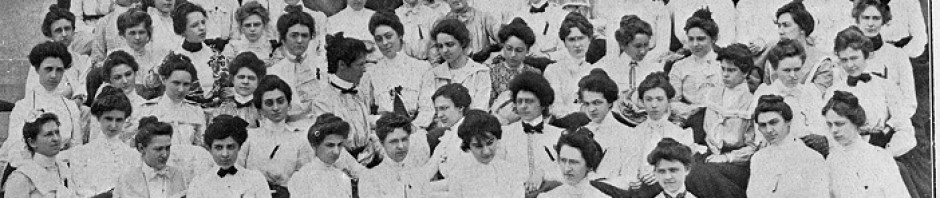
“Hazing as Girls Practice It” – The University of Chicago’s Esoteric Club, 1896

“What objection can Miss Talbott (sic) make to a national fraternity in the face of this?” was written on a page that had an undated article entitled “Hazing as Girls Practice it.” It was in with some late 1890s correspondence about a women’s fraternity that was hoping to form a chapter at the University of Chicago.

The Chicago Tribune article read: 

Much curiosity and amusement was caused among University of Chicago students Thursday by the strange actions and curious appearance of Miss Darida (sic) Harper, daughter of President Harper, and her many changes of costume during her promenade on the campus are explained by the fact that she was being initiated into the Esoteric club, a women’s secret society at the university.

The young women took advantage of the high position of the president’s daughter to inflict upon her many new and fiendish barbarities.

In the morning she was compelled to go to her classes a huge market basket, wearing an immense straw hat of the umbrella pattern, gorgeously bedecked with long streamers of green and yellow ribbon. A little later she was seen promenading up and down the campus in the hot sunshine arrayed in fur cap, boa, muff, mittens and ear muffs. Another change followed, and she came out in a calico dress of bright and varied hue. At one time she pushed a little red wheelbarrow containing a diminutive yellow dog and a choice collection of disabled dolls.

Next she tripped across the grassy sward carrying a green lantern in one hand a bird cage in the other, and once she made a flying trip ringing a cow bell and pulling after her a toy wagon filled with bricks.

Dean Marian Talbott (sic) finally interfered and put a stop to the fun. Today Miss Harper is a finished Esoteric and is receiving the congratulations of her friends.”

That same small article was published by the Utica (NY) Morning Herald on April 27, 1896. The Chatham (NY) Courier published a condensed version of the article in its April 29, 1896 issue describing the “grotesque requirements” of the Esoteric. All the articles misspelled the name of Helen Davida Harper [Eaton], the only daughter of William Rainey Harper.

William Rainey Harper graduated from Muskingum College at age 14. He then did postgraduate studies at Yale University. In 1891, when Harper was 35, John D. Rockefeller picked him to help him create the University of Chicago. Rockefeller also selected him to be its first president. Harper also assisted with the creation of Bradley University and served as its first president.

The University of Chicago website describes the Esoteric as a:

student organization that ran from the early 1900s through 1962. It was created for the purpose of advancing social life on campus. Enhancing campus social life was especially important for women in the early years of the University because sororities were not permitted. As a result, women were often active in creating what became known as social clubs, such as the women-only Esoteric.

esoteric

From letters available in the University of Chicago archives, it appears that Dean of Women Marion Talbot did not wish the women’s fraternities/sororities to be a part of campus life. The woman who wrote the note on the above newspaper article was aware of an 1896 effort to install a chapter of Pi Beta Phi on campus. Her note was sent to an officer of that organization. A letter from Katharine L. Sharpe, Grand President of Kappa Kappa Gamma, is also in the University of Chicago archives.

Talbot was a graduate of Boston University and she also had a degree from the Massachusetts Institute of Technology. Talbot had been a Wellesley College instructor until she resigned to become a part of the University of Chicago when it opened in 1892. Ten years earlier, in 1882, she was a co-founder of the Association of Collegiate Alumnae; in 1921, it joined with the Southern Association of College Women and became the American Association of University Women.

The men’s fraternity system at the University of Chicago pre-dates Rockerfeller’s creation of the University. The Old University of Chicago was founded in 1857 and it failed in 1886. The University of Chicago’s Phi Delta Theta chapter was established at the “First University in 1865 near 35th street (sometimes called ‘The Old University’), and floundered with it.” The Phi Delt chapter was revived in 1897. Chapters of men’s fraternities have existed on the campus throughout the university’s history.

It took nearly a century after the first attempt was made to establish a National Panhellenic Conference organization  on campus. Alpha Omicron Pi chartered a chapter in 1985 and it was followed by a Kappa Alpha Theta chapter the next year. Delta Sigma Theta, a National PanHellenic Conference sorority, established a Chicago chapter in 1947. On April 20, 2013, Pi Beta Phi installed its Illinois Kappa Chapter, culminating an effort that had started more than a century ago.

My thanks to Emily Jones for her help with the archives research and to Christopher Walters for the picture of the Esoteric badge.

© Fran Becque  www.fraternityhistory.com   All rights reserved.


Posted in American Association of University Women, Bradley University, Davida Harper Eaton, Delta Sigma Theta, Kappa Kappa Gamma, National Pan-Hellenic Council (NPHC), National Panhellenic Conference, Phi Delta Theta, Pi Beta Phi, Sorority History, University of Chicago, Women's Fraternities, Women's Fraternity History | Tagged , , , , , , , , | Comments Off on “Hazing as Girls Practice It” – The University of Chicago’s Esoteric Club, 1896

Mary Kingsbury Simkhovitch, Settlement House Founder and Kappa Kappa Gamma

Mary Kingsbury Simkhovitch was a social worker at a time when that discipline was in its infancy. She was also a fraternity woman and played a role in the first gathering of what came to be the National Panhellenic Conference.

In August 1890, the Kappa Kappa Gamma chapter at Boston University invited representatives from the six other groups that had chapters on campus – Alpha Phi, Delta Delta Delta, Delta Gamma, Gamma Phi Beta, Kappa Alpha Theta, and Pi Beta Phi – to a meeting planned for April 1891. That meeting was called to order by Mary M. Kingsbury [Simkhovitch], Kappa Kappa Gamma and Chairman of the Executive Committee on Convention. Although the National Panhellenic Conference was not founded until 1902, this meeting in Boston was the first attempt at getting together the women’s organizations.

Mary Kingsbury Simkhovitch

She also served as her chapter’s delegate to convention. Decades later she reflected on that trip, “I was lucky enough in my junior year to be a delegate to a convention in Minneapolis. This allowed me to stop at Akron and Wooster and other places where we had chapters. The difference of attitude and emphasis in all these places helped me to modify my New England provincialism.”

As a collegian, she and Margaret B. Dodge created a Kappa Kappa Gamma Kalendar for 1889. An announcement in the 1889 Delta Upsilon Quarterly touted it as:

a new idea in fraternity publications. It consists of twelve pages, about six inches by nine in size, and is handsomely printed on fine heavy paper. A page is given to the calendar for each month, historical points of Kappa Kappa Gamma are named, and opposite each day is a quotation garnered from eminent authors, fraternity magazines and other sources.

In 1890, she graduated from Boston University where she was also a member of Phi Beta Kappa. She served Kappa Kappa Gamma as the Editor of Volume VI of the Key of Kappa Kappa Gamma and was Kappa’s first Historian.

In her autobiography, Simkhovitch wrote of her time as a collegiate member of Kappa Kappa Gamma:

There was the ambition inculcated into new members to make a success of themselves in any field of college life. Loafing was discouraged and there was a healthy competition to see which fraternity could secure the greatest number of honors. This may not have been the highest motive for work, but we all enjoy the warmth of fellowship and group approbation and undoubtedly standards were maintained under this stimulus that might otherwise have slipped. ‘Kappa’ honor, skill and reputation were all cherished.

After graduate work at Radcliffe College and Columbia University, she  traveled to Berlin to study. There she met a Russian student, Vladmir Simkhovitch, whom she later married. She worked at the College Settlement House and the Friendly Aid House that was supported by All Souls Unitarian Church.

In 1902, she founded and served as Director of the non-sectarian Greenwich House Settlement in New York City. It opened at 26 Jones Street on Thanksgiving Day. The goal of the settlement house was to help immigrants adjust to their lives in their new country. Classes in music, art and drama were added. In 1919, a nursery school was established.

The New York City Panhellenic was formed in October 1920. At a luncheon meeting in April, 1921 at the Hotel Astor, the program centered on the history of the Panhellenic movement. According to a fraternity magazine’s account of the meeting, “Quite by chance it happened that Mrs. Mary Kingsbury Simkhovitch of [Kappa Kappa Gamma’s] Phi chapter, who was the principal officer of the first Panhellenic Conference in Boston, was present at the first meeting of the National Panhellenic.”

Simkhovitch had a hand in many of the great social reforms of the day. She was a member of the American Association of Social Workers and was awarded honorary degrees from Boston University, New York University, Columbia University, Smith College and Colby College. She retired from Greenwich House on February 1, 1946 and became its Director Emeritus. Simkhovitch died in 1951.

Today, the Greenwich House offers programs in social services including counseling, drug treatment, senior health and AIDS mental health counseling. The cultural arts education programming that began more than 100 years ago continues still.

© Fran Becque  www.fraternityhistory.com   All rights reserved.


Posted in Boston University, Conventions, Fraternity meetings, GLO, Greek-letter Organization, Greek-letter Organization History, Kappa Kappa Gamma, National Panhellenic Conference, Notable Sorority Women, The Key of Kappa Kappa Gamma | Tagged , , , | Comments Off on Mary Kingsbury Simkhovitch, Settlement House Founder and Kappa Kappa Gamma

“War Work” by NPC Groups During World War I

World War I opened the doors to greater philanthropic efforts by the NPC groups. The war began in 1914 and although America did not enter it until 1917, the NPC magazines of that era tell about the hasty departures of members who were traveling or studying in Europe when the war started. There are also stories from members, including Zeta Tau Alpha’s Grand President, Dr. May Agness Hopkins, who went abroad to be of service in any way they could – as nurses, canteen workers, phone operators, and even at least one surgeon, Kappa Kappa Gamma Dr. Mary Crawford.

What follows below is a post I wrote for the Circle of Sisterhood Foundation. The work that Foundation and the Panhellenic Council which support it are doing is much like the “War Work” done by the NPC groups in the 1920s. 

Philanthropy has long been a part of National Panhellenic Conference (NPC) organizations. Prior to 1910, chapters and alumnae clubs often adopted projects on a local level. Purchasing coal for a family in need, endowing a room in a hospital, supplying milk for a free milk station, and helping to establish a community library are just a few examples of work done by sorority women in the 1800s and early 1900s.

By 1914, a few national philanthropic efforts had begun; these included Alpha Chi Omega’s Star Studio at the MacDowell Colony in Peterborough, NH, and Pi Beta Phi’s Settlement School in Gatlinburg, Tennessee. In addition, loan funds and scholarship programs were being created by the organizations.

World War I opened the doors to greater philanthropic efforts by the NPC groups. The war began in 1914 and although America did not enter it until 1917, the NPC magazines of that era tell about the hasty departures of members who were traveling or studying in Europe when the war started. There are also stories from members, including Zeta Tau Alpha’s Grand President, Dr. May Agness Hopkins, who went abroad to be of service in any way they could – as nurses, canteen workers, phone operators, and even at least one surgeon, Kappa Kappa Gamma Dr. Mary Crawford.

Mildred Bates Smith, a Boston University Pi Beta Phi alumna. She, along with her husband, joined in the Salvation Army. It was the only possible way that they could serve together overseas.

Mildred Bates Smith, a Boston University Pi Beta Phi alumna. She, along with her husband, joined in the Salvation Army. It was the only possible way that they could serve together overseas.

The NPC women who stayed on North American soil mobilized and took part in efforts to help those affected by the war. In chapter houses and at alumnae club meetings, members began war work in earnest. They knitted items, collected scrap metal, and purchased Liberty Bonds and Thrift Stamps.

Kappa Alpha Thetas who were representatives of the Committee for Devastated France helped start schools for French children and cared for orphans. Noted author Dorothy Canfield Fisher, a Kappa Kappa Gamma, led reconstruction efforts in Bellevue-Meudon, France. She enlisted her Kappa sisters for support, inviting them to become “Aunties of Bellevue-Meudon” by sending clothes and money to help the children.

Several groups, including Alpha Gamma Delta and Sigma Kappa, supported the American Red Cross. Kappa Alpha Theta gave $3,800 (more than $88,000 in 2013 funds) to equip the nurses of one base hospital. Phi Mu established a nurses’ hut at another base hospital; there a Phi Mu served as hostess. Gamma Phi Beta funded the needs of Belgian children as did Delta Gamma. Gamma Phi Beta’s fundraising efforts took place in theater lobbies where they set up a milk bottle campaign to collect change.

milk bottle

It is a picture of Gamma Phi Beta’s milk bottle fundraising campaign. Many of the NPC groups’ World War I relief fundraising efforts were member centered. This effort by Gamma Phi took place in theater lobbies where the general public could contribute.

Chi Omega supported two workers in the devastated areas of France and contributed to the YWCA’s Overseas Service. Alpha Omicron Pi gave funds for relief work in France’s Chateau-Thierry district while Alpha Chi Omega donated funds to help three French villages.

Two groups set up rooms for French female industrial workers. Alpha Phi maintained one in Roanne for the women who worked in the munitions factories. Delta Delta Delta helped support one in Tours.

European war orphans were “adopted” by many organizations including Zeta Tau Alpha, Alpha Omicron Pi, Gamma Phi Beta, and Delta Zeta. It was not a physical adoption, but a monetary one, with funds being sent to an overseas organization to be used for the care of the children. Each Sigma Kappa chapter adopted an orphan. Almost every Alpha Delta Pi chapter and alumnae club adopted an Armenian orphan. In 1918-19, Alpha Chi Omega adopted 67 French orphans.

Some groups assisted foreign students. Pi Beta Phi helped six French girls who were studying in Minnesota colleges and a Serbian girl who studied at Westhampton College. They were provided with funds to be used for books, warm clothes and travel. Delta Gamma helped educate an Armenian girl.

The work done during World War I gave the NPC organizations a good foundation for increased philanthropic efforts. In the 1921 Story of Gamma Phi Beta, Lindsey Barbee made an interesting observation. Although she was speaking of Gamma Phi Beta’s efforts, the sentiments can be transferred to the other NPC groups. She wrote, “The war work taught the sorority not only the beauty of service but the splendid possibilities of concerted action. From coast to coast, Gamma Phis met the national crisis with courage, with efficiency and with timeless endeavor; and thereby they experienced the happiness of making a real effort and a real sacrifice and the inward contentment which comes from filling a need, from relieving suffering and from being a vital part in the world struggle.”


Posted in GLO, Greek-letter Organization, Greek-letter Organization History, National Panhellenic Conference, Notable Sorority Women, Women's Fraternities, Women's Fraternity History | Tagged , , , | Comments Off on “War Work” by NPC Groups During World War I

And the Answer Is….Knox College in Galesburg, Illinois!

The question is, of course, “Where is the only existing building connected to a Lincoln-Douglas debate?” Their fifth debate for the Illinois Senate seat took place on the east side of Old Main on the Knox College campus from 2:30 – 5:30 p.m. on October 7, 1858. The crowd was estimated at between 15,000 and 20,000 people.

Photo by Chi Zhang, Courtesy of Knox College

Abraham Lincoln, the Republican candidate, and Stephen Douglas, the Democratic candidate, both made an interesting entrance to the debate. R. Lance Factor, in his book Chapel in the Sky, explained, “A hastily constructed platform blocked the east door and both Lincoln and Douglas had to use a window as a door to reach the debate platform. The obstacle of a window as a door prompted Lincoln’s (possibly apocryphal) remark, ‘Now I can say I have gone through College.'”

The six other debate sites were in Ottawa, Freeport, Jonesboro, Charleston, Quincy, and Alton.  Lincoln lost the election and Douglas won the Senate position. Lincoln, however, was awarded an honorary degree by Knox College in 1860, the same year he was nominated by the Republican party as its candidate for President of the United States.

In 1994, C-Span reenacted the debates and those reenactments can be viewed on the internet. The new Abraham Lincoln Presidential Library and Museum* in Springfield, Illinois, which opened in 2005, has an exhibit that is a replica of the debate scene. The debate has been reenacted several times at Knox College, and the picture above is of one of the more recent Lincoln impersonators coming out of the door of Old Main.**

* If you think you visited this museum in the 1960s with your parents as you traversed the country in a station wagon, you’re wrong. This is a fabulous new museum that deserves a visit. You will not be disappointed. 

**And if you just said to yourself, “This is a blog about fraternity history – why isn’t this post about fraternity history?” just click on Knox College on the right column and you will find several posts about Knox and fraternity history. It’s home to Delta Delta Delta’s third chapter, it’s linked to Alpha Xi Delta’s history, and two national presidents who were a married couple graduated from Knox. And yes, two of my offspring are alumni. When I spied the above picture in a calendar that was in a pile of mail, I knew I wanted to use it in a post.

© Fran Becque  www.fraternityhistory.com   All rights reserved.

Posted in Knox College, Presidents | Tagged , , , , | Comments Off on And the Answer Is….Knox College in Galesburg, Illinois!

The Surprises Archivists Love to Get – Kappa Delta’s Unexpected Gift

Meeting archivists from other fraternities has been a joy! Shirley McCann Gee is the Kappa Delta Foundation Archives Manager. Shirley and I have attended the two National Archives Conference for Fraternities and Sororities that have taken place at the University of Illinois and it’s been so good to have met her. Today’s post is courtesy of Kappa Delta Sorority; it’s an article Shirley wrote for The Angelos, Kappa Delta’s magazine.

One day Shirley opened a package that was waiting for her in the archives. It was a scrapbook the donor uncovered while cleaning out her mother and stepfather’s home. The scrapbook belonged to Elizabeth “Bettie” Fay Booth, a member of the Kappa Delta chapter at the University of Southern California. Shirley wrote me about it, “I loved writing the article on Bettie’s scrapbook.  You would love sitting down with this scrapbook and spending time with it.  I felt as if I had been dropped in a different time period.  I’ve not seen any scrapbook so complete, so carefully crafted and created.”

Click on the link below and you can read this wonderful story!

Great_Memories_Winter_2013_Angelos


Posted in Alpha Delta Phi, Delta Gamma, Fran Favorite, George Banta, Panhellenic House, Phi Kappa Psi, Pi Kappa Alpha, Sigma Alpha Epsilon, The Lyre of Alpha Chi Omega | Tagged , , , | Comments Off on The Surprises Archivists Love to Get – Kappa Delta’s Unexpected Gift

Happy Founders’ Day, Kappa Alpha Theta!

On January 27, 1870, Bettie Locke [Hamilton] stood before a mirror and repeated the words of the Kappa Alpha Theta initiation vow she had written. She then initiated Alice Allen [Brant], Bettie Tipton [Lindsey], and Hannah Fitch [Shaw].

In 1867, 17-year-old Bettie was the first female to enroll in Indiana Asbury College (now DePauw University) in Greencastle, Indiana. Although the first decision to allow women to attend Asbury was made in 1860, it was rescinded several times with debate following each decision. The daughter of Dr. John Wesley Locke, a mathematics professor, Bettie was a formidable student.

During her sophomore year, Bettie received an invitation to wear a Phi Gamma Delta badge. The badge did not come with the relationship arrangement as later tradition would have it, nor did it come with the benefits given to men who were initiated into the fraternity. When she declined the badge because it did not come with full membership rights and responsibilities, the Phi Gamma Delta chapter substituted a silver cake basket, inscribed with the Greek letters “ΦΓΔ.” With encouragement and prodding from her father, a Beta Theta Pi, and her brother William, a Phi Gamma Delta, Locke began plans to start her own fraternity. She and Alice Allen, another female in the first coeducational Asbury class, studied Greek, parliamentary law and heraldry with an eye towards founding a fraternity for women (Wilson, 1956).

Badges larger than the current Kappa Alpha Theta badges were painstakingly designed by the founders and made by Fred Newman, a New York jeweler. The original badge was intended to be “something near enough to the Phi Gamma Delta badge to suit Betty Locke and yet slenderized to give it individually” (Wilson, 1956, p. 5). The badges were first worn to chapel services by the members of Kappa Alpha Theta on March 14, 1870 (Shaw, 1918).

Bettie later said of her time at Indiana Asbury College, “We were all refined, good girls from good families, and we realized somehow that we weren’t going to college just for ourselves, but for all the girls who would follow after us – if we could just win out” (Manhart, 1962, p. 82).

This post is excerpted from my dissertation, “Coeducation and the History of Women’s Fraterniies 1867-1902.”

Posted in DePauw University, Founders' Day, GLO, Greek-letter Organization, Greek-letter Organization History, Kappa Alpha Theta, Notable Sorority Women, Phi Gamma Delta, Sorority History, Women's Fraternities | Tagged , , , , | Comments Off on Happy Founders’ Day, Kappa Alpha Theta!

George Banta and the Delta Gamma / Phi Delta Theta Connection

There are a few men who names emerge in the history of women’s fraternities/sororities. These men include Dr. Wesley P. Coddington, Dr. Charles Richardson, Dr. Guy Potter Benton, and the Right Reverend Edward D. Kelly. The man most influential in the early growth of the women’s fraternity system during the 1870-80s is George Banta. He was a stalwart proponent of Greek-letter life for all of his adult years. He was both a Phi Delta Theta and a Delta Gamma.

This post is courtesy of Delta Gamma and its Fraternity Archivist, Marilyn Ellis Haas. Originally published in the Winter 1993 Anchora, the article quoted below was written by Frances Lewis Stevenson with Carmalieta Dellinger Jenkins.  Frances was one of Delta Gamma’s first traveling consultants and she worked at Headquarters for 39 years. Among the jobs she held during those years were Historian and Anchora Editor. The archives are named in her honor. Carmalieta served as Assistant to the President of the Phi Delta Theta Educational Foundation and former Executive Secretary of Delta Gamma Fraternity.

“Generations of Delta Gamma pledge lessons have been learned and, often, buried amidst the bits and scraps of information our minds collect. It is likely, however, that one myth could be instantly recalled from many Delta Gammas’ mental files – while what could be more important information has been discarded. It is this: Phi Delta Theta is Delta Gamma’s ‘brother fraternity.’ This has been accepted as fact whether or not a Phi Delt chapter existed on one’s campus.

“A myth is a legend often based on some fact, and such is the Phi Delta Theta connection with Delta Gamma. In May 1878, 20-year-old George Banta was on a train returning to Franklin College in Franklin, Indiana, from a Phi Delta Theta Convention. He sat with Monroe McClurg and shared with him his concern over the fraternity political situation in Indiana, noting that Indiana needed another female Greek group. Brother McClurg agreed and offered a solution. In Oxford, Mississippi, where he was in school at ‘Ole Miss,’ there prospered a fine ladies’ group with a few other chapters in southern girl’s schools. The group was Delta Gamma, and Monroe McClurg was happy to put Brother Banta in touch with these young women.

“George Banta wasted no time in making contact with the Delta Gammas in Oxford, They, too, were eager for new expansion and invested him with the power to form chapters in academically well-recognized northern colleges. George Banta set about achieving their expansion goal, having been told to select the Greek letters of his choice for the new chapters. It was logical that when he organized the first northern chapter at Franklin College the Greek letter should be Phi, in honor of Phi Delta Theta Fraternity. No doubt, the first initiate was his fiance, Lillie Vawter.

“George Banta later wrote, ‘I think we were also told to adopt our own ritual and bylaws, the latter to serve as well as it might for a constitution. These were used to organize at Hanover, Buchtel (now the University of Akron), and Wisconsin . . . and probably at Northwestern. I cannot recall when no in what order the organization were effected at Hover and Buchtel (but) in both cases it was through the direct and active effort and cooperation of membership of my fraternity.

“From these events, no doubt, comes the ‘brother’ relationship of Phi Delta Theta and Delta Gamma, one that in no firm nor official way ever existed. The support of the Phis is recorded often in Delta Gamma’s early history, notably on two occasions:

“Delta Gamma’s second Convention was held May 24-26, 1883, in Akron at the new Phi Delta Theta hall, with all manner of social attentions showered upon the visitors by their hosts.

“When a rival group at Wisconsin was found to be pilfering the Delta Gamma mailbox, the ladies of Omega chapter asked the correspondents of other chapters to use the post box of a friendly Phi Delta Theta.

Lillian Vawter Banta, Delta Gamma

“When George and Lillie were married in 1882, he had been for two years the president of the fraternity’s General Council (national president), the first to hold this office. The marriage was brief, for Lillie died in 1885 leaving a young son, Mark, George later remarried and was the father of two children, George, Jr., and Eleanor who became a Delta Gamma at Indiana University, as did her two cousins a few years later.

“George Banta’s interest in Delta Gamma’s welfare never wavered. He was a leader in the fraternity world, and his advice was often sought. He was a frequent visitor to the Delta Gamma Conventions. Often the guest speaker, he appeared for the last time in 1934, a year before his death. Most memorable was  his appearance at the 1909 Convention. He was seated on the platform with the officers when the door of the hall opened to admit two of Delta Gamma’s Founders, attending a Convention for the first time. Many described that moment – Mr. Banta rising, bowing to the two ladies and stepping down to greet them each personally.

“Phi Delta Theta as Delta Gamma’s ‘brother Fraternity’ is indeed a myth, but as the myth can be credited to the energies of one brother, George Banta, who saw to the growth which created this truly international organization, Delta Gamma.”

George Banta, Phi Delta Theta and Delta Gamma

Banta spent his life as a strident supporter of the fraternity world. In 1901, he founded  the George Banta Printing Company in Menasha, Wisconsin. In addition to printing the magazines of many fraternities and sororities, he published Banta’s Greek Exchange.

It is also interesting to note that Banta’s sons Mark and George, Jr. became members of Phi Delta Theta. George Jr. followed in his father’s footsteps; he served as president of the Phi Delta Theta Grand Council from 1932-34.


©Fran Becque, www.fraternityhistory.com, 2013. All Rights Reserved.

Posted in Delta Gamma, Fran Favorite, Franklin College, Fraternity meetings, George Banta, GLO, Greek-letter Organization, Greek-letter Organization History, National Panhellenic Conference, Phi Delta Theta, Sorority History, The Anchora of Delta Gamma | Tagged , , , , , , | Comments Off on George Banta and the Delta Gamma / Phi Delta Theta Connection

Choosing a Convention Delegate – As True Today As It Was Almost 100 Years Ago!

In the early 1900s, the magazines of the National Panhellenic Conference organizations would often contain an “Exchanges” section. The editors would chose items from the other NPC and men’s fraternity magazines and publish them. The May 1915 issue of the Themis of Zeta Tau Alpha contains an excerpt from the Anchora of Delta Gamma. It is entitled “The Convention Delegate.” Had I not known the date of the issue (and I ignored the use of “girl” and opted to read it as “woman”), I’d say that the advice could been written today and it still hits the mark.

“Pick the girl best able to represent our chapter to send to convention. Do not send a girl because she has been no other office and deserves something. This is no place for reward of merit. Do not pass over a girl because she has had many chapter honors. If she has filled these offices well she may be the one best fitted to send. Do not send a girl because she has pretty clothes. Do not send one because she has not. Do not send one who has given all her time to her books and gained nothing else from college life. Do not send a senior or girl who will not be in college next year.

“Send the girl who knows best what is good for your chapter. Send the girl who is willing to devote a great deal of time to preparing herself for convention. Send the girl who will not merely ‘second the motion’ but will make it and will have a good statement for her reasons for wanting it passed. Send the girl who can hold her own in both a business and a social way. Send the girl who will make an impression by her way of doing things. Send the girl who will be so well remembered in after years that she will be sought as an officer.”

Posted in Conventions, Fran Favorite, The Anchora of Delta Gamma, The Themis of Zeta Tau Alpha | Tagged , , , | Comments Off on Choosing a Convention Delegate – As True Today As It Was Almost 100 Years Ago!

Happy Birthday, P.E.O. Sisterhood! P.E.O.s Help Women Reach for the Stars

P.E.O., a “philanthropic organization where women celebrate the advancement of women; educate women though scholarships, grants, awards, loans and stewardship of Cottey College; and motivate women to achieve their highest aspirations” was founded as a collegiate organization on January 21, 1869. The seven founders – Franc Roads [Elliott], Hattie Briggs [Bousquet], Mary Allen [Stafford], Alice Coffin, Ella Stewart, Alice Bird [Babb] and Suela Pearson [Penfield] – were students at Iowa Wesleyan University, one of the oldest institutions of higher education west of the Mississippi River.

Although it began as a collegiate organization, in 1902 it became a community-based one. The collegiate chapter at Iowa Wesleyan became Alpha Xi Delta’s second chapter. P.E.O. chapters spread across the country from Midwestern roots. In 1911, P.E.O. established its first Canadian chapter in Vancouver, British Columbia. P.E.O. existed in quiet splendor and kept a very low profile in communities all over North America. Chapters did not toot their own horns about the good works they were doing. That changed in 2005, with a new logo and the introduction of an “It’s OK to Talk About P.E.O.” campaign. On January 21, Founders’ Day, P.E.O.s are encouraged to wear their P.E.O. emblems, the star shaped pins members receive.

Today P.E.O. has six projects that benefit education for women. Over the last 100+ years, P.E.O. has helped more than 88,000 women in their educational pursuits.

The oldest of P.E.O.’s projects is the Educational Loan Fund (ELF); it began in 1907 and has helped more than 70,000 women with loans surpassing a total of $136 million.

Cottey College, the only American college for women owned by women, was given to the P.E.O. Sisterhood in 1927. More than 8,500 women from 50 states, four Canadian provinces, and 85 countries are Cottey alumnae.  (more about Cottey is at http://wp.me/p20I1i-h3)

Established in 1949, the P.E.O. International Peace Scholarship Fund (IPS) gives to international women scholarships for graduate study in the United States or Canada. More than $28 million has been awarded to women from all over the globe. These IPS scholars have had educational opportunities they never would have had without P.E.O.’s generosity.

The P.E.O. Program for Continuing Education began in 1973. Needs-based grants are given to American and Canadian women whose educations have been interrupted. More than $40 million has been distributed. These grants have helped countless women and, in turn, their families by providing them with the opportunity to obtain the credentials they need to find viable employment.

Since 1991, the highly competitive P.E.O. Scholar Awards have provided financial assistance to American and Canadian women pursuing doctoral-level study. The amount that has been awarded is nearly $15 million.

The youngest of P.E.O.’s projects is the STAR Scholarship, established in 2009. It provides college scholarships to exceptional high school women in the United States and Canada. In the few years of its existence, nearly $2 million has been dispersed.

To purchase a copy of this book about Lulu Corkhill Williams and her family, visit https://peoillinoismarketplace.square.site/s/shop

To read more about the history of the Illinois State Chapter of P.E.O. visit the link to the page about it and Lulu Corkhill Williams  http://wp.me/P20I1i-Qf .

© Fran Becque  www.fraternityhistory.com


Posted in Alpha Xi Delta, Founders' Day, Iowa Wesleyan College, P.E.O. | Tagged , , , , | Comments Off on Happy Birthday, P.E.O. Sisterhood! P.E.O.s Help Women Reach for the Stars

Alumnae Panhellenics: The Foundation for Sorority Success

My thanks to Jane Sutton, Alpha Xi Delta and National Panhellenic Conference Chairman, for being today’s guest blogger. Jane also has her own blog at http://alphaxideltanpc.blogspot.com/

As chairman of the National Panhellenic Conference (NPC) and previously as the national president of Alpha Xi Delta, some of my fondest memories are of times spent with Alumnae Panhellenics all over the country. The opportunity to meet with a collection of like-minded individuals who share my love and passion for the sorority experience is always a pleasure and they have great stories. I have always found the history of these organizations to be fascinating.

Alumnae Panhellenics (originally called City Panhellenics) were first formed in 1910, only eight years after the creation of the NPC (originally called the Inter-Sorority Conference). The role of the Alumnae Panhellenics was to assist the Conference in its quest to “improve the methods of rushing and pledging and to consider questions of general interest to the sorority world,” (Report of the Fifth Inter-Sorority Conference from Sept. 14, 1906).

In 1959 there were 275 Alumnae Panhellenics across the country with a purposeful connection to NPC. In 1975 the name was changed from City Panhellenics to Alumnae Panhellenics but the role of providing recruitment assistance remained. In addition, more and more Alumnae Panhellenics began fundraising initiatives to provide scholarships to sorority women. In 2011-12 over $332,495 was raised by Alumnae Panhellenics for scholarships awarded to 297 sorority women and $97,629 was raised for community needs. In addition, over 45,000 hours of community service work was done.

Today we state that Alumnae Panhellenics exist to:

• Inform fraternity women of current trends.

• Promote the fraternity system.

• Improve the Panhellenic image.

• Stimulate a continuing interest in Panhellenic affairs.

There are over 200 Alumnae Panhellenics serving the fraternal world and their communities with a variety of programs. Some are more social, some fundraise and do massive community outreach efforts and some still maintain the recruitment support role. The NPC member groups also have 3,887 alumnae clubs or chapters supporting their own initiatives.

Regardless of their current purpose their collective history remains ingrained in NPC and our success. We understand and value the role alumnae play in our own organizations but also in NPC and the lives of the women and communities they are changing every day.

A small (2″ x 3″) ceramic favor purchased on eBay. It is from the 50th anniversary of the Denver City Panhellenic.*

* The Denver City Panhellenic is now the Denver Area Alumnae Panhellenic. It  traces its history to 1908 when it was formed as a club. This entry from the Pi Beta Phi Denver Alumnae Club in the  July 1909 Arrow makes reference to it, “The Pan-Hellenic Club in Denver is quite large and at the banquet this spring more than one hundred members were present. There are two meetings a year, a banquet in the spring and a party in the fall given by the fraternity whose member is president, that office going by rotation to the different fraternities.” It is also interesting to note that in 1908 there were only two NPC groups at the University of Denver; Pi Beta Phi’s chapter was founded in 1885 and Gamma Phi Beta’s chapter was chartered in 1897. By 1908, there were also four NPC groups on the University of Colorado campus in Boulder – Pi Beta Phi (1884), Delta Gamma (1886), Kappa Kappa Gamma (1901) and Chi Omega (1906).

Posted in Alpha Xi Delta, Chi Omega, Delta Gamma, Fraternity meetings, Gamma Phi Beta, GLO, Greek-letter Organization, Greek-letter Organization History, Kappa Kappa Gamma, National Panhellenic Conference, Pi Beta Phi, Sorority History, The Arrow of Pi Beta Phi, University of Colorado, University of Denver, Women's Fraternity History | Tagged , , , , , , | Comments Off on Alumnae Panhellenics: The Foundation for Sorority Success