More Than Enough Love to Spread Around

I read blog posts and tweets from Greek-letter Organizations (GLOs) other than my own. I get teary-eyed reading some and I swell with pride after reading others. The feelings conveyed in the posts are ones I’ve had about my own organization. I think all GLOs have things of which they can be proud and things which they need to work on. I truly think we are all special in our own ways. We all have rich histories. We have those special people, places, and things which make us unique.

I have friends who belong to some of the other 25 National Panhellenic Conference (NPC) organizations. I expect that they love their organization more than mine.I think we each love our own organization more than any others. That is just the way it is. There is nothing wrong with that. Just as I love my own kids a tad bit more than my nieces and nephews, I love them deeply, too. They are my family.

Being proud of our collective history is important, but first things first. Chapter members need to know the history of their own chapter and their organization. 

The odds are overwhelmingly great that a member will be an alum of a GLO for much longer than they were a collegiate member. However, collegians hold the future of the chapter in their hands. The efforts put forth by those who stood where current members are standing today can be for naught depending on the commitment, knowledge and dedication shown by the current members.

Sometimes members get caught up in the “firsts” for their organization and/or the famous individuals who wore their letters. Our organizations stand for so much more than who had the first central office located in a city of more than 50,000 in a state beginning with the letter “M.”  Does anyone make a conscious decision to join a particular group because of those things? Frankly, I would be suspect of a member who became a member solely because of one of these “firsts” or a famous alum.

Why can’t we be proud of the sum total of men and women who have worn the badges of all our organizations? Would it mean we don’t love and cherish our own GLO? Absolutely not! An impressive number of notable men and women have belonged to our organizations over the years. An even greater number lived their lives in relative obscurity outside of their sphere of influence, and yet they gave of themselves and dedicated themselves to the ideals of their organization on a daily basis. 

All who take the oath of membership in a GLO have a responsibility to the organization. Knowing how your GLO spread from an idea, the “let’s have an organization of our own” moment, to what it is today, in 2014, can help cement dedication to the ideals put forth by those paved the way. Knowing the history of one’s GLO and chapter as well as a general knowledge of other organizations can only help the entire fraternity and sorority system grow. We are all in this together.

Months ago, I put together a series of Pinterest pages on GLO history. I haven’t revisited them in a while, but I needed some information,and I knew I had some of the answers there. Having forgotten most of the pins that were on there, I took a new look at it and what fun it was.  If you have some spare time or are getting tired of watching football, take a look https://www.pinterest.com/glohistory/. It truly is a fun way to learn more about the history of GLOs.

photo (57)

© Fran Becque, www.fraternityhistory.com, 2014. All Rights Reserved. If  you enjoyed this post, please sign up for updates. Also follow me on twitter @GLOHistory and Pinterest www.pinterest.com/glohistory/

Posted in Fran Favorite | Tagged , | Comments Off on More Than Enough Love to Spread Around

Four Founding Days (ΔΔΔ, ΦΣΣ, KA Society, and ΣAM), Ferguson, and UVA

Delta Delta Delta was founded at Boston University on November 28, 1888, which fell on the day before Thanksgiving that year. Founders’ Day is celebrated on the Wednesday before Thanksgiving. Its founders are Sarah Ida Shaw [Martin], Eleanor Dorcas Pond [Mann, M.D.], Florence Stewart and Isabel Breed.

In the fall of 1888, the four women seniors who had not joined any of the women’s fraternities then at Boston University (Kappa Kappa Gamma, Alpha Phi, and Gamma Phi Beta) discussed their situation. Pond talked to Shaw and they decided to start a society of their own. Pond suggested that they use a triple Greek letter and Shaw chose the Greek letter Delta. Shaw and Pond threw themselves into the details associated with the founding. All was finished by Tuesday of Thanksgiving week, 1888, but the two met again on Wednesday afternoon, before leaving for the holiday. They met in the Philological Library at the top of the college building. Shaw and Pond embraced and said “Tri Delta is founded.”

Shaw and Pond were intent and ultimately successful in  getting the other two unaffiliated seniors, Florence Stewart and Isabel Breed, to join their organization. All four are considered founders.

The second chapter of Delta Delta Delta came about through the efforts of Etta May Budd, the daughter of an Iowa State College professor, who was in Boston studying art. She boarded at the Young Women’s Christian Association and there met Josephine Centre, an early initiate of the Alpha Chapter. Budd, who then became a member of the Alpha Chapter, belonged to two local organizations, one at Simpson College in Indianola, Iowa, and another at Iowa State University in Ames, Iowa. The organization Budd belonged to at Simpson College was called L. F. V. It stood for “Lovers of Fun And Victory,” but the men on campus called the group the “Light Footed Virgins.” L. F. V. was founded in 1871 and by 1889, it had 95 members. On April 25, 1889, nine L. F. V. members signed pledges to become members of Delta Delta Delta. A charter was secured and L. F. V. became the Delta Deuteron Chapter of Delta Delta Delta. An initiation followed on May 10, 1889. In 1897, it became known as the Delta chapter when the first national convention changed the system of naming chapters.

As she had done with the local organization to which she had belonged at Simpson College, Budd attempted to bring the local organization she had founded at Iowa State University, U. D. T. into the Delta Delta Delta fold. In May 1889, she returned to Iowa State with a charter for the local organization. There was much anti-fraternity sentiment on campus and U. D. T. had been forced to disband. Budd organized another group to have the Delta Delta Delta charter and was successful in 1890. However due to the continuing anti-fraternity sentiment, that charter was surrendered two years later. Fourteen members were initiated and two pledged before the charter was returned. Ultimately, the chapter was reestablished on September 21, 1912.

***

Phi Sigma Sigma was founded at New York’s Hunter College on November 26, 1913. Its founders are Lillian Gordon Alpern, Josephine Ellison Breakstone, Fay Chertkoff, Estelle Melnick Cole, Jeanette Lipka Furst, Ethel Gordon Kraus, Shirley Cohen Laufer, Claire Wunder McArdle, Rose Sher Seidman and Gwen Zaliels Snyder.

The organization’s original name was Phi Sigma Omega, but it was discovered that the name was already in use. In 1918, its second chapter was founded when a friend of one of the founders, a student at Tufts University, expressed an interest in the organization. A third chapter was chartered at New York University.

At the 1918 convention in New York City, founder Fay Chertkoff was elected the organization’s first grand archon. A constitution was approved and a Supreme Council was elected.

***

Two men’s fraternities were founded on this date. Kappa Alpha Society and Sigma Alpha Mu.

Kappa Alpha Society is the oldest of the Union Triad, the three fraternities founded at Union College in Schenectady, NY.  It was established in 1825 by nine men, John Hart Hunter, Thomas Hun, Isaac W. Jackson, John McGeoch, Orlando Meads, James Proudfit, Joseph Anthony Constant, Arthur Burtis, Jr., and Joseph Law. Its second chapter was founded at Williams College in 1833.

Sigma Alpha Mu was founded on  November 26, 1909 at the City College of New York. Its eight founders first met at a meeting of the sophomore class. Its founders are Lester Cohen, Hyman Jacobson, Adolph I. Fabis, Samuel Ginsburg, Abram N. Kerner, Jacob Kaplan, Ira N. Lind, David D. Levinson. 

Two years later, a second chapter was established at Cornell University, quickly followed by chapters at Long Island University and Columbia University.

***

 I know this post is getting a bit long, but there are two additional items I’d like to mention. Pi Beta Phi’s Headquarters is in a St. Louis suburb and I just returned from a quick visit there. What is going on in St. Louis is heartbreaking in so many ways. This was posted on facebook by the Missouri State Chapter of the P.E.O. Sisterhood: 

As we all watch in amazement at the unrest in Ferguson MO., I want everyone to know that our P.E.O. sisterhood has 2 amazing chapters in Ferguson, Chapters IM and FH-HL. I had the privilege of helping with the merger of FH-HL just 2 years ago. I was embraced by their warmth and loving concern for each other! Please keep this area in your thoughts and prayers as this area regroups from unrest!  Lovingly the Missouri State PEO Executive State Board

Pete Smithhisler, President and CEO of the North-American Interfraternity Conference, wrote this in response to the University of Virigina’s suspension of all fraternity activities until January 2015, http://www.cnn.com/2014/11/24/opinion/smithhisler-uva-rape-allegations/  A friend whose daughter is a UVA alumna added this  in a facebook post:

So sad to see the women lumped in with the men. As my UVA grad says, this problem is not only a Greek issue. She did her thesis on sexual assault at UVA. She won an award at graduation for it.

7 daisies

© Fran Becque, www.fraternityhistory.com, 2014. All Rights Reserved. If  you enjoyed this post, please sign up for updates. Also follow me on twitter @GLOHistory and Pinterest www.pinterest.com/glohistory/

Posted in Boston University, Ida Shaw Martin, Kappa Alpha Society, NIC, North-American Interfraternity Conference, Phi Sigma Sigma, Sigma Alpha Mu | Tagged , , , , , , , , , , , | Comments Off on Four Founding Days (ΔΔΔ, ΦΣΣ, KA Society, and ΣAM), Ferguson, and UVA

“I’d Rather Be Nine People’s Favorite Thing…” – Giving Thanks

“I’d Rather Be Nine People’s Favorite Thing Than a Hundred People’s Ninth Favorite Thing” is the title of a song from a 2008 Broadway one-act musical [title of show], with words and music by Jeff Bowen and a book by Hunter Bell. It sums up my gratitude for the small fraternity of you who faithfully read this blog.

I had another title for this post, “Everyday is a New Day in the Blogosphere,” but that one reminded me too much of a certain former governor of the state in which I live. Hint – he’s doing time.

I’ve been asked why I do not write posts for every organization’s Founders’ Day. It’s a good question. I’ve tried my best to write posts for the 26 National Panhellenic Conference (NPC) sororities/women’s fraternities and the four National Pan-Hellenic Council sororities. In those, I attempt to write something about an interesting fact or a prominent alumna. Some come quickly to me, others take a good deal of research. 

On occasion, I have written posts for the men’s and multi-cultural women’s groups. It just depends on my schedule and how much I know about the organizations.  (And by the way, Happy Founders’ Day to Psi Upsilon and Tau Theta Pi, founded on this day in 1833 and 1998, respectively.) I’d like to do more, and I hope to do so in the coming year, but researching takes time and it’s often time I am stealing from another project or commitment.

I have about 50 drafts of posts waiting for more research. I have stacks of papers and folders on my desktop of things I’d like to write more about. I have a few friends who send me ideas on a regular basis. I have been doing some freelance writing and some speaking and for those opportunities I am grateful. More time in a day would be a great Christmas present, Santa.

As we approach Thanksgiving, I want all of you who are reading this to know how thankful I am that you take time to read these posts. The generosity of your time is so very much appreciated. Happy Thanksgiving!

photo (55)

P.S. I am most grateful for my generous Rotarian friends who honored me as a Paul Harris Fellow at the 25th anniversary celebration on Friday night. It was a total surprise and I thank you all so very much.

© Fran Becque, www.fraternityhistory.com, 2014. All Rights Reserved. If  you enjoyed this post, please sign up for updates. Also follow me on twitter @GLOHistory and Pinterest www.pinterest.com/glohistory/

Posted in Fran Favorite | Tagged , , | Comments Off on “I’d Rather Be Nine People’s Favorite Thing…” – Giving Thanks

There’s Celebrating in Columbia, SC – #‎SisMullisishappyhappy‬!

Two years ago, I made a promise to Joanne and Brenda, two Pi Phi friends. We were in Gatlinburg, Tennessee, celebrating the centennial of Pi Beta Phi’s commitment to literacy. A statue was being unveiled on the Arrowmont property and as we were standing around chatting, I promised them that if their chapter was ever reinstalled I would be there.

Their chapter, the South Carolina Alpha chapter of Pi Beta Phi at the University of South Carolina, is being rechartered this weekend. Unfortunately, circumstances do not allow me to attend. I will not be there and I feel awful about it.

I first heard of Sis Mullis decades ago. I was a new member of the Alumnae Advisory Committee (AAC) at the University of Michigan’s Pi Beta Phi chapter. Sis, a University of South Carolina alumna, was a Pi Phi volunteer. The Michigan Beta AAC chairman mentioned Sis’s name here and there. In my mind I pictured Sis as a tall, proper, southern belle with a hairdo adding a few extra inches to her stature. When I finally met Sarah Ruth “Sis” Mullis in 1984, I realized my mental picture was about a foot or so off the mark. But she was all that I’d  heard about and more.

I had the sheer luck and pleasure of working with her when I was Director of Collegiate Programming and she was my Grand Council counterpart. In those days before texts and e-mails, Dan and the kids knew that when the phone rang and it was Sis, I’d be busy for a while. And there would be a lot of laughing going on.

Sis and me at the 2013 Pi Beta Phi Convention Photo by Amanda Pilger)

Sis and me at the 2013 Pi Beta Phi Convention (Photo by Amanda Pilger)

Sis has attended every convention since she was initiated and she has been to more chapter installations than any living Pi Phi. She, along with Barbie Tootle, shared the 1965 Amy Burnham Onken Award, Pi Phi’s highest collegiate honor. I kid her that the Grand Council members who made the decision to have co-winners that year really got their money’s worth. She has served in every capacity and was able to squeeze in two years as Grand President before she termed off of Grand Council.

At her very first convention in 1962, Sis got to meet two of the Pi Phi greats, Grand President Emeritus Dr. May Lansfield Keller and Honorary Grand President Amy Burnham Onken. She is our link to those women who, in turn, met and knew most of the Founders.

While I feel awful about breaking a promise I made, I know Sis, Brenda, Joanne, and their South Carolina Alpha sisters will be having a fabulous time this weekend. And I can’t wait to hear all about it. A facebook post this morning from another Pi Phi  friend sums up my thoughts exactly:

On the road again. Flying from Columbia MO to Columbia SC. Looking forward to welcoming Pi Beta Phi SC Alpha chapter back to campus.‪#‎installation‬ weekend ‪#‎SisMullisishappyhappy‬!

Sis Mullis with her South Carolina Alpha pledge class sisters. Sis is front and center.

Sis Mullis with some of  her South Carolina Alpha sisters. Sis is front and center.


The Rotary Club of Carbondale - Breakfast is celebrating its 25th anniversary tonight. As the incoming president, I will be there tonight celebrating instead of enjoying a Cookie Shine with my South Carolina Alpha friends.

The Rotary Club of Carbondale – Breakfast is celebrating its 25th anniversary tonight. As the incoming president, I will be there instead of enjoying a Cookie Shine with my South Carolina Alpha friends but my thoughts will be with the women in Columbia, South Carolina.

© Fran Becque, www.fraternityhistory.com, 2014. All Rights Reserved. If  you enjoyed this post, please sign up for updates. Also follow me on twitter @GLOHistory and Pinterest www.pinterest.com/glohistory/

Posted in Fran Favorite, Pi Beta Phi, Women's Fraternity History | Tagged , , , , | Comments Off on There’s Celebrating in Columbia, SC – #‎SisMullisishappyhappy‬!

The @GLOHistory Twitter Feed – a ΘΧ Mustang, ΦΚΘ, ΧΩ’s PBS Inquiry , a New ΦΚΨ House, and a ΠBΦ Connection

Some days I have no idea what I will write about. Yes, I have a calendar with the founding dates and other important events and I consult it regularly. Somedays, I just go to the twitter posts I favorited.

needs your help to celebrate Founders Day! Let’s fill up the social feeds with .

Today is Founders’ Day for Phi Theta Kappa, the international honor society for students in two-year college programs. Eligible members can be enrolled in programs at community and junior colleges or in Associate’s programs at four-year institutions. Patterned on the four-year senior honor society, Phi Beta Kappa, Phi Theta Kappa has its roots in Missouri and specifically at eight junior colleges for women. Only one of those first eight chapters is still in existence; it is the Epsilon chapter at Cottey College in Nevada, Missouri. Cottey College is the only college for women owned by women (the P.E.O. Sisterhood, a Philanthropic, Education Organization, oversees the college). (To read more see http://wp.me/p20I1i-wy) @PHTLove

***

I wrote four histories of GLO chapters at the University of Illinois for the Society for the Preservation of Greek Housing. The most recent was the Gamma Mu chapter of Sigma Nu. I’ve also written the history of the Kappa Alpha Theta chapter, the Pi Beta Phi chapter (both founded on the campus in 1895 although the Theta charter was transferred from Illinois Wesleyan and has an earlier date on it), and the Kappa Kappa chapter of Sigma Chi. I love reading about the history of the University of Illinois and that’s why I stopped and clicked on this link about the history of the Phi Kappa Psi chapter at Illinois. 

The Shield account of the 1904 founding of Illinois Delta of at the University of Illinois:

The chapter house has been demolished and a new house, incorporating some of the old house, is being built. To view what is taking place with the house, see   

***

One of my first cars was an old Mustang convertible. As I recall it was painted an Earl Scheib (“I’m Earl Scheib, and I’ll paint any car, any color for $19.95. No ups, no extras.”) yellow. When I left for college, it was given to my sister. The demise of the Mustang was a story she and her high school friends loved to tell. I don’t ever recall hearing the full story because there were so many tangents to it. In any event, yesterday was a memorable day in the history of the Ford Mustang.

Lee Iacocca

The Ford Mustang makes its debut.

Theta Chi Facebook page

Another post celebrating the 50th year of the Ford Mustang, developed by Brothers Lee Iacocca, Beta Sigma/Lehigh 1945 and Hal Sperlich, Alpha Gamma/Michigan 1951: In this debut photo from the World’s Fair in 1964, we see Brother Iacocca, then-Ford Division Manager leaning on the hood. Then-Product Planning Chief Hal Sperlich is at center in the back row. To read more about the development of the Ford Mustang and the roles played by Iacocca and Sperlich, check out: http://www.11alive.com/…/mustang-50-anniversary-bi…/7782681/

 ***

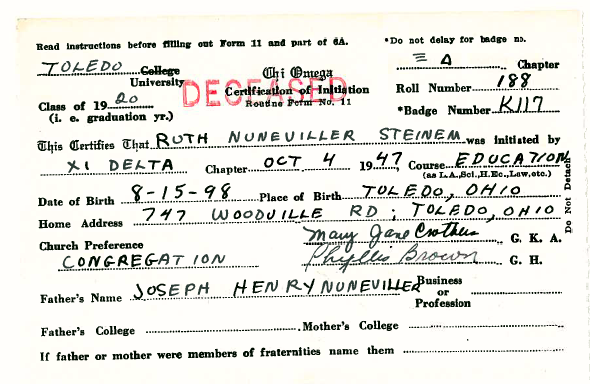
My friend Lyn Harris is the Chi Omega Archivist. She posted about a recent e-mail she had from the staff of the PBS show Finding Your Roots. Here is her account “So… it’s an exciting day when the Chi Omega Archivist gets to help PBS!! Indeed, Gloria Steinem’s mother Ruth, was a Chi Omega at Xi Delta/Univ of Toledo. She was initiated in 1947 and had probably been a member of the local group in the 1920s which became Xi Delta.” And below is her twitter post about it.

So contacted me for help in researching Gloria Steinem’s Mom

 
***

Linda Langford, Ph.D., is one of my daughter’s three pledge sisters. They were convention initiates at the 2011 Pi Beta Phi convention. The story behind her initiation is a heartwarming one. At a meeting during the  Novak Institute for Hazing Prevention, a Pi Phi staff member noticed Linda was wearing a Pi Phi ring. Asked if she was a Pi Phi, she replied that she was not, but her mother was. Her mother had recently died and she wore the ring in her memory. That story was enough to get the ball rolling on an alumna initiation.

Dr. Langford leads Suicide Prevention Social Media chats and the post below is from one of those chats.

I  co-authored a paper on messaging about military/veteran suicide, in case anyone’s interested:

© Fran Becque, www.fraternityhistory.com, 2014. All Rights Reserved. If  you enjoyed this post, please sign up for updates. Also follow me on twitter @GLOHistory and Pinterest www.pinterest.com/glohistory/

Posted in Chi Omega, Cottey College, Phi Kappa Psi, Phi Theta Kappa, Pi Beta Phi, Theta Chi, University of Illinois | Tagged , , , , , , , , , | Comments Off on The @GLOHistory Twitter Feed – a ΘΧ Mustang, ΦΚΘ, ΧΩ’s PBS Inquiry , a New ΦΚΨ House, and a ΠBΦ Connection

A Door Closes – the Last Lombard College Alumni Dies, R.I.P. Ray Truedson

Galesburg, Illinois. was once home to two colleges. Knox College is the oldest. It was founded 14 years before Lombard College, which was established by the Universalist Church in 1853. Alumnus Carl Sandburg earned money for school by ringing its bell.*

Lombard College is where Alpha Xi Delta was founded. Pi Beta Phi’s second chapter in Illinois was founded there, too. Pi Phi’s fourth chapter in Illinois was chartered at nearby Knox College. When Lombard College closed in the midst of the Depression, there was never any formal merger of the two colleges, and the Greek-letter organizations did the best they could to keep the Lombard chapters alive. For Pi Beta Phi it meant merging the chapter into the Illinois Beta-Delta Chapter, the only Pi Phi chapter with a dual Greek-letter name. I remember reading something about the Sigma Nu chapter at Lombard. A few years before the closure, the chapter built a new house. Once Lombard closed, the men were suddenly living a few miles away from the Knox campus. It caused problems for the chapter.

Lombard’s last class graduated in 1930. There were 83 students students – 30 seniors, 22 juniors, 28 sophomores and 3 freshmen – who transferred to Knox. The last of them graduated in the Knox College class of 1933. All 7,500 Lombard College alumni and their records were “adopted” by Knox College and the alums were invited to Knox events.

On November 10, 2014, Ray Truedson, the last living alumnus of Lombard College, died at the age of 104. A door closes for Knox College. I offer my sincere condolences to his family and Knox College friends.

I just returned from my first alumni event, the annual get-together of the Chicago FYC, held this year at Cantigny Park. Forty Chicago FYC members braved the 100+ degree heat to attend the luncheon and visit with one another and with me. One very special attendee was Ray Truedson, Lombard Class of 1932 and one of four remaining Lombard alumni. Ray was born 101 years ago on February 15th -- Founders Day for both Knox and Lombard! We concluded the event with the Knox Fight Song, after which Ray did a solo on the Lombard Fight Song for a few of us. I was touched by the depth of the friendships among the Knox alums I met and grateful for the kind welcome I received. Many of the women were especially pleased that Knox has appointed a woman president -- this is the natural evolution of Knox's mission of access, so I am honored to be here at this time in Knox's history.

This picture, posted on July 22, 2011, is from the Facebook page of Dr. Teresa Amott, the Knox College President, “I just returned from my first alumni event, the annual get-together of the Chicago FYC, held this year at Cantigny Park. Forty Chicago FYC members braved the 100+ degree heat to attend the luncheon and visit with one another and with me. One very special attendee was Ray Truedson, Lombard Class of 1932 and one of four remaining Lombard alumni. Ray was born 101 years ago on February 15th — Founders Day for both Knox and Lombard! We concluded the event with the Knox Fight Song, after which Ray did a solo on the Lombard Fight Song for a few of us.”

 ***

Happy Founders’ Day to Omega Psi Phi and Delta Phi, founded on this day in 1911 and 1917, respectively.

* A search of “Lombard College” in the little search box on this page will bring up the past posts about the college.

© Fran Becque, www.fraternityhistory.com, 2014. All Rights Reserved. If  you enjoyed this post, please sign up for updates. Also follow me on twitter @GLOHistory and Pinterest www.pinterest.com/glohistory/

​ 
Posted in Fran Favorite, Knox College, Lombard College | Tagged , , , , | Comments Off on A Door Closes – the Last Lombard College Alumni Dies, R.I.P. Ray Truedson

Alpha Sigma Alpha’s Founders’ Day and an Outstanding Educator, Freida Joy Riley

Alpha Sigma Alpha was founded on November 15, 1901 at the State Female Normal School (now Longwood University) in Farmville, Virginia. It is the youngest of the Farmville Four, the four National Panhellenic Conference (NPC) organizations founded on that campus. The other three organizations are Kappa Delta, Sigma Sigma Sigma, and Zeta Tau Alpha. The Alpha Sigma Alpha founders had been invited to join some of the other sororities on campus, but they wanted to stay together. So they found an organization of their own. The five, Virginia Lee Boyd (Noell), Juliette Jefferson Hundley (Gilliam), Calva Hamlet Watson (Wootton), Louise Burks Cox (Carper) and Mary Williamson Hundley, created Alpha Sigma Alpha.

Years ago, on one of our drives east to visit family, we listened to Rocket Boys by Homer Hickam, Jr. The National Museum of Education has an Honorary Registry of Education. Freida Joy Riley. who taught at Big Creek High School in Coalwood, West Virginia, is on that registry, added on December 1, 2005 by Andrew R. (no last name provided). Homer Hickam added these thoughts:

            A few years ago, I wrote a memoir titled Rocket Boys which has since gone on to become a classic.  Rocket Boys (from which the film October Sky was based) is about life in a West Virginia coal town during the 1950’s and centered on my high school days when some friends and I decided to become rocket-builders.   One of the folks I wrote about was our chemistry and physics teacher, a young woman named Freida Joy Riley.  Because of the book and movie, Miss Riley, as we knew her, has taken on near-icon status amongst teachers across the nation and the world. Wherever I go, I am thanked by people of all walks of life, but especially by teachers, for telling her story.  At long last, they say, someone has written about a real school teacher, one who not only fought for her students, but insisted that they learn.
 
            In Rocket Boys, I quote Miss Riley as saying, “All I’ve done is give you a book. You have to have the courage to learn what’s inside it.”  She had just provided me with a book about rockets that required a thorough knowledge of calculus and differential equations to understand.  Although I was having trouble with algebra at the time, Miss Riley believed in me and so I believed in myself.

            Miss Riley was not an easy teacher.  She was a tough teacher.  She gave lots of homework and required each of us to arrive in class prepared and ready to discuss the day’s lessons.  Miss Riley paid attention to all her students, not just her missile-building boys.  She was fierce in her belief that going to school was the job of her students and, therefore, sacred.  To do a poor job was simply not acceptable.  When I got arrogant because of my rocket successes, or in trouble for my failures, she kept me on an even keel with just a few words of appropriate encouragement and a form of tough love.  Even when she was diagnosed with Hodgkin’s Lymphoma, she never stopped teaching.  At the last, she was carried by stretcher to her classroom.

            Miss Riley died while I was on military duty overseas. When I found out, I wished then that I had told her how much she meant to me.  At least, I was able to do that retroactively in Rocket Boys.  I am most happy that she lived long enough to see Neil Armstrong step on the moon.  I trust she thought of her Rocket Boys when he did.

Freida Joy Riley was 31 years-old when she died. She was teaching at the same high school from which she graduated. An initiate of the Alpha Sigma Alpha chapter at Concord College, she did graduate work at Ohio State University and West Virginia University. There are several awards named in her honor. One is given by her college. Another is sponsored by the Christopher Columbus Fellowship Foundation and administered by the Partnership for America’s Future. And then there is an award given by and given to a member of her sorority.

Alpha Sigma Alpha’s Freida Riley Award for Teaching Excellence is given to one of its members, in good standing, who is a full-time or retired K-12 school teacher, with at least three years of teaching experience. The Award for Teaching Excellence demonstrates Alpha Sigma Alpha’s commitment to a quality education and recognizes outstanding Alpha Sigma Alpha educators. The women who are nominated embody Riley’s qualities of  “inspiring students to do their best, showing care and respect for students, and ‘going the extra mile’ to make their students’ experiences memorable.” 

Freida Joy Riley

© Fran Becque, www.fraternityhistory.com, 2014. All Rights Reserved. If  you enjoyed this post, please sign up for updates. Also follow me on twitter @GLOHistory and Pinterest www.pinterest.com/glohistory/

Posted in Alpha Sigma Alpha, Founders' Day, Fran Favorite | Tagged , , , , | Comments Off on Alpha Sigma Alpha’s Founders’ Day and an Outstanding Educator, Freida Joy Riley

The Books Find Me!

Last weekend was spent working at the Friends of the Carbondale Public Library Book Sale. Through our book sales, the “largest in southern Illinois,” according to our claims, we are able to help the Library fund projects and events. Our stock of books depends, as I like to say, on “who moves, retires, or dies.”

As I was straightening up the books, I came across this student directory from Tulane University, circa 1958-59.

photo (52)

Never mind that someone has been carting this around and giving it room in their home since then, and never mind that none of the phone numbers will connect you to the person who had the number in 1958, or that few of the businesses which advertised are still there (my educated guess) – just look at the back cover of this booklet! What a surprise to see the words “Pi Beta Phi”!

B18f1h7IQAIH5Ux

My anthropologist friend and I have headed the sorting/logistics part of the book sale for more than a decade. For years, she had been nattering about alphabetizing the books. I kept telling her it was too overwhelming to even contemplate. One day I told her that if she felt strongly about it, she should just do it. And she must have known that she had practically worn me down since she had already loosely alphabetized the “Mystery Room.” The patrons who loved mysteries thought the concept was wonderful and we’ve been putting all “A” authors together, all “B” authors together, etc. ever since. We also do the same to the fiction section and we loosely alphabetize the biographies by subject. The latter is my job because bio is one of my favorite subjects. I came across this book as I was doing this job. I shirked my responsibilities and started to read it on the spot. After a chapter, I knew I had to purchase it, because I needed to get back to work.

photo 2 (8)Joyce Carol Oates is also an alumna of Syracuse University. She was initiated into the Phi Mu chapter. When she was in the chapter, the Phi Mu house was next to the Pi Phi house on Walnut Place. When I was there, the house next door to Pi Phi was home to the Beta Theta Pi chapter. Another member of the Pi Phi chapter wrote this in a facebook post, “one of the Beta brothers had a mother who had been a Phi Mu at SU in the ’60s and she was so horrified at the state of the house when she saw it they said she almost cried!”

Later that day, I had to drop some items off at the Church Women United Thrift Shop. The shop does wonderful things for the community and my husband is on the Board (I keep asking him what exactly he doesn’t understand about the “church women” part of the name, but he isn’t the only male on the board and it does help to have some men who can fix things around to help with the minor repairs and maintenance). In dropping off the items, I saw this book and I knew I had to buy it.photo 1 (11)

Bill Cook and his family restored the West Baden Springs Hotel (see http://wp.me/p20I1i-12a) and the Indiana Landmarks Center, where the Centennial of the Indianapolis Alumnae Panhellenic was celebrated a few weeks ago (http://wp.me/p20I1i-12a). I knew that this book hadn’t ever come through the library book sale or I would have purchased it then for a third of the $2.99 cost. Bill Cook was a Beta Theta Pi at Northwestern; his wife Gayle was an initiate of the Alpha Omicron Pi chapter at Indiana University.

 © Fran Becque, www.fraternityhistory.com, 2014. All Rights Reserved. If  you enjoyed this post, please sign up for updates. Also follow me on twitter @GLOHistory and Pinterest www.pinterest.com/glohistory/

Posted in Fran Favorite, Indiana University, Northwestern University, Syracuse University | Tagged , , , , , , , , | Comments Off on The Books Find Me!

In Flanders Fields on Veterans Day and Gamma Phi Beta’s War Work on Its Founders’ Day

Today is Veterans Day, a day when we give thanks to the brave men and women who make it their business to protect the rest of us. The sacrifices they make are many and I, for one, am truly grateful. Long before it became Veterans Day, it was the day on which some young women at Syracuse University found an organization of their own. Some of those early Gamma Phi Beta women also answered the call to duty and served in civilian capacities during World War I.

The haunting poem, In Flanders Fields, was written by John McCrae, M.D., a Lieutenant Colonel in the Canadian Army during World War I. He was a Zeta Psi.

In Flanders Fields
In Flanders fields the poppies blow
Between the crosses, row on row,
That mark our place; and in the sky
The larks, still bravely singing, fly
Scarce heard amid the guns below.

We are the Dead. Short days ago
We lived, felt dawn, saw sunset glow,
Loved and were loved, and now we lie
In Flanders fields.

Take up our quarrel with the foe:
To you from failing hands we throw
The torch; be yours to hold it high.
If ye break faith with us who die
We shall not sleep, though poppies grow
In Flanders fields.

President Woodrow Wilson, a member of Phi Kappa Psi, proclaimed November 11, 1919, as the first commemoration of Armistice Day (the truce took place on the eleventh hour of the eleventh day of the eleventh month although the treaty was signed months later). He said, “To us in America, the reflections of Armistice Day will be filled with solemn pride in the heroism of those who died in the country’s service and with gratitude for the victory, both because of the thing from which it has freed us and because of the opportunity it has given America to show her sympathy with peace and justice in the councils of the nations…” After World War II, the day took on the name “All Veterans Day” to honor those of other conflicts. Somewhere along the way, the day became known as “Veterans Day.”

The Poppies at the Tower of London, November 2014 (Photo by Linda Smith Tabb)

Blood Swept Lands and Seas of Red is the display of poppies at the Tower of London. It was created by ceramic artist Paul Cummins and it was designed by Tom Piper.  Each of the 888, 246 red poppies represents a World War I British military fatality.  (The photo was taken in November 2014 by Linda Smith Tabb, a Pi Phi friend and world traveler extraordinaire.)

 ***

A church oyster supper was the first social event Frances Haven (Moss) attended after enrolling in Syracuse University in 1874. Her father, Dr. Erastus Otis Haven, had been recently elected Chancellor of the university. At that supper, she met the man who would later become her husband, Charles Melville Moss. She also met two members of Alpha Phi, a women’s fraternity founded at Syracuse in October of 1872. Instead of accepting the invitation to join Alpha Phi which had been offered to her, she joined with three other women – Mary A. Bingham (Willoughby), E. Adeline Curtis, and Helen M. Dodge (Ferguson) –  and they created an organization of their own. The date was November 11, 1874. The organization is Gamma Phi Beta, the first of the National Panhellenic Conference (NPC) organizations to use the term “sorority;” Syracuse Latin professor Frank Smalley coined the word for the women.*

World War I gave sorority women the opportunity to be of service to their country. There was much “war work” done by Gamma Phi Beta including these efforts:

“But there were those of us who went overseas, who, in their indefatigable energy and enthusiasm, carried the crescent into Italy and France and to whom came the wonderful privilege of seeing history in the making and of aiding the splendid men who had offered themselves to a great and glorious cause. Grace Banker (Iota) was chief operator of the American Telephone Service at Coblenz and received the Distinguished Service Medal from Lieutenant General Hunter Liggett for her work during the St. Mihiel drive (see http://wp.me/p20I1i-t6 for more information about her).

Grace Banker

Grace Banker

“Mary Katherine Taylor (Delta) was with Base Hospital Number Three which was located at the foothills of the Vosges and had many thrilling experiences; Josephine Russell (Epsilon) did active service in canteen work at a huge artillery training camp in central France and later followed the troops of occupation into Germany; Mary Jones (Kappa), with Base Hospital Number Forty-nine, bore the official title of Red Cross Recreational Hut Director and on her arrival in the large hospital center at Allerey had the excitement of meeting Margaret Reiley (Lambda) who afterwards assisted her in the hut; Margaret Reiley, by the way, had an interesting experience which is worth the telling. One day, as she was gazing into a shop window at Paris, a strange soldier rushed up to her and began to shake her hand most vigorously while she endeavored to explain to him that he must think her some other auburn haired lass from the States. ‘No,’ he shouted, ‘You are the one I mean, for you wear a Gamma Phi pin and I’ve got a girl in Boston town that wears one, too. I haven’t seen anything that looked so good to me since I left home and after the war is over I’m going back to marry that Gamma Phi pin.’

“Jeanette Monroe (Kappa), as Red Cross Dietitian, served in Dijon, France, and for Red Cross Hospital Number One Hundred and One in Neuilly, a suburb of Paris; Ethel Cosgrove, of the same chapter, went to England for the Y.M.C.A. Canteen and served in Eagle Hut, London; from there to Liverpool. where, with a man secretary, she looked after a motor transport corps of two hundred boys; then to Paris where she conducted a Y.M.C.A. bookshop in the lobby of the Palais de Glace on the Champs Elysees; and finally to Prague, Czecho Slovakia, as business manager of a unit which conducted a summer training course in social service. Her work was carried on by permission of the government in the wonderful old Siteradels Castle, once the home of the Austrian governors; Julia Bell, also of Kappa, was Director of the Department of Personnel of the American Red Cross in Paris for a year then joined the Near East Relief and was sent to Tiflis in the Caucasus to work under Colonel W.N. Haskell, who had been appointed ‘Allied High Commissioner to Armenia’ by the Peace Conference in Paris; Mary Clarke (Kappa), in war work near Nancy, was under fire many times, was decorated by the French government, and brought a French protégé to America for education.

“Geraldine Doheny (Lambda) went abroad with the purpose of being a hut worker with the Red Cross but, after reporting in Paris, she was temporarily loaned for canteen service and assigned to duty in the Riviera. Florence French Dickson, of the same chapter, accompanied Base Hospital Number Fifty to France as Dietitian, this unit being composed almost entirely of University of Washington men. Marjorie Templin Wellhouse (Sigma), after assignment to a Base Hospital unit at Atlanta, was transferred to France; Nell Watts (Zeta) after splendid work as Chairman of the Goucher War Work Committee went overseas for reconstruction work; Minnie Mason Beebe (Alpha), a member of the faculty of Syracuse University, engaged in Y.W.C.A. work at the front; Mary Hungate Bennett (Pi) was dietitian at a large hospital in France and Sarah Cole Usinger (Pi) was also in France and now with her husband is doing reconstruction work in that country; Katharine Dame (Delta), through the Bryn Mawr Service Corps, became a member of the American Red Cross Tuberculosis Committee for Italy in the triple capacity of filing clerk librarian and translator; Lillian White Blanzino (Epsilon), who has lived in Italy for fourteen years, was a nurse in the Green Cross Hospital, the Italian branch of the Red Cross, while her husband was in seacoast defense and later on she was sent to America by Count Della Somagila, Managing Director of the Italian Red Cross, to raise five hundred thousand dollars for a surgical hospital in Rome.”

To read more…..

* For more on Dr. Frank Smalley and the word “sorority” 

For more information on Dr. Erastus Haven, the father of Frances

© Fran Becque, www.fraternityhistory.com, 2014. All Rights Reserved.  If  you enjoyed this post, please sign up for updates. Also follow me on twitter @GLOHistory and Pinterest www.pinterest.com/glohistory/
Posted in Fran Favorite | Tagged , , , , | Comments Off on In Flanders Fields on Veterans Day and Gamma Phi Beta’s War Work on Its Founders’ Day

Steeped in New England Sensibilities – Mount Holyoke College and Sigma Kappa

A bit more than 250 miles and 37 years (and a day) separates the founding of Mount Holyoke College and Sigma Kappa, yet both share roots in New England. The story of each of  their foundings reflects the New England sensibility of doing what needs to be done, with a practical hand and a nod to the future.

Mary Lyon was an early pioneer in the quest for women’s education. As a student, she was introduced by her mentor to an environment where women were treated as intellectual equals, an uncommon experience in the early 1800s. Her dream of having her own school prompted her to establish a women’s seminary (a seminary in Mary Lyon’s day was a secular school for women, not a religious training institution). It took her two years to find $15,000 in funding to help make her idea a reality. Chartered in 1836, Mount Holyoke Seminary opened on November 8, 1837. Training women to become strong teachers was its primary mission.

Mary Lyon’s last year of full-time teaching was 1847-48 and she died the following year. By the late 1800’s, it had become necessary for the seminary to evaluate its educational status in order to keep up with the changing American society. Mount Holyoke Seminary moved away from being a seminary and became a full-fledged women’s college. 

Donna Albino, a Mount Holyoke alumna, has an extensive collection of Mount Holyoke memorabilia. Visit http://www.mtholyoke.edu/~dalbino/ to take a look at the wonderful items in her collection.

Donna Albino, a Mount Holyoke alumna, has an extensive collection of Mount Holyoke memorabilia. 


Sigma Kappa was founded on November 9, 1874, by five young women, the only females enrolled at Colby College in Waterville, Maine. They received a letter from the faculty approving the organization’s petition, which included a constitution and bylaws.

The five founders of Sigma Kappa are Mary Low Carver, Elizabeth Gorham Hoag, Ida Fuller Pierce, Louise Helen Coburn and Frances Mann Hall. In Sigma Kappa’s first constitution, membership in Sigma Kappa was limited to 25 women. The original chapter is known as the Alpha chapter. After Alpha chapter’s membership reached 25, a Beta chapter was formed. A Gamma chapter soon followed. Although there were some early joint meetings, the members did not think it feasible to continue that way. In 1893, a vote was taken to limit Alpha chapter to 25 members and to allow no more initiations into Beta and Gamma chapters. In due time, Beta and Gamma disappeared.

The Delta chapter was installed at Boston University in 1904. In 1905, Sigma Kappa became a member of the National Panhellenic Conference. Sigma Kappa’s Alpha chapter closed in 1984 when Colby College banned all fraternities and sororities from campus.

Violets, Sigma Kappa's flower

Violets, Sigma Kappa’s flower

© Fran Becque, www.fraternityhistory.com, 2014. All Rights Reserved.  If  you enjoyed this post, please sign up for updates. Also follow me on twitter @GLOHistory and Pinterest www.pinterest.com/glohistory/

Posted in Colby College, Mount Holyoke College, Sigma Kappa, Women's Fraternity History | Tagged , , , , | Comments Off on Steeped in New England Sensibilities – Mount Holyoke College and Sigma Kappa