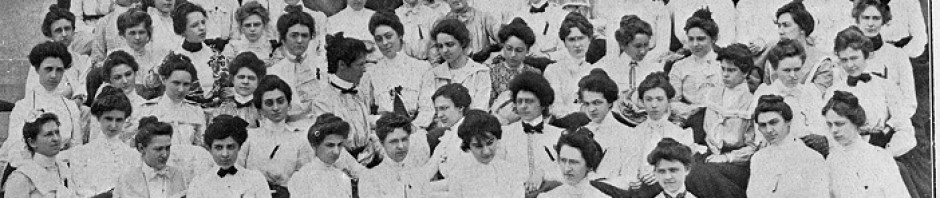
Happy 93rd Sigma Gamma Rho!

Today, Sigma Gamma Rho Sorority, Inc. celebrates the 93rd anniversary of its founding. The sorority was founded on November 12, 1922 by seven young women educators in Indianapolis, Indiana. On December 30, 1929, a charter was granted to the Alpha chapter at Butler University making the organization a national college sorority. It is the only one of the National Pan-Hellenic Conference sororities not founded at Howard University, site of the Alpha chapters of  Alpha Kappa Alpha, Delta Sigma Theta, and Zeta Phi Beta.

Sigma Gamma Rho, Alpha chapter, 1924

Sigma Gamma Rho, Alpha chapter, 1924

Sigma Gamma Rho was founded in a hotbed of Ku Klux Klan activity at a time when Butler University had quotas on the number of African American students it would admit. Nine African American women educators, Nannie Mae Gahn Johnson, Mary Lou Allison Little, Vivian White Marbury, Bessie M. Downey Martin, Cubena McClure, Hattie Mae Dulin Redford, and Dorothy Hanley Whiteside, gathered together and formed Sigma Gamma Rho. At that time, Butler was located in Irvington and not on its current campus, about 10 miles northwest of the original Butler campus. 

Irvington was the home of David Curtiss Stephenson, the Grand Dragon of the Indiana Branch of the Ku Klux Klan. It must not have been a welcoming environment for the young Sigma Gamma Rho women. In 1925, Stephenson’s henchmen kidnapped a young teacher, Madge Oberholtzer. Stephenson assaulted Oberholtzer and it played a role in her death. After she died, he was convicted of killing her. The trial and the sensation it caused helped reverse the growth and influence of the KKK (see http://wp.me/p20I1i-1RY).

In July 1939, when the Los Angeles chapter of Sigma Gamma Rho was founded, actress Hattie McDaniel was a charter member. Her role as “Mammy” in Gone With the Wind earned her the 1940 Academy Award for Best Actress in a Supporting Role. She was the first African American woman to win the award.

Hattie McDaniel, February 1940.

Hattie McDaniel with her Oscar, February 1940.

McDaniel was also the first African American woman to sing on American radio. She has been honored with two stars on the Hollywood Walk of Fame, one for her contributions to radio and the other for her contributions to motion pictures. In 2006, she became the first African American Academy Award winner to be honored with a U.S. postage stamp.

Hattie McD

Breast cancer claimed McDaniel’s life in 1952 at the age of 57. Sigma Gamma Rho created the Hattie McDaniel Cancer Awareness and Health Program in her honor and memory. The mission of the program is to provide education and support of early detection of breast, prostate, ovarian, colon and other cancers as well as research for prevention of the cancers.

© Fran Becque, www.fraternityhistory.com, 2015. All Rights Reserved.  If  you enjoyed this post, please sign up for updates. Also follow me on twitter @GLOHistory and Pinterest www.pinterest.com/glohistory/

Posted in Butler University, Fran Favorite, Sigma Gamma Rho | Tagged , , , , | Comments Off on Happy 93rd Sigma Gamma Rho!

11/11 Gamma Phi Beta’s Founding Day and Armistice Day

Frances Haven (Moss) grew up in Ann Arbor, Michigan, and Evanston, Illinois, as her father, Dr. Erastus Otis Haven, headed up the University of Michigan and then Northwestern University. When Dr. Haven was elected Chancellor of Syracuse University, Frances moved to Syracuse, too, and enrolled at Syracuse University. The first social event she attended was a church oyster supper. There she met the man who would later become her husband, Charles Melville Moss. She also met two members of Alpha Phi, a women’s fraternity founded at Syracuse in October of 1872. Instead of accepting the invitation to join Alpha Phi which had been offered to her, she joined with three other women – Mary A. Bingham (Willoughby), E. Adeline Curtis, and Helen M. Dodge (Ferguson) –  and they created an organization of their own. The date was November 11, 1874. The organization is Gamma Phi Beta, the first of the National Panhellenic Conference (NPC) organizations to use the term “sorority;” Syracuse Latin professor Frank Smalley coined the word for the women.*

Shortly after the U.S. entered the World War I, Gamma Phi Beta’s Grand Council adopted a French orphan, Louise Miroux. This is from a 1918 Crescent of Gamma Phi Beta:

[Louise Miroux, who has been adopted by the Council of Gamma Phi Beta, sends the following quaint and delightful letter which we print exactly as it was written.]

17 Novembre, 1917.
My dear benefactress:
How may be able to tell you all my gratitude for your generosity about us. That will do ray mother less poor in this time so hard, she il all the day working in manufactory. I go to the school during this time with my little sister, SIMONE, which is nine years old. We work our best possible at the school where we learn to love our France.
Our Mistress tell us it is a great bonheur for us to have many friends as your “AMERICAN’S” and we must love you like our soldiers.
Dear Miss it is a great pleasure for me to send you my photographie with my sister SIMONE. I have not any other sister, not brother. My little sister would kiss my benefactress and I kiss you also with all my heart. I send also a good kiss to your dear mother. My mother thanks you very much and asks you to accept her best regards.
I must tell you dear miss, I am learn to knit for our soldiers.
Your Little Affectionate
Louise Miroux.

Since this is Veteran’s Day, too, “the eleventh day of the eleventh month,” I would like to honor all those Gamma Phi Betas and others who have served in the armed services. This includes a reader of this blog, Cele Hoffman Eifert, who allowed me to use these photos.

USC AFROTC Drill Team Early 1970s. There are two women in this photo. Cele

The University of Southern California AFROTC Drill Team in the early 1970s. There are two women in the photo. Cele is in the back row, fourth from the left, and her female comrade-in-arms is in front of her.

Cele

Cele and Lesa Crow Wagner Juday on the cover of the Crescent. The photo was taken in 1977 when, during training at Lackland Air Force Base in San Antonio, TX, they discovered they were Gamma Phi Beta sisters. Cele wrote the article about military sisters for this issue.


Cele

Cele in front of a poster of that cover which is displayed in Gamma Phi’s HQ.

* For more on Dr. Frank Smalley and the word “sorority,” see http://wp.me/p20I1i-ZH.

For more information on Dr. Erastus Haven, the father of Frances, see http://wp.me/p20I1i-e5.

For more information about the history of Gamma Phi Beta,  http://wp.me/p20I1i-6h. This link includes a picture of an early Gamma Phi house on Irving Avenue in Syracuse.

***

IMG_2675

Today is Veterans Day, a day when we give thanks to the brave men and women who make it their business to protect the rest of us. The sacrifices they make are many and I, for one, am truly grateful. 

The haunting poem, In Flanders Fields, was written by John McCrae, M.D., a Lieutenant Colonel in the Canadian Army during World War I. He was a Zeta Psi.

In Flanders Fields
In Flanders fields the poppies blow
Between the crosses, row on row,
That mark our place; and in the sky
The larks, still bravely singing, fly
Scarce heard amid the guns below.

We are the Dead. Short days ago
We lived, felt dawn, saw sunset glow,
Loved and were loved, and now we lie
In Flanders fields.

Take up our quarrel with the foe:
To you from failing hands we throw
The torch; be yours to hold it high.
If ye break faith with us who die
We shall not sleep, though poppies grow
In Flanders fields.

President Woodrow Wilson, a member of Phi Kappa Psi, proclaimed November 11, 1919, as the first commemoration of Armistice Day (the truce took place on the eleventh hour of the eleventh day of the eleventh month although the treaty was signed months later). He said, “To us in America, the reflections of Armistice Day will be filled with solemn pride in the heroism of those who died in the country’s service and with gratitude for the victory, both because of the thing from which it has freed us and because of the opportunity it has given America to show her sympathy with peace and justice in the councils of the nations…” After World War II, the day took on the name “All Veterans Day” to honor those of other conflicts. Somewhere along the way, the day became known as “Veterans Day.”

For a post about the War Work done by NPC women during World War I, see http://wp.me/p20I1i-BT.

© Fran Becque, www.fraternityhistory.com, 2015. All Rights Reserved.  If  you enjoyed this post, please sign up for updates. Also follow me on twitter @GLOHistory and Pinterest www.pinterest.com/glohistory/

Posted in Fran Favorite, Gamma Phi Beta, Phi Kappa Psi, The Crescent of Gamma Phi Beta, University of Southern California, Zeta Psi | Tagged , , , , , , , , | Comments Off on 11/11 Gamma Phi Beta’s Founding Day and Armistice Day

On Sigma Kappa’s Founders’ Day, the Maine Sea Coast Mission

Sigma Kappa was founded on November 9, 1874, by five young women, the only females enrolled at Colby College in Waterville, Maine. They received a letter from the faculty approving the organization’s petition, which included a constitution and bylaws.

Violets, Sigma Kappa's flower

Violets, Sigma Kappa’s flower

The five founders of Sigma Kappa are Mary Low Carver, Elizabeth Gorham Hoag, Ida Fuller Pierce, Louise Helen Coburn and Frances Mann Hall. In Sigma Kappa’s first constitution, membership in Sigma Kappa was limited to 25 women. The original chapter is known as the Alpha chapter. After Alpha chapter’s membership reached 25, a Beta chapter was formed. A Gamma chapter soon followed. Although there were some early joint meetings, the members did not think it feasible to continue that way. In 1893, a vote was taken to limit Alpha chapter to 25 members and to allow no more initiations into Beta and Gamma chapters. In due time, Beta and Gamma were no more.

The Delta chapter was installed at Boston University in 1904. In 1905, Sigma Kappa became a member of the National Panhellenic Conference.

At the 1918 convention, the Maine Sea Coast Mission was chosen as Sigma Kappa’s first national philanthropy. The decision honored Sigma Kappa’s founding in Maine as well as the members who volunteered in support of this missionary society. Sigma Kappas still support the Maine Sea Coast Mission. Through the Sigma Kappa Foundation, members support the mission’s Christmas program, emergency relief program and scholarships. 

The February 1927 Arrow of Pi Beta Phi had an article about Sigma Kappa’s Seacoast Work:

Among the big national philanthropic projects being fostered
by Greek letter organizations is that of the Maine Sea Coast
Mission, supported in part by Sigma Kappa.

On August 28, 1926 there was launched the new ‘Sunbeam’
which carries the staff of the Mission to its duties with comfort
and expedition. It serves a parish which extends along more
than three-fifths of the Maine Coast. The Sunbeam is eighty
feet long, sixteen and a half beam and draws six feet. She is
fisherman type, built according to a proved design and equipped with auxiliary sailing for steadying in bad weather. Her power is that of a 120 h.p. crude oil engine and her cruising radius is nearly fifty per cent longer than that of the old Sunbeam. She is equipped with a small hospital and other accessories.

Sophie Parsons Woodman, New York Beta of Pi Beta Phi,
who was staying at her ‘best loved spot’ of South Bristol, Maine
last summer had the pleasure of attending the launching of the
new Sunbeam at Damaris Cotta.

In sending the above photograph and information to the
ARROW Editor she writes: ‘As you know this is the visible means to the splendid work of the Maine Sea Coast Mission, supported in part by Sigma Kappa. My snap isn’t very good as I had to aim into the sun from my vantage point of a keg of salt fish on the fish-house wharf but it at least shows that a Pi Phi was there. On the street afterwards I met a very charming girl, Carolyn Peasley. Maine Alpha of Pi Beta Phi, whose mother is head of the Bible work of the Mission,. and she helps in the summers.’

The Maine Sea Coast Missionary Society is undenominational in religion and concerned only that it is a real need to which it is called to minister. The facilities of the Mission are available for service under all circumstances and in any place within its physical limitations. The Mission co-operates enthusiastically with any agency religious or social which has a contribution to make to the solution of the problems of the coast.

IMG_2639

Sigma Kappa’s Alpha chapter closed in 1984 when Colby College banned all fraternities and sororities from campus.

© Fran Becque, www.fraternityhistory.com, 2015. All rights reserved. If  you enjoyed this post, please sign up for updates. Also follow me on twitter @GLOHistory and Pinterest www.pinterest.com/glohistory/


Posted in Colby College, Fran Favorite, Sigma Kappa | Tagged , , | Comments Off on On Sigma Kappa’s Founders’ Day, the Maine Sea Coast Mission

GLO Connections at the Book Sale

My anthropologist friend and I head up the book sale for the Friends of Carbondale Public Library. It is a labor of love. We love books and we love to get them into the hands of people who will love them, too. Although I spent a dozen hours this weekend dealing with the sale and the people who come to the sale, I did manage to find some GLO connections. These are but a small sampling of the GLO connections I found while straightening up the books.

Jim Davis, Garfields "Dad"

Jim Davis, Garfield’s “Dad,” is a Theta Xi.

Carl Bode

Carl Bode, who wrote a definitive biography of H. L. Mencken, was a member of Alpha Tau Omega.

Jane Porter is a Pi Beta Phi.

Jane Porter is a Pi Beta Phi.

Some paintings came our way to sell. This is one of Tennessee Williams.

Some paintings came our way to sell. This is one of Tennessee Williams.

Doris Kearns Goodwin is a Delta Delta Delta.

Doris Kearns Goodwin is a member of Delta Delta Delta.

Art Linkletter was a member of a local organization at San Diego State University.

Art Linkletter was an Alpha Tau Omega. While a student at San Diego State University, he was a member of a local, Tau Delta Chi, which later became the Epsilon Chi chapter of ATO. He was initiated as an alumnus in 1950. He enjoyed meeting ATO brothers across the country and played a large role in the fraternity’s centennial in 1965.

James Thurber as a Phi Kappa Psi.

James Thurber was a Phi Kappa Psi.

This book about astronauts, had these two female astronauts on the same page. One is a sorority woman and the other is not, The sorority woman is Judith Resnick, Alphe Epsilon Phi, and not Sally Ride.

This book about astronauts had these two female astronauts on the same page. One joined a National Panhellenic Conference organization and the other did not, although many people think to the contrary. The sorority woman is Judith Resnick, Alpha Epsilon Phi, and not Sally Ride, who did not belong to any NPC group.

Virgil “Gus” Grissom, Edward H. White II, and Roger B. Chafee were killed in the Apollo 1 cabin fire. White was a member of Phi Kappa Sigma.

A collection of old magazines was donated. This cover from 1967 shows the Apollo 1 astronauts who were killed in a cabin fire. Pictured are Virgil “Gus” Grissom, Edward H. White II, and Roger B. Chafee. White was a member of Phi Kappa Sigma.


© Fran Becque, www.fraternityhistory.com, 2015. All rights reserved. If  you enjoyed this post, please sign up for updates. Also follow me on twitter @GLOHistory and Pinterest www.pinterest.com/glohistory/

Posted in Alpha Tau Omega, Delta Delta Delta, Fran Favorite, Phi Kappa Psi, Pi Beta Phi, Theta Xi | Tagged , , , , , , , , , , , , , | Comments Off on GLO Connections at the Book Sale

Alpha Sigma Tau and Delta Upsilon, Founded on 11/4

On November 4, 1899, Alpha Sigma Tau was founded by eight young women, Mable Chase, Ruth Dutcher, May Gephart, Harriet Marx, Eva O’Keefe, Adriance Rice, Helene Rice, and Mayene Tracy. The event took place at the Michigan State Normal College (now Eastern Michigan University) in Ypsilanti, Michigan. The organization became a national one in October 1925.  In 1926, Alpha Sigma Tau joined the Association of Education Sororities (AES). Alpha Sigma Tau became a full member of the National Panhellenic Conference (NPC) when the merger of AES and NPC was formalized in 1951.

Volume 1, No 1 of the Anchor, the organization’s magazine was published in June 1925. Among the mentions of alumnae of the Alpha chapter in the first issue was this entry, “Katherine Bergegrun, while here in college, specialized in physical training, had charge of playground work in Detroit for some time, went to California where she studied at University of California for a time and then took up the study of medicine at the University of Michigan and afterwards continued her medical course in Philadelphia where she graduated this year.”

The catalogue of the University of Michigan noted that she had a degree from the University of Southern California. While at the University of Michigan, she became a member of the Alpha chapter of Alpha Epsilon Iota, a national women’s medical sorority. The 1923 Michigan yearbook lists 21 women who were members or pledges of the sorority. There is a drawing of a house on the Alpha Epsilon Iota page and presumably, some of the members lived in the house. Women were a distinct minority in medical school in the 1920s, so the support and fellowship must have been very welcomed in that environment. She is listed as a 1927 graduate of the Temple University School of Medicine. Her full name appears in the Temple University yearbook, Elsie Katherine Bergegrun,  as well as her nicknames, “Kay” and “Bergy.” It should also be reiterated that Alpha Sigma Tau was a sorority at a normal school and, in the 1920s, almost all of its alumnae were trained to be teachers. For a woman to have attended a college where teaching degrees were the norm and to have pursued a medical degree was certainly a very non-traditional career path.

Ast

***

There were no women students at Williams College in Williamstown, Massachusetts, when Delta Upsilon was founded by thirty men on November 4, 1834. In fact, women had yet to enter higher education when Delta Upsilon, the oldest non-secret fraternity, was organized.

Ten freshmen, ten sophomores and ten juniors met in the Freshman Recitation Room  of Old West College. They met in opposition of the activities of the two secret societies then at Williams. The name they chose was “Anti-Secret Confederation” (ACS).

Union College men established a chapter in 1838, followed by the Middlebury College group in 1845. In 1847, groups at Hamilton College and Amherst College were formed. The Convention of 1864, adopted the name “Delta Upsilon,” a name which several of the chapters had been using.

Among its distinguished members is football coach Lou Holtz, a member of the Kent State chapter. Hear Coach Holtz offer leadership advice to his Delta Upsilon brothers http://www.youtube.com/watch?v=rKAu3UuVaow&feature=player_embedded

Basketball coach Jim Boeheim, a member of the Basketball Hall of Fame, has spent most of his life and career at Syracuse University. He is an initiate of Syracuse’s Delta Upsilon chapter.

Jim Boeheim during his years playing on the Syracuse basketball team.

Jim Boeheim during his years playing on the Syracuse basketball team.

© Fran Becque, www.fraternityhistory.com, 2015. All rights reserved. If  you enjoyed this post, please sign up for updates. Also follow me on twitter @GLOHistory and Pinterest www.pinterest.com/glohistory/

Posted in Fran Favorite | Tagged , , , , , , | Comments Off on Alpha Sigma Tau and Delta Upsilon, Founded on 11/4

11/2/1909 – Lambda Chi Alpha is Founded

Lambda Chi Alpha was founded at Boston University on November 2, 1909. Most Greek-letter organizations celebrate Founders Day on the date of the founding.  Lambda Chi’s official Founders Day is March 22, according to the Fraternity’s website, “but celebrations typically occur at any time during the spring semester.”

On November 2, 1909, according to the Lambda Chi website:

Warren A. Cole (Boston 1912) founded Alpha Zeta of Lambda Chi Alpha at Boston University. As an incoming law student at the university, it was Cole’s dream to start a college fraternity from the very beginning. After graduating with a Bachelor of Law degree, Cole set out to build Lambda Chi Alpha into an international fraternity and served as the first Grand High Alpha, or chairman, until December 1919. He also served as the administrative secretary and editor of the Purple, Green, and Gold magazine.

Lambda Chi’s Historian Mike Raymond wrote a terrific article in the fraternity’s March 2011 Cross & Crescent. It is entitled “Why We Have Two Founders Days.” The second date, March 22, was originally called “Lambda Chi Alpha Day.” March 22, 1913 was the date of “the first assembly with representatives from more than one chapter, it was also the place where sweeping changes were made in the fundamental nature of Lambda Chi Alpha Fraternity.”

During World War I, 2,500 Lambda Chis, more than 82% of the fraternity’s membership, were in war service. In another Cross & Crescent article about the history of the magazine, Raymond wrote about the September 1918. It was:

made up entirely of a directory of Lambda Chis then serving in the military. The directory is organized by chapter, zeta number, name, military rank, and mailing address of each serviceman. This comprehensive listing was arranged by R.R. Rowe (Massachusetts Institute of Technology). The list includes 168 officers serving in the Army and Navy, 96 non-commissioned officers, and 763 enlisted men. A total of 1,027 brothers were in uniform in 1918 — an impressive number from a very young fraternal organization.

Thirty-seven Lambda Chi were killed during service in World War I. 

University of New Hampshire Lambda Chi Alpha chapter in 1919-1920. (Courtesy of UNH Archives)

University of New Hampshire Lambda Chi Alpha chapter in 1919-1920. (Courtesy of UNH Archives)

The October 11, 1939, acquisition of the 24 chapters of Theta Kappa Nu by Lambda Chi Alpha made it the largest fraternity merger at that time. Theta Kappa Nu had itself been created when 11  established local fraternities joined together on June 9, 1924. Theta Kappa Nu’s expansion was quick and the pattern of acquiring established locals continued; by the time of the merger, more than 50 Theta Kappa Nu chapters had been established and the fraternity had almost 6,000 members. The Great Depression caused collegiate membership to decline in both organizations (as well as in most fraternities and sororities). The merger documents were signed at Howard College (now Samford University) in Birmingham, Alabama. 


Posted in Boston University, Lambda Chi Alpha | Tagged , | Comments Off on 11/2/1909 – Lambda Chi Alpha is Founded

Happy Founders’ Day to Sig Ep, the Men of the Red Doors

On November 1, 1901,  Sigma Phi Epsilon was founded. It was founded by twelve young men who were students at the University of Richmond. One of the twelve, Carter Ashton Jenkins, was a Chi Phi member from Rutgers University; he first sought a charter from Chi Phi, but the request was declined because the University of Richmond, a Baptist school, was considered too small.

Jenkins then  found 11 other congenial men who were also eager to share a brotherhood built upon “the love of God and the principle of peace through brotherhood.”  They named the organization Sigma Phi unaware that there was already a men’s fraternity by that name. The group then took the name Sigma Phi Epsilon.

One of the fraternity’s traditions, that of the red door, began at Syracuse University. In 1928, a few of the brothers painted the front door red, one  the fraternity’s colors.

The red doors of a Sigma Phi Epsilon chapter.

The red doors of a Sigma Phi Epsilon chapter.


New York Alpha was the organization’s 18th chapter; it was founded on the campus in 1905. The chapter currently resides at 721 Comstock Avenue. The first red door made its appearance at the chapter’s former home on Walnut Place; that building is now the Slutzker International Center. The tradition continues at its home on Comstock Ave.

The Slutzker International Center at Syracuse University, the former home of Sigma Phi Epsilon on Walnut Place. The red door tradition began at this house.

 The “welcome to all” tradition caught on quickly and red doors became a mainstay of Sig Ep chapters nationwide.

© Fran Becque, www.fraternityhistory.com, 2015. All rights reserved. If  you enjoyed this post, please sign up for updates. Also follow me on twitter @GLOHistory and Pinterest www.pinterest.com/glohistory/

Posted in Sigma Phi Epsilon, Syracuse University | Tagged , , | Comments Off on Happy Founders’ Day to Sig Ep, the Men of the Red Doors

Theta Delta Chi Founded on Halloween, 1847

Happy Halloween! It’s also the founding date of Theta Delta Chi. In 1847, at Union College, Theta Delta Chi, was founded by  William G. Akin, Abel Beach, Theodore Brown, Andrew H. Green, William Hyslop, and Samuel F. Wile. The second charge, as Theta Delta Chi’s chapters are known, was founded in 1849 at Ballston Law School.  It was short-lived and after the school moved, the charge’s members were absorbed into the Alpha charge.

A charge was formed at the City College of New York, and among the charge’s early members was Gonzalo de Quesada, a Cuban born immigrant. He later became a key architect of Cuba’s Independence movement in the late 1800s. In 1900, he was named a Special Commissioner of Cuba to the United States. He was a member of the 1901 Cuban Constitutional Convention.  Entering the Cuban diplomatic service, he became minister to the United States. He then became minister to Germany and it was in Berlin that he died on January 9, 1915.

Gonazalo

Gonazalo de  Quesada

The City College Quarterly published an article about him after his death. Included was this. “In the New York Herald, June 8 1902, is an appreciation written by Frank L. Jones, one of his classmates and a member of the same College fraternity. With his permission, the following is reproduced in part.”

One autumn afternoon eighteen years ago, a youth scarcely out of his knickerbockers walked slowly through the main corridor of the College building. He was small, slender, and thin and of a complexion that plainly betokened his birth under a Southern sun. As he passed a group of upper classmen, they watched him closely for it was within their power to determine whether or not he was to be admitted to one of the College secret societies. There was little about him at that time to attract attention save the wonderfully deep dark eyes that sparkled like coals under the heavy eyebrows.

It was those eyes that turned the scales in his favor for one of the group said quietly, ‘That chap has more life and ambition in him than any of the others we have seen.” The verdict was in his favor and Gonzalo de Quesada became a member of the Theta Delta Chi fraternity. To day that organization is justly proud that she holds on her rolls the name of the first Cuban Minister to the United States. The act of that day held more of moment than any participant ever dreamed. In the days to come Quesada, representative of the Cubans fighting almost without hope, stood in Washington vainly striving for the recognition of his people. Officially, the United States did not dare to take cognizance of his credentials. But in no small measure, because Quesada wore upon his breast the shield of Theta Delta Chi, one all important door was open to him. This was the home of John Hays, who was a member of that fraternity, and his introduction to the young Cuban had been due largely to that fact Quesada’s own striking personality, his intelligent vivacity genuineness of feeling, and above all his overwhelming devotion to the cause of his country, speedily won Mr. Hays regard and when the latter became Secretary of State, Quesada was often a welcome, though not official visitor, at his home and office. The college days of Senor Quesada had a most marked effect upon his later life. 

John Milton Hay, a Theta Delta Chi at Brown University was, Secretary of State in the McKinley and T. Roosevelt administration and President Lincoln’s Secretary. This is about Theta Delta Chi from one of his biographies:

So vividly after the lapse of half a century did the recollection of John Hay’s capture by Theta Delta Chi (as one its members over the chagrin of rival fraternities) lie in the memory of Brother Stone an indication of the importance attached by undergraduates to their societies and club.s Hay proved himself a loyal Theta Delt. His wit enlivened the meetings and suppers, he wrote verses abundantly, one of his poems being sung at every reunion, and he formed lifelong associations with many of the brothers. A few years later, while serving as Secretary to President Lincoln, he saved from undeserved execution two Theta Delts and afterwards when he had risen to a position of great influence he never forgot the claims of members of his fraternity. 

© Fran Becque, www.fraternityhistory.com, 2015. All rights reserved. If  you enjoyed this post, please sign up for updates. Also follow me on twitter @GLOHistory and Pinterest www.pinterest.com/glohistory/


Posted in Theta Delta Chi | Tagged , | Comments Off on Theta Delta Chi Founded on Halloween, 1847

Monmouth College, June 7, 1934

Monmouth college degree abo

It is a picture taken on June 7, 1934 after an honorary degree was conferred upon Pi Beta Phi’s Grand President, Amy Burnham Onken. To Pi Phis and the NPC world, she was known as Miss Onken. The picture also appeared in the February 1935 Arrow of Pi Beta Phi. Unfortunately, only a handful of people were identified in the caption (“the rest are members of Pi Beta Phi”). In May of 1934, there were only three of the twelve founders living. Margaret Campbell lived in Monmouth. The other two were in Minnesota and Washington, respectively. I recognized Lois Franklin Stoolman to Miss Onken’s left. Mrs. Stoolman’s husband, A.W. Stoolman was a contractor in Champaign-Urbana and built many of the fraternity and sorority houses which still stand today.  He also built the Virginia Theatre, named for the Stoolman’s daughter.

Dr. Thomas Hanna McMichael, President of Monmouth College, is the man in the picture. His wife, Minnie McDill McMichael, was a Pi Phi, but she is not in this picture; she passed away in 1929. The McMichaels were instrumental in bringing the Greek-letter organizations back to Monmouth College. Mrs. McMichael spearheaded the reestablishment of Monmouth College’s Pi Beta Phi chapter, the Alpha chapter, after she and her husband accompanied Clara Brownlee Hutchinson, a founder, to the 1927 Pequot convention. There they plead the case of Zeta Epsilon Chi, the local organization which hoped to bring the Pi Phi charter back to Monmouth. Mrs. McMichael died a short time after she coordinated the installation festivities. It was her fervent wish to see a Pi Beta Phi chapter back at its founding campus and she made sure it happened. This Dr. McMichael was the second Dr. McMichael to serve as the College’s President. His father previously served in that role.

The September 1934 Arrow contained this tribute:

That to Amy Burnham Onken, beloved Grand President. we not  only acknowledge her superior leadership of our fraternity under all situations with deep appreciation. but we attest our admiration of her noble personality and her undying loyalty and devotion to the ideals, aspirations and projects of Pi Beta Phi . We also acknowledge the distinct honor brought to the fraternity through the conferring upon her of the honorary degree of Master of Arts by Monmouth College on the occasion of their 78th anniversary. This is the first time that such a signal honor has been bestowed upon a fraternity leader.

The report of the Monmouth Alumnae Club provided a glimpse of what went on that day:

June 7, 1934,was a great day for Monmouth Pi Phis, also for Monmouth College. An honorary degree was conferred upon our Grand President, Miss Amy B. Onken on Commencement day. Miss Mary Ross Potter, dean of women of Monmouth College, who was dean at Northwestern University when Miss Onken was a student there, on behalf of and on the recommendation of the faculty presented Miss Onken to Dr. T. H. McMichael, president of the college. He in turn recognized Miss Margaret Campbell, one of our Founders, who placed the hood on Miss Onken. thus conferring on her the honorary degree of Master of Arts, History was made that day as Miss Onken is the first national president to be thus honored by any institution. Mrs. Lois Stoolman, National Treasurer, was a guest of Monmouth Pi Phis for the day. Also there were representatives from Bloomington and Galesburg. Illinois, and Mt. Pleasant and Burlington, Iowa. At one o’clock a luncheon was served to some sixty Pi Phi guests and local members.

In the fall of 1934, the Alpha chapter of Kappa Kappa Gamma was returned to campus. A local sorority, Kappa Alpha Sigma, became the Alpha Deuteron Chapter of Kappa Kappa Gamma on October 13, 1934, bring the fraternity back to its founding home at Monmouth College.

Owls made for the 1934 installation of the Alpha Deuteron chapter of Kappa Kappa Gamma at Monmouth College. These owls are on display at Stewart House and I suspect they may have been made by Monmouth Pottery.
Owls made for the 1934 installation of the Alpha Deuteron chapter of Kappa Kappa Gamma at Monmouth College. These owls are on display at Stewart House. (Photo courtesy of Kappa Kappa Gamma)

© Fran Becque, www.fraternityhistory.com, 2015. All rights reserved. If  you enjoyed this post, please sign up for updates. Also follow me on twitter @GLOHistory and Pinterest www.pinterest.com/glohistory/

Posted in Fran Favorite, Kappa Kappa Gamma, Monmouth College, Pi Beta Phi | Tagged , , , , , , , , | Comments Off on Monmouth College, June 7, 1934

October, a Terrific Month for Marrying

It’s official. October almost did me in. The blog has been sparse and Founders’ Day posts for the NPC groups celebrating in October have been quickly pulled together from past posts. My to-do list has its own zip code. Frankly, those interested in fraternity and sorority history might skip this post because it really doesn’t include any.

The month opened with the excitement of the marriage of our oldest, our daughter, to an old friend. They graduated from high school in the same class, but never really travelled in the same circles. After college, they reconnected at a mutual friend’s party and continued communicating on the internet while he was in Thailand teaching English. The wedding came together although there were some minor glitches (i.e. having to find a new venue four weeks before the wedding). I tried my best to follow the advice of my Pi Phi friend Lisa, “Bite your tongue and write checks.”

While I am not shy in giving advice, and my strong-willed daughter is not shy in rolling her eyes or doing that quirky “No way, Ma,” thing with her lips, it all came together wonderfully. It was Simply Simone in so many ways. I am proud of my one contribution to the event. Last spring when I spoke at the Centennial of the Kansas State Pi Phi chapter, I helped clean-up after the lunch program. They used burlap runners on the tables. Someone asked if anyone knew of people who might be able to use some of the runners – people getting married or celebrating something. I blurted out that my daughter was getting married in October. A few weeks later, one of my Pi Phi friends e-mailed me that she left some of the burlap runners in the archives. When I showed Simone the runners, she let me know that her color scheme involved burgundy. “No problem,” I said, “I can dye them.” Word to the wise, do not try dying anything in a high efficiency washer. It won’t work. So I took to the small plastic pool I had purchased for the dogs who do not like to have water play in it. Turns out it is perfect for dying things. Dan strung up an impromptu clothes line and I managed to dye, iron and trim the runners. It was my small part in making Simone’s day special.runners

On the morning of the wedding, according to the bride’s  schedule, her father and I were to be dressed and at her beck and call by 10:30 a.m. so that the requisite parent/daughter pictures could be taken. I said, “Yes, dear,” and we magically appeared ready for our close-ups. I hadn’t realized that one of my duties would be pinning her Pi Phi arrow to the inside of her dress. Simone is an alumna initiate and did not have the collegiate experience, so this really touched my heart.

She also presented us with handkerchiefs. For mine, she went through my cards (yes, I keep cards) and found signatures from my Mom and my sister, Louise, who are both deceased. Simone doesn’t know that her grandmother’s signature is done with her left hand. After my mother lost the use of her right hand, she taught herself to write with her left hand. The amazing thing was that her signature looked exactly the same although her block letters looked different from her right-handed letters. 

hankie

The card she gave me with the hankie asked me not to cry since it would start her crying, too. When I saw the hankie, the tears started to flow, and I am writing this now with tears flowing down my face. It was such a thoughtful and loving gesture from a loving and thoughtful daughter. (She gave her brothers Teenage Mutant Ninja Turtle cuff links, a most appropriate gift for them. I must mention the wonderful toast that her brothers gave her at the reception. It was so touching and heartfelt that after they finished, Simone jumped out of her seat, crossed the dance floor and hugged them both. I suspect there were tears in her eyes, too.)

with simone

I wish Simone and her husband, our son-in-law, Brian, a happy and wonderful life together. They started married life as they started dating life, although he is not a few continents away as he was then. He’s only a few states away, As a proud mother, here is the link to some of Simone’s movie reviews, http://news.wsiu.org/programs/siu-reviews.

A happy belated anniversary to my husband, Dan. For the second year in a row, I’ve been gone for the Holt House Committee meeting. One of us had a dinner at the Barnstormer, Monmouth’s finest restaurant, on our anniversary and it wasn’t him.

In front of Holt House with my friend Lisa, she of the "bite your tongue and write checks" remark.

In front of Holt House with my friend Lisa, she of the “bite your tongue and write checks” remark.

© Fran Becque, www.fraternityhistory.com, 2015. All rights reserved. If  you enjoyed this post, please sign up for updates. Also follow me on twitter @GLOHistory and Pinterest www.pinterest.com/glohistory/

Posted in Fran Favorite | Tagged , , | Comments Off on October, a Terrific Month for Marrying