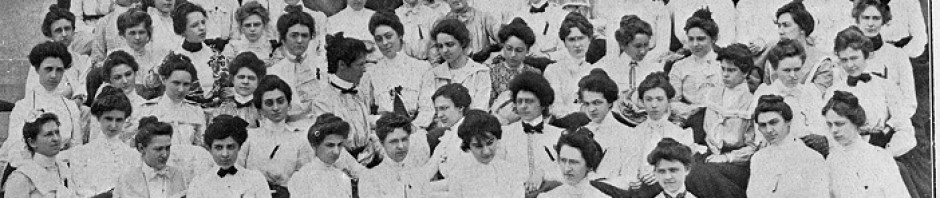
Delta Sigma Theta and Mary McLeod Bethune

On January 13, 1913, Delta Sigma Theta Sorority, Inc. was founded at Howard University. All 22 founders – Winona Cargile (Alexander), Madree Penn (White), Wertie Blackwell (Weaver), Vashti Turley (Murphy), Ethel Cuff (Black), Frederica Chase (Dodd), Osceola Macarthy (Adams), Pauline Oberdorfer (Minor), Edna Brown (Coleman), Edith Mott (Young), Marguerite Young (Alexander), Naomi Sewell (Richardson), Eliza P. Shippen,  Zephyr Chisom (Carter), Myra Davis (Hemmings), Mamie Reddy (Rose), Bertha Pitts (Campbell), Florence Letcher (Toms), Olive Jones, Jessie McGuire (Dent), Jimmie Bugg (Middleton), and Ethel Carr (Watson) – had been members of Alpha Kappa Alpha, which was founded at Howard University on January 16, 1908. When a disagreement about the future of the organization arose between the active chapter and the alumnae, an ultimatum was given, decisions were made, and in the end, the active members left Alpha Kappa Alpha and became Delta Sigma Theta Sorority, Inc.

Myra Davis went from being the president of the Alpha Kappa Alpha chapter to being president of the Delta Sigma Theta chapter. Many of the first meetings were held in Edna Brown’s living room. The 1913 Valedictorian and Class President, she married Frank Coleman, a founder of Omega Psi Phi Fraternity, Inc. Florence Letcher’s hobby of collecting elephant figurines led to the animal becoming the sorority’s symbol.

Nearly two months after its founding, on March 3, 1913, the women took part in the historic suffrage march in Washington, D.C. They were the only African-American women’s group to participate. Honorary member Mary Church Terrell joined them in their march.

In 1923, at the fifth national convention, Mary McLeod Bethune, a prominent educator, became an Honorary member of Delta Sigma Theta.

The daughter of former slaves, Bethune worked in the fields at age five. Due to the generosity of a benefactor, she graduated from Scotia Seminary (now Barber-Scotia College). Bethune-Cookman University in Daytona Beach, Florida can trace its history to 1904, when Bethune opened a school for African-American girls. There were five girls in the first class.  In 1923, the school merged with the Cookman Institute of Jacksonville, Florida to become a high school. In 1931, it became a junior college. Ten years later Bethune-Cookman became a four-year college. Bethune served as the college president from 1923-42 and 1946-47.  She was also a leader in the National Association of Colored Women and served as its national president. In addition, she founded the National Council of Negro Women and served as a Cabinet member in Franklin Delano Roosevelt’s administration.  Her push to upgrade the libraries at historically black institutions during her tenure as Director of the Negro Division of the National Youth Administration, and her firm belief that these libraries needed to be improved, played a part in Delta’s first national project. She died in 1955. In 1993, Bethune was inducted posthumously into the National Women’s Hall of Fame.

Mary McLeod Bethune and some of her students during the early years of her school. Photo courtesy of Bethune-Cookman University.

© Fran Becque, www.fraternityhistory.com, 2016. All Rights Reserved. If  you enjoyed this post, please sign up for updates. Also follow me on twitter @GLOHistory and Pinterest www.pinterest.com/glohistory/

Posted in Alpha Kappa Alpha, Delta Sigma Theta, Howard University, Omega Psi Phi | Tagged , , , , , | Comments Off on Delta Sigma Theta and Mary McLeod Bethune

Tau Kappa Epsilon and Ronald Reagan

On January 10, 1899, Tau Kappa Epsilon was founded at Illinois Wesleyan University in Bloomington, Illinois. In a meeting at 504 East Locust Street, Charles Roy Atkinson, Clarence Arthur Mayer, James Carson McNutt, Joseph Lorenzo Settles, and Owen Ison Truitt formulated plans for a fraternity they first called the Knights of Classic Lore. The name was changed to Tau Kappa Epsilon when, in 1902, the men rented the Wilder Mansion, a home which formerly belonged to the College’s president. It was the first men’s fraternity house on the campus.

One of its most famous members, the 40th President, Ronald Reagan, pledged TKE’s Iota Chapter at Eureka College on September 19, 1928 and served in several leadership roles as a chapter member, including Chapter Prytanis (President). 

The Reagans were not a well-to-do family and finding the money to attend college was a challenge, but one that was met head on. At the 1982 Eureka College commencement, President Reagan said “Everything that has been good in my life began here.”

Reagan kept up his TKE connections. In 1955, while on a tour junket of the Morrison, Illinois, General Electric plant, he stopped and visited and visited the high school where one of his fraternity brothers, Enos “Bud” Cole, was principal. In a 1967 interview with the Chicago Sun-Times, Cole noted that as college students, “We talked about politics then, but it never entered anybody’s head that Dutch would go into politics. He had a lot of ideas.”

frater reagan

In the fall of 1977, he spoke at Hillsdale College in Michigan. He insisted time be built into his schedule to visit the local TKE chapter.

Ronald Reagan with Hillsdale College TKEs.

In March 1984, a TKE luncheon was held at the White House with about 60 alumni in attendance. The President was awarded the Order of the Golden Eagle, TKE’s highest honor. He was also the recipient of the North-American Interfraternity Conference’s Gold Medal Award. Another ceremony took place at the White House in June 1988 when the President was given the Order of the Silver Maple Leaf Award. In turn, he presented the Ronald Reagan Leadership Award, given to  TKE undergraduate, to that year’s winner.

reagan eureka

Reagan’s older brother, John Neil “Moon” Reagan, followed his brother to Eureka. He, too, became a TKE and served as Chapter Prytanis. According to a quote on the Eureka College website:

Ron came home at the end of his first year with the news that he had it all fixed for me. I would have a scholarship at the school and he had a job for me ‘hashing’ at the girls dormitory so I’d have three meals a day. He said he’d have me pledged to the fraternity he belonged to. I laughed and said, ‘You got to be out of your mind!‘

The Iota Chapter President was invited to the funeral services for President Reagan after his death in 2004. This Youtube video shows the President talking about his fraternity. Its message is heartfelt and true.


Fran Becque, www.fraternityhistory.com, 2014. All Rights Reserved. If  you enjoyed this post, please sign up for updates. Also follow me on twitter @GLOHistory and Pinterest www.pinterest.com/glohistory/.

Posted in Illinois Wesleyan College, Presidents, Tau Kappa Epsilon | Tagged , , , | Comments Off on Tau Kappa Epsilon and Ronald Reagan

Phi Beta Sigma, Lou Brock, Richard Nixon, and Carrie Chapman Catt

Phi Beta Sigma Fraternity was founded on January 9, 1914, at Howard University in Washington, D.C., by three African American students, A. Langston Taylor, Leonard F. Morse, and Charles I. Brown. Happy Founders’ Day, Phi Beta Sigma!

A goodly number of sports stars are members of Phi Beta Sigma, but the name that stood out for me on the list of baseball players was Lou Brock, the St. Louis Cardinals legend.

lou brock

From the loubrock.com website comes this concise biography:

The journey of life for Lou Brock began when he ‘walked on’ the baseball field at Southern University as a non-athlete and became a baseball player.

The journey of life for Lou Brock reached new meaning when he ‘walked off’ the baseball field at Busch Stadium as one of the greatest players ever to play Major League Baseball.

While at Southern University, Brock became a member of Phi Beta Sigma.

Lou Brock holding a Phi Beta Sigma crescent while a student at Southern University.

Lou Brock holding a Phi Beta Sigma crescent while a student at Southern University.

Brock and his wife Dr. Jacqueline Brock are ordained ministers. The Hall of Famer is currently recuperating from the amputation of his left foot. According to November 2015 news report, his goal to make it to Cardinal Stadium on opening day in April, if not to spring training festivities before then. I wish him a speedy recovery.

***

January 9 is also the birthday of President Richard M. Nixon, an alumnus of Whittier College. Whittier does not allow national fraternities and sororities, although local “societies” consider themselves as Greek life on the campus, at least that is how the college’s website mentions the societies.

An Orthogonian paddle courtesy of the Whittier College Museum

An Orthogonian paddle courtesy of the Whittier College Museum

The Orthogonian society was founded in 1929 as a literary society. President Nixon was a founder and first president of the Orthogonians. (A link to the post about U.S. Presidents who are members of fraternities can be found on the top of this page.)

Richard Nixon whose birthday is January 9, with Elvis Presley, whose birthday is January 8.

Richard Nixon whose birthday is January 9, with Elvis Presley, whose birthday is January 8.

***

Today is also Pi Beta Phi’s Chapter Loyalty Day and the local Pi Phis will be getting together for lunch. This day was chosen as Chapter Loyalty Day because it is Carrie Lane Chapman Catt’s birthday and she was quite loyal to her chapter. She was an early initiate of the Pi Beta Phi chapter at Iowa State University.

The insert of the favor for the Founders' Day Luncheon of the New York Alumnae Club on April 15, 1924. It took place at the Hotel Astor.

The insert of the favor for the Founders’ Day Luncheon of the New York Pi Beta Phi Alumnae Club on April 15, 1924. It took place at the Hotel Astor. Catt assisted in early attempts to organize the NYC alumnae.

She used her Pi Phi connections to network during her early years in the suffrage movement. She was a speaker at the 1890 Pi Beta Phi convention held in Galesburg, Illinois. She routinely spoke to chapters and alumnae clubs about suffrage. In 1924, she was the keynote speaker at the Eastern Conference of Pi Beta Phi, a one-time event between two conventions. The sole purpose of that event was to present the Howard Chandler Christy portrait of the First Lady, Grace Goodhue Coolidge to the United States.

One of my favorite pictures of Catt is one which was taken several years after her graduation from Iowa State. She taught school and served as a principal in Mason City, Iowa. In the picture taken during those years, she is wearing her arrow badge. There was no reason for her to wear her badge as an  alumna, but she chose to wear it. Here are a few links to the previous posts (http://wp.me/p20I1i-yR, http://wp.me/p20I1i-rU, http://wp.me/p20I1i-hJ).


Fran Becque, www.fraternityhistory.com, 2014. All Rights Reserved. If  you enjoyed this post, please sign up for updates. Also follow me on twitter @GLOHistory and Pinterest www.pinterest.com/glohistory/.

Posted in Carrie Chapman Catt, Grace Coolidge, Iowa State University, Phi Beta Sigma, Pi Beta Phi | Tagged , , , , , , , , , | Comments Off on Phi Beta Sigma, Lou Brock, Richard Nixon, and Carrie Chapman Catt

Ernie Ovitz, Elvis, Sis Doc, and More

Sometimes when I am knee deep in a project, I need to divert my attention for a few minutes to help get me past a stumbling block. The first of yesterday’s diversions was Ernest G. “Ernie” Ovitz, a member of the Phi Kappa Psi chapter at the University of Illinois.

The first mention of Ovitz comes in the April 1906 Shield of Phi Kappa Psi . “…Ovitz, our new pitcher, has everything that a pitcher needs. Incidentally the only thing that keeps Ovitz from wearing a Phi Psi pledge button is that his father is opposed to fraternities, but we hope to overcome that objection shortly, and put a pin on him.” By the October issue, the situation has changed, “We take great pleasure in announcing the names of the following men who are wearing the pledge button of our fraternity : Ernest G. Ovitz, ’09, of Mineral Point, Wisconsin…” (that list of pledges included Clarence F. Williams, ’10, of Elgin, Illinois, whose nickname “Dab” was known to generations of Phi Psis as the fraternity’s Executive Secretary/Director and who, along with W. Elmer Eckblaw, an Acacia friend who later went on to serve as that fraternity’s National President, is given credit as a co-founder of the football homecoming weekend).

In 1907, it was reported that Ovitz and two other Phi Psis were elected to the Yoxan honorary junior and senior society. Another chapter report in the Shield noted that Ovitz had pitched in the Illinois-Williams baseball game and that he had led the grand march at the Prom on “December 13 in spite of the superstition connected with the date and the whole chapter at tended to see him do it.” He also bowled on the chapter’s intramural team.

Ovitz, along with another Phi Psi, were elected to Shield and Trident, the senior society. Another chapter report noted that the “whole school was thrown into an uproar a few weeks ago, because of the fact that Brother Ovitz had become entangled in the mazes of red tape and had been declared ineligible for the Varsity nine. Ernie was the mainstay of the pitching staff and his loss would have been a serious matter. The matter was agitated by various student organizations and the result was that the Council of Administration reconsidered the matter and Brother Ovitz will face the sluggers from Chicago in the next game.”

It was this mention of Ovitz that had me googling, “Varsity baseball pitcher, has joined Dubuque in the Three I league, and is making a hit with his fine playing. He received offers from the Boston Americans and the Chicago Cubs, but refused to accept because of desires to enter Northwestern Medical School next fall, where he will complete his medical course.” What did he do? Did he play major league baseball or did he finish medical school?  He did indeed play major league ball, as a pitcher for the Chicago Cubs during the 1911 season. He pitched two innings in the one game he played. He spent the rest of his career as a doctor.

ovitz ernie

***

I also took the time to read a blog post about Sam Becker, a member of Sigma Phi Epsilon at Miami University in Ohio. I encourage you to read it, too.

https://paveyourpathproject.wordpress.com/2016/01/05/my-fraternity-my-cerebral-palsy/

***

I would be remiss if I did not acknowledge the birthday of a very important founder of Chi Omega, Dr. Charles Richardson, “Sis Doc,” who was also a member of Kappa Sigma. Sis Doc and I share a birthday with Elvis Presley, an honorary member of the Arkansas State College chapter of  Tau Kappa Epsilon. Today, Elvis would have turned 81.

Rick Husky pins a TKE pin on his newest fraternity brother Elvis Presley. (Photo courtesy of Elvis Presley Enterprises)

Rick Husky, President of the Arkansas State College chapter of Tau Kappa Epsilon, pins honorary TKE Elvis Presley. (Photo courtesy of Elvis Presley Enterprises)

© Fran Becque, www.fraternityhistory.com, 2016. All Rights Reserved. If  you enjoyed this post, please sign up for updates. Also follow me on twitter @GLOHistory and Pinterest www.pinterest.com/glohistory/

Posted in Fran Favorite | Tagged , , , , , , , , , , , , , | Comments Off on Ernie Ovitz, Elvis, Sis Doc, and More

Calvin Coolidge and Kappa Alpha Psi Share January 5th


Two days after her 54th birthday, Grace Goodhue Coolidge became a widow. The 30th President died suddenly on the morning of January 5, 1933.

Calvin Coolidge was a member of the Phi Gamma Delta chapter at Amherst College. His wife was a charter member of the Pi Beta Phi chapter at the University of Vermont. Together, they were the first President and First Lady who were initiated into Greek-letter organizations as college students.

After leaving the White House in 1929, Calvin and Grace Coolidge returned to the duplex they rented at 21 Massasoit Street in Northampton, Massachusetts. They moved into it after their October 1, 1905 wedding and prior to the September 7, 1906 birth of their son John.  While it was a fine home for a Northampton lawyer, and even for Mayor Coolidge, it was not a suitable for a former president. The Coolidges needed a place with more  privacy to keep away the gawkers and celebrity seekers in the days before Secret Service protection for former presidents.

In May 1930, they purchased “The Beeches,” a secluded 13-room home set on six acres. They also spent time at the Coolidge family homestead in Plymouth, Vermont.  In a Round Robin letter to her Pi Phi friends dated September, 1931, written from Vermont, she wrote, “As he grows older I think he will turn more and more to these peaceful hills. It is in the Coolidge blood and I think you will all agree that where he leads I follow.” 

On the morning of January 5, 1933, the 60-year-old President left for his office at 25 Main Street in Northampton. The chauffeur brought the President and his secretary, Harry Ross, back to the house a short time later. The January 6, 1933 New York Times gave details of the President’s death. In the article,  Ross recounted the morning’s events:

We drove out to The Beeches, and went into his study on the ground floor. Mrs. Coolidge was getting ready to go downtown for her regular morning shopping. She came into the study and chatted with us awhile. As she got up to go out the door without calling the car, Mr. Coolidge said: ‘Don’t you want the car?’ 

‘No,’ she replied, ‘It’s such a nice day, I’d rather walk than ride.’ These were their last words together.

When the First Lady returned from her trip to town, she went upstairs to call her husband to lunch. That is when she found him dead on the floor.

The Times article told of the funeral arrangements: 

In keeping with the simplicity of Mr. Coolidge’s nature and his life, Mrs. Coolidge decided that her husband would have preferred, if had been able to express his opinion, funeral services of the utmost simplicity. Such will be their nature. 

Instead of having the body taken to Washington or to Boston, to lie in state in places where he exercised the power of government as President of the United States and previously as Governor of the Commonwealth of Massachusetts, Mrs. Coolidge ordered that her husband’s body remain in his home in this city, where he lived before and after his Presidential career. 

The funeral services took place at the Edwards Congregational Church on Main Street, where the Coolidges were faithful members. The President was buried in the family plot in the small cemetery in Plymouth, Vermont. 

cal cool grave

Phi Gamma Delta refers to deceased brothers as being “Ad Astra.” It means “to the stars.” According to Towner Blackstock, Phi Gamma Delta’s Curator of Archives, the full saying is “Fratres qui fuerunt sed nunc ad astra” (Brothers who were, but are now with the stars).  This wonderful image of my favorite Phi Gam was on the twitter feed yesterday. It’s worth sharing. 

It’s what you need… Coming Soon – Fiji Academy 2016

Embedded image permalink

***

Happy Founders’ Day to Kappa Alpha Psi Fraternity, Inc.. It was founded on January 5, 1911 by ten students at Indiana University. It was originally called Kappa Alpha Nu. At the Grand Chapter meeting of December 1914, a resolution was adopted and the name of the fraternity was changed to Kappa Alpha Psi. The change became effective April 15, 1915. 

B6lxpkKCMAAkshF

Kappa Alpha Psi’s founders are: Elder Watson Diggs; John Milton Lee; Byron Kenneth Armstrong;Guy Levis Grant; Ezra Dee Alexander; Henry Tourner Asher; Marcus Peter Blakemore; Paul Waymond Caine; Edward Giles Irvin; and George Wesley Edmonds.

Elder Watson Diggs

Elder Watson Diggs as a young man.

Elder

Elder Watson Diggs later in life.

According to the organization’s website:

From its inception, and for the next six years, Brother Diggs served as the Grand Polemarch of KAPPA ALPHA PSI Fraternity. Through his leadership and indefatigable application, augmented by the efforts of B.K. Armstrong, and John M. Lee, who comprised the remainder of the original Grand Board of Directors, the infant Fraternity was guided through the most perilous years of its life. Accordingly, much of the credit for the organization’s survival through this period is shared by these three men.”

© Fran Becque, www.fraternityhistory.com, 2016. All Rights Reserved. If  you enjoyed this post, please sign up for updates. Also follow me on twitter @GLOHistory and Pinterest www.pinterest.com/glohistory/


Posted in Amherst College, Grace Coolidge, Indiana University, Kappa Alpha Psi, Phi Gamma Delta, Pi Beta Phi, Presidents, University of Vermont | Tagged , , , , , , | Comments Off on Calvin Coolidge and Kappa Alpha Psi Share January 5th

Grace Coolidge, Loyal Pi Beta Phi

January 3 is the birthday of Grace Goodhue Coolidge. Gracious and humble, she was a dedicated member of Pi Beta Phi, having been a charter member of the chapter at the University of Vermont. She also served as Alpha Province Vice President. One of my favorite letters written during her years as First Lady is a handwritten one to Pi Beta Phi’s Grand President, Amy Burnham Onken, in response to an invitation to attend the 1927 convention at the Breezy Point Lodge, in Pequot, Minnesota.

On April 22, 1927 she wrote on White House stationery, “I should be happy indeed, were I able to write and tell you that I would see you all at the Convention at Breezy Point in June. Unfortunately it is most difficult if not absolutely impossible for me to step aside from the beaten path and I must therefore content myself with wishing for Pi Beta Phi the most successful Convention in its glorious history. From one of its loyal members.”

Grace Goodhue Coolidge (center) with Pi Phi friends at the 1915 convention in Berkeley, California.

As a collegian,  Grace Coolidge was her chapter’s delegate to the 1901 Syracuse convention. There she met Anna Robinson, the representative from the chapter at Boston University. A lifelong friendship was formed. She was a founder and the first president of the Western Massachusetts Alumnae Club and she attended the 1915 Berkeley convention as a fraternity officer. From that journey on the train from Massachusetts to Berkeley, she and a group of Boston University and University of Vermont Pi Phis formed a Round Robin letter that lasted until the end of their lives.

In 1924, Pi Beta Phi presented to the nation the First Lady’s official portrait painted by Howard Chandler Christy. It was a glorious day in April when more than 1,100 Pi Phis visited the White House to be a part of the unveiling. Her Round Robin friends, including the Fraternity’s Grand Vice President, Anna Robinson Nickerson, the Boston University Pi Phi she had known since 1901, presented her with a diamond arrow badge.

An Arrow correspondent described the events:

The guests assembled in the historic East Room, forming a semi-circle about the panel on the west wall, where hung the curtains, in wine red velvet, with cords of silver blue, which covered the portrait. The presentation party was assembled in the Green Room. Promptly at four-thirty a section of the Marine Band began to play, announcing the opening the opening of the simple ceremony. The presentation group, led by Miss Onken and Mrs. Nickerson, came first from the Green Room, taking their places on the inner side of the circle, facing the portrait. On either side of the portrait stood the two active girls who were to draw the curtains.

Through the double doorway appeared the Army, Naval, and Marine Aides to the president. With the Senior Aides as escort, came Grace Coolidge, First Lady of the Land. She wore a soft grey georgette crepe afternoon dress trimmed with crystal, and, as jewels, a diamond eagle on her shoulder, a chain with a crystal pendant, a gold bracelet, her wedding ring, and the diamond studded arrow, which had been presented the day before by a group of personal friends in Pi Beta Phi. Wonderfully slim and straight, with arms at her side, she stood very still through the entire ceremony, except for a constant play of understanding appreciation, which lighted her expressive face.”

The representatives of Vermont Beta and Michigan Beta drew the silver blue cords, the heavy wine-red curtains parted, and the portrait was revealed. Then, as Mrs. Nickerson put it, “to express a little of what was in their hearts,” the Anthem was sung, with Mrs. Coolidge joining in. After the portrait was presented, the group moved to the Blue Room. A single line was formed and the guests were presented by name to the First Lady. To each she gave a smile, an individual word of greeting, and a warm handshake.

The lower floors of the White House were open, so that the attendees had an opportunity to see the staterooms. At the conclusion of the reception, the group headed to the gardens, where a panoramic photo was taken. As the First Lady left the grounds after the picture, she spoke to the nearby Pi Phis, “This is the loveliest thing I have seen here. I should like to keep you here always, to make beautiful the White House lawn.”

A portion of the picture taken on the White House lawn when the Pi Phis presented the official portrait of the First Lady. The only man in the picture is the artist, Howard Chandler Christy. Two of the Founders, who by then were in their 70s attended as well as Carrie Chapman Catt who was the keynote speaker at the event. The First Lady's husband, Calvin Coolidge was a Phi Gamma Delta.

A portion of the picture taken on the White House lawn when the Pi Phis presented the official portrait of the First Lady. The only man in the picture is the artist, Howard Chandler Christy. Two of the Founders, who by then were in their 70s, attended as well as Carrie Chapman Catt who was the keynote speaker at the event. Unfortunately she is in the front row to the right of the artist and is not visible in this portion of the photo.  Also note that the First Lady is the only female without a hat since she was the one being visited and not a visitor.

The day the Pi Phis visited a Vermont Beta sister in the White House remained one of the highlights of the First Lady’s life.  Three month later the Coolidge’s world would be shattered. Their youngest son, Calvin Junior, died on July 7, 1924, from blood poisoning stemming from a blister that formed on his foot following a tennis game he played without socks.

© Fran Becque, www.fraternityhistory.com, 2016. All Rights Reserved. If  you enjoyed this post, please sign up for updates. Also follow me on twitter @GLOHistory and Pinterest www.pinterest.com/glohistory/

Posted in First Ladies, Grace Coolidge, Pi Beta Phi | Tagged , | Comments Off on Grace Coolidge, Loyal Pi Beta Phi

Madeleine Z. Doty, Prison Reformer and Alpha Omicron Pi

Alpha Omicron Pi was founded on January 2, 1897. One of AOPi’s early members was Madeleine Zabriskie Doty. In 1900, she earned a B.L. from Smith College. She then enrolled in law school at New York University. There she became a charter member of the NU chapter of Alpha Omicron Pi.

The members of AOPis Nu Chapter. Doty is the second from the left in the top row.

The charter members of AOPi’s Nu Chapter. Doty is the second from the left in the top row.

In posts in To Dragma, in the alumnae notes section of Nu Chapter at NYU, she is identified as Madeleine Z. Doty ’02. One early post stated that she was writing under the pen name of Otis Notman for the New York Times Saturday Book Review Supplement. In addition to freelance writing, she also practiced law.

I found her in the May 1916 To Dragma, the Social Service edition, in an article which appeared in the April 1916 Good Housekeeping magazine. The article was reprinted in its entirety. Its title,  Wanted – a Mother, seemed nebulous. Here is the introduction to the article, written by William Frederick Bigelow, Editor of Good Housekeeping.

Once upon a time a young woman took her law sheepskin as a license to open an office and offer her services in getting people out of trouble. The usual number of clients came to her, and she was satisfied until it occurred to her that she was doing only what a man could do and probably do better. In other words, her womanhood was counting for nothing. So she decided to turn her attention and energies in a direction where the fact that she was a woman and knew women could count. She chose prison reform. As a beginning she served a voluntary week in prison and came out hating the prison system with an intensity that fired her with an unquenchable zeal. A few weeks ago, Warden Kirchwey of Sing Sing introduced her to a thousand convicts as the best friend the man behind bards ever had. Many of those convicts knew her personally; she had won their confidence and held secrets of their lives that no one else knew. To her they had admitted things that they had lied to keep from judges and officers of the law. One of these things was that the majority of inmates were “old” offenders, that two-thirds of them had, as children, been in reformatories. This being true – and she verified the stories – the best place to work for prison reform was seen to be in the institutions which took young and essentially innocent young boys and gave them criminal tendencies. The beginning of this work was in this magazine last month. Madeleine Z. Doty hopes by the grace of God and the help of good women of America to open the doors of reformatories, to break the connection between them and  the prisons. Will you join her?  

Doty wrote several articles and books about her experiences and spent her life as a reformer. Here is a National Humanities Review review of one of her books:

An epoch making book on prison conditions has just come from the press of The Century Co. in Society’s Misfits.  A member of the Commission on Prison Reform Miss Madeleine Z. Doty, with a friend, spent a week as a convict in the state prison at Auburn, NY. Her description of the treatment of women prisoners equals the account left by O. Henry. The everlasting nagging of the matrons, the unyielding system which took all life and enthusiasm out of the prisoner, the threat of the cooler or dungeon in which women were thrust for the slightest infraction of rules and left for hours, possibly days, on bread and water. All these things emphasize the fact that prison reform is just in its infancy. Miss Doty made a study of 1,700 records and 200 stories gathered from the convicts of Auburn and Sing Sing Prisons. After gaining the prisoners’ confidence, she asked them why they were there. A study of these records and the verification of the stories led her to state that two-thirds of those confined in prison had been as children in some sort of juvenile institution. The pitifulness of the stories told made plain why so many reformatories do not reform. Physically, mentally, and morally, children in institutions were being abused. When not abused, the spirit was neglected. There was no love. Another study of the records reveals the fact that 50 percent of the two-thirds came from broken homes in which either the father or the mother died before the child was 15. Hundreds of lonely little children in institutions exist year after year unkissed, unloved, uncared for. The heart sickens without love the soul grows hard evil enters and society pays. Imagine a system which prevents a child from hearing from his mother more than once a month and not this often if he happened to be naughty in the meantime. Can you imagine a system which allows children eight and nine years age to be beaten to the point of unconsciousness, their wounds smeared over with iodine and then forced to kneel or stand in an awkward position for hours at a time in the sight of all the other inmates?

Doty died in 1963. Her papers are in the Sophia Smith Collection at Smith College. There is a file of correspondence from Dorothy Canfield Fisher, a Kappa Kappa Gamma.

© Fran Becque, www.fraternityhistory.com, 2016. All Rights Reserved. If  you enjoyed this post, please sign up for updates. Also follow me on twitter @GLOHistory and Pinterest www.pinterest.com/glohistory/

Posted in Alpha Omicron Pi, Barnard College, Fran Favorite, New York University, To Dragma of Alpha Omicron Pi | Tagged , , , , , , | Comments Off on Madeleine Z. Doty, Prison Reformer and Alpha Omicron Pi

Sigma Nu May the Force Be With You!

Sigma Nu became a Greek-letter organization on January 1, 1869. It was founded at Virginia Military Institute in Lexington, Virginia by three young men who were opposed to the hazing that was a part of a cadet’s life at VMI. James Frank Hopkins, Greenfield Quarles, and James McIlvaine Riley formed the “Legion of Honor” to abolish the hazing that was rampant on campus. The three first met on an October night and pledged to form a brotherhood based on honor. From that moonlit night in October to the end of 1868, the organization was kept a secret. On the first day of 1869, Sigma Nu made its debut on the campus.

Short-Creed

Sigma Nu is part of the Lexington Triad, the three men’s fraternities founded in Lexington, Virginia. Alpha Tau Omega and Sigma Nu were founded at Virginia Military Institute, in 1865 and 1869, respectively. Kappa Alpha Order was founded at Washington College (now Washington and Lee University) which is literally next door to VMI. Until the early 1900s, fraternities were part of VMI campus life. When Sigma Nu was founded, there were two other fraternities on campus – ATO and Kappa Alpha Order. Beta Theta Pi followed in 1869. Other fraternities that established chapters at VMI are Kappa Sigma, Sigma Alpha Epsilon, Phi Delta Theta, Sigma Chi, and Sigma Phi Epsilon. Lexington is the home of the headquarters of both Kappa Alpha Order and Sigma Nu. A plaque in Lexington honors the founding of the Lexington Triad.

lex triad

A Sigma Nu who has been on the big screen this holiday season is Harrison Ford, a member of the Sigma Nu chapter at Ripon College. He stars in a movie that takes place a long time ago in a galaxy far, far away and seems to have been seen by every one I know.

Harrison Ford at Ripon College (Courtesy of Ripon College)

Harrison Ford at Ripon College (Courtesy of Ripon College)

***

Happy 2016 to the followers of this blog! Thanks for your support.

© Fran Becque, www.fraternityhistory.com, 2016. All Rights Reserved. If  you enjoyed this post, please sign up for updates. Also follow me on twitter @GLOHistory and Pinterest www.pinterest.com/glohistory/

Posted in Alpha Tau Omega, Fran Favorite, Kappa Alpha Order, Sigma Nu, Virginia Military Institute, Washington and Lee University | Tagged , , , , | Comments Off on Sigma Nu May the Force Be With You!

2015 – GLOing, GLOing, Gone

2015 is almost a memory. Less than 16 hours separates 2015 from 2016. Time flies!

Greek-Letter Organizations (GLO) continue to exist on college campuses despite efforts to the contrary. Done well, GLO membership is one of the most valuable experiences of a college career. My wish for 2016 is that every member of every GLO would have a top-notch experience. Unfortunately, membership changes from year to year, sometimes from semester to semester, and lessons need to be learned again and again with each new crop of officers. While experience is sometimes the best teacher, the lessons learned are offset by the collective backlash that envelopes all GLOs whether they are the guilty party or not.

Twenty years ago, when the internet was in its infancy, Alpha Tau Omega was honored by the Smithsonian Institute for its innovative use of technology. What did ATO do 20 years ago that was so innovative?  The fraternity connected alumni and chapters in a CompuServe chat room. That was cutting edge 20 years ago.

Over the past few years, I’ve enjoyed writing this blog and hope that it’s made a difference. One of the most read posts is about the U.S. Presidents who have been members of fraternities. I hope that post helps put to rest the “all but two presidents” statistic that is still bandied about the internet.

I thank those of you who read this blog and encourage others to read it. I am grateful for the e-mails and messages about posts, errors I’ve made, and suggestions for future efforts. Every now and then I get presents. This came a few months ago and I’ve been meaning to write about it.

IMG_4387

When I opened to the title page, I did not know about the author Irene Pierson (Priebe), but I recognized the name of the illustrator, Robert Vogele.

IMG_4388Vogele was initiated into the Alpha Tau Omega chapter at the University of Illinois and I suspect he was a student when he illustrated the first edition of Campus Cues. In addition to being an award winning designer he has been a loyal Tau, serving in various capacities on the Palm of Alpha Tau Omega staff, including Editor, and designing materials for the Centennial in 1965.

A graduate of the University of Illinois, Pierson earned an A.B. in 1925 and a Master’s in 1944. She was a member of Alpha Xi Delta and Mortar Board. She was the first woman president of the Student Senate. From 1932-39, she served as Assistant Dean of Women at her Alma Mater. In 1940, she began her tenure as social director for the Illini Union and held that position until her retirement in 1962. In 1966, at the 25th anniversary reunion of the Illini Union Board the Irene Pierson Award was established to honor her service.

The first edition of Campus Cues was published in 1948. The second edition, the one I was given, was published in 1956. A third edition was released in 1962. It is an etiquette guide that instructs on proper social behavior. Reading the book provided a glimpse into a world which no longer exists. I shudder to think what she would think about the manner in which electronic devices (phones, headphones, tablets, laptops) are used as barriers to face-to-face communications.

IMG_4390

And with that thought, I offer my best wishes for a wonderful 2016. Thanks, Carolyn, for the book. And to all who have made it this far, thanks for reading this post and blog! Please know that I appreciate your time.

© Fran Becque, www.fraternityhistory.com, 2015. All Rights Reserved. If  you enjoyed this post, please sign up for updates. Also follow me on twitter @GLOHistory and Pinterest www.pinterest.com/glohistory/

Posted in Alpha Tau Omega, Alpha Xi Delta, Fran Favorite, University of Illinois | Tagged , , , , , | Comments Off on 2015 – GLOing, GLOing, Gone

ZBT – the Last Fraternity Founders’ Day of the Year

Does anyone else find it fitting that the last GLO founding date of the year belongs to Zeta Beta Tau whose name starts with the last letter of the alphabet?

Zeta Beta Tau was created on December 29, 1898 when a group of young men attending several New York universities met at the Jewish Theological Seminary and formed an organization called Z.B.T. (yes, with the periods between the letters). The organization was inspired by Richard J. H. Gottheil, a Columbia University professor of languages. For a few years the organization served as an organization for the Jewish students who were excluded from the other Greek-letter organizations in existence on the campuses where they were studying. In 1903, the organization became Zeta Beta Tau. Six years later, there were 14 chapters established, all but one in the Northeast. The first chapter outside the Northeast was at Tulane University. In 1913, the fraternity became international with the establishment of a chapter at McGill University.

Although Zeta Beta Tau began as a Jewish fraternity, in 1954, sectarianism was eliminated as a membership qualification. Five other national Jewish fraternities became a part of Zeta Beta Tau. Phi Alpha merged into Phi Sigma Delta in 1959. Two years later, Kappa Nu merged into Phi Epsilon Pi. Phi Sigma Delta and Phi Epsilon Pi merged into Zeta Beta Tau in 1969-70.

In 1967, Jerome Lawrence and Jerry Herman were each awarded a Zeta Beta Tau Man of Distinction Award. Lawrence joined ZBT at The Ohio State University and Herman was initiated into the University of Miami chapter. A year earlier, the Broadway musical Mame opened on Broadway. Lawrence and Robert Edwin Lee wrote the book and Herman wrote the music and lyrics.

The Jerry Herman Ring Theater at the University of Miami courtesy of the University of Miami

The Jerry Herman Ring Theatre at the University of Miami (courtesy of the University of Miami)


Another Zeta Beta Tau member of prominence, composer Leonard Bernstein, an initiate of the chapter at Harvard University, in 1966 was awarded the fraternity’s Richard J.H. Gottheil Award. The award memorializes the fraternity’s spiritual founder, the late Professor Richard J.H. Gottheil. It is given to an individual or group “that has advanced human understanding among all people.” He may be the only member of the organization to have won that particular award. 

Leonard Bernstein (1918-1990) c. 1939. Inscribed to Helen Coates, Bernstein's piano teacher and later secretary. Leonard Bernstein Collection, Music Division, Library of Congress.

Leonard Bernstein (1918-1990) c. 1939. Leonard Bernstein Collection, Music Division, Library of Congress.

© Fran Becque, www.fraternityhistory.com, 2015. All Rights Reserved. If  you enjoyed this post, please sign up for updates. Also follow me on twitter @GLOHistory and Pinterest www.pinterest.com/glohistory/

Posted in Zeta Beta Tau | Tagged , , , , , | Comments Off on ZBT – the Last Fraternity Founders’ Day of the Year