Happy Birthday Delta Gamma – Founded During a Christmas Holiday!

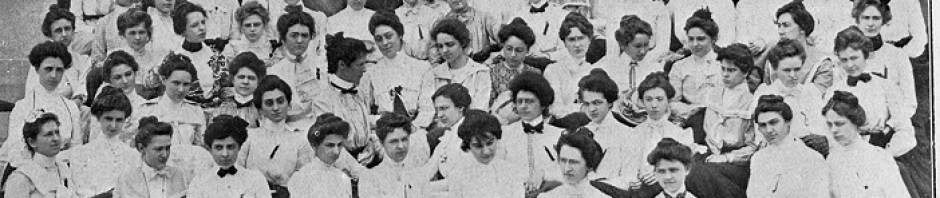
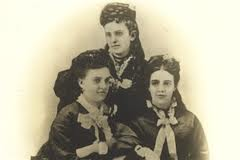
Delta Gamma was founded at the Oxford Female Institute, also known as the Lewis School, at Oxford, Mississippi. The school was established before the Civil War and eventually was absorbed by the University of Mississippi. Delta Gamma’s three founders, Eva Webb [Dodd], her cousin Anna Boyd [Ellington], and Mary Comfort [Leonard], all from Kosciusko, Mississippi, were weather-bound at the school over the Christmas holidays in December of 1873 (Leonard, 1909).

Mrs. Hays, the lady principal and their host for the holidays, had a son who was a fraternity member at the University of Mississippi. He and the women’s other gentlemen friends may have imbued the girls with the idea to start their own Greek-letter society. According to founder Dodd (1909): When the idea first came to three homesick girls during the Christmas holidays of 1873 to found fraternity or club as we then called it, little did we realize that we were laying the cornerstone of such a grand fraternity as Delta Gamma. The school we attended at Oxford, Miss., was not much more advanced than a high school of today. During the week we decided on our motto and selected the Greek letters to represent it. We did not know that there were any other fraternities for girls in the United States known by Greek letters when we gave our club its name. We spent the holidays deciding on our pin and initiation and writing our constitution. In January 1874, we had our first initiation. We initiated four girls. The initiation was in one of the rooms of the house where we were boarding. We were careful to select only the girls we thought would be in sympathy with us and make our fraternity worthy of its name. (p. 226)

The Lewis School was a preparatory school and as such the members of the chapter were seemingly younger than the women at Syracuse University, Monmouth College, Indiana Asbury College, and Boston University. Stevenson, Carvill and Shepard (1973) offered an explanation of the situation: During the early years in Oxford observers from elsewhere note a peculiarity in the Mother Chapter – that the ‘actives’ are in reality the inactive members of the group and the alumnae or inactive members are really most active in the chapter. This is attributed to the youth (those over 13 years of age) of the members, for we must remember that the Institute was really a prep school. In the early ‘eighties when the University began to admit women, many of Psi’s members were entered in classes which is the reason letters to the Anchora are datelined during this period “University of Mississippi.” Actually, the chapter itself was still established at the Institute and was never moved to the University – until it was installed many years later as Alpha Psi. (p. 52)

During the first few years of its existence, Delta Gamma installed several chapters at southern seminaries. These included: Fairmount College in Monteagle, Tennessee, a chapter that was formed in 1877; Water Valley Seminary, in Water Valley, Mississippi, established in 1877; and Bolivar College in Bolivar, Tennessee, a chapter founded in 1878. By 1881, all three of these chapters had disbanded. In 1880, a short-lived chapter was installed at Trinity College in Tehuacana, Texas. It lasted only a year and was the last Delta Gamma chapter installed in the South until after the turn of the century. The “Mother” chapter at Oxford was active until 1889 (Robson, 1968).

It was a man who took Delta Gamma north. Phi Delta Theta George Banta was a student at Franklin College in Franklin, Indiana. He was seeking to have a national woman’s fraternity come to Indiana to even the field for his fraternity during the Indiana State Oratorical Contest. “The fraternity of which I am a member, in those days seemed to always find the delegates belonging to either of the two sororities* then in the state, combined against them at these elections” (Stevenson, Carvill & Shepard, 1973, p. 53). Through a chance meeting with a male student from the University of Mississippi, Banta learned of Delta Gamma’s existence. He began correspondence with the chapter and on May 27, 1879, Corinne Miller of the Alpha chapter wrote Banta to let him know he was voted to full membership. Banta then initiated three women, Mary Vawter, her cousin and Banta’s future wife, Lillian Vawter,** and Banta’s cousin Kitty Ellis.

The chapter at Franklin College was in existence from 1878 until 1885, but even in its short life it provided the impetus to expand in the north and gave new life to Delta Gamma. Banta was later a pioneer in the fraternity publishing world and according to Glover (1909), he attended at least one Delta Gamma convention and shared with the members in attendance his part in Delta Gamma’s history.

The Delta Gamma chapter at Franklin College installed a chapter at Hanover College, in Indiana. It was the first women’s fraternity on Hanover’s campus and it was in existence from 1881 until 1887. Lillian Thompson of the Franklin College chapter was instrumental in locating potential members. MacDonnell (1909) recalled that the meetings were held during the first year or two in the Phi Hall in the yard of the old McKee residence.

The Franklin College chapter also established the Eta Chapter at Buchtel College in Akron, Ohio, on March 15, 1879. It is Delta Gamma’s oldest existing chapter. Banta’s Phi Delta Theta connection proved to be an influencing force in the founding of the Delta Gamma chapter and it was with the assistance of Buchtel College’s Phi Delta Theta chapter that the Eta chapter of Delta Gamma became a reality (Delta Gamma Fraternity, 1966). March 15 is the date that Delta Gamma celebrates Founders’ Day.

*Banta is most likely referring to Kappa Alpha Theta, founded in Indiana, and Kappa Kappa Gamma.

**George Banta and Lily Vawter married. Vawter was “a Franklin girl who became a victim of the White Plague within three years of her marriage” (Peerenboom, 1865, p. 9). After her death, Banta moved to Wisconsin, remarried, and soon began a printing business, with many fraternity magazines among his clientele.
The text is from my dissertation, Coeducation and the History of Women’s Fraternities 1867-1902, by Frances DeSimone Becque. All rights reserved.
Posted in Delta Gamma, Founders' Day, GLO, Greek-letter Organization, Greek-letter Organization History, National Panhellenic Conference, Notable Sorority Women, Phi Delta Theta, Sorority History | Tagged , | Comments Off on Happy Birthday Delta Gamma – Founded During a Christmas Holiday!

A Holiday First for the Coolidges and the United States

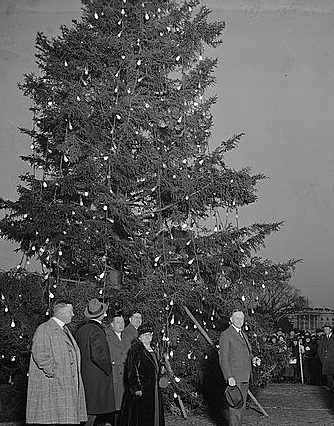
At 5 p.m. on December 24, 1923, President Calvin Coolidge (Phi Gamma Delta, Amherst College) began a White House tradition. He touched a button and the electric lights on a 48-foot balsam fir sparkled with electricity. First Lady Grace Goodhue Coolidge (Pi Beta Phi, University of Vermont), had previously approved the tree’s site in the middle of the Ellipse.

Frederick Morris Feiker (Sigma Alpha Epsilon, Worcester Polytechnic Institute), an electrical engineer serving as an assistant to Secretary of Commerce Herbert Hoover, with the assistance of an electric industry trade association, conceived the idea of a national tree lit with electric lights; it was also a means to help cultivate a market for the electric outdoor holiday decorations. The tree which was festooned with 2,500 electric red, white and green bulbs donated by the Electric League of Washington was grown in Vermont. The President and his wife were both born and raised in Vermont. Middlebury College donated a tree and its alumni donated funds to ship the tree to Washington.

Electrical cables had to be buried underground in order for electricity to be available to light the tree. The electrical industry donated $5,000 worth of cable in order to accomplish this task.

At 3 p.m., Christmas carols were sung on the White House’s South Portico for two hours prior to the lighting. The National Broadcasting Company broadcast the singing on the radio. Afterwards, the choirs from Epiphany Church and First Congregational Church choir led the crowds in singing Christmas carols. By midnight, more than 9,000 people had visited the lit tree.

President Coolidge is to the right. I have no idea where his wife was when the picture was taken, but she is not the woman in the picture.

To read more about the Coolidges, the first President and First Lady initiated into Greek-letter societies while in college, please visit these links: https://www.franbecque.com/category/calvin-coolidge/

Posted in Amherst College, Calvin Coolidge, First Ladies, Fran Favorite, GLO, Greek-letter Organization, Greek-letter Organization History, Phi Gamma Delta, Pi Beta Phi, Presidents, Sigma Alpha Epsilon, University of Vermont | Tagged , , , , , , , , | Comments Off on A Holiday First for the Coolidges and the United States

Syracuse University and the Tragedy of Pan Am Flight 103 Over Lockerbie

December 21, 1988, four days before Christmas, was to have been filled with joyful reunions. It quickly turned horrible for the families and friends of the 259 people on board and 11 on the ground who perished when Pan Am Flight 103 blew up over Lockerbie, Scotland. Twenty-five Syracuse University students were among the fatalities. Another 10 were from other campuses but were part of Syracuse’s study abroad program.

In the days before 24-hour news on TV and the internet, I remember where I was when I first heard the news. My sister called to tell me that the Pi Beta Phi chapter house at Syracuse, the place where I had lived most of my college life, was pictured in the New York Daily News. The chapter lost three sisters in the terrorist attack. My heart turned heavy. As a young mother preparing for the holidays, I silently wept for the families whose holidays would be forever marred by the tragedy.

The Pi Phis on board were Karen Lee Hunt, Julianne Kelly, and Alexia Tsairis. Cynthia J. Smith, a Delta Phi Epsilon, and Amy Shapiro, a Kappa Kappa Gamma, were also on the flight. Syracuse fraternity members on board were: Gary Colasanti, Sigma Alpha Epsilon;  Steven Berrell, Phi Delta Theta; Stephen Boland, Delta Tau Delta; Alexander Lowenstein, Zeta Psi; and Richard Monetti, Alpha Tau Omega. Thomas Schultz, a Phi Delta Theta at Ohio Wesleyan University, was enrolled in Syracuse’s semester abroad program.

There were four Colgate University students on board; John Flynn was a member of Colgate’s Kappa Delta Rho chapter. Four Brown University students and one from Hampshire College were on the flight as well as two from the State University of New York at Oswego. One of the SUNY-Oswego students, Colleen Brunner, was a member of a local sorority Alpha Sigma Chi.

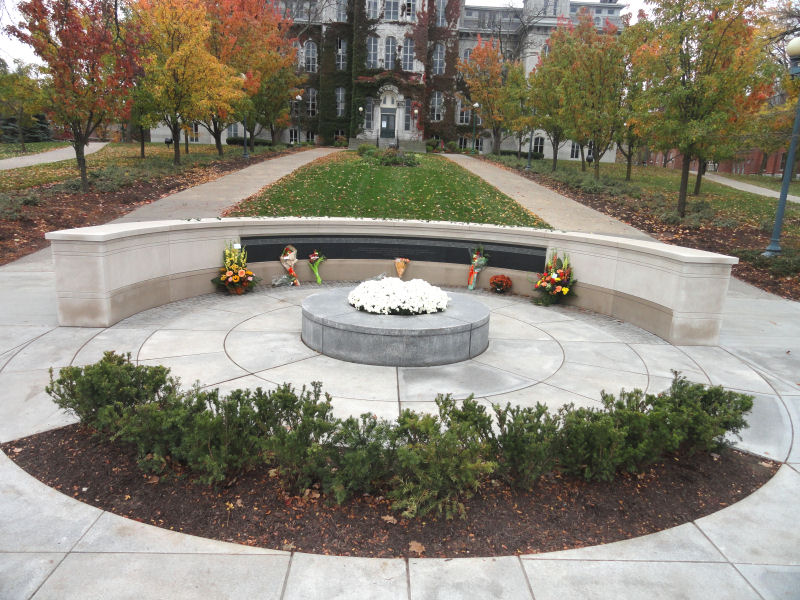
A memorial wall in front of the Hall of Languages was dedicated in April 1990. A “Remembrance Week” takes place each fall. Each year on December 21 at 2:03 p.m., the exact minute the plane exploded, a service is held at Hendricks Chapel. Syracuse University established two programs to memorialize the lives lost. Thirty-five seniors are chosen yearly to be “Remembrance Scholars.” Two graduating seniors from Lockerbie Academy are given the opportunity to study at Syracuse for a year through the “Lockerbie Scholars” program.

My thoughts and prayers go out to all the families who were affected by the events that took place 24 years ago.


© Fran Becque, www.fraternityhistory.com, 2012. All Rights Reserved.

Posted in Alpha Tau Omega, Brown University, Delta Tau Delta, Fran Favorite, GLO, Greek-letter Organization, Greek-letter Organization History, Kappa Kappa Gamma, National Panhellenic Conference, NIC, North-American Interfraternity Conference, Ohio Wesleyan University, Phi Delta Theta, Pi Beta Phi, Sigma Alpha Epsilon, Sorority History, SUNY - Oswego, Syracuse University, Zeta Psi | Tagged , , , , , , , , | Comments Off on Syracuse University and the Tragedy of Pan Am Flight 103 Over Lockerbie

An American Tragedy in Newtown Brings Thoughts of a First Lady

The events that took place on December 14, 2012, at the Sandy Hook School in Newtown, Connecticut, strike at the heart of us all. So many lives taken, so close to Christmas and none of it makes much sense. Among the dead are the six-year-old daughter of Jeff Previdi, a Bethany College Beta Theta Pi, the six-year-old son of  Colgate University Pi Beta Phi Cynthia Radley Mattioli, a son of a Kappa Kappa Gamma alumna, the six-year-old daughter of Pi Kappa Phi Rich Rekos, and Lauren Rousseau, an alumna of Pi Beta Phi’s chapter at the University of Connecticut. Rousseau  had just been hired on as a permanent substitute and was having “the best year of her life.” Another UConn alumna, Kappa Kappa Gamma Kaitlin Roig-DeBellis, a first grade teacher at Sandy Hook, protected her 15 students by hiding them in a bathroom. (See the Spring 2013 Key of Kappa Kappa Gamma)

Newton, Connecticut, is the town in which my husband worked when we were first married. How wonderful it would have been had we been able to reside there and raise our family there. Newtown would have remained just one of those quaint New England towns, with a green and a flag and the wholesomeness of a Norman Rockwell painting had it not been for what took place at the Sandy Hook Elementary School on December 14, 2012.

The senseless of it all brings me back to another New Englander. Born in Vermont and a resident of Massachusetts for most of her adult life, Grace Coolidge’s most devastating and public sorrows took place after she and her husband moved to the White House.

July 7, 1924 was likely one of the worst days of Grace and Calvin Coolidge’s life together. Their youngest son, Calvin, Jr., died at the age of 16. On June 30, he had played tennis on the White House court. He wore tennis shoes, but for whatever reason, he did not wear socks. After playing against his brother John, he developed a blister on his right foot. The blister tuned into blood poisoning.  Drugs to combat the infection were not yet available.

The young Calvin was a student at Mercersburg Academy in Pennsylvania. When his father became President of the United States after Warren Harding’s death, Calvin, Jr. was working in a Massachusetts tobacco field. Another young worker remarked to him, “If my father was President, I would not work in a tobacco field.” Calvin, Jr. replied, “If my father were your father, you would.”

In a July 1932 letter to her son John, now in the collections of the Calvin Coolidge Memorial Foundation, Grace Coolidge described the dreadful day:

I leaned over his bed knowing that he was fast slipping beyond the reach of my voice, perhaps even then would not hear, and I said,  ‘You’re alright, Calvin,’ as I said so many time in the days when he was in trouble about some little matter. Without opening his eyes, he nodded his head, ever so little and the flicker of his old smile came and was gone. Then, they began giving him oxygen and kept his heart beating but his spirit had slipped away. All that afternoon, dark, awe-inspiring clouds had rolled across the sky, the lightening was almost constant and thunder followed it in mighty roars of majestic power. Calvin’s delirium seemed to be a part of it all and, for a long time, he seemed to be on a horse leading a cavalry charge in battle. He called out, ‘Come on, come on, help, help!’ And, for a time, he thought he was sitting backwards on his horse and asked us to turn him around. Father put his arms under him and tried to persuade him that he had turned him but he thought he was still wrong side around. Finally he relaxed and called out, ‘We surrender, we surrender!’ Dr. Boone said, ‘Never surrender, Calvin.’ He answered only, ‘Yes.’ And some how I was glad that he had gone down still fighting. After it was all over, Dr. Coupal broke down and cried. I found him at the window and I put my arms around him and told him that everything was alright that he and the other doctors had done everything within their power and we must comfort ourselves with the thought that courage such as Calvin had shown us all must now be our example.

His casket was taken by train from Washington to Northampton for services at Edwards Congregational Church.  From there the train continued to Ludlow, Vermont. The last 12 miles were in a car with a cavalry escort to Plymouth and the Coolidge homestead. Boy Scouts holding roses stood at the last third of a mile. After the service, they placed the roses on the grave.

It is said that when Calvin, Jr. died, his father suffered deeply and sorrowfully. Grace Coolidge, her heart broken, carried on almost as if she thought it was her duty.

Grace, a charter member of Pi Beta Phi’s Vermont Beta Chapter at the University of Vermont, had a group of Pi Phi friends with whom she kept in contact with a Round Robin letter. After her son’s death, she wrote her Round Robin friends addressing them as “Dear Robins on the Wing.” She then wrote:

I thus address you feelingly and enviously because you all can come and go as you will. When I wrote the word I was looking out the window and wishing I could steal away without being seen and have one day unaccompanied just to go about unrecognized all by myself. The poor Prince! Someday I will again be a humble citizen while he can never be just himself….I want to say a word in appreciation of all your kind words of sympathy. I did not try to reply except by the little card but knew you would understand. I knew that the Robin would come along before a great while and that I could then tell  you how deeply I felt your loving sympathy. No longer can we see and touch Calvin but in a very real sense he is with us and has his place in our family circle. Two years ago this year he taught me how to swim – not because I wanted to learn but just because he wanted to teach me. He put his hand under my chin and I just had to do my best to please him. I’ll never forget how happy he was when I took a few strokes, and I hear his encouraging voice and I am not going to disappoint him.

On the fifth anniversary of her son’s death, the First Lady wrote a poem which was published in Good Housekeeping magazine.

THE OPEN DOOR

You, my son,
Have shown me God,
Your kiss upon my cheek
Has made me feel the gentle touch
Of Him who leads us on.
The memory of your smile, when young,
Reveals His face,
As mellowing years come on apace.
And when you went before,
You left the gates of heaven ajar
That I might glimpse,
Approaching from afar,
The glories of His Grace.
Hold, son, my hand,
Guide me along the path,
That coming,
I may stumble not,
Nor roam,
Nor fail to show the way
Which leads us-Home.

My apologies as some of this post has appeared in one of my previous posts, but this is what I keep coming back to as I try to process the events of 12-14-12.

Posted in Beta Theta Pi, Calvin Coolidge, First Ladies, Fran Favorite, GLO, Grace Coolidge, Greek-letter Organization, Greek-letter Organization History, Pi Beta Phi, Presidents, University of Vermont | Tagged , | Comments Off on An American Tragedy in Newtown Brings Thoughts of a First Lady

100 Years Ago – 12/12/1912 in Fraternity and Sorority History

Today is 12/12/2012. One hundred years ago, on 12/12/1912, a Thursday, the world was a different place. Taking a glimpse into what was happening in the Greek-letter organization world a century ago offers a wonderful insight. While life is vastly different in so many ways, it is charmingly similar in many others.

The biggest event on December 12, 1912 was the installation of the Pi chapter of Phi Mu. Nine University of Maine coeds, seven of whom founded the local organization Phi Alpha, were initiated by Grand President Louise Monning (Elliott). She inspected the campus and found the group and conditions favorable. Getting to Maine required much travel time, especially for an organization founded in Georgia and whose group until that time was mainly in the south. While she was in Orono, she sought the Fraternity’s permission and extended her visit to install the chapter. The chapter first met in a room in Stevens Hall.  The chapter celebrates its first century as Phi Mu’s fifth oldest chapter.*

On December 12, 1912, the Illinois Zeta chapter of Pi Beta Phi at the University of Illinois hosted the chapter’s first faculty tea. The chapter’s patronesses, alumnae and nine other fraternities were invited and about 100 guests attended.

Meanwhile at Syracuse University in upstate New York, the Pi Beta Phi chapter held a senior dinner. The seniors reported having a “fine time.” The Arrow magazine correspondent noted “these class dinners do much to bring girls of various interests and affiliations into close touch with one another.”

The December 12, 1912 edition of the Minnesota Daily Student newspaper announced “in the special meeting of Pan-Hellenic which was called last Thursday it was decided that a reception would be given Monday evening at Shevlin Hall in honor of the new sorority Alpha Omicron Pi. All of the fraternity men and women on the campus will be asked to meet the guests of honor.”

The deadline for chapter correspondents to submit news to The Scroll of Phi Delta Theta must have been in mid-December. Seven chapter correspondents wrote their chapter’s news on December 12, 1912. The chapters and their correspondents were: Ohio Eta (Case School of Applied Science), Albert T. Case; Ohio Theta (University of Cincinnati), Clint Wunder; Kentucky Epsilon (Kentucky State University), Adolph Waller; Massachusetts Alpha (Williams College), Edward H. Geten, Jr.; Missouri Alpha (University of Missouri) Joseph H. Moore; Kansas Alpha (University of Kansas), Leonard L. Hurst; and Idaho Alpha (University of Idaho), Vernon P. Fawcett.

Fawcett penned this representative entry: “The 1912 football season closed with Idaho second in the North West Conference. Idaho Alpha was represented on the varsity by brothers Phillips and Leuschel, and Phikeias Brown, Lockhart, and Shipkey, the latter four being new I men. In basketball Brother Soulen and Phikeias Keane, Jardine, Ankcorn, Shipkey, and David are trying out for the team. In the class basketball tournament, we are represented by Brothers S.K. Denning, ’13, Harry Soulen, ’14, and Phikeias Kean Ankcorn, Jardine, and Shipkey on the freshman team. Brother Lewis was a member of the prize-winning stock judging team at the recent Northwest Live Stock Show held at Lewiston, Idaho.

“Recently the faculty have ruled that the Greek letter organizations can have but two informal functions a year and these must be held in the chapter houses. The rule has met with much dissatisfaction on the part of the fraternities and sororities. Through the influence of the Pan-hellenic Council, the faculty are now reconsidering the rule.

“The university is to lose its present president, Doctor MacLean, through resignation to take effect February 1. He goes to take a similar position at Winnipeg University. His successor has not yet been selected.

“During November were we visited by the following Phis: Campbell Kennedy, Indiana Beta, T.C. Grier, Illinois Zeta, and W.S. Ferris, Massachusetts Alpha, who is president of Kappa Province.”

Hurst wrote about the Kansas chapter’s thirtieth anniversary celebration at the chapter house,  “a smoker on the evening of Nov. 22. Many of our alumni came back, and needless to say, enjoying meeting each other again and talking of old times. We had an interesting program, which consisted of short talks from several of the alumni, and songs by the active chapter, during which refreshments were served.”

On the evening of December 12, 1912 the Phi Beta Kappa chapter at Amherst College was in the midst of the dedication of the Phi Beta Kappa rooms in Morris Pratt Memorial Dormitory. Professor Benjamin K. Emerson, President of the Chapter, presided.  It was noted  “the rooms are convenient and handsome and suited to the needs of the Society.” The rooms included,  “an anteroom for use as a coat room and for the storage of folding chairs; a study and writing room provided with chairs, tables and desks; and a general meeting room furnished with bookcases, cupboard and drawers, open fireplace, armchairs, tables and rugs. The rooms are convenient and handsome and suited to the needs of the Society.”

* I had originally stated that the Phi Mu chapter at the University of Maine was the longest continuous chapter at the University of Maine. I was in error. Alpha Omicron Pi’s Gamma chapter was chartered in 1908 and has been in existence since then. My apologies to Alpha Omicron Pi.


Posted in Alpha Omicron Pi, Amherst College, Fran Favorite, GLO, Greek-letter Organization, Greek-letter Organization History, Phi Beta Kappa, Phi Mu, Pi Beta Phi, Sorority History, The Arrow of Pi Beta Phi, University of Idaho, University of Illinois, University of Maine, University of Minnesota, Women's Fraternity History | Tagged , , , , , , , , , , , , | 2 Comments

“We Should Live Together When We’re Old!” Kappa’s Boyd Hearthstone

By Kylie Towers Smith, Kappa Kappa Gamma’s Archivist/Museum Curator

“We should live together when we’re old!” My sister and I said that when we were little. My school friends and I talked about it while we were growing up. And my college friends and I STILL talk about how great it would be to live together in our twilight years. The most recognizable attribute of the women’s Fraternity system is shared living in large and gracious homes, despite the fact that less than half of our undergraduate chapters actually have chapter houses. As the Archivist/Curator for Kappa Kappa Gamma, I frequently hear a rallying cry to bring back a novel idea that was tried in the 1930s – a retirement home for Kappas.

In 1936, a committee was formed to create a clubhouse for alumnae “who sought congenial companions, security, and pleasant surroundings.” Property was purchased in Winter Park, Fla., in 1937, and in 1938 was dedicated as the Boyd Hearthstone – in honor of Kappa Kappa Gamma Founder, Louise Bennett Boyd. The venture met with such enthusiasm that Kappa’s second Grand President, Charlotte Barrell Ware, announced at the dedication that she would deed *Warelands (her husband’s ancestral 17th century farm in Norfolk, Mass.) for a second Hearthstone.

At one point the base rate to stay at the Boyd Hearthstone was $42.50/week, including meals; a figure that went down if one took advantage of the six-month special. The home could accommodate ten guests and a hostess manager. It was intended for year-round use, but seasonal demand complicated planning and operation. Sadly the house was never fully utilized and as a result was financially unsound. In 1960 the Fraternity voted to end the project and the Boyd Hearthstone was sold in 1962. The timing was somewhat fortuitous and in 1965 it was voted to use the proceeds toward the restoration of Fraternity Headquarters, which had been severely damaged by fire.

The initial dream and later demise of the Boyd Hearthstone sounds a bit familiar to anyone who has read about Panhellenic House in New York City. I’ve heard it said that no one lives longer than an educated woman, so it seems likely that one day we’ll figure out a way to spend our golden years together, in fraternal (dare I say panhellenic?) harmony!

* Warelands proved to be a tremendous tax burden and the property was sold before a second Hearthstone could be planned.


If you enjoy reading this post, subscribe to updates (button on the right side of the page) or follow on twitter @GLOhistory

Posted in GLO, Greek-letter Organization, Greek-letter Organization History, Kappa Kappa Gamma, National Panhellenic Conference, Panhellenic House, Sorority History, Women's Fraternity History | Tagged , , , , | Comments Off on “We Should Live Together When We’re Old!” Kappa’s Boyd Hearthstone

Happy Founders’ Day, Alpha Omicron Pi!

Alpha Omicron Pi was founded on January 2, 1897 at the home of Helen St. Clair (Mullan). She and three of her Barnard College friends, Stella George Stern (Perry), Jessie Wallace Hughan, and Elizabeth Heywood Wyman had pledged themselves to the organization on December 23, 1896. That first pledging ceremony took place in a small rarely used upstairs room in the old Columbia College Library.

Celebrating a Founders’ Day on the second day of the new year proved to be a challenge for the organization, so Alpha Omicron Pi now celebrates Founders’ Day on December 8, Stella’s birthday.

Alpha Omicron Pi’s second chapter was halfway cross the country and to the south, 1,300 miles away from Manhattan. Stella contacted Evelyn Reed, a classmate from New Orleans. Evelyn’s sister, Katherine, was a student at H. Sophie Newcomb Memorial College.

Newcomb College as it was known, was founded in 1886 by Josephine Louise Newcomb in memory of her daughter Harriott Sophie. In 1870, 15 year-old Sophie died of diphtheria. Her widowed mother was despondent and sought to create a memorial to her beloved Sophie. Newcomb College, the women’s coordinate of Tulane University.

On September 8, 1898, Katherine Reed became the first pledge of the Pi Chapter at Newcomb College. Not only was it Alpha Omicron Pi’s second chapter, but it was also the second women’s fraternity at Newcomb. Pi Beta Phi’s Louisiana Alpha chapter was established in 1891. “The little Greek community at Newcomb was very delightfully entertained at a charmingly original birthday party, given by the Alpha Omicron Pi girls, to celebrate the first anniversary of the founding of their chapter,” reported the Pi Phi chapter in the January 1900 Arrow of Pi Beta Phi.

The third chapter, Nu,  was established in New York University in 1900.

Stella George Stern (Perry)

Posted in Alpha Omicron Pi, Founders' Day, Fran Favorite, GLO, Greek-letter Organization, Greek-letter Organization History, National Panhellenic Conference, Pi Beta Phi, Sorority History, The Arrow of Pi Beta Phi | Tagged , , , , | Comments Off on Happy Founders’ Day, Alpha Omicron Pi!

Phi Beta Kappa Society, Oldest Greek Letter Organization

The Phi Beta Kappa Society was founded on December 5, 1776 by five College of William and Mary students. The first meeting of the organization took place in the Old Raleigh Tavern’s Apollo Room.

As the first Greek-letter collegiate society, it led the way for the other organizations, both social and honorary, that followed it. Among its hallmarks were a badge, an oath of secrecy, a Greek motto, an initiation ceremony, and a handshake. Phi Beta Kappa’s motto is “Love of learning is the guide of life.”

The chapter at the College of William and Mary might have been a footnote in history had it not been for Elisha Parmele, a former Yale College student and Harvard College alumnus. While in Williamsburg, he became associated with Phi Beta Kappa and obtained charters from the society to establish chapters at Harvard and Yale. When the College of William and Mary faced a temporary closure in 1781, prior the British invasion, the Phi Beta Kappa chapter disbanded. However, Parmele had used the charters to establish the chapter at Yale in 1780 and one at Harvard in 1781. The Dartmouth chapter was founded in 1887 and the society became an honorary academic association.

Parmele became a minister; in those days, most Yale and Harvard grads pursued the ministry. He died at the age of 31. The most lasting accomplishment in his short life was likely establishing those two Phi Beta Kappa chapters in New England.

The first two women to become members of Phi Beta Kappa were members of the University of Vermont’s Kappa Alpha Theta chapter. Lida Mason and Ellen Hamilton Woodruff became the first of many fraternity women who have been members of the organization.


Posted in Colleges and Universities, Dartmouth College, Fran Favorite, GLO, Greek-letter Organization, Greek-letter Organization History, Harvard University, Phi Beta Kappa, Yale University | Tagged , , | Comments Off on Phi Beta Kappa Society, Oldest Greek Letter Organization

P.E.O. Bling – Supporting the Education of Women

“If someone doesn’t outbid her, you know it’ll soon be the subject of a blog post!” said my favorite Presbyterian pastor at our P.E.O. chapter’s annual fundraiser. And here the post is!

The collection of P.E.O. themed items that our chapter president brought back from this summer’s state convention was mine for a song. Do I need more stuff? Not a chance! But all the proceeds of the auction go toward P.E.O.’s six projects funding education for women. Our chapter is also blessed to have women who are sometimes willing to pay more than fair market value for items because they know the funds are going to a wonderful cause!

The items I purchased as part of the “P.E.O. bling bag” at Illinois State Chapter KL’s annual Christmas Auction.

P.E.O. was founded as a collegiate organization at Iowa Wesleyan College (IWC) on January 21, 1869. Its first competitor on the IWC campus was the Iowa Alpha chapter of Pi Beta Phi which was founded a month earlier. Between 1869 and 1902, the P.E.O. members who had been initiated while enrolled at IWC stayed active in the college chapter even though they were no longer enrolled at IWC. Many remained in or near Mount Pleasant. Others formed chapters in nearby towns. The early P.E.O. chapters that had been formed at nearby colleges did not survive and P.E.O.’s growth was in community chapters. The chapter at Iowa Wesleyan College was finding it difficult to operate on a college campus with the rules put forth by the community chapters.

The P.E.O. chapter at Iowa Wesleyan College was known as Original Chapter A. It later took on the name A-J to distinguish itself from the Mount Pleasant chapter. It then became known as Chapter S. After the turn of the century, the governing body of P.E.O. made the decision to withdraw the charter of Chapter S. The college co-eds wished to remain a collegiate organization and discussed becoming a chapter of a Greek-letter organization. The chapter became the Beta (second) chapter of Alpha Xi Delta on June 9, 1902 when P.E.O. officially became a community organization.

Today, P.E.O. is a Philanthropic Education Organization with six projects that benefit education for women. The oldest of these projects is the Educational Loan Fund (ELF); it began in 1907 and has helped more than 70,000 women with loans surpassing a total of $136 million.

Cottey College, the only American college for women owned by women, is another P.E.O. project. It was given to the P.E.O. Sisterhood in 1927. More than 8,500 women from 50 states, four Canadian provinces, and 85 countries are Cottey alumnae. Cottey is in the midst of a capital campaign and I am certain at my chapter will make sure we increase out contribution to Cottey this year. (more about Cottey is at http://wp.me/p20I1i-h3)

Established in 1949, the P.E.O. International Peace Scholarship Fund (IPS) gives scholarships to international women for graduate study in the United States or Canada. More than $28 million has been awarded and women from all over the globe have had educational opportunities they never would have had without P.E.O.’s generosity.

The P.E.O. Program for Continuing Education began in 1973. Needs-based grants are given to American and Canadian women whose educations have been interrupted. More than $40 million has been distributed. These grants have helped countless women and, in turn, their families by providing them with the opportunity to obtain the credentials they need to find viable employment.

Since 1991, the highly competitive P.E.O. Scholar Awards have provided financial assistance to American and Canadian women pursuing doctoral-level study. The amount that has been awarded is nearly $15 million.

The youngest of P.E.O.’s projects is the STAR Scholarship, established in 2009. It provides college scholarships to exceptional high school women in the United States and Canada. In the few years of its existence, nearly $2 million has been dispersed.

My P.E.O. “bling bag” items will join the other things that I purchased at the auction, some of which may make another appearance at next year’s auction, so KL sisters you still have a chance to own this spectacular collection!

© Fran Becque, www.fraternityhistory.com, 2014. All Rights Reserved.

Posted in Cottey College, Fran Favorite, Iowa Wesleyan College, P.E.O., Pi Beta Phi | Tagged , , , | Comments Off on P.E.O. Bling – Supporting the Education of Women

Volunteering Or You Never Know Who’s Going to Write a Best Seller (Jen Lancaster!)

One of the best volunteer jobs in any fraternity or sorority is one where you have the opportunity to interact with collegians. The lessons that are learned on both sides, as a collegian and as an alumna/alumni, can be enlightening, eye-opening, frustrating, rewarding, and priceless, often all at the same time.

As a Collegiate Province President from 1991-93, I worked with four chapters, two in Illinois and two in Indiana. I loved my visits to Northwestern, the University of Illinois, Purdue, and Indiana University-Purdue University at Fort Wayne (IUPUFW). I knew one of the women who was very active in the Fort Wayne Alumnae Club when the chapter was founded (Hi Kay!) and I enjoyed that connection.

IUPUFW is a commuter campus and fraternity life there has some special challenges and opportunities, yet the chapter members I met truly valued their membership. The chapter was welcoming of me and I enjoyed talking with them and sharing the love of our fraternity. It wasn’t until 15 years later that I realized that in my visits to the chapter I had met a future New York Times Best Seller List author. If only I had a crystal ball with me, I’d have asked for some autographs!

A few years ago, when I picked up a book off the biography table at the McCracken County Public Library Book Sale in Paducah, Kentucky, it looked interesting and the title caught my eye. I thought it read Bitch is the New Black, because there was a sticker over some of the word “Bitter.” The full title of the book is Bitter is the New Black: Confessions of a Condescending, Egomanical, Self-Centered Smartass, or Why You Should Never Carry a Prada Bag to the Unemployment Office.

After I read the hilarious book, I realized that the author, Jen Lancaster, was not only a Pi Phi, but she was a member of the Indiana Eta Chapter when I visited it all those years ago. To her and the other chapter members I may have been that “woman from nationals who is going to go on and on about all sorts of drivel,” but I kept plugging away, hoping to impart some words of wisdom. I was just thankful that my visit wasn’t one of the things she discussed in hilarious fashion in her writings.

Jen’s greatest accomplishment, in my book, is making a lemonade to die for out of some very juicy and somewhat bitter lemons. You’ll have to read her books to find out her story. Her other books include Bright Lights, Big Ass, Such a Pretty Fat,  Pretty in Plaid, My Fair Lazy, If You Were Here, and Jeneration X. Her web-site is at www.jennsylvania.com.

Special thanks to one of my favorite Pi Phis, Jenny Whittom Schmidt, for picking up this signed first edition for me.

Special
Posted in Fran Favorite, GLO, Greek-letter Organization, Greek-letter Organization History, National Panhellenic Conference, Notable Fraternity Women, Notable Sorority Women, Pi Beta Phi, Sorority History, Women's Fraternity History | Tagged , , , , | Comments Off on Volunteering Or You Never Know Who’s Going to Write a Best Seller (Jen Lancaster!)