This past weekend, I had the opportunity to attend a P.E.O. event in the Chicago area. It was the Q Suburban Round Table luncheon. The name of the group comes from the railroad line, the Chicago, Burlington & Quincy suburban train, which once connected the chapters in the round table. Representatives from the chapters in the round table meet several times a year. (P.E.O.s note that Illinois round tables are what other state, provincial and district chapters know as reciprocities.)
When I first saw the invitation, I was intrigued by the guest speaker. Although initially I had no plans on being at an event in the northern part of the state, I found myself in the Chicago area and was able to attend at the last minute. I am glad it worked out.
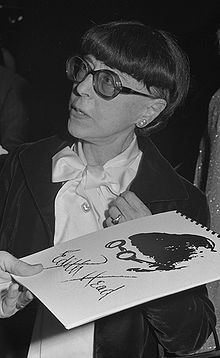
Martina Mathisenwas Edith Head in a truly wonderful program. And although Head’s Delta Zeta connection wasn’t mentioned, I told a few of my table mates about it.
Fashion designer Edith Head was born on October 28, 1897. She was Delta Zeta’s 1960 Convention initiate as a member of Mu Chapter at the University of California-Berkeley. Head was a Berkeley graduate and had a master’s degree from Stanford University. She started as a teacher, took a few art courses so she could teach art, and by happenstance, applied for a job at one of the studios. Her hard work and perseverance paid off.
In 1968, she was Delta Zeta’s Woman of the Year. She had an unprecedented 35 Oscar nominations, of which she won eight. Moreover, she had 400 film credits over the course of her 50-year career. She was the first female head of a movie studio costume design department.
She lent her many talents to the Southern California Council of Delta Zeta for their Lamplighters’ Flame Fantasy fashion show and luncheon during the 1960s and 1970s. The February 1968 show took place in the Century Plaza Hotel. More than a 1,000 alumnae and their friends attended the show. According to pre-event publicity, “Delta Zeta’s own Edith Head, Academy Award winning costume designer and noted author, will commentate the couturier show which will feature original California designs.”
Palos Verdes Peninsula News, February 16, 1978
Betty Davis called her “one of Hollywood’s greatest designers. She was an amazing woman in a field dominated by men in the 1930s and 1940s. While other designers were busy starring their clothes in a film, Edith was making clothes to suit a character; for her, the character always came first.”
Delta Zeta’s Foundation awards a scholarship in her name. Members studying fashion design or a related field are eligible. She has a star on the Hollywood Walk of Fame at 6504 Hollywood Blvd.
Head died in 1981, four days shy of her 84th birthday.
It’s hard to remember a time when there was a 24-hour news cycle and not a 24-7 constant barrage of news. Three Stetson University students were killed in an avalanche in Innsbruck, Austria on January 17, 1979. Save for two articles that were distributed by the Associated Press, I could find little about the tragedy.
The three students who were killed were:
Dennis Long, Delta Sigma Phi
Scott Fenlon, Sigma Nu
Katharine “Katy” Resnick, Pi Beta Phi
Most of the group continued on and finished their travels. They returned to the United States on January 30, went back to Stetson, mourned and got on with their lives. The tragedy was largely forgotten on campus.
On April 11, 1924, one of the most unique events took place at the White House. It did not involve the President, a Phi Gamma Delta from Amherst College, and he was not a part of the festivities. It was the First Lady’s day to shine. The President did visit with some of their Massachusetts friends in the White House private quarters that day. They had socialized at Pi Beta Phi alumnae events when the couple lived in Massachusetts.
The day honored the First Lady, a charter member of the Vermont Beta Chapter of Pi Beta Phi at the University of Vermont. She had been an active member of the organization from her first days wearing the arrow. One of the women who met with the President that day was Anna Robinson Nickerson, Pi Phi’s Grand Vice President. She and the First Lady had met when they were chapter delegates at the 1901 Syracuse Convention.
The President and First Lady were initiated into Greek-letter organizations while enrolled in college, making them the first First Couple to have this designation. Grace and Calvin Coolidge were both proud of their affiliations with Phi Gamma Delta and Pi Beta Phi, respectively. When his fraternity gave him a new badge, he quipped that it was fortuitous because his wife was always wearing his.
Grace Goodhue Coolidge became First Lady on August 3, 1923 when President Warren G. Harding died unexpectedly in California. The Coolidges were at the family’s homestead in Plymouth Notch, Vermont, and the news made it to them four hours after Harding’s death. President Coolidge was sworn in by the light of a kerosene lamp in the sitting room of his father’s home; his father, a notary, administered the oath of office.
The excitement that the Fraternity members felt in having a dedicated, life-long member of Pi Beta Phi as the First Lady must have been incredible. News of the event appeared in the March 1924 Arrow. Every Pi Phi was invited to attend. The Fraternity made plans to purchase a portrait of the First Lady that was being painted by Howard Chandler Christy. Funds were sought from the membership and the financial goal was met quickly.
Mrs. Nickerson played an integral role in planning the event and acted as Toastmistress at the Banquet. She wrote to her friend asking her for permission to hold the event. The First Lady responded that she “would be deeply touched and greatly pleased to receive such a mark of affection and recognition” from Pi Beta Phi. With the help of May Brodhead Wallace, Iowa Gamma, wife of Secretary of Agriculture Henry C. Wallace, plans were made to entertain the Pi Phis at the White House. More than 1,300 Pi Phis made their way to Washington, D.C., to be a part of the Eastern Conference. The portrait of the First Lady painted by Howard Chandler Christy was paid for by her sorority sisters and was being presented to the United States. In the portrait, the First Lady is wearing her Pi Beta Phi arrow.
The Eastern Conference was the largest gathering of fraternity women up until that time. The Willard Hotel did not have enough room to serve all the attendees at the Saturday evening banquet. A second banquet at the Raleigh Hotel, with an identical menu and program, was arranged. After the meal, the Raleigh Hotel group adjourned to the Willard Hotel group for the speeches and ceremonies.
The Willard Hotel’s Red Room was the registration and reunion center; concerts were given there each afternoon. A tenth-floor ballroom served as the conference hall. At the ballroom’s south end, there was an exhibit of Pi Beta Phi Settlement School products. Black and white replicas of the Grace Coolidge portraits were sold for the benefit of the School’s library.
On Friday morning, the group met for a business session, but the business was mainly fun. Former Grand President Emma Harper Turner called the meeting to order. The group sang the Anthem. The Chicago Alumnae Club and Illinois Epsilon presented a special radio program featuring Kathryn Browne, Illinois Zeta. A Grand Opera star, she received special permission so that she could sing fraternity songs from a radio station in Chicago. Along with eight Illinois Epsilons as the chorus, she sang Speed Thee, My Arrow and Anthem. The banquet took place on Saturday evening. It culminated with a speech by another of the organization’s most prominent members, Carrie Chapman Catt, Iowa Gamma.
Between Friday morning’s fun session and Saturday’s trip to Mount Vernon and evening banquet was the capstone of the gathering, the presentation of the portrait. A group of Pi Phi notables processed from the Willard Hotel to the White House. An Arrow correspondent described the events:
The guests assembled in the historic East Room, forming a semi-circle about the panel on the west wall, where hung the curtains, in wine red velvet, with cords of silver blue, which covered the portrait. The presentation party was assembled in the Green Room. Promptly at four-thirty a section of the Marine Band began to play, announcing the opening the opening of the simple ceremony. The presentation group, led by Miss Onken and Mrs. Nickerson, came first from the Green Room, taking their places on the inner side of the circle, facing the portrait. On either side of the portrait stood the two active girls who were to draw the curtains.
Through the double doorway appeared the Army, Naval, and Marine Aides to the president. With the Senior Aides as escort, came Grace Coolidge, First Lady of the Land. She wore a soft grey georgette crepe afternoon dress trimmed with crystal, and, as jewels, a diamond eagle on her shoulder, a chain with a crystal pendant, a gold bracelet, her wedding ring, and the diamond studded arrow, which had been presented the day before by a group of personal friends in Pi Beta Phi. Wonderfully slim and straight, with arms at her side, she stood very still through the entire ceremony, except for a constant play of understanding appreciation, which lighted her expressive face.
The representatives of Vermont Beta and Michigan Beta drew the silver blue cords, the heavy wine-red curtains parted, and the portrait was revealed. Then, as Mrs. Nickerson put it, “to express a little of what was in their hearts,” the Anthem was sung, with Mrs. Coolidge joining in. After the portrait was presented, they moved to the Blue Room. There the guests were presented by name to the First Lady, and being her gracious self, she greeted each member.
The lower floors of the White House were open, so that the attendees had an opportunity to see the staterooms. At the conclusion of the reception, the group headed to the gardens, where a panoramic photo was taken. As the First Lady left the grounds after the picture, she spoke to the nearby Pi Phis, “This is the loveliest thing I have seen here. I should like to keep you here always, to make beautiful the White House lawn.”
The day the Pi Phis visited Mrs. Coolidge at the White House was a happy and memorable one. Three month later the Coolidge’s world was shattered. Their youngest son, Calvin Junior, died on July 7, 1924, from blood poisoning stemming from a blister that formed on his foot following a tennis game he played without socks. The day the Pi Phis visited one of its most loyal members remained one of the highlights of Grace Goodhue Coolidge’s life.
A portion of the picture taken on the White House lawn when the Pi Phis presented the official portrait of the First Lady. The only man in the picture is the artist, Howard Chandler Christy. Two of the Founders, who by then were in their 70s attended as well as Carrie Chapman Catt who was the keynote speaker at the event. The First Lady’s husband, Calvin Coolidge was a Phi Gamma Delta.Grace Coolidge signed her letter to Pi Beta Phi Grand President “From one of its most loyal members.”
Irene Simpson Van Brunt attended Wellesley College in Massachusetts but graduated from the University of Nebraska-Lincoln. There she became a member of Kappa Kappa Gamma.
She married Winslow M. Van Brunt, Jr., a Phi Kappa Psi, who also graduated from the University of Nebraska-Lincoln. He had been a busboy at the Kappa house.
Their engagement was announced in July of 1924. Their wedding was on the night of the Ak-Sar-Ben electrical parade. A newspaper article about the wedding had the title “Will Wed Night of Electric Parade,” and noted that friends of the couple would have to “decide between seeing her married and witnessing the Ak-Sar-Ben electrical parade.” (Ak-Sar-Ben is Nebraska spelled backwards and there is a story to it.)
The Van Brunts were married at 8:30 p.m. on Wednesday, October 1, 1924, at the Simpson family home.
Their family grew to include three daughters, one of whom was intellectually disabled, and a son. Van Brunt served as president of the Omaha Wellesley Club and as a director of the University of Nebraska Alumni Association. Moreover, she was dedicated in her service to P.E.O. at the local, state and international levels.
She was President of Supreme Chapter of the P.E.O. Sisterhood from 1964-1965. It is a two-year term, but she assumed the presidency when Uretta A. Hinkhouse died during her term of office. She had to pivot quite quickly and all the plans she had for her presidency were set aside so she could finish out Hinkhouse’s term.
The Van Brunts were friends with the parents of Warren Buffett. Although Winslow Van Brunt was an engineer by training, he switched careers and sold insurance. Buffett became one of his customers.
The Van Brunt’s daughter Beth and Buffett’s future wife Susan Thompson were also school mates at Central High School. Beth encouraged her parents to invest with Buffett at the very start of Buffett’s career. At her first suggestion, her father told her that Buffett would not invest less than $10,000 and that he did not have $10,000 at his quick disposal. But a few years later, Winslow Van Brunt had made an investment with Buffett.
Their initial investment was later rolled into Berkshire Hathaway stock. When Winslow Van Brunt died in 1981, it was a successful investment, and Irene endowed an engineering scholarship in his memory at their alma mater. The University Bell was given to the Nebraska Alumni Association in 1985 in Winslow’s honor by Irene Van Brunt. It was not until Irene Van Brunt died in 1995 that the investment had became a windfall.
The family honored the Van Brunts by donating the Van Brunt Visitors Center to the University of Nebraska-Lincoln as well as support for the Weigel Williamson Center for Visual at the University of Nebraska Medical Center. (The Center is named for Alice Van Brunt Williamson and Beth Van Brunt Weigel, the two Van Brunt offspring who were alive at the time their mother died.)
Charlotte Herman Kerr, M.D., was born on May 25, 1920, in Champaign, Illinois. Her father worked for printing service at the University of Illinois. That may have entered into her college choice.
At Illinois, she became a member of Pi Beta Phi. She spent her summers working as a camp counselor at Camp Kiwanis in Mahomet, Illinois. Her undergraduate major was home economics and she graduated with honors. She was a member of Alpha Lambda Delta, Torch and Phi Upsilon Omicron honor societies. In addition, she was president of the Home Economics Club and the Women’s Athletic Association.
After graduation, she taught at the Pi Beta Phi Settlement School in Gatlinburg, Tennessee. According to a report in The Arrow of Pi Beta Phi, she was “in charge of the home-economics department, has built up and maintained interest in her program for the high school girls. She has also worked with the adult women.”
After her stint at the Settlement School, she went to Ames, Iowa, where she enrolled in a master’s in nutrition program. In 1944, she graduated from Iowa State University and returned to Champaign where she spent the year as a research associate and earned another Illinois degree in 1946. She was awarded the Pi Beta Phi Fellowship for 1944-45. There was only one fellowship available in those days, and the competition was quite keen. That she was the one to whom it was awarded is a very big deal.
She returned to the University of Illinois and entered its College of Medicine in Chicago. In a cohort of 150 students, she was one of 18 women – about 8% of the class – and she graduated in the top 10%.
On Saturday, August 10, 1946, she married Dr. John Edwin Kerr. He was a member of Alpha Gamma Rho and had a doctor of veterinary medicine degree from Iowa State University. At the time of their wedding, he was “awaiting orders for his commission in army as a veterinary surgeon.”
She earned her M.D. in 1948. Shortly after her graduation, her brother, Lt. Everett W. Herman, was killed in a training plane crash in Virginia. He had started his college degree at the University of Illinois where he became a member of Phi Kappa Psi. He transferred to and graduated from the U.S. Naval Academy. The family had been together at the Chicago graduation just prior to his death.
Kerr did rotations at Cook County Hospital for her internship. A residency in obstetrics followed at the Salvation Army Booth Hospital. Kerr stayed in Chicago and became an attending physician at Passavant Memorial Hospital and Cook County Hospital. She also served as an Instructor in Obstetrics and Gynecology at the Northwestern University School of Medicine.
However, her husband, the veterinarian became her husband, the urologist. He graduated from the University of Illinois College of Medicine in 1953.
Kerr moved to Michigan City, Indiana, in 1958. There she became Chairman of the Department of Obstetrics and Gynecology at St. Anthony Hospital, Memorial Hospital, and LaPorte Community Hospital.
The Kerrs moved from the midwest to Florida in 1974, and set up practices in Seminole.
She became a member of the Chicago branch of the American Medical Women’s Association (AMWA) upon her graduation in 1948. Kerr served as the branch president of in 1958. She also was active in the national organization. Among the positions she held were Treasurer (1965, 1971), Councillor for Growth and Development (1973), Second Vice President (1974) and President (1977). In 1984, the organization honored her with its Elizabeth Blackwell Award.
Kerr also belonged to the American Medical Association, the Florida State Medical Association, the Pinellas County Medical Society, and the Central Association of Obstetrics and Gynecology. In addition, she was a fellow of the American College of Surgeons and the American College for Obstetrics and Gynecology.
In 1973, she was appointed as a consultant to the FDA’s Advisory Panel for Obstetric and Gynecologic Devices. She chaired the panel in 1977. At about the same time, she was a member of the FDA’s Ad Hoc Committee for the Study of Intrauterine Devices.
She was honored by the University of Illinois in 1988 and received an Alumni Achievement Award, its highest recognition. She had received a Home Economics Alumni Award of Merit in 1980. Kerr died June 22, 2006 at the age of 86.
Beverly Danielle Boston was born in Baltimore, Maryland on April 28, 1939. In 1957, she graduated from Frederick Douglass High School. While in high school, she met the man who would become her husband, Frank Dobson Boston, Jr.
She enrolled at Morgan State College (now Morgan State University). There, she became a member of the Alpha Gamma Chapter of Delta Sigma Theta Sorority, Incorporated. She also earned a master’s degree from Loyola University Maryland.
Boston was a lifelong educator. She taught math in Baltimore City Schools including Lombard Junior High School, Diggs Johnson Middle School, and Walbrook and Forest Park High Schools. She served as the head of the department at Forest Park High School and also lectured at Coppin State University
In her retirement, she volunteered with the Baltimore Homeless Youth Initiative and at Ames Memorial United Methodist Church’s United Women of Faith.
Boston died on July 8, 2022, at the age of 83. A Delta Sigma Theta Sorority, Incorporated service preceded the funeral.
Isabel Kline Rock grew up in Jersey City, New Jersey. She enrolled at Goucher College where she followed in her sister’s footsteps. Her older sister was a Gamma Phi Beta at Goucher and the biological sisters became sorority sisters. In addition to being president of her sorority chapter, she was treasurer of the senior class of 1912. She majored in English and Sociology.
Three years later, in 1915, she married architect P. Arthur Rock. The couple had two sons.
Rock was a visitor to the 1917 Gamma Phi convention which was held in Baltimore.
The Rock family moved to Connecticut in 1936. Isabel Rock immersed herself in civic and community activities. Among the organizations which benefited from her leadership were AAUW, Red Cross, Community Chest, Family Service Bureau, League of Women Voters and the Mental Health Society. She was also active in the Daughters of the American Revolution.
She was elected to the Connecticut State Assembly in 1961 and served until 1969. Rock was a charter member of the National Society of State Legislators.
In a talk to the Douglass College alumnae in 1961, Rock said:
One of the joys of living a long life is the satisfaction of seeing dreams come true. Never stifle a new thought nor a good intention. Test its soundness, then give it all your enthusiasm and your energy. You will find miracles happening all around you.
Margaret Sawyer grew up in Tuscola, Illinois. She was initiated into Kappa Alpha Theta in 1914 as a student at the University of Illinois and was her chapter’s president. She also served the Women’s League in the same capacity and was vice president of the Household Science Club.
Her childhood dream was to be a nurse. After earning her undergraduate degree in home economics, she spent a year studying at Cornell medical school with Dr. Graham Lusk. She then headed west and enrolled at the University of Iowa where and spent three years developing a course to train dietitians.
In 1918, she belonged to a research unit attached to the United States Army aviation corps. The researchers studied the diet of the aviators to determine if there was a definite relationship between diet, physical conditioning and the effects of altitude.
After her war service she became the national director of nutritional service for the Red Cross. For five years, she oversaw the nutrition activities which were undertaken by Red Cross chapters. She was hired by the Postum Company, which was taken over by General Foods.
In 1924, she developed a home economics department for General Foods. Her title was director of the educational department. At that time, General Foods consisted of brands and products including Postum, Jello, Minute tapioca, Calumet baking powder, Diamond salt, Log Cabin, Maxwell House, Hellmann’s, and Sanka. Her department was responsible for answering consumer questions and letters, approving and testing recipes, publishing booklets and preparing food demonstration events.
In 1929, she lived in an apartment building at 10 Mitchell Place. It was down the street from the Beekman Tower Panhellenic, at 3 Mitchell Place, which had opened in 1927 as a residence for sorority women.
She was selected as the representative from Illinois in a national honor roll of women who had moved to New York City and found success. In a profile in the October 1930 issue of McCall’s, she said of her job:
The food industry absorbs 26 percent of the national income. Women spend that income. They buy products and, if the food does not meet their requirements our sales suffer. I supervise a staff of 40 trained women whose business it is to make our products acceptable to the ultimate consumer. We make studies of food in relation to human welfare. We work to standardize methods and measurements so that results will be uniform in the kitchens of Maine or California.
Sawyer died on December 17, 1959, a day after her 68th birthday.
Born on November 1, 1888, in London England, Rhoda Muriel Ivimey came to America when she was three years old. After graduating from Morris High School, she entered Barnard College. There, she joined Alpha Phi and was known by her middle name. Her biological sister Ethel Marguerite Ivimey Langmuir was also a member of the chapter.
She took part in class plays and athletic competitions. In a Barnard publication, she said she expected to become a librarian.
She studied medicine at Johns Hopkins University in Baltimore, Maryland, and graduated in 1922. Clinical neurology and psychiatry were her specialties.
Johns Hopkins University, 1922 (She is in the New York listing)
In 1938, she and sister Ethel sailed on the Aquitania for a summer tour of England and Scotland. Around this time, she began spending time in Spencertown in Berkshire County, Massachusetts, where she planned to retire. She was a member of the Austerlitz Grange and was active in the civic affairs of Spencertown.
LatimerCountyNewsDemocrat, August 10, 1928
She helped found the Association for the Advancement of Psychoanalysis in 1941 and she also helped found the American Institute for Psychoanalysis. Ivimey served both organizations as an officer and spent her life as an active teacher and practitioner. In addition, she authored many academic papers.
Ivimey died on February 26, 1953, at New York Hospital after suffering a heart attack. At the time of her death, she was Associate Dean of the American Institute for Psychoanalysis. She lived at 829 Park Avenue in the Lenox Hill section of New York City near the 77th Street subway station. It was then a 12-story apartment building comprised of 46 apartments. It became a cooperative in 1957. Today the units start at about $3 million each and go up from there.
Ivimey’s estate was split between sister Ethel and brother Theodore. Its gross value was more than $83,000 and the net value was $77,690 – more than $900,000 in 2024 dollars.
In a memorial, Dr. Bella S. Van Bark wrote of Ivimey, “She had the grand capacity to get to the heart of the matter and present it in a forthright, simple, and brisk, down to earth manner. Combined with this was a real feeling for other people, tact, and sensitive perception.” Ivimey was also described as having a “fine sense of humor” and being an “indefatigable worker, who never spared herself, and gave generously of time, energy, thought, effort and human support.
On March 25, 1917, seven female Cornell University students founded Sigma Delta Tau. Their organization was originally called Sigma Delta Phi, but when they discovered the name belonged to another Greek-letter organization they changed the “Phi” to “Tau.”
Sigma Delta Tau’s founders are Dora Bloom (Turteltaub), Inez Dane Ross, Amy Apfel (Tishman), Regene Freund (Cohane), Marian Gerber (Greenberg), Lenore Blanche Rubinow, and Grace Srenco (Grossman).
Dolores “Dee” Chackes Sherman Golden was born on February 27, 1925 in Saint Louis, Missouri. She grew up about 45 miles south of the city, in DeSoto, Missouri. She attended the University of Illinois where she became a member of Sigma Delta Tau. According to her obituary “she loved being a member” of the sorority.
There, she also met her first husband, Allan Sherman. He was a Sigma Alpha Mu, and he would later find fame with the song Hello Muddah, Hello Faddah. She was an accomplished pianist. According to an article in the Winter 2011 issue of Chicago Jewish History:
Allan and Dee planned to marry. Both spent the summer of 1944 on campus. They decided to build a record collection and went to a local music store where they purchased the Liszt Piano Concerto No. 1. Dee’s sorority house had the best phonograph they knew of, but the building was closed for the summer. Undaunted, Allan broke a window, the couple gained entry, found the phonograph, and turned on the record. Within minutes, they were joined by the campus police. They were charged with breaking and entering. Sherman was expelled from the university and Dee was suspended.
They married on June 15, 1945 at the Ambassador East Hotel in Chicago and moved to New York City where her husband could purse writing for radio and later television shows. In 1961, the Sherman family, which now included a son and daughter, moved to Los Angeles. The Shermans divorced in the mid-1960s.
She then became Mrs. William R. Golden. He was the head of publicity at MGM Studios. Attending the Academy Awards became a yearly event for her. Although he died in 1986, she stay in Los Angeles until 2003 when she moved to Park City, Utah, to be closer to her daughter and her family.
She died on July 17, 2012 at the age of 87. Her body was donated to the University of Utah Medical School.
There are many posts on this blog. Use the search button to find the posts about your organization.
Welcome!
Welcome! Chances are good you found this blog by searching for something about fraternities or sororities.
I was the last person anyone would have suspected of joining a sorority in college. I am sure I would have agreed with them, too.
When I made my way to Syracuse University, I saw the houses with the Greek letters that edged Walnut Park, and wished I could tour them. My roommate suggested I sign up for rush (as it was then called, today it’s known as recruitment) and go through the house tour round and then drop out of rush. It sounded like a plan. I didn’t realize that I would end up feeling at home at one of the chapters. And that I would become a member.
In this blog I will share the history of GLOs and other topics. I wrote a dissertation on “Coeducation and the History of Women’s Fraternities 1867-1902.″ It chronicles the growth of the system and the birth of the National Panhellenic Conference.
My Master’s thesis details the history of the fraternity system at Southern Illinois University Carbondale from 1948-1960. The dates are significant ones and the thesis is available on the top menu.
I have done research at the Student Life Archives and have written several histories of University of Illinois fraternity chapters for the Society for the Preservation of Greek Housing.


 There, she also met her first husband, Allan Sherman. He was a Sigma Alpha Mu, and he would later find fame with the song Hello Muddah, Hello Faddah. She was an accomplished pianist. According to an article in the Winter 2011 issue of Chicago Jewish History: